


Exploring the city …

How do people perceive their city? Which places do they find pleasant, perhaps even health-promoting, and which places are unpleasant or have barriers? Where can these places be found on a city map and at which points do people with different map literacies use to orient themselves on a digital maptable?
To find out, we set out to explore downtown Herne using the PhotoVoice method (Wang & Burris, 1997). Our co-researchers photographed places and recorded them with a green frame for positive place or a red frame for negative place.


In doing so, we have been able to mark numerous points in the city, discussed them afterwards in the group following the SHOWeD method (Layh et al., 2020) and located some on the city map.


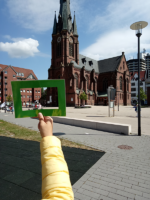
The discussion brought up many-sided views of the places in Herne. For example, green spaces or cultural points in the city center were perceived positively.
Likewise, stores with wheelchair ramps, guide stones for the blind or benches in the pedestrian zone were rated “good”.


In contrast, issues such as litter and discarded cigarette butts came up as bad. Cobblestones and construction sites also sometimes pose major barriers for people with walking disabilities. Recommendations for improvement and discussion from an inclusion perspective are two of the many results we were able to record.


Locating selected points was also to get acquainted with the digital map table: zooming in or out, finding points and operating the huge tablet using finger gestures.
References:
Layh, S., Feldhorst, A., Althaus, R., Bradna, M. & Wihofszky, P. (2020): Photovoice-Forschung mit Jugendlichen – ein Leitfaden zur Durchführung, in: S. Hartung, P. Wihofszky & M. T. Wright (Hrsg.), Partizipative Forschung: Ein Forschungsansatz für Gesundheit und seine Methoden. Wiesbaden: Springer VS, S. 233-262.
Wang, C. C. (1999): Photovoice: A Participatory Action Research Strategy Applied to Women’s Health, in: Journal of Women’s Health & Gender Based Medicine, Jg. 8, Nr. 2, S. 185–192.
Wang, C. C. & Burris, M. A. (1997): Photovoice: Concept, Methodology, and Use for Participatory Needs Assessment, in: Health Education & Behavior, Jg. 24, Nr. 3, S. 369–387.

OpenEdition schlägt Ihnen vor, diesen Beitrag wie folgt zu zitieren:
Myriam Vittinghoff (14. März 2023). Exploring the city … DiMDiCi. Abgerufen am 20. Juli 2026 von https://dimdici.hypotheses.org/640


We used photovoice again in a course at the adult education center in the city of Bochum with a diverse group including people in a wheel chair and other divrse abilities. It was interesting to discuss in this diverse group for alsmost half an hour about one photo showing a portable toilet cabin . I can encourage everyone to try this method out to expess ones esperience and view.