It’s known a set with infinitely many points in the plane, with all mutual distances integers, can exist only if all points lie on a straight line (Erdos – Anning theorem). It’s also known, there exists a finite set with arbitrary many points with the same property, not lying on the same line.
Here we consider some additional properties, such finite set of points has, illustrated with three similar problems of math competitions. One – given at Putnam 1993, the other – at a Bulgarian competition, and the third one – at Miklos Schweitzer 2018. We start with the Putnam problem, since that idea is used in the other two problems.
Putnam 1993, Problem B5. [1] Show there do not exist four points in the Euclidean plane such that the pairwise distances between the points are all odd integers.
Solution. We use a formula for the volume of a tetrahedron knowing the lengths of its edges:

Here  denote the lengths of some combinations of edges,
  is taken over the
  cases where
  form an open path of length
  .
.  is taken over the
  cases where form the sides of a face.
  is taken over the
  cases where
  are opposite sides (without a vertex in common).
In our case the volume of the tetrahedron is  , since it lies in a plane. Hence

It remains some simple calculations  . If all edges of a planar tetrahedron are odd integers, then the LHS of
  equals
  , which is impossible.
Miklos Schweitzer 2018, Problem 4. [2] Let  be a finite set of points in the plane. Assume that the distance between any two points is an integer. Prove that can be colored by three colors such that the distance between any two points of the same color is an even number.
Solution. Consider a graph  with vertices
  . Two vertices
  are connected if and only if the distance between them is odd. We wish to show the vertices could be colored by three colors. First, to see does not contain
  (a complete graph on vertices. Indeed, it’s exactly the previous Putnam problem, which says no four points on a plane can have all mutual distances being odd integers.
Suppose now, there is a triangle in , say all distances between  are odd. We color them by colors
  respectively. Consider any other point
  and let see the possible parities of
  . We’ve established they are not all odd. It’s also impossible all three of them to be even. Indeed, assuming that, we obtain that the LHS of is odd, which is impossible.
It’s also impossible two of those distances to be even and the remaining one – odd. Indeed, in that case again from we get the LHS is odd, a contradiction.
The only possibility is two of those distances to be odd and the remaining one, say  – even. Then, we color
  by the color
  .
.
In that way, we color all points in . It’s easy to prove the coloring is appropriate, since otherwise we get points, all connected.
Let us consider now the case there is no triangle in . In this case we claim there is no odd cycle in . For the sake of contradiction, let there is one  . Then,
  have to be connected with
  . Indeed, otherwise by , the LHS would be odd, impossible. Hence,
  is an edge. Analogously,
  are also edges and finally we get a triangle
  , but we’ve assume there is no triangle in , a contradiction.
So, in this case the graph is a bipartite graph and can be colored by  colors.
Bulgarian Spring Math Competition,2000, P 10.3. [3]  points lie in a plane. The distance between any two of them is integer. Prove at least
  of the distances between the points are multiple of .
Solution. Take some points. We prove there is a distance among them multiple of . Assume on the contrary all 6 distances are not multiple of . We use again . Since  for any edge of the corresponding tetrahedron, we get
  and
and  are multiple of 3 (number of terms in is 12 and in – 6). We also obtain
  which contradicts to .
Thus, for any 4 points, there is a distance among them multiple of 3. In all possible combinations  any edge can be counted at most
  times. It means the number of distances multiple of 3 is at least

Since all possible distances are  , the result follows.
Some comments on the presented problems. The official solutions of the last one uses cosine formula to prove there is a distance multiple of 3 among any 4 points, say  . We apply cosine formula for the triangles
  , then use
  and play with it to get a contradiction. Another approach is presented in [3], see post #5. I like it, one does not need to know some fancy formulas. It can be also applied on the other two problems. The Miklos Schweitzer’s one is the hardest presented problem, since those mod 2 arguments are applied many times.
References.
[1] Putnam 1993, Problem B5.
[2] Miklos Schweitzer 2018, Problem 4.
[3] Bulgarian Spring Math Competition, 2000, Problem 10.3/11.3.


![c=(c_{ij}),i\in [1..n],j\in[1..m]](https://s0.wp.com/latex.php?latex=c%3D%28c_%7Bij%7D%29%2Ci%5Cin+%5B1..n%5D%2Cj%5Cin%5B1..m%5D&bg=ffffff&fg=1a1a1a&s=0&c=20201002)


‘s in every row and every column.
-th column.


 be a measurable function such that
  is locally integrable for every
  as a function of
  . Prove that
  be a closed interval with
  (hereafter
  is the Lebesgue measure). We’ll prove
  . Seeking a contradiction, assume it is false. Let
  . Then, either
  or
or  . WLOG, suppose
  and an offset
  such that
  . It would contradict the given hypothesis. The set
  will be constructed as a disjoint union of measurable sets
  where
where  are small intervals and
 except a small set of
  is appropriate set of translations). We take care the sum of those “exceptions” is not too much, hence there exists
  for which
  The details follow.
 with
with  . Let
. Let ![I:=[0,1]](https://s0.wp.com/latex.php?latex=I%3A%3D%5B0%2C1%5D&bg=ffffff&fg=1a1a1a&s=0&c=20201002) with
with  . Then
 except a set with measure less than
  .
.  . Then
  . Assume
  does not hold on a subset of
  . We have


 .
.  . We can find
  such that
 ![m\left(A:=\{x\in I=[0,1]: f(x)\le N\}\right)>1-\delta\quad (3)](https://s0.wp.com/latex.php?latex=m%5Cleft%28A%3A%3D%5C%7Bx%5Cin+I%3D%5B0%2C1%5D%3A+f%28x%29%5Cle+N%5C%7D%5Cright%29%3E1-%5Cdelta%5Cquad+%283%29&bg=ffffff&fg=1a1a1a&s=0&c=20201002) .
.  , we can find as small interval
  as we want with
  , where
  .
.  . Applying Lemma for
  it follows
 with
with  . Thus, for any
  we have
![T':=\{t\in \mathbb{R}: D+t\subset I=[0,1]\}](https://s0.wp.com/latex.php?latex=T%27%3A%3D%5C%7Bt%5Cin+%5Cmathbb%7BR%7D%3A+D%2Bt%5Csubset+I%3D%5B0%2C1%5D%5C%7D&bg=ffffff&fg=1a1a1a&s=0&c=20201002) . Note that
. Note that  and
and  since
since  .
.  Proceeding through
  we choose corresponding
  outside of which
  holds and
 are mutually disjoint (it can be arranged that way). We choose
  such that
  . It follows there exists
  for which
 are corresponding sets satisfying
  and
and  . Denote
  . Then
 are disjoint, we obtain
 It means
  is not locally integrable, contradiction.
![f(x), x\in [a,b]](https://s0.wp.com/latex.php?latex=f%28x%29%2C+x%5Cin+%5Ba%2Cb%5D&bg=ffffff&fg=1a1a1a&s=0&c=20201002) and want to estimate, say to find a lower bound for
and want to estimate, say to find a lower bound for  where
where ![x_i\in [a,b], \sum_{i=1}^n\alpha_i=1.](https://s0.wp.com/latex.php?latex=x_i%5Cin+%5Ba%2Cb%5D%2C+%5Csum_%7Bi%3D1%7D%5En%5Calpha_i%3D1.&bg=ffffff&fg=1a1a1a&s=0&c=20201002) Unfortunately,
Unfortunately,  which is convex in
 ![[a,b]](https://s0.wp.com/latex.php?latex=%5Ba%2Cb%5D&bg=ffffff&fg=1a1a1a&s=0&c=20201002) and
and ![g(x)\leq f(x), \forall x\in[a,b]](https://s0.wp.com/latex.php?latex=g%28x%29%5Cleq+f%28x%29%2C+%5Cforall+x%5Cin%5Ba%2Cb%5D&bg=ffffff&fg=1a1a1a&s=0&c=20201002) and then write
and then write
 be a linear function because the second inequality in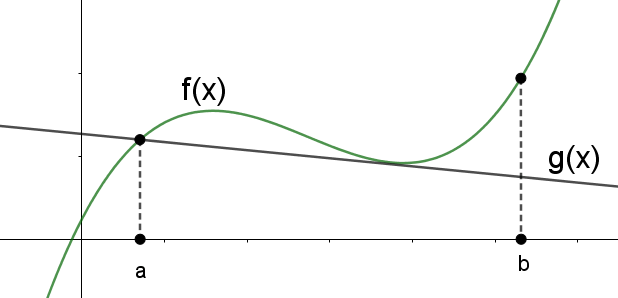
 , where
  and
and  , but
, but  may depend on
  . Choosing appropriate linear function
  . Since
  , which is a much easier task. Assume, for those values of
  , the first inequality in
  are exactly the points where
  be an integer, and
  be non-negative real numbers with
  . Determine the minimum value of
 and
and  . Then
  and we have to find the minimum value of
 . Let
. Let  , see figure 2.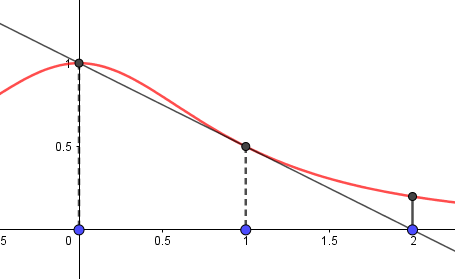
![f(x)\geq g(x), \forall x\in[0,2]](https://s0.wp.com/latex.php?latex=f%28x%29%5Cgeq+g%28x%29%2C+%5Cforall+x%5Cin%5B0%2C2%5D&bg=ffffff&fg=1a1a1a&s=0&c=20201002) and it can be easily checked
and it can be easily checked  . Using
 . But
. But 
 for some
  . Hence, it yields
 . Thus,
  is indeed the minimum value of the LHS of
  is
is  .
. 
 are non-negative real numbers such that
  .
. and
and  , so
, so  . We have to find the minimum value of
 and is tangent to
  , see figure 3.
 , it touches
  and also passes through
  . Thus, we have
 attains its maximum, since

 is attained when
  for some
 ![k\in[1..4]](https://s0.wp.com/latex.php?latex=k%5Cin%5B1..4%5D&bg=ffffff&fg=1a1a1a&s=0&c=20201002) and the two others
and the two others  and
and  . It means
  .
.  of 3D lattice points are given inside the lattice
 ![[1..n]^3](https://s0.wp.com/latex.php?latex=%5B1..n%5D%5E3&bg=ffffff&fg=1a1a1a&s=0&c=20201002) . It is known the projections of
. It is known the projections of  do not intersect. What condition
  and
and  should satisfy?
  which is sharp. So, any ideas would be appreciated.
  , are
, are  real numbers in the interval
 ![\left [ 0,1 \right ]](https://s0.wp.com/latex.php?latex=%5Cleft+%5B+0%2C1+%5Cright+%5D&bg=ffffff&fg=1a1a1a&s=0&c=20201002) . Define
. Define 
 Find the minimal possible value of
  that lie on the same line parallel to one of the axes
  or
or  . In other words, it means the projections of
  do not intersect.
 lie on a line parallel to
  or
or  and
and  . But this is impossible since

 lattice and
  be the sets of their projections on the axes
  correspondingly. Clearly, we have
  . This is the main difference between two and three dimensional cases (for example
  and
and  in 3D have the same first coordinate but their projections on
  are distinct). Back to 2D, it gives us
  which implies
 and
and  be their projections. Since they do not intersect,
  We denote by
  the intersections of the planes
  with
with 

 it yields

 there is no way
  with
with  . Take some
  . If any of those numbers is not on the edge of its values as required in
  for any small
  . It means for all pairs
  except at most one, either
  or
or  A clumsy calculation with these values shows it’s impossible
  , thus
  .
.  the following example satisfies the problem’s conditions. Fix a small
  and consider the tripples
 see
see  A Point of View.