-
-
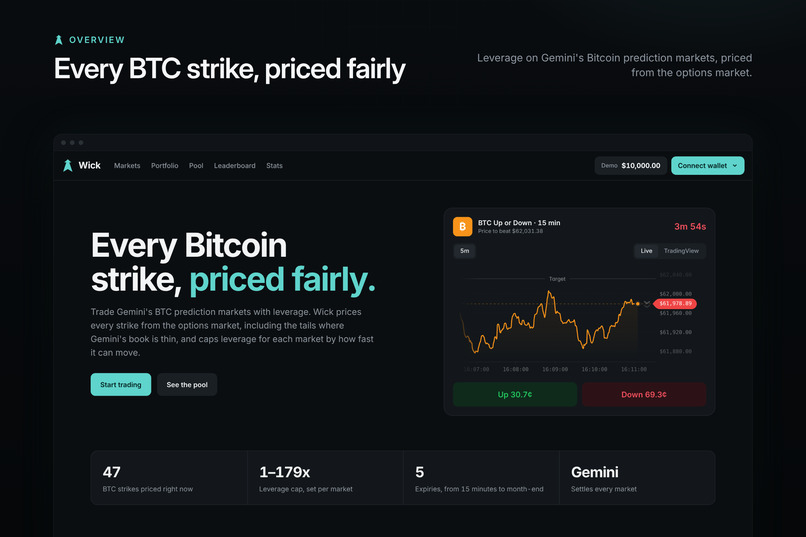
Every Gemini BTC strike priced at fair value from Deribit options, tradable at up to 300x leverage on Solana.
-
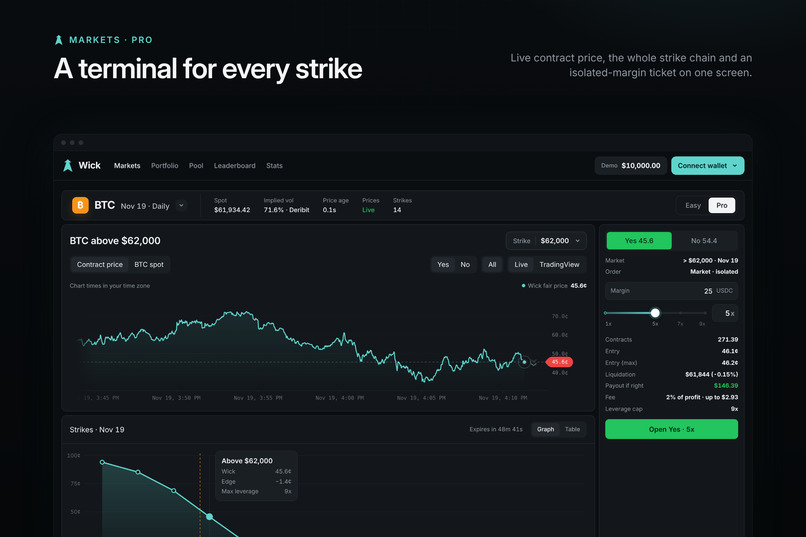
Pro view with the live contract price charted against Deribit fair value, plus the leverage cap and order ticket.
-
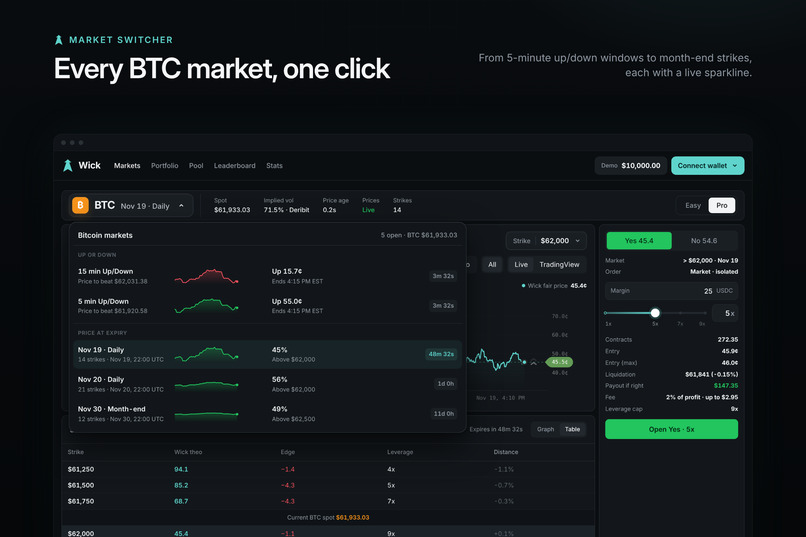
Switch between every live Gemini BTC market in one click, from 5-minute Up/Down to month-end strikes.
-
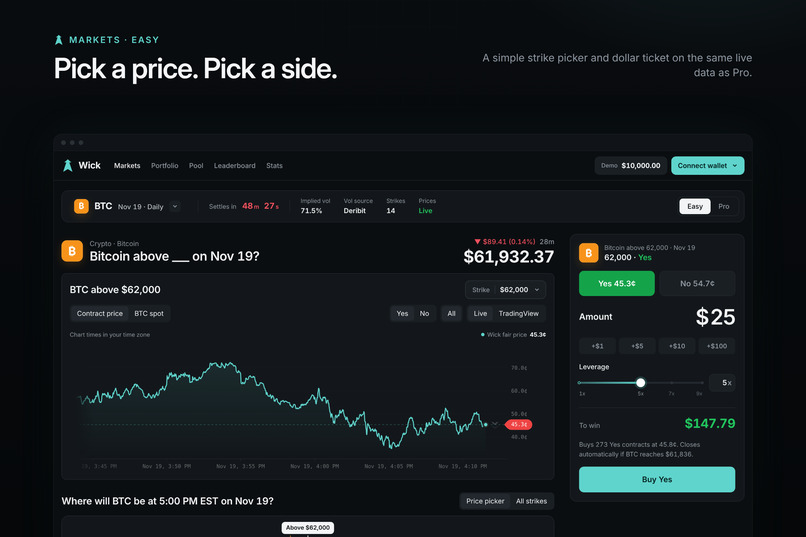
Easy view: pick a strike and a side. Leverage caps automatically to how fast each market can move.
-
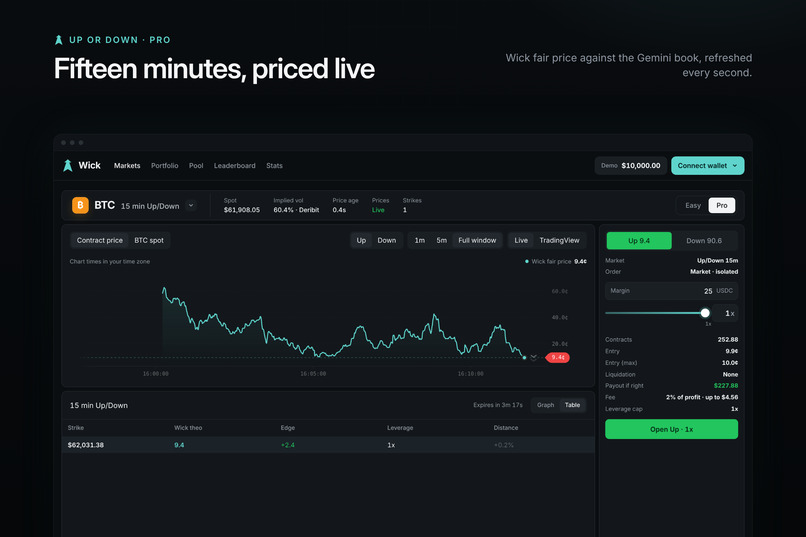
Short-dated BTC Up/Down markets priced as digital options, with leverage that tightens as expiry nears.
-
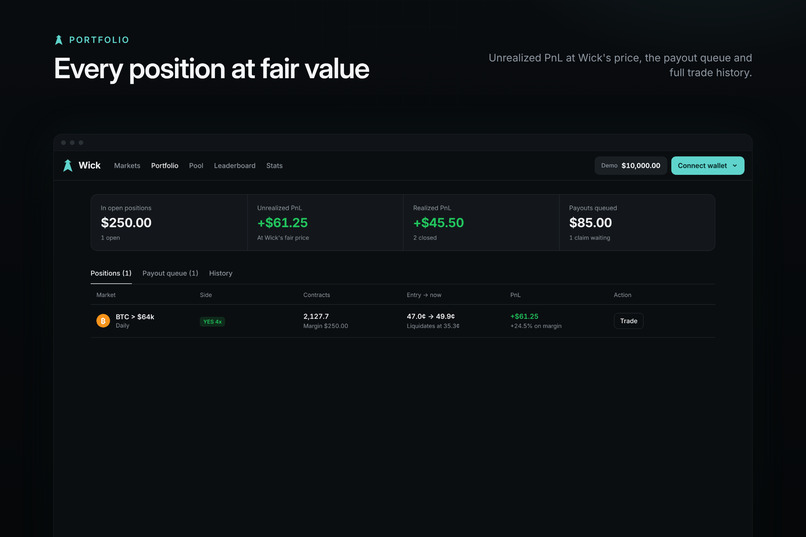
Every open position marked at fair value, with PnL and liquidation price. Shown with demo data.
-
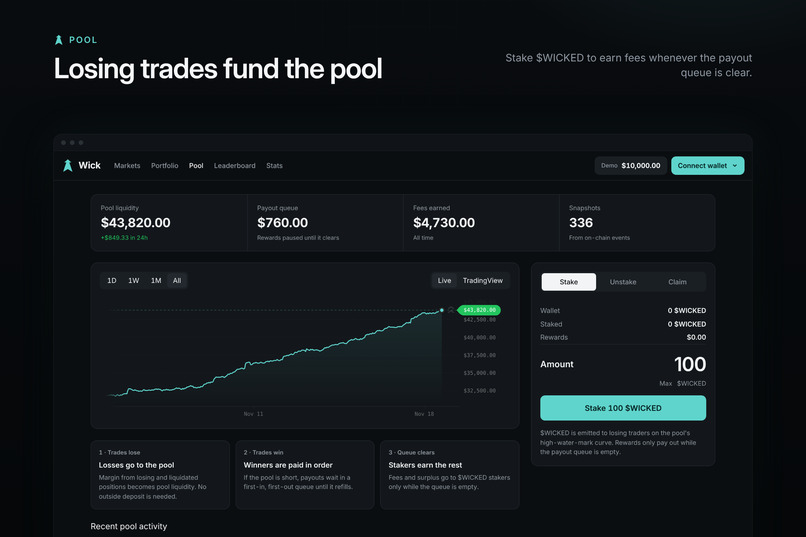
The self-funding pool: trader losses and liquidations become liquidity that pays winners. Shown with demo data.
-
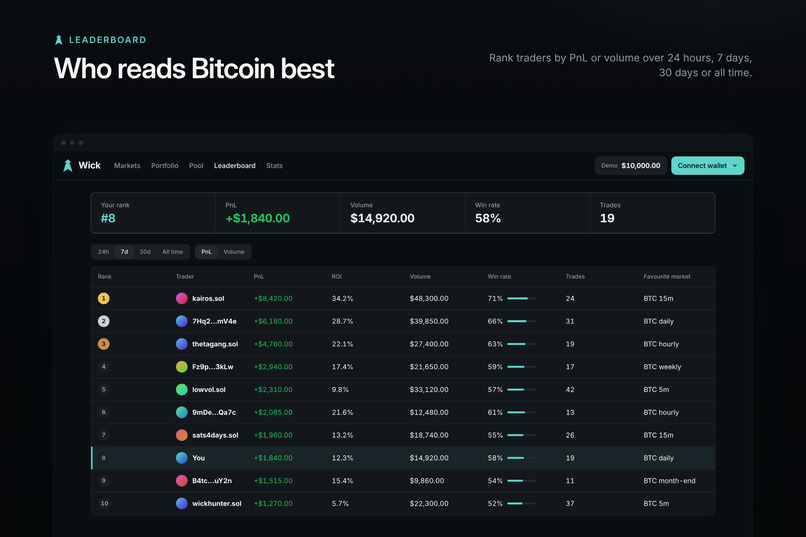
Top traders ranked from on-chain activity indexed live by QuickNode Streams. Shown with demo data.
-
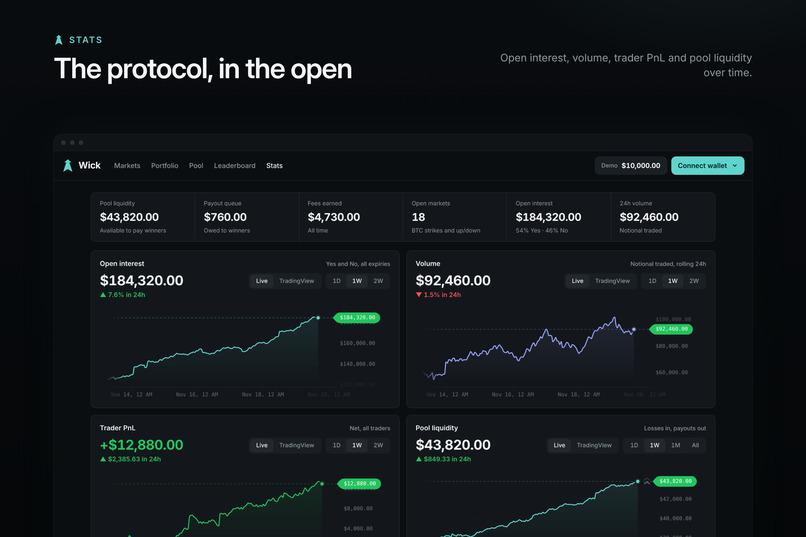
Protocol stats for volume, open interest and pool exposure, streamed from Solana by QuickNode. Shown with demo data.
-
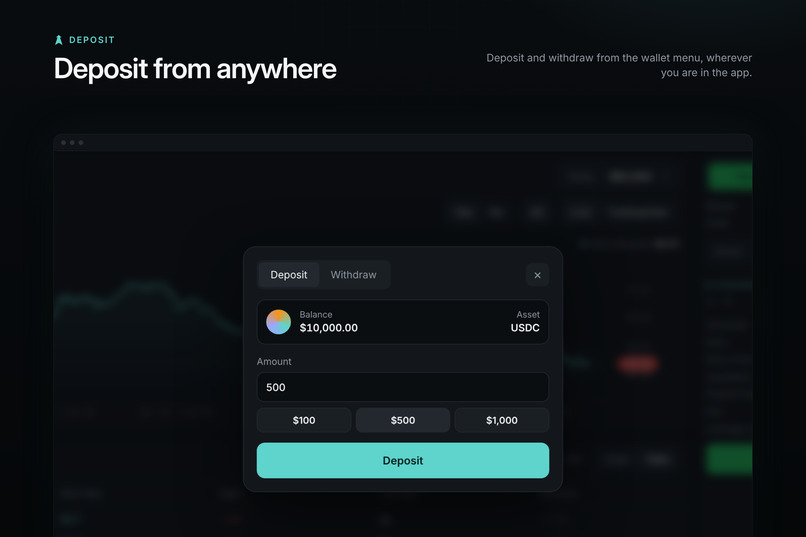
Deposit test USDC from Phantom, Solflare or a one-click browser wallet to start trading on Solana devnet.


Inspiration
We were inspired by Papertrade, where traders earn tokens even when they lose and the platform funds itself from its own trading. We asked what that model would look like on a real, regulated prediction market. Gemini was the obvious fit: its prediction markets are CFTC-regulated, run live BTC markets from 5 minutes to month-end, and settle on an official outcome. But every contract has to be paid for in full, and most of those markets are thin. Wick is our answer: a leverage and liquidity layer on top of Gemini's markets, funded by its own traders.
What it does
Wick is the leverage and liquidity layer for prediction markets. Traders can trade any Gemini market at up to 300x, priced from Deribit options and filled by a self-funding pool on Solana.
- Fair value on every strike. A prediction contract is a digital option. Wick prices every Gemini strike, tails included, from Deribit's BTC options surface and charts that fair value live next to the contract's price.
- Leverage sized to each market's risk. One leverage limit is too tight for a month-out strike and reckless for a contract with minutes left. Wick sets a cap per market from how fast it can move: about 4x with 10 minutes left, 38x at 12 hours and 300x on a month-out strike. The program enforces it on every trade.
- Always a counterparty. Wick's pool takes the other side of every trade, so traders get filled instantly even when Gemini's book is empty.
- Official settlement. Every position settles on Gemini's official outcome, never on a price Wick invents.
- $WICKED. Every dollar a trader loses mints up to 100 $WICKED, so a losing trade still earns a stake in the protocol. Stakers earn 50% of fees plus pool surplus, and winners are always paid first.
How we built it
- Gemini Prediction Markets. Gemini is our market list and our only outcome oracle. We use its REST API for events, strikes and official results, and its WebSocket
bookTickerandcontractStatuschannels for live quotes and contract lifecycle, with a two-second REST fallback. Every response passes a strict schema tested against recorded real Gemini responses. - Deribit. Deribit supplies the BTC index and the full options chain over REST and WebSocket. We fit each expiry's volatility smile and interpolate between expiries to price any Gemini strike at any time to expiry.
- Pricing. Up/Down contracts are priced as digital options, and "BTC above \(K\)" ladders use a smile-aware Black-76 call spread, with a cubic spline across strikes and total-variance interpolation across expiries.
- Risk engine. Leverage comes from binary gamma, the sensitivity of the contract's price to BTC. The cap is sized so a three-sigma, five-second move stays inside margin.
The fair value of an Up/Down contract:
$$ d_2 = \frac{\ln(S/K) - \sigma^2 T/2}{\sigma\sqrt{T}}, \qquad p_{yes} = N(d_2) $$
The leverage cap, where \(\Delta t\) is 5 seconds and \(mm\) is the maintenance margin:
$$ g = \frac{\phi(d_2)}{\sigma\sqrt{T}}, \qquad \sigma_m = g\,\sigma\sqrt{\Delta t}, \qquad L_{cap} = \left\lfloor \frac{p\,(1 - mm)}{3\,\sigma_m} \right\rfloor $$
- Solana. One Anchor program on devnet holds all of the economic state: 18 instructions, 6 account types and 20 events, with checked fixed-point math. It enforces margin, the leverage cap, stale-mark and cutoff checks, liquidation, settlement on Gemini's outcome, per-market and vault exposure caps, a FIFO payout queue, $WICKED emissions and staking. The pool's PDA is the $WICKED mint authority. Our keeper posts batched marks for every live Gemini market every few seconds, a cadence and cost that only works on Solana.
- QuickNode Streams. A Stream on
solana-devnetpushes every confirmed Wick transaction to our backend, so positions, activity, the leaderboard and pool history update within seconds without polling. Our filter matches the Wick program ID in top-level and inner instructions and skips failed transactions. The destination is an authenticated webhook that decodes Anchor events and writes them idempotently into SQLite, with a 60-second RPC reconciler that only fills gaps. - Backend. One Node.js process (Fastify) runs market discovery, pricing, the keeper, liquidator and settler loops, the Streams indexer, and the REST, WebSocket and SSE APIs. Solana is the source of truth, so the index can always be rebuilt from program accounts.
- Frontend. A Next.js app with Easy and Pro trading views, live fair-value and contract-price charts, a portfolio, pool analytics and a leaderboard. Traders connect with Phantom or Solflare, or create a local devnet wallet in one click and fund it with test USDC from the built-in faucet.
- Testing. 191 TypeScript tests, 16 Rust tests and nine Anchor lifecycle tests run on every push. The deployed program also runs 1,000 pricing vectors on-chain and matches them against our TypeScript engine.
Challenges we ran into
- Leverage on a binary contract. A prediction contract's price is not smooth near expiry. An at-the-money contract with minutes left can jump from 50¢ to 90¢ on a small BTC move, so a fixed leverage limit is either too tight for long-dated markets or reckless for short ones. Turning binary gamma into a live, per-market cap that is safe five seconds ahead took several iterations.
- Paying winners from a pool with no outside capital. With no LP deposits, the pool can be short when a big winner closes. We built a first-in, first-out payout queue: margin pays first, the rest waits as a claim that later pool gains repay, and stakers only receive surplus once every claim is paid. Exposure caps at the market and vault level keep any single position from draining the pool.
- Pricing the tails. Gemini's "BTC above \(K\)" ladders span far out-of-the-money strikes, where a flat volatility gives badly wrong prices. We had to fit Deribit's smile and interpolate between option expiries that never line up with Gemini's, then check the model against real expired Gemini strikes.
- Matching Gemini's settlement. Gemini settles some markets on a short time-weighted window, so we adjust the variance for the final minute instead of pricing to a single instant.
- Keeping every mark fresh. The program rejects trades on a mark older than six seconds, and a Solana transaction holds about 18 mark updates. We split the keeper's marks into parallel batches so every live market stays fresh at once.
- Trust boundaries. Wick never infers an outcome. Only Gemini's official result settles a position, and stale marks halt new trading on-chain.
Accomplishments that we're proud of
- Fully deployed on Solana devnet. Traders take leveraged positions on Gemini's live BTC prediction markets end to end: fair-value pricing, opening and closing a position, liquidation and settlement on Gemini's outcome. The keeper has already created, marked and settled hundreds of real Gemini markets on-chain.
- Fair value for every strike. We price the whole Gemini BTC ladder, tails included, from Deribit options instead of relying on a thin order book.
- No outside liquidity required. The pool bootstraps itself from trader losses, with $WICKED emissions and staking built into the same program.
- A trading interface that feels real. Easy and Pro views, live charts, leverage that updates with each market's risk, and a wallet you can create in one click.
What we learned
While researching prediction markets, we found two fundamental problems.
- No leverage. 78% of the $79 trillion traded on crypto exchanges in 2025 was leveraged perpetuals. On Gemini's prediction markets, that number is zero.
- No liquidity. In a snapshot of Gemini's live markets, 95% of events had never traded, 37% of contracts had no bid at all, and the median spread was 12¢ on a $1 contract.
The two problems share one fix. A pool that is always the counterparty solves liquidity, and once there is always a counterparty, pricing from options lets us offer leverage safely. We also learned how much of a prediction market's risk lives in time to expiry, and how fast a binary contract's risk changes in its last few minutes.
What's next for Wick
- Today: live on Solana devnet across Gemini's BTC markets, from 5-minute Up/Down to month-end strikes.
- Testnet: a public testnet open to all traders, a multi-party keeper network instead of a single keeper, invariant and fuzz testing, and calibration against Gemini's settlements.
- Mainnet: an independent program audit and live USDC trading on Solana.
- Every Gemini market: crypto beyond BTC, then sports, weather and commodities on the same engine.
Built With
- anchor
- deribit
- fastify
- gemini
- next.js
- node.js
- phantom
- playwright
- pnpm
- quicknode
- railway
- react
- rust
- solana
- solflare
- spl-token
- sqlite
- tradingview
- typescript
- vercel
- vitest
- websockets
- zod

