-
-
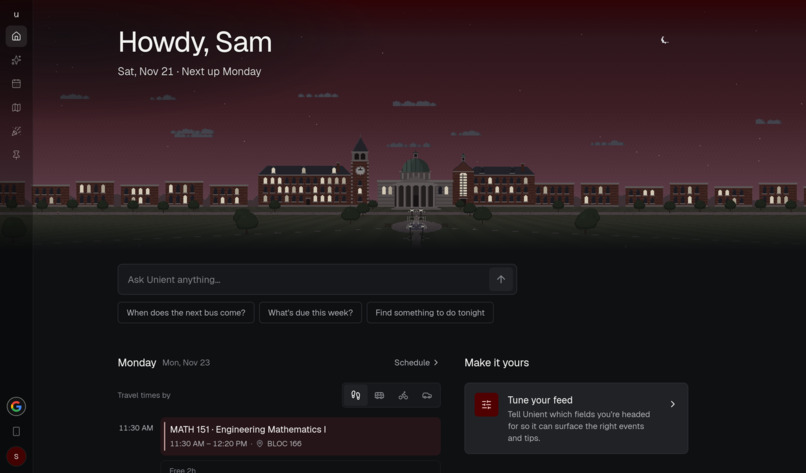
Today: your day as one timeline, with when to leave for each class
-
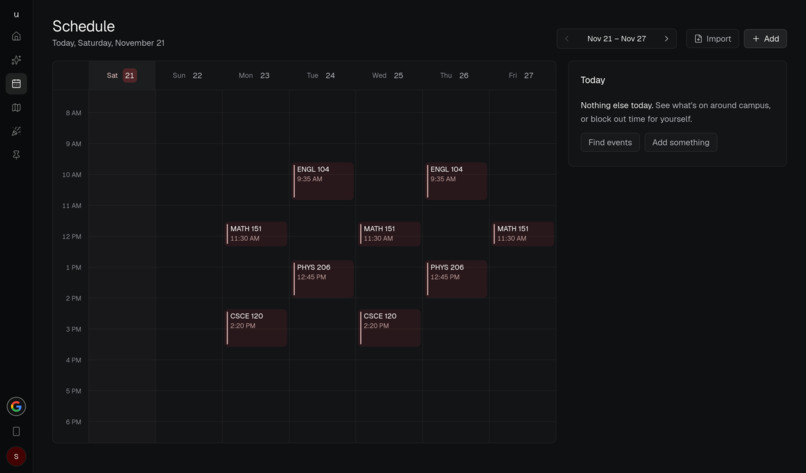
Schedule: your week, with free time and overlaps
-
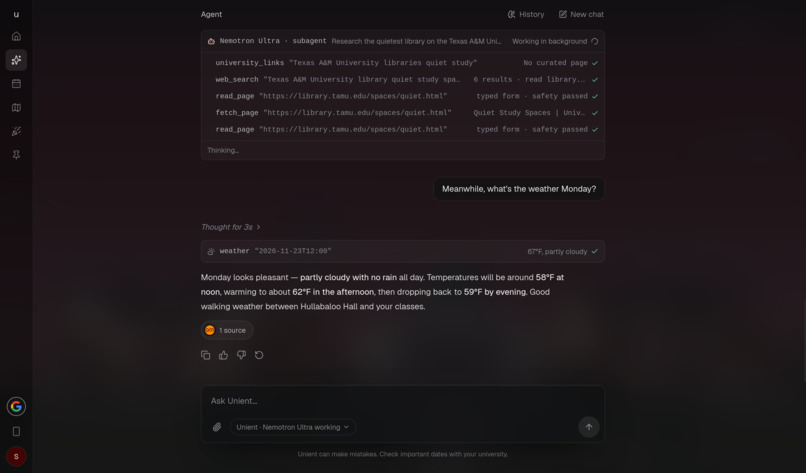
Agent: Nemotron subagents work in the background while you keep chatting
-
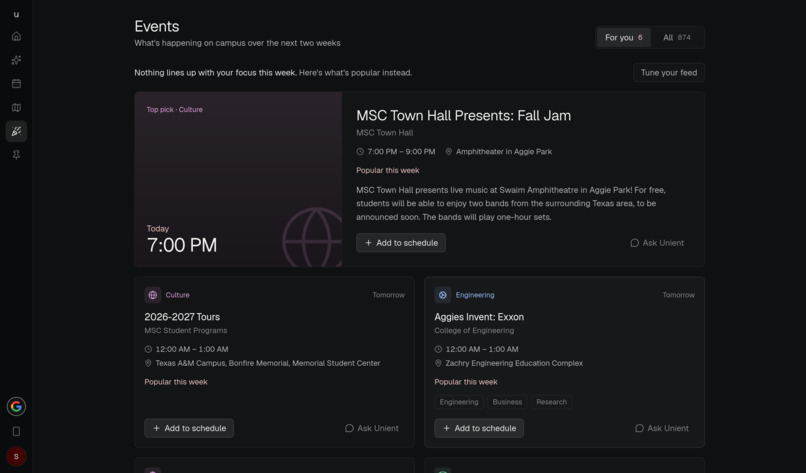
Events: real calendar.tamu.edu events ranked for you
-
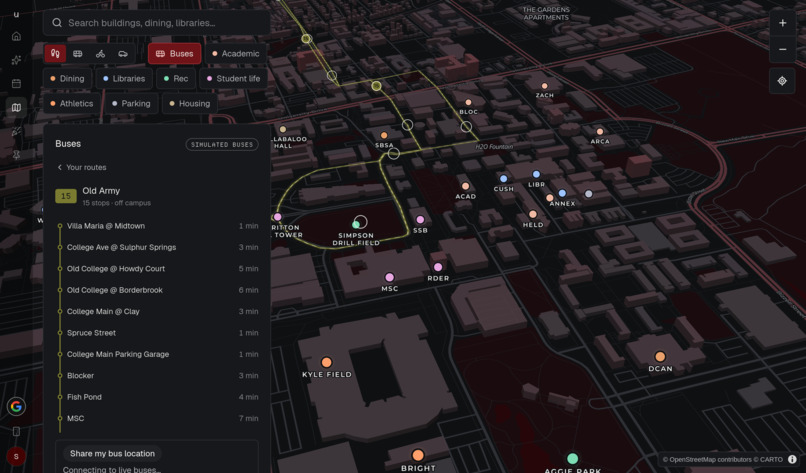
Map: the real Aggie Spirit routes and stops, following one route (bus positions simulated)


Inspiration
A normal week at A&M means Howdy for registration, Canvas for assignments, Outlook for email, another app for the bus, calendar.tamu.edu for events, and a group chat to figure out where any of it is. None of these talk to each other, so you end up being the glue.
Meta's Muse is a personal agent that handles your email and calendar. We wanted something like that, built around being a student on a specific campus.
What it does
Unient is a personal agent for college students. It works for any school, and Texas A&M is the first campus we wired real data in for. Pick A&M during onboarding and the app turns maroon behind the setup card.
Onboarding asks for your school, major, graduation year, class schedule and where you live. You don't type classes in one at a time. Upload a calendar file, a PDF or a screenshot of your registration page, or paste the text, and Unient reads it.
After that you get:
- Today: one timeline of your day, with walking, biking or bus time between classes and when to leave.
- An agent you can ask anything. You watch each step it takes and it cites its sources. Ask "when is the last day to Q-drop?" and it reads the date from the registrar's calendar instead of guessing.
- Background subagents. Ask it to plan your week and it hands the job to NVIDIA Nemotron subagents that run in parallel while you keep chatting. Their steps stream into the chat and their results land in the thread.
- A schedule view that flags free time, overlapping classes and tight walks across campus.
- A 3D campus map with buildings, all 19 Aggie Spirit routes and their stops, and directions.
- Events from calendar.tamu.edu ranked by what you said you care about, with one tap to add them.
Sign in with Google and it runs on the web or as an iPhone app.
What's real and what isn't
| Data | Source | Status |
|---|---|---|
| Academic calendar | Registrar JSON feed | Real |
| Campus events (874) | calendar.tamu.edu | Real |
| Dining, library hours | A&M sites | Real |
| Rec crowd, garage parking | A&M feeds | Real |
| Grade distributions, RateMyProfessors | Public data | Real |
| Weather | Open-Meteo | Real |
| Web search | Self-hosted SearXNG | Real |
| Bus routes and stops | Official Aggie Spirit map | Real |
| Bus positions and arrival times | Demo | Simulated |
How we built it
The web app is SvelteKit on Cloudflare Workers, with Cloudflare D1 for campus data. The main agent runs on Workers AI with OpenAI's open-weight gpt-oss-120b for tool calling and Llama 3.3 70B as a fallback. The server runs the tool loop and streams each step to the client: thinking, tool calls, sources and the answer.
Bigger jobs go to Nemotron through NVIDIA's API. The main agent has a delegate tool that sends planning, comparisons, research and email drafts to a subagent:
- Nemotron 3.5 Lightning by default
- Nemotron 3 Ultra for harder tasks
- Nemotron 3.5 Super VL when there's an image
Each subagent is its own request with its own tool loop, so several can work at once. We route these on the server because gpt-oss kept trying to do everything itself.
Schedule import also uses Workers AI. Llama 3.3 reads text and PDFs, Llama 4 Scout reads screenshots, and we parse .ics files ourselves.
The map is MapLibre on OpenStreetMap data, recolored in school colors with 3D buildings. Bus routes and stops come from the official Aggie Spirit map, saved as a snapshot in the app.
The iPhone app is the same Svelte code in a small SwiftUI web view. Nobody on the team has a Mac, so we build and package it on Linux with xtool.
Challenges we ran into
Search was the big one. DuckDuckGo showed a bot check, Bing returned one generic result and Brave rate limited us. Early on the agent answered most deadline questions with "I couldn't find that." We moved search to our own SearXNG, and for A&M we skipped search entirely: the registrar's calendar page loads its dates from a public JSON feed, so the agent reads that.
Live buses. We got the official feed working, live GPS included, but buses stop early on Saturdays and there was nothing to show at judging time. The routes and stops are real. Bus positions and arrival times in the demo are simulated, and the app says so.
Answers kept cutting off mid-sentence after long multi-step questions. gpt-oss spends part of its output budget on reasoning, and the default limit left too little for the answer.
Accomplishments that we're proud of
Picking your school and watching the app change color behind the card is our favorite moment. We also like that the agent shows its work, so you can see it check your schedule or open the registrar's calendar before it answers.
Shipping an iPhone app without a Mac felt like a small win on its own.
What we learned
An agent is only as good as its data. The model was fine. Answers got good when we gave it the right tools, like the registrar feed, instead of hoping web search would find things.
What's next for Unient
- Live bus positions from the official feed when buses are running, with the simulation only as a fallback
- Canvas assignments and TAMU email
- Registration help with open seats (Howdy blocks automated requests, so this needs another approach)
- Campus data for more universities
Built With
- bun
- cloudflare-d1
- cloudflare-workers
- gpt-oss
- llama
- maplibre
- nemotron
- nvidia
- open-meteo
- openstreetmap
- searxng
- svelte
- sveltekit
- swift
- swiftui
- tailwindcss
- typescript
- workers-ai
- xtool
