-
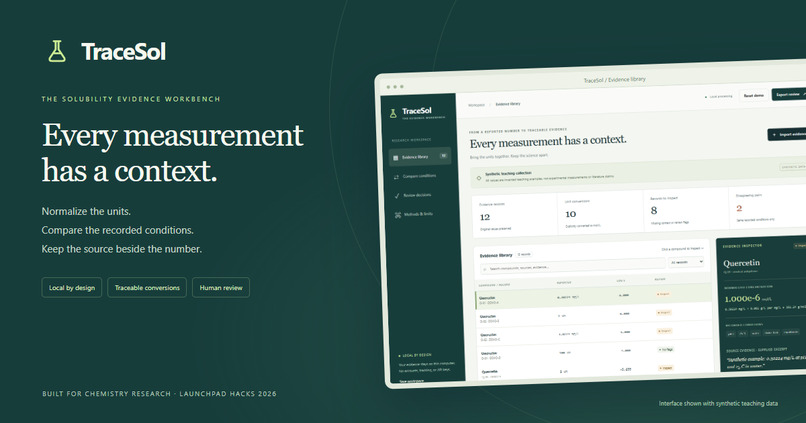
Cover Image
-
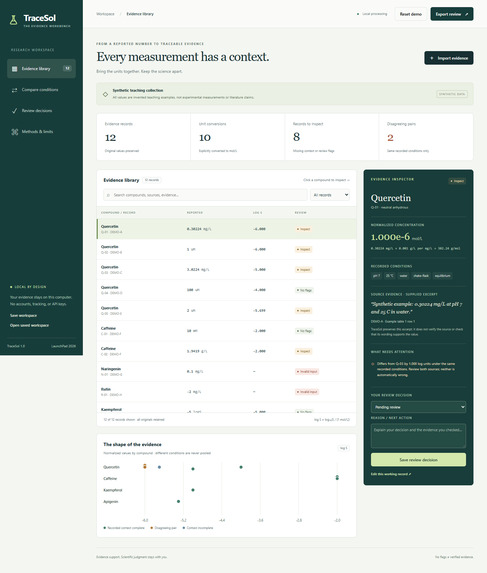
Evidence Workbench
-
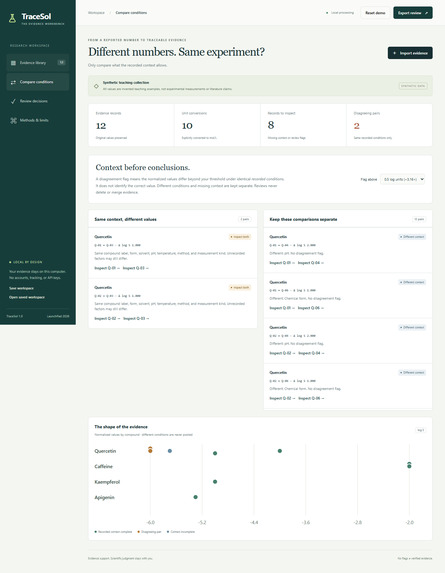
Condition Comparisions
-
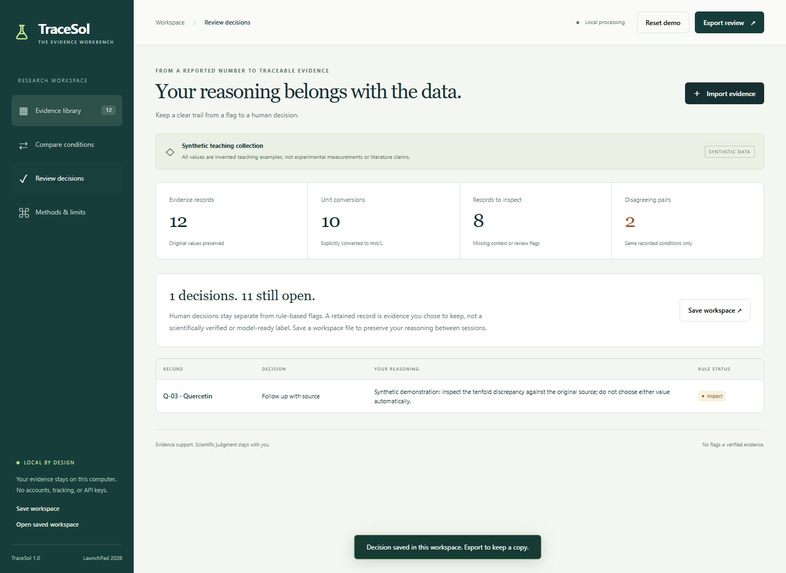
Review Decisions
-

Mobile Interface


Inspiration
In chemistry, two different numbers do not always mean two experiments disagree. A solubility value reported in mg/L may be equivalent to another reported in micromolar. Differences in pH, temperature, solvent, or chemical form can also change what a comparison means.
My interests in Chemistry and Biological Chemistry, flavonoid solubility, and scientific data verification inspired TraceSol. I wanted a practical workspace where the original value, its experimental context, and its source evidence could be reviewed together.
What it does
TraceSol is a local solubility evidence workbench for chemistry students and researchers.
Users import a CSV, inspect each record, and convert supported concentrations into mol/L and log S. Every conversion includes its calculation. Mass-based concentrations require a supplied molecular weight; missing information stays missing.
The workbench distinguishes between:
- Equivalent values: different units produce the same normalized concentration.
- Possible disagreements: values differ beyond a chosen threshold under matching recorded conditions.
- Different conditions: records differ in chemical form, solvent, pH, temperature, method, or measurement kind.
- Insufficient context: information needed for comparison is missing or invalid.
Each record keeps its source excerpt and page or table locator beside the measurement. Users can record a review decision with a reason, edit a working record, save and reopen their workspace, and export CSV, JSON, or a printable HTML report.
How I built it
TraceSol uses Python’s standard library for CSV parsing, numerical validation, unit conversions, comparison rules, exports, and a local HTTP server. The interface uses HTML, CSS, JavaScript, and SVG.
The application runs without package installation, accounts, API keys, or runtime cloud calls. Its interface includes an evidence library, source inspector, condition comparisons, review log, and an explanation of its methods and limitations.
An AI coding assistant generated the implementation, interface, synthetic examples, tests, and documentation during development. The application itself uses explicit, deterministic rules and makes no AI calls. Earlier projects informed the problem selection; no private research data or code was copied into TraceSol.
Challenges
The main challenge was deciding when a comparison should be allowed. Treating two missing pH values as a match would create a misleading conclusion. TraceSol therefore requires complete recorded context before flagging a possible disagreement.
Another challenge was preserving the evidence trail during corrections. Editing a record recalculates comparisons, resets that record’s review decision, and preserves the change in workspace history.
Handling malformed CSV files, invalid concentrations, safe exports, and narrow-screen layouts also required careful testing.
What I learned
Building TraceSol reinforced an important distinction: numerical comparability does not establish scientific equivalence.
A useful research tool should make uncertainty visible, explain its calculations, and leave room for human judgment. Missing information should prompt investigation rather than become an invented assumption.
Validation and limitations
The implementation passed 32 automated calculation and server tests and 15 browser workflow checks, including imports, conversions, comparisons, review decisions, workspace restoration, and exports.
All built-in measurements and excerpts are synthetic teaching examples. TraceSol does not independently verify sources, resolve molecular structures, predict solubility, or declare records model-ready. Matching recorded conditions does not establish full experimental equivalence.
What’s next
Next steps include independent researcher feedback, evaluation against permission-cleared real-paper examples, and richer experimental metadata such as equilibration time and solid state.
