-
-
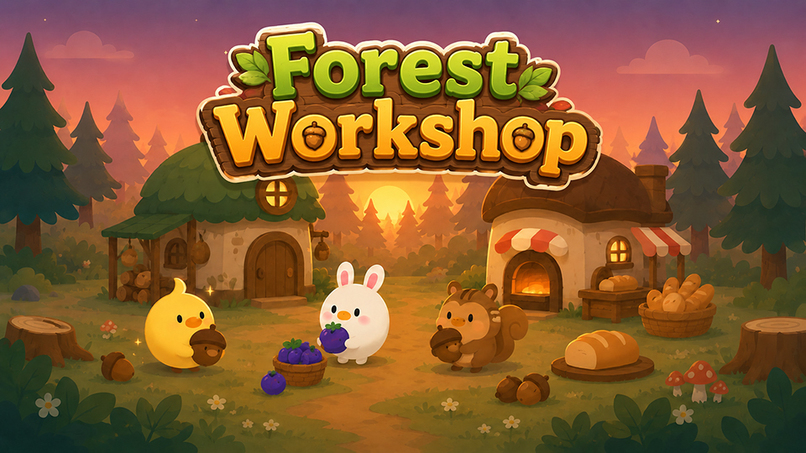
Title
-
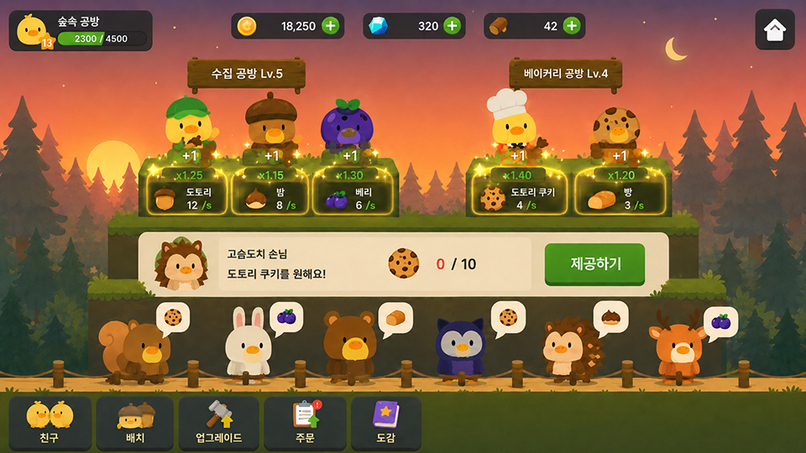
Play
-
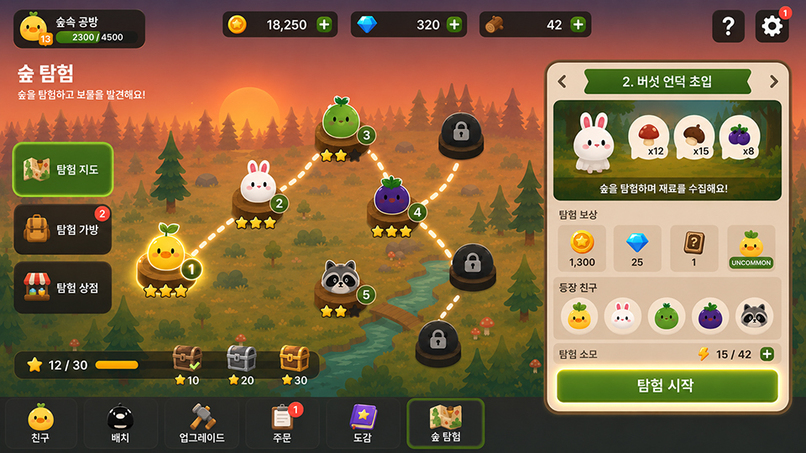
Exploration
-
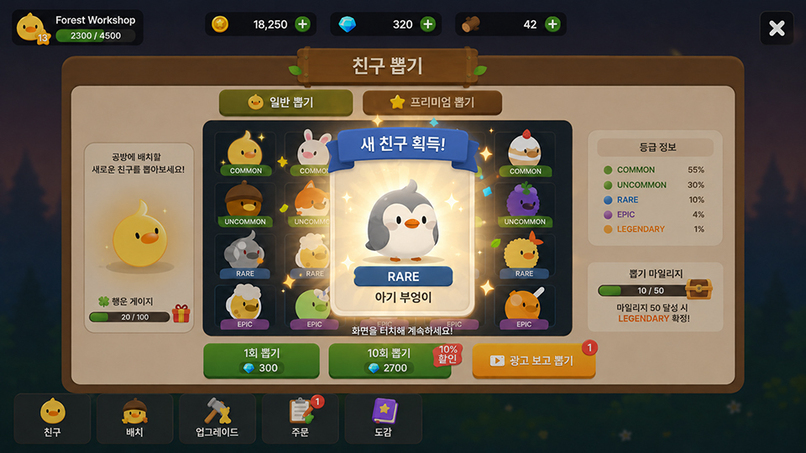
Collection


Inspiration
Forest Workshop was inspired by the idea of making a cozy game that still has real management depth. We wanted to avoid creating a workshop game that was only about decoration or cute characters. Instead, our goal was to design a small forest workshop where every action supports a clear simulation loop:
$$ Orders \rightarrow Materials \rightarrow Crafting \rightarrow Coins \rightarrow Upgrades \rightarrow Better Production $$
The main inspiration came from the feeling of running a tiny but growing business. A customer arrives, the player checks what is needed, crafts the item, earns a reward, and reinvests that reward into the workshop.
The cozy forest theme makes the game approachable, but the real focus is management: solving bottlenecks, choosing upgrades, and improving the workshop layout over time.
What it does
Tiny Forest Workshop is a mobile-first simulation and management game where players run a small forest workshop for animal customers.
Players receive customer orders, gather or spend materials, craft requested items, earn coins, and reinvest those coins into workshop upgrades. As the player progresses, the workshop becomes more capable and visually improved.
The core experience is not only about crafting items. It is about deciding how to manage production pressure:
- Which order should be completed first?
- Which material is currently limiting production?
- Which upgrade will reduce the biggest bottleneck?
- How should the workshop layout grow to handle more customers?
This creates a cozy but active management loop where the player can clearly see the workshop improve through their decisions.
How we built it
We built the project as a focused simulation and management design package. The design was developed around a clear first 15-minute experience that proves the core loop quickly.
We started by defining the core player action:
Fulfill customer orders and reinvest the rewards.
From there, we designed the economy on paper, including materials, recipes, crafting time, coin rewards, workshop unlocks, and upgrade costs. We then planned the first 15-minute player journey to make sure the player could understand the goal quickly, complete the first order, earn the first reward, choose the first upgrade, and see the workshop grow.
The workshop progression was designed around staged growth. The player begins with a small production area and gradually unlocks more workshop functions, creating a stronger sense of progression than a single crafting station.
The visual direction was also designed around mobile readability. Order cards, resource counters, crafting states, timers, and upgrade buttons were planned to be clear on a phone screen. The art style uses warm rounded UI, soft natural colors, and low visual noise so that the management information remains easy to read.
Challenges we ran into
The biggest challenge was balancing a cozy mood with real management pressure.
If the orders are too slow, the game becomes passive. If the pressure is too high, the game loses its relaxing forest workshop feeling. We solved this by using light order pressure, short crafting times, simple customer needs, and clear upgrade choices.
Another challenge was making workshop progression feel visible, not only numerical. Coins, timers, and upgrade levels are useful, but they are not enough by themselves. The player needs to see that their decisions changed the workshop. For that reason, the first 15 minutes include visible improvements such as an upgraded station, a clearer production area, or a small layout expansion.
A final challenge was scope control. Many features sounded fun, but not all of them supported the core experience. We intentionally moved larger ideas, such as multiple regions, full decoration collections, seasonal events, and advanced automation chains, outside the initial scope. This helped the project stay focused, buildable, and coherent as a simulation and management game.
Accomplishments that we're proud of
We are proud that the project has a clear and buildable management loop:
$$ Receive\ an\ Order \rightarrow Solve\ a\ Production\ Problem \rightarrow Reinvest\ the\ Reward \rightarrow Watch\ the\ Workshop\ Grow $$
We are also proud of the first 15-minute structure. The player can understand the goal quickly, complete a first order, earn a reward, make an upgrade decision, and see visible workshop growth. This makes the game feel accessible while still proving that it is a management game, not just a cozy crafting theme.
Another accomplishment is the mobile-first visual planning. The UI was designed around readable order cards, resource counters, crafting states, and upgrade choices, so the player can understand the management state at a glance.
What we learned
The biggest lesson we learned was that a strong management game does not need many systems. It needs a focused loop where every system supports the same goal.
At first, many additional ideas felt exciting, such as multiple regions, large decoration collections, helper systems, seasonal events, and complex automation. However, we learned that adding more features does not always make the design stronger.
For this project, the most important question became:
Does this feature make the first 15 minutes clearer, more satisfying, or more strategic?
This helped us reduce the scope and focus on the most important experience: the player receives orders, crafts items, earns coins, upgrades production, and sees the workshop visibly improve.
We also learned that visible progression is extremely important. Numbers alone are not enough. The player needs to see the workshop change as a result of their decisions.
What's next for Forest Workshop
The next step for Forest Workshop is to turn the design package into a playable MVP. The first build should focus on proving the core loop with a small but complete experience: customer orders, materials, crafting, rewards, upgrades, and visible workshop growth.
After the MVP is validated, we would expand the game carefully with features that strengthen the management loop, such as:
- Additional workshop types with different production roles
- More customer types with distinct order patterns
- Layout choices that affect crafting speed or order handling
- Special orders that create short-term production goals
- More visible workshop growth states
Larger features such as multiple regions, full decoration collections, seasonal events, and advanced automation would come later only if they support the core loop. The goal is not to make the game bigger as quickly as possible, but to make the workshop feel deeper, clearer, and more satisfying to manage.
Built With
- amazon-web-services
- chatgpt
- claude
- typescript
- windows-desktop-editor


Log in or sign up for Devpost to join the conversation.