-
-
Pictures
-
-
-
-
-
-
-
-
-


Inspiration
Four of us went to the TAMU career fair in September. Between us we talked to about forty recruiters in one afternoon. By that Sunday, when it was time to send messages on LinkedIn, we could collectively name maybe six of them, and, we didn't know anything about them.
That is the whole problem. A recruiter shakes two hundred hands before lunch and every face blurs. A student talks to thirty companies and remembers the logos, not the people. Everybody walks out with the same stack of free pens and the same plan to "follow up," and almost nobody does, because nobody remembers enough to actually start a conversation. The messages that do get sent all say "it was great connecting with you at the career fair," which is the exact message everyone else says, so it gets ignored.
That’s what we kept coming back to. You cannot out-GPA the person standing next to you in line. You cannot out-resume them. You are both wearing the exact same blazer. The only lever left is whether the recruiter remembers you, and the only way that happens is if you remember them first. Not just their name, but thing they mentioned about their interests. The project you said you would send. The fact that their team is hiring in six months, not now.
Connections are not made in only one conversation. They are made over small, consistent, specific contact. The message you send afterward matters as much as the conversation itself, and the fifth one matters more than the first. We built Thread because that kind of consistency is entirely a memory problem, and memory is something software is actually good at.
What it does
Thread is an iPhone app that pairs with Ray-Ban Meta glasses to help you remember the people you meet and the conversations you have.
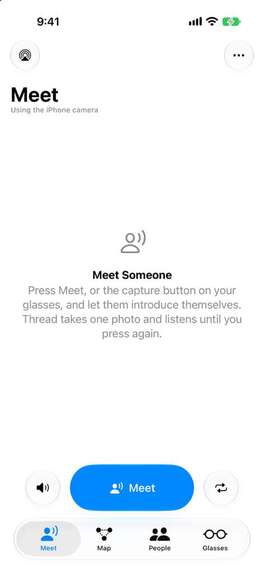
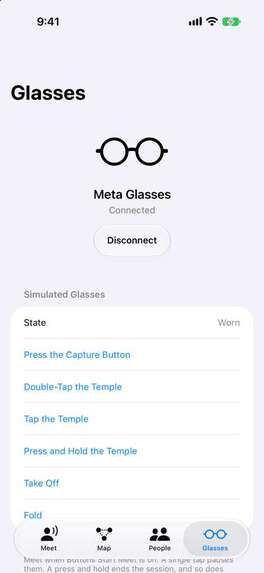
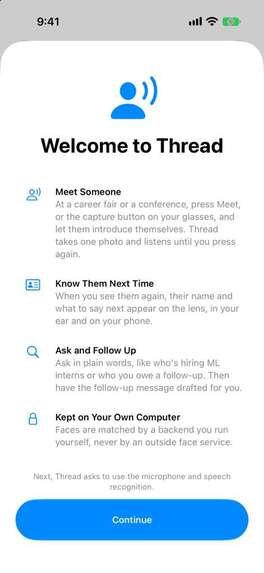
Our working prototype starts with meeting someone. You press the glasses' capture button to take a photo and start a conversation capture, and press again to finish. The iPhone and Meta Glasses both transcribe the conversation, and NVIDIA Nemotron organizes the person's name, role, company, topics, and commitments. Thread keeps track of both directions: what you promised someone, and what they promised you.
When you meet that person again, Thread matches their face against your saved contacts and speaks their name and useful context through the glasses, before you have to guess who they are.
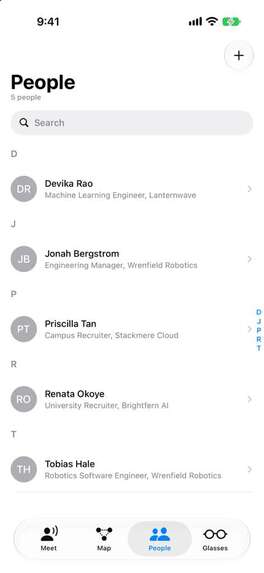
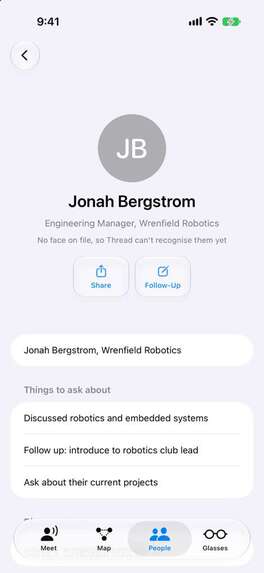
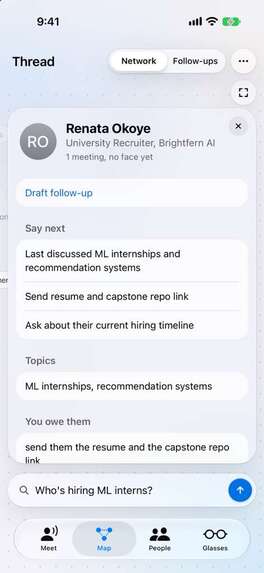
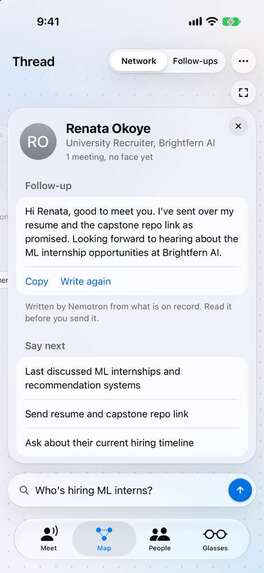
The People tab lets you revisit any conversation and generate a follow-up draft grounded in the saved record. Not "great connecting," but the specific thing they told you and the thing you owe them. You review the message and send it yourself. Thread never sends anything on your behalf.
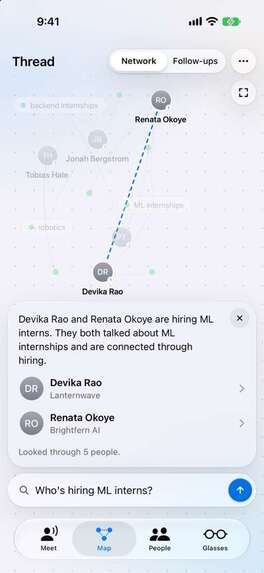
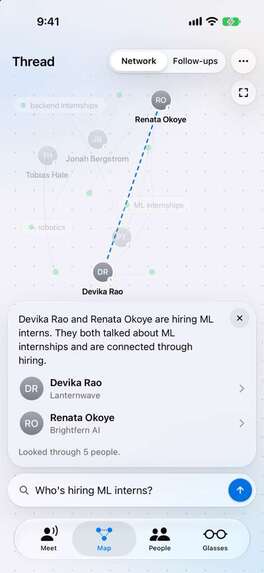
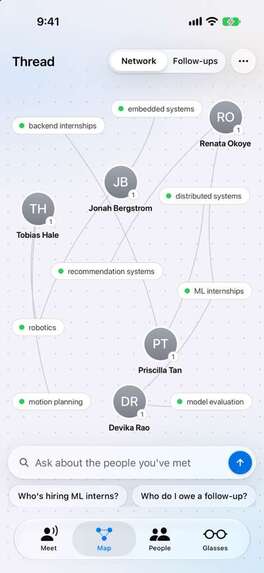
The Map connects people through the topics they share. You can explore those connections, or ask questions in plain words:
- "Who do I owe a follow-up?"
- "Who is hiring machine learning interns?"
- "Who did I talk to about robotics?"
Thread answers from your own saved conversations and shows you why it picked each person.
This is our first working use case for a broader idea: a memory and planning companion for busy students. The same capture, recall, and follow-through loop extends to class reviews, office hours, study groups, and project meetings.
How we built it
The iPhone app is Swift and SwiftUI on iOS 26, with Apple's on-device speech recognition turning conversations into text. Meta's Wearables Device Access Toolkit connects the glasses' camera, capture button, and audio output. We used the system's own components and Liquid Glass for the controls that float over content, so Meet looks like Camera and People looks like Contacts.
The backend is Python, FastAPI, and SQLite. It stores people, conversations, topics, and commitments in one file. Face recognition uses OpenCV's YuNet for detection and SFace for matching, comparing a captured face against the people already saved in Thread. Photos never go to the language model.
We self-host NVIDIA Nemotron 3.5 Lightning 30B-A3B through vLLM on an NVIDIA H100, hosted on Brev. Nemotron does five jobs: it extracts the structured facts from a conversation, writes the short reminder spoken through the glasses, builds the context cards, drafts the follow-up messages, and answers questions about your saved network.
The structured tasks are constrained by JSON schemas generated from Pydantic models, and every response is validated before it is used. The model does not get to answer in prose. It has to fill the exact object the app needs, which matters because a card going to a lens has no room for "I would be happy to help you with that." For questions, Nemotron acts as an agent with six read-only tools: find_people, person, connections, topic, recent_meetings, and promises. It chooses which to call, and the backend checks every returned name and connection against the database before anything is shown. The network visualization is D3.js running inside a WKWebView.
Challenges we ran into
Connecting hardware, speech recognition, face matching, and a language model exposed problems that were hard to reproduce in isolation.
The glasses camera delivered one photo successfully and then failed on every capture after it. We changed how we maintained and restarted the camera stream, added timeouts at each step, and built an iPhone camera fallback so a capture always returns a frame, with the result card saying honestly which camera took the photo.
Bluetooth audio was the next problem. Initially, the glasses being used as a standard headset microphone dropped the audio quality badly, however, we were able to build a galsses microphone path using it as normal audio, allowing for better transcription.
Face matching struggled when a bystander stood closer to the camera than the person we were actually talking to. We changed face selection to favor the center of the frame and improved detection for backlit faces.
Nemotron's hardest task was figuring out who owed a commitment. "Send me your resume" and "I'll send you the application" describe opposite responsibilities, and mixing them up makes the reminder useless, or worse than useless. This is the one place we still miss sometimes, and we measured exactly how often.
Our first version of Ask took about nine seconds per answer because it ran every tool up front. Letting Nemotron decide when to call a tool brought that down to roughly 0.5 to 1.5 seconds in our testing.
Accomplishments that we're proud of
We ran the complete flow on real Ray-Ban Meta Gen 2 glasses with an iPhone 16 Pro: starting a capture with the glasses button, taking the photo, transcribing the conversation, saving the contact, recognizing the person again later, and hearing their name spoken through the glasses. The first time that whole loop closed on real hardware was the best moment of the hackathon.
We also built the path from remembering to acting. Thread can surface a commitment and draft a specific follow-up from the conversation that created it, which is the part a student would actually use on Monday.
We tested the system instead of trusting it. Our backend suite has 145 passing tests, with two skipped. Separately, we evaluated the real Nemotron model on 15 scripted career-fair conversations across three runs. Names and companies were correct in all 15 conversations on every run. Follow-ups were recorded, or correctly left empty, in all 15. Responsibility for a follow-up was correct in nine of 11 applicable cases. These are small scripted tests, but they gave us a concrete way to find weaknesses and judge whether a change actually helped.
What we learned
Remembering a conversation is only part of the problem. The useful part is bringing back the right detail at the moment someone needs to act on it.
Structured output does not guarantee a true answer. A response can match the schema perfectly and still assign a promise to the wrong person. Checking every answer against the saved records, and evaluating specific failure cases instead of eyeballing outputs, is what moved the quality.
And the thing we did not expect: the glasses are not the product. The glasses get people excited for thirty seconds. The lasting value is the connection between an earlier conversation and a useful next step, and that has nothing to do with hardware.
What's next for Thread
The follow-up draft should learn your voice. Right now it writes in a neutral register. It should write the way you actually write, from a few of your own messages pasted in once.
We want a cadence nudge, so Thread tells you when it has been a few weeks since you last reached out to someone and gives you a real reason to do it rather than an empty "checking in." That is the piece that turns a career fair into a relationship. From there the same loop generalizes to conferences, alumni events, and coffee chats.
The same capture, recall, and follow-through loop also reaches past networking. During a class review, a professor might recommend specific topics or practice problems, and later a student could ask "what did my professor say I should review for the final?" and get the passage back with its original context. After a study group it could recall the unresolved questions. After a project meeting it could surface the assigned tasks. These are planned extensions. The current prototype demonstrates the underlying loop through conversations, people, commitments, and follow-up drafts.
We also want to improve commitment attribution, grow the evaluation set well beyond 15 conversations, add source-linked recall so every recalled detail points back to the moment it was said, and handle weak connections more gracefully.
