-
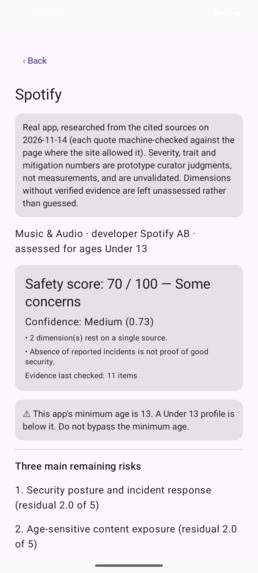
Age-specific report: score, confidence, evidence coverage, and minimum-age warning.
-
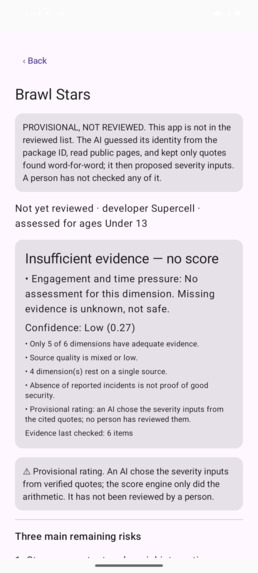
AI-assisted research for an unreviewed app is clearly labeled provisional.


Inspiration
A child asks to install an app. The parent needs to know who can contact them, what data it collects, what purchases it encourages, and whether its safeguards fit the child's age. Store ratings and time limits leave much of that decision unexplained.
AppLens helps a family make that decision together. The Android prototype is called Family App Check in the app and repository.
What it does
A child searches for an app or shares a Google Play link, reads an age-specific report, and asks a parent for permission. The parent unlocks Parent mode with a PIN, reviews the evidence, and approves, denies, or approves with a daily time limit.
Each report covers six dimensions: privacy, security and incidents, stranger contact, content, spending, and engagement. Parents can open the source URL and exact quote behind a claim. A deterministic scoring engine applies a versioned age rubric and shows confidence and missing evidence. The score is an explainable heuristic, not a probability of harm or a security certification.
The bundled catalog covers 26 real apps and 309 researched claims. Apps with incomplete evidence show "Insufficient evidence." For an app outside the catalog, opt-in AI research proposes official pages. The app fetches the pages and accepts a claim only when its quote appears verbatim in the downloaded text. Any resulting rating is marked provisional and low confidence; all six dimensions need evidence before a number appears. AI-assisted severity inputs pass deterministic validation and caps. A parent always makes the approval decision.
An accessibility service provides best-effort blocking and daily limits without permission to retrieve screen content. Requests, decisions, reports, and the bundled catalog work offline.
How we built it
The app uses Kotlin, Jetpack Compose Material 3, Room, DataStore, WorkManager, and OkHttp. Pure Kotlin domain logic handles scoring, policies, usage accounting, and research validation. A separate curation pipeline verifies source quotes and builds the bundled evidence catalog.
Every runtime model call goes through Firebase AI Logic, protected by Firebase App Check. Debug builds use the debug provider; release builds are configured for Play Integrity.
Firebase AI Logic hybrid inference uses InferenceMode.PREFER_ON_DEVICE for app-name lookup and the first attempt at a plain-language report explanation. On a supported device, Gemini Nano can handle these short tasks locally. The SDK falls back to cloud Gemini when local inference is unavailable; invalid local output also triggers a validated cloud retry. A status card exposes model availability and download controls, and explanations identify whether they came from the device or cloud.
Long official pages and evidence extraction use cloud inference. This keeps larger research tasks off the smaller local model. The score itself is calculated by the deterministic engine. AI is opt-in, with a daily budget, quota cooldown, and offline explanations when model calls cannot complete.
Challenges we ran into
An AI can invent a plausible citation. We fetch source pages ourselves and check exact quotes before accepting findings. We also restrict fetched URLs and validate the model's structured output.
Evidence is often incomplete or inaccessible. JavaScript-only pages may provide too little readable text, and free-tier model calls can hit quota limits. The UI reports these gaps instead of interpreting missing evidence as safety.
Hybrid inference also needs honest verification. The Android 15 emulator has no supported local Nano model. Live Firebase AI Logic calls and cloud fallback have been tested there; on-device Gemini Nano execution has not yet been verified on a supported physical phone.
Accomplishments
The prototype connects the child's search, evidence report, permission request, parent decision, and child-visible result in one flow. Repository verification notes record 135 JVM tests with no failures, emulator checks of the request and enforcement flows, and live Firebase AI Logic research and fallback checks.
The project began on November 14, 2026, according to its first commit. The implementation includes the hybrid inference path, model-status UI, evidence validation, local request workflow, and best-effort enforcement.
What we learned
Matching a quote proves that the text appeared on a page; it does not prove that the source is complete or that a severity judgment is correct. Separating source evidence, judgment, scoring, and parental approval makes those limits visible.
Hybrid inference fits different parts of the same workflow: short lookups and explanations can run locally when supported, while longer research uses cloud models.
What's next
Verify Nano execution on a supported physical phone, test accessibility with TalkBack and larger text, review the age rubric with child-safety experts, and expand the evidence catalog through reviewed updates. Separate parent and child devices and Device Owner enforcement are future work.
This remains a single-device, single-child prototype. Blocking can be bypassed and is not tamper-proof. Physical-device behavior, release App Check enforcement, and local Nano inference still need testing.
