-
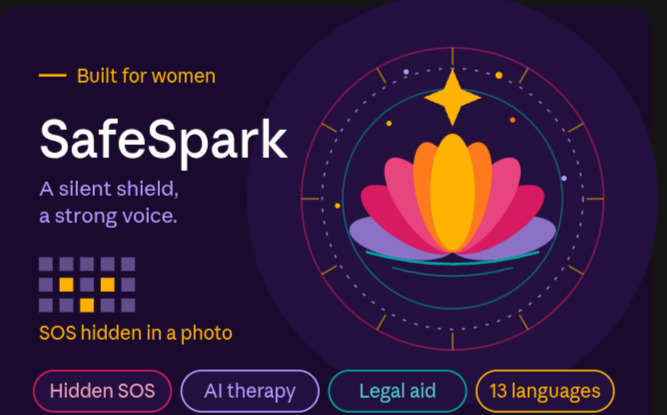
Women Safety Agent

Inspiration
Millions of women endure domestic coercion and violence in isolation because their phones, chats, and search histories are monitored by the perpetrator. In India, 80.1% of abused married women never tell anyone, and only 1.3% turn to police or formal institutions. Calling 112 or sending a plain-text SOS can get a survivor caught. We wanted to build a silent shield and a strong voice: a companion that is discreet, empathetic, and actually useful. That became SafeSpark (WithYou).
What it does
SafeSpark is an AI-powered safety platform for women, built around "The Spark Within":
- Covert steganographic SOS: hides distress details and GPS coordinates inside an ordinary photo using LSB encoding. Authorities decode it into a structured dossier.
- "Maya", a 3D AI therapy companion: trauma-informed support with grounding and breathing techniques, plus voice replies.
- Bilingual LawBot: explains the PWDVA 2005 and BNS with live, cited research from official government sources.
- Self-healing help directory: verified One Stop Centres, shelters, and legal aid clinics, auto-refreshed with current contacts.
- Law & Helpline Watch: detects changes to national helplines and legal advisories and posts short alerts.
- Complaint Assist: a web agent that pre-fills complaint forms but never submits. It halts so the survivor presses "Review & Submit Yourself".
- Incident command dashboard: severity-based triage, geocoded reports, and status tracking for authorities.
- 13 Indian languages with voice: "Speak to Fill the Form" for low-literacy users, plus hands-free dictation and spoken replies.
- Privacy by design: triple-Esc quick exit, PII scrubbing, zero trackers, and zero audio storage.
How we built it
- Frontend: Next.js 15 (App Router), React, TypeScript, Tailwind CSS, Framer Motion, Three.js with react-three-fiber for Maya, and Clerk for role-based guest/authority auth.
- Backend: Python and FastAPI on Render, with MongoDB and local JSON fallbacks.
- AI and research: Google Gemini for LawBot, JSON form extraction, and voice intent recognition. TinyFish handles live search, parallel batch fetch, and browser automation for Complaint Assist.
- Voice: Sarvam Saaras and Bulbul v3 for Indic speech, and ElevenLabs for text-to-speech.
- i18n:
next-intlwith static JSON files, so no translation API calls and no data leakage, plus a CI parity check across all locales. - Deployment: Vercel for the frontend and Render for the backend.
Challenges we ran into
- Designing a privacy-first system where nothing could leak: PII scrubbing, server-side key isolation, and ephemeral audio.
- Making lip-sync for the 3D avatar work across 12 Indic languages, where phoneme alignment only covers English. We used a Web Audio amplitude fallback.
- Keeping 13 languages in sync without breaking emergency numbers and legal terms.
- Stopping LawBot from hallucinating on legal topics. We used strict context injection, low temperature, and fallbacks to local statutes on rate limits.
- Making the web agent safe by design, so it can never submit, enter OTPs, or solve CAPTCHAs on a survivor's behalf.
- Embedding the avatar natively so it needed no separate localhost server.
Accomplishments that we're proud of
- A working steganographic SOS pipeline from photo to authority dashboard.
- A fully localized, voice-enabled experience in 13 Indian languages.
- LawBot answers with live citations from official government sources.
- A human-in-the-loop agent that protects survivor agency.
- A survey-backed evidence base (WHO, NFHS-5, NCRB, Gallup) built into the product.
- A live production deployment with automated tests for the PII stripper and voice services.
What we learned
- Safety products need privacy and abuse-resistance designed in from the start, not added later.
- Trust comes from restraint: citing sources, halting before submit, and keeping voice off by default.
- Accessibility (voice, regional languages, low bandwidth) decides whether the people who need the product can use it.
- Combining AI agents, voice, 3D, and i18n at scale taught us a lot about orchestration and graceful fallbacks.
What's next for SafeSpark
- Partnerships with verified NGOs and One Stop Centres for real escalation.
- A mobile app (PWA first) with disguised-app mode.
- More languages and offline-first SOS.
- Safer encoding methods and a stronger authority verification flow.
