-
-
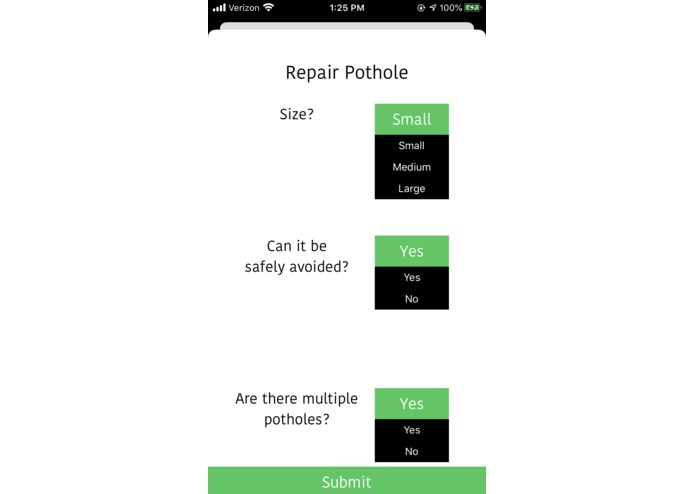
Detailed description for issue with subcategories
-
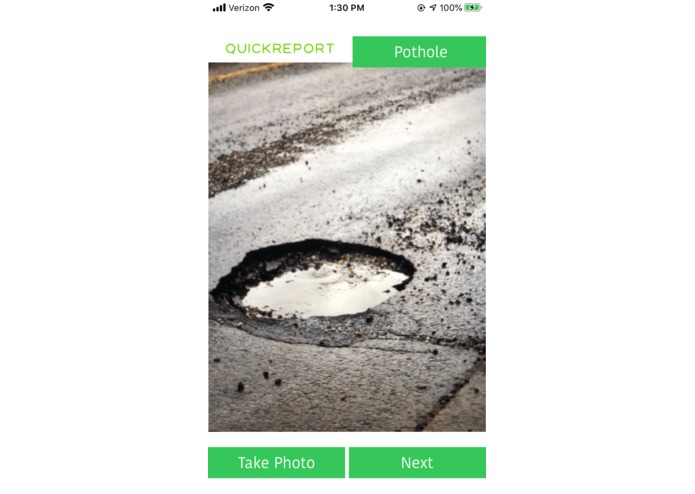
Image of environmental issue identified as a pothole
-
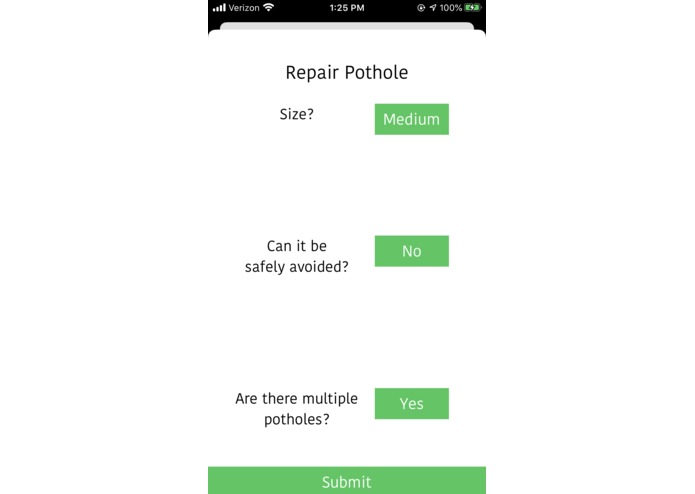
Selected description
-
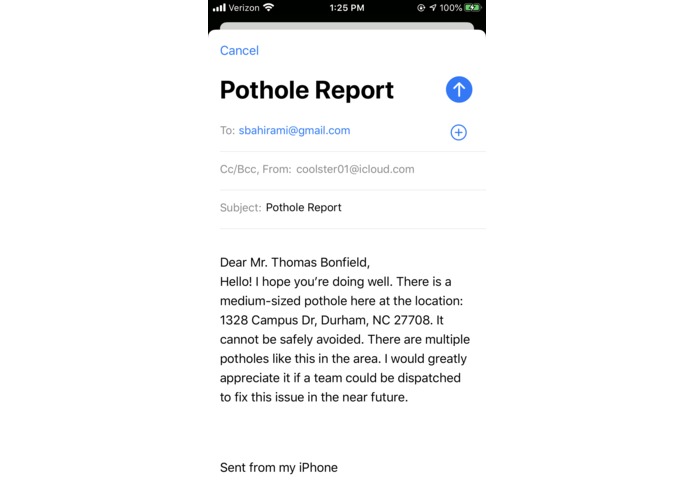
Automatically generated email regarding issue


Purpose
Some of the greatest growing concerns that our environment faces today are the degrading quality of our nation’s roads and sidewalks, littering, graffiti, and overgrown vegetation hindering the visibility of traffic signs. These issues are especially present in the city of Durham. People have the option to report these issues to an online website, Durham One Call. However, several hindrances mean that filling out the form is an incredibly time-intensive and inefficient process. A portion of the population also are unaware of this website, leaving them incapable of reporting any problems they come across.
To address the inconveniences associated with Durham One Call, we created a mobile application called EasyClick. Users are able to submit issues regarding potholes, improper waste disposal, and more.
Based on the neural network that our model was trained on, the app will automatically recognize what type of environmental issue the image shows. Afterwards, the app directs the user to describe the problem in greater detail by answering a few simple questions (e.g. number of potholes). Then, all of the information is automatically summarized into an email which can be sent to Thomas Bonfield, the Durham City Manager.
How we built it
We created our own image based dataset, through online resources and our own data collection. Our image data was sorted into 6 categories — potholes, graffiti, broken sidewalks, signs covered by trees, broken traffic signs, or littering — after we uploaded our dataset to the Google Cloud Console. Through the use of Google’s Cloud AutoML Machine Learning system, we developed a deep learning Neural Network Image Classifier that identified images and placed them into one of our five categories with an average precision of 0.981. Additionally, the frequency of false positives generated by our model was 5.00%, and the frequency of false negatives was 9.52%.
Prior to using Google’s Cloud AutoML, we experimented with Apple’s CreateML to develop models for our image classification system. While CreateML served as a useful placeholder, we experienced difficulties in achieving a high enough level of image identification precision with this software. After we managed to get AutoML working, we replaced CreateML with AutoML and our app’s functionality increased significantly.
After creating a working machine learning model, we focused on the app development aspect of our project. We originally attempt to develop both Android and Ios versions of our app, but we eventually decided to just focus on Ios. We intend to develop an Android app after the completion of HackDuke, since we intend to eventually place our product on the app store. We developed a basic UI to allow the user to change the category of the maintenance request (for the rare cases when AutoML fails to classify the incident correctly). Following that, the user is asked 2-3 additional questions about the event. These questions come from the City of Durham website. Lastly, the information about the incident is emailed to the correct person within the City of Durham maintenance department, along with the address of the incident and the photo of it.
Challenges
Initially, we used Apple’s Create ML app to develop a machine learning model that would predict the type of environmental issue we categorized based on Durham One Call’s form. CreateML was unable to create a model for us that was precise enough for our needs, and often misidentified maintenance incidents even after extensive training. We solved this challenge through the use of Google’s AutoML system instead. We were really excited that our neural network was fully functioning after training for two hours. However, we believe that if our data set had provided a more extensive and accurate depiction of all of our categories, we could develop a significantly more accurate Neural Network Image Classifier. Unfortunately, due to the time constraints and lack of a data set which we were faced with, we were unable to achieve a more accurate machine learning program within 24 hours.
Another challenge we faced was developing the app from Android, since, none of us had any Android App Development experience. We were unable to overcome this challenge in the allotted time, and so we instead decided to focus solely on developing an IOS app.
What's next
Moving forward, we would like to get EasyClick to work with the Durham One Call website. Furthermore, we plan on developing our app to address environmental and maintenance issues in other locations in North Carolina (e.g. Raleigh) as well as around the world. For instance, Raleigh also has a convoluted online request form for resolving street issues that must be filled out by a user. EasyClick would be a viable, efficient approach towards addressing those problems.

Log in or sign up for Devpost to join the conversation.