-
-
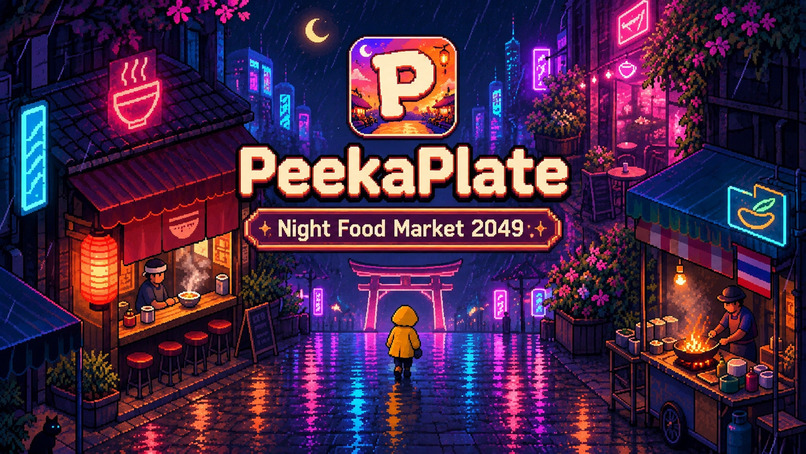
PeekaPlate - Night Food Market 2049 Cover
-
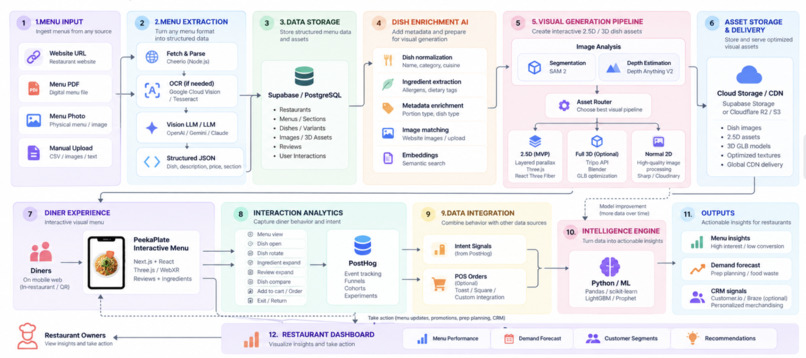
Inforation Architecture/ Data Infra
-
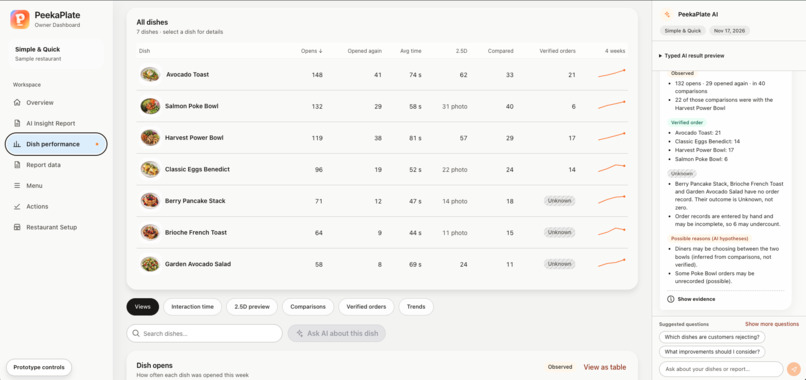
Menu Intelligence on Restaurant Owner Dashboard
-
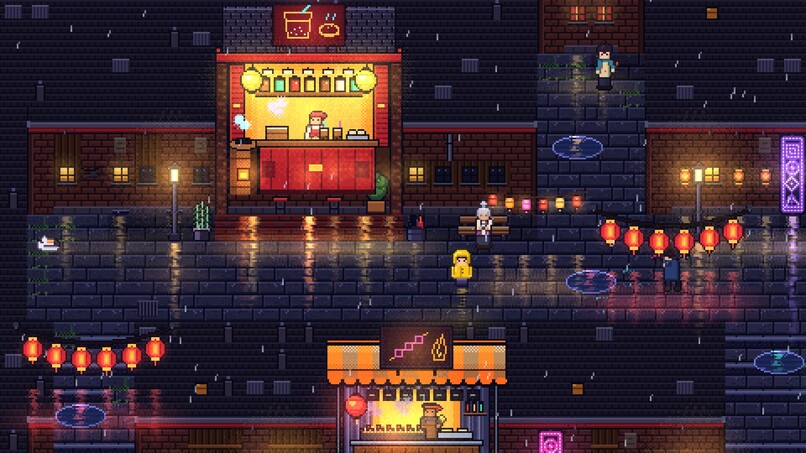
Lantern Market Design
-
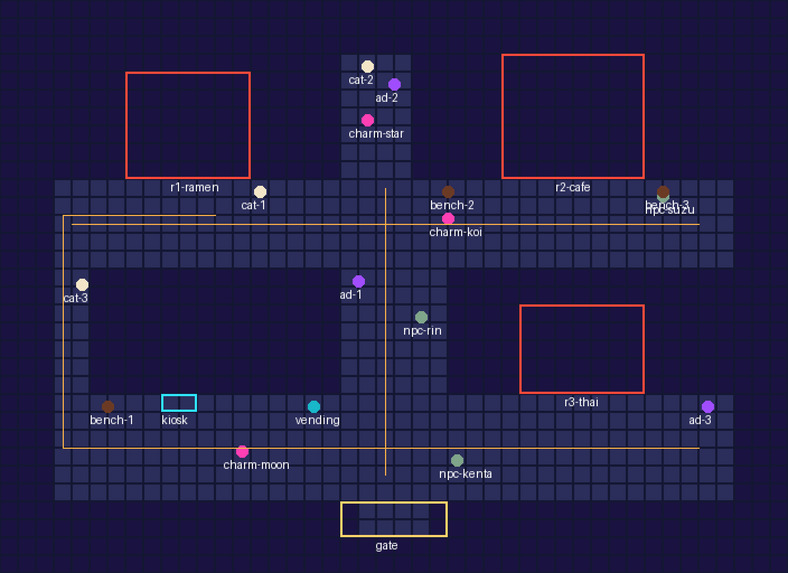
Market Map Schema
-
-
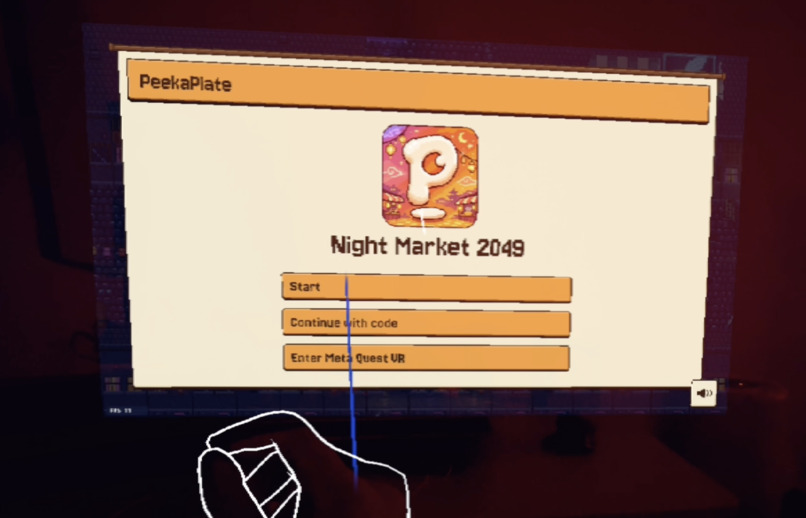
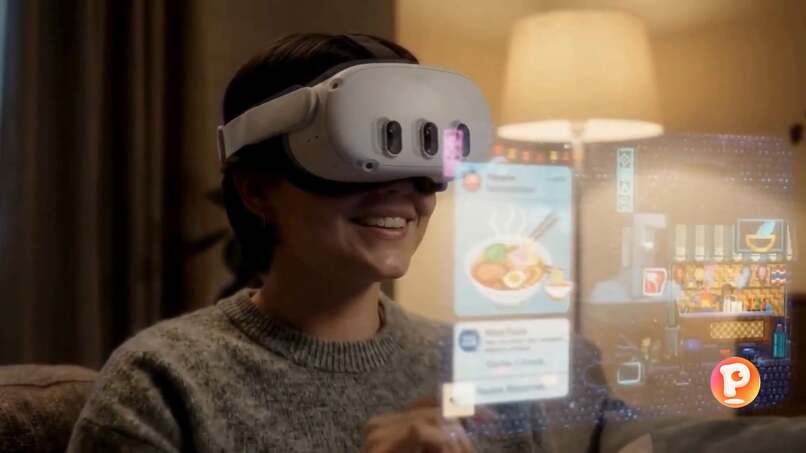
Trying PeekaPlate on Spectacle


Inspiration
What if ordering food felt more like exploring a night market than scrolling through a delivery app?
We love discovering local restaurants, but online food ordering often reduces that experience to static photos, text descriptions, and endless scrolling. It's difficult to understand what a dish actually looks like, how large the portion is, or whether it's what you're craving.
Meanwhile, restaurants know what customers order, but rarely understand what they almost ordered. Traditional ordering platforms capture transactions, not the curiosity, comparisons, and decisions that happen before them.
We started PeekaPlate with a question: What if we could make food discovery more immersive and playful, while turning those interactions into meaningful insights for local restaurants?
Our vision is to bring the energy of a night market into extended reality (XR), combining gaming, AI, and spatial computing to rethink how people discover and order food.
What it does
PeekaPlate is an AI-powered XR food ordering experience that connects diners with local restaurants through gamified virtual night markets.
Instead of browsing a conventional menu, diners can explore themed virtual environments, discover restaurants, and interact with food in 3D.
The experience brings together three layers:
1. Immersive food discovery
Diners explore themed night markets in VR, discovering local restaurants through a playful, spatial experience. Rather than simply reading a menu, they can interact with food as part of a virtual world.
2. Visualizing food before ordering
Our interactive menus let diners explore dish details, ingredients, allergens, and portion representations. The AR portion-view experience is designed to help users better understand what they're ordering, using 2.5D visualizations as a fallback when full 3D models aren't available.
3. Restaurant intelligence
Every menu interaction can reveal valuable information about diner interests. PeekaPlate tracks signals such as dish views, comparisons, saves, and engagement time to help restaurants understand:
- Which dishes attract the most attention
- What diners compare before deciding
- Which menu items generate interest but may not convert into orders
- How customers interact with different menu offerings
These insights could eventually help restaurants improve menu planning, customer relationship management (CRM), and demand forecasting, with the longer-term goal of reducing food waste.
How we built it
PeekaPlate combines AI-powered menu processing, a web-based restaurant management platform, and an immersive XR experience.
AI-powered menu ingestion
We built an ingestion pipeline that accepts restaurant menu photos, PDFs, and website URLs. OCR and vision-language models extract menu information and structure it into individual dishes, including descriptions, prices, ingredients, and allergen information.
Restaurant owners can review and correct extracted information before publishing, keeping humans in control of what customers see.
3D and AR food visualization
We developed a portion-visualization pipeline designed to connect restaurant-uploaded dish photos with interactive diner experiences.
Our approach prioritizes accessibility: when a full 3D model isn't available, a 2.5D representation can provide a visual fallback. We're also exploring AI-based image-to-3D generation to make spatial food experiences easier for restaurants to create.
XR night market
We designed a gamified virtual market experience for discovering local restaurants, with an emphasis on immersive interaction, themed environments, and spatial food presentation.
Our XR work explores Meta's immersive web technologies to make restaurant discovery feel more like exploring a world than navigating a conventional ordering interface.
Restaurant analytics
We built an event-tracking and reporting architecture to turn diner interactions into restaurant-facing insights.
The platform distinguishes between simply opening a dish and actively engaging with it, while using privacy thresholds to avoid exposing insights from very small groups of diners.
Technology
Our stack includes React and TypeScript for the web experience, Cloudflare Workers, Queues, and R2 for backend processing and asset storage, Supabase for structured data, and AI vision/OCR services for menu extraction. The XR experience is developed separately and designed to connect with the published menu data.
Challenges we ran into
Turning ordinary food photos into immersive experiences
Restaurants typically have 2D images, not production-ready 3D assets. Requiring every restaurant to manually create 3D models would make the product difficult to scale.
We approached this by designing a progressive visualization pipeline, supporting 2.5D fallbacks while developing the path toward AI-generated 3D assets.
Making AI-extracted menu data trustworthy
Restaurant menus come in inconsistent formats, from scanned PDFs to multi-page websites. Extracting dish names is only the beginning: ingredients, allergens, prices, and image associations must also be accurate.
We introduced structured extraction and owner verification before publication, especially for safety-critical information such as allergens.
Connecting multiple product experiences
PeekaPlate isn't a single interface. It includes the restaurant onboarding experience, menu publishing pipeline, diner-facing menu, analytics dashboard, and XR environment.
One of our biggest engineering challenges was creating consistent data and asset mappings across these surfaces, so that a dish approved by a restaurant could be represented correctly throughout the experience.
Balancing visual ambition with performance
Immersive experiences can be computationally expensive. We needed to consider how to preserve the feeling of spatial interaction without requiring every device to render high-fidelity 3D content.
This shaped our progressive approach to rendering, fallback assets, and lightweight menu experiences.
Accomplishments that we're proud of
One of our proudest accomplishments is taking PeekaPlate beyond a visual concept and building the underlying product architecture needed to support real restaurant menus.
We developed an AI-assisted menu ingestion workflow that can process restaurant menu content, structure dishes, and support human verification.
We also built the foundation for an end-to-end restaurant experience: from onboarding and verifying menu content to publishing diner-facing menus and collecting interaction signals.
On the diner side, we brought together dish discovery, ingredients, allergen information, saving, comparison, and portion visualization into a connected product experience.
Beyond the technical work, we're proud of bringing together product design, AI, data engineering, and XR development around a shared vision.
The most meaningful achievement is that PeekaPlate isn't just a virtual restaurant environment. It's an attempt to connect the experience of discovering food with the intelligence restaurants need to understand their customers.
What we learned
Immersive technology becomes meaningful when it solves a real problem.
We initially focused on how exciting it would be to see food in 3D. But as we developed the concept, we realized the value isn't just visual novelty. It's helping people make more confident ordering decisions.
Restaurants don't necessarily need more data. They need better insights.
An order tells a restaurant what was purchased, but not what customers considered along the way. We learned to think about menu interactions as potential signals of demand, while recognizing that interest alone doesn't prove purchase intent.
AI needs human oversight to be useful in real workflows.
Automatically generating menu content is powerful, but restaurants need to trust what gets published. Human review, clear data ownership, and sensible fallbacks are just as important as the AI model itself.
XR should complement, not complicate, everyday experiences.
Not every diner will have a VR headset, and not every restaurant will have 3D assets. Designing accessible 2D and 2.5D experiences alongside XR makes the product more practical and scalable.
What's next for PeekaPlate
Our next goal is to connect PeekaPlate's immersive discovery experience with a fully functional restaurant ordering and intelligence platform.
1. Complete the photo-to-3D pipeline
Enable restaurant owners to upload ordinary dish photos and generate optimized 3D food assets, reducing the need for manual 3D modeling.
2. Expand the XR night market
Create more themed virtual environments, richer spatial interactions, and a connected experience where diners can explore multiple local restaurants.
3. Integrate real ordering and POS systems
Connect food discovery and ordering data so restaurants can better understand the relationship between customer interest and actual purchases.
4. Develop predictive restaurant intelligence
Go beyond descriptive engagement metrics to explore demand forecasting, menu optimization, personalized customer engagement, and opportunities to reduce food waste.
5. Pilot with real local restaurants
Work directly with restaurant owners to validate whether immersive menus improve diner confidence and whether interaction insights lead to useful operational decisions.
Our long-term vision is to create a more intelligent and engaging local food ecosystem—one where diners can explore food before ordering, and restaurants can better understand demand before it becomes a transaction.
PeekaPlate is where immersive food discovery meets restaurant intelligence.
Built With
- blender-python-api
- cloudflare-queues
- cloudflare-r2
- cloudflare-workers
- glb
- gltf
- google-gemini
- iwer
- javascript
- meta-immersive-web-sdk
- meta-quest
- node.js
- ocr.space
- openai-api
- playwright
- postgresql
- posthog
- python
- supabase
- three.js
- typescript
- vite
- vitest
- webxr
- zod


