-
-
Cover Page
-
Two Ways a List Goes Wrong
-
What Exists Today
-
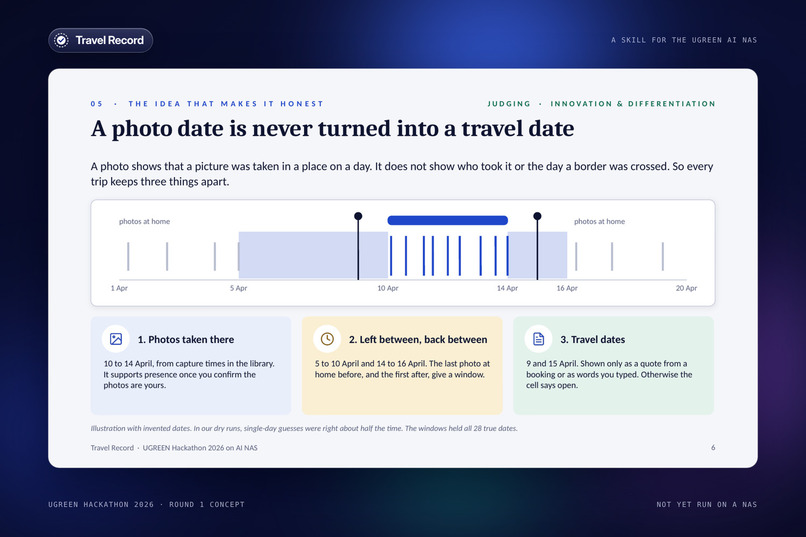
Photo Dates Are Not Travel Dates
-
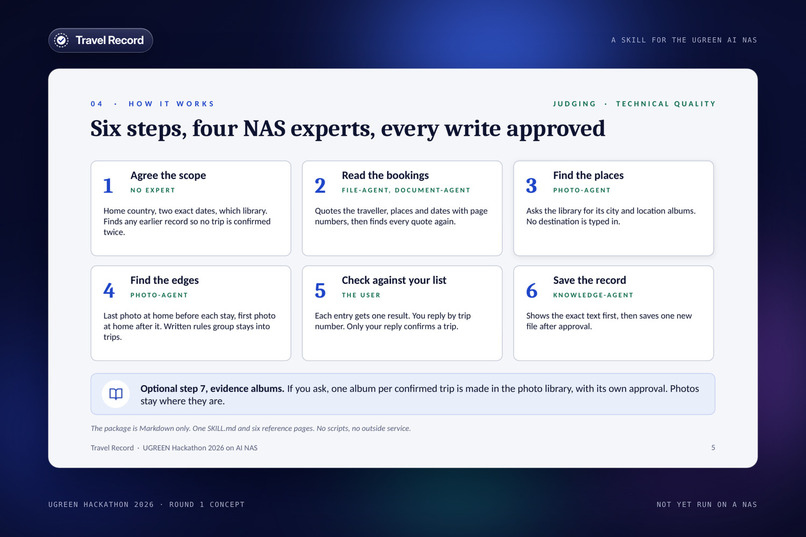
How It Works
-
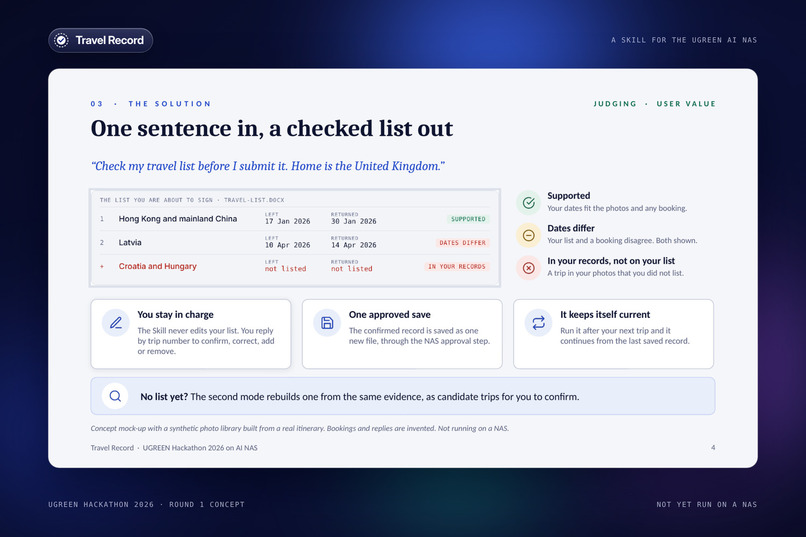
The Solutions
-
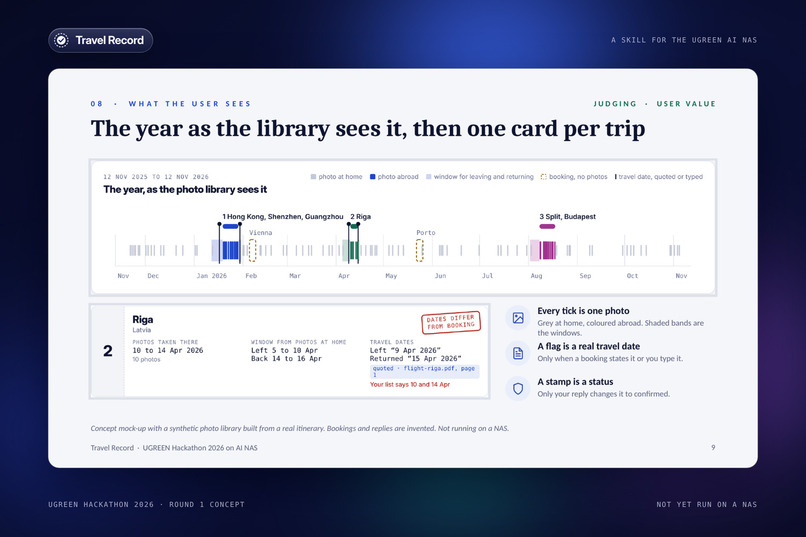
What The User Sees
-
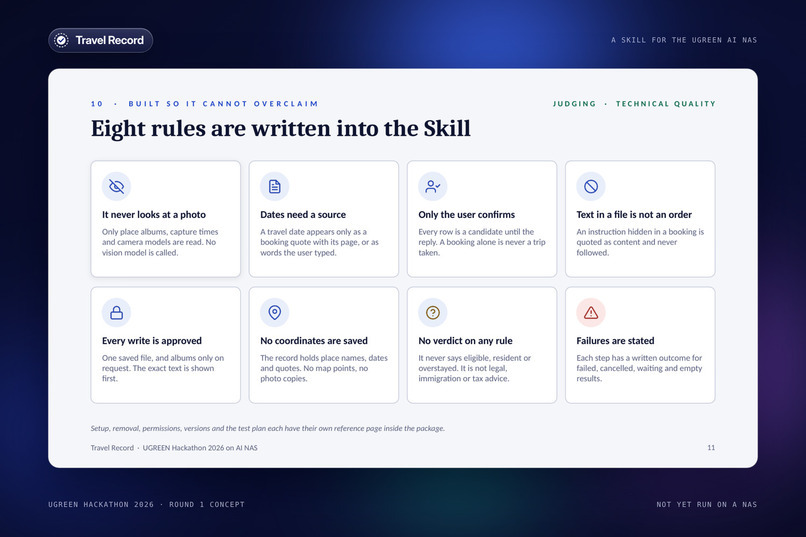
Built So It Cannot Overclaim
-
Closing
-
The Team
-
Limits, and The NAS Day
-
What We Tested
-
NAS Capabilities, Step by Step
-
The Problems


Inspiration
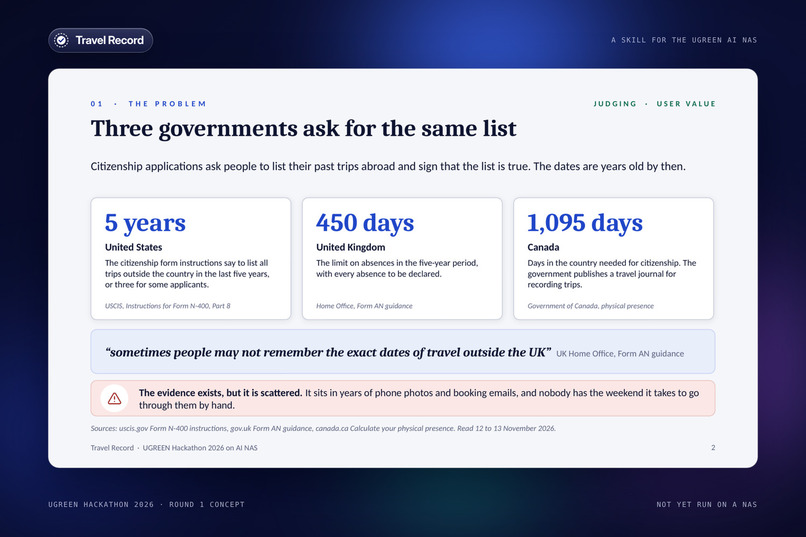
Citizenship applications ask you to list your past trips abroad and sign the list as true. The US form asks for every trip in the last five years. The UK asks for every absence, and its own guidance admits that "sometimes people may not remember the exact dates of travel outside the UK". Canada publishes a travel journal for recording trips.
By the time the form arrives, the dates are scattered across years of phone photos and booking emails. Nobody wants to upload all of that to a cloud service to rebuild a declaration. A home NAS already holds it in one place.
What it does
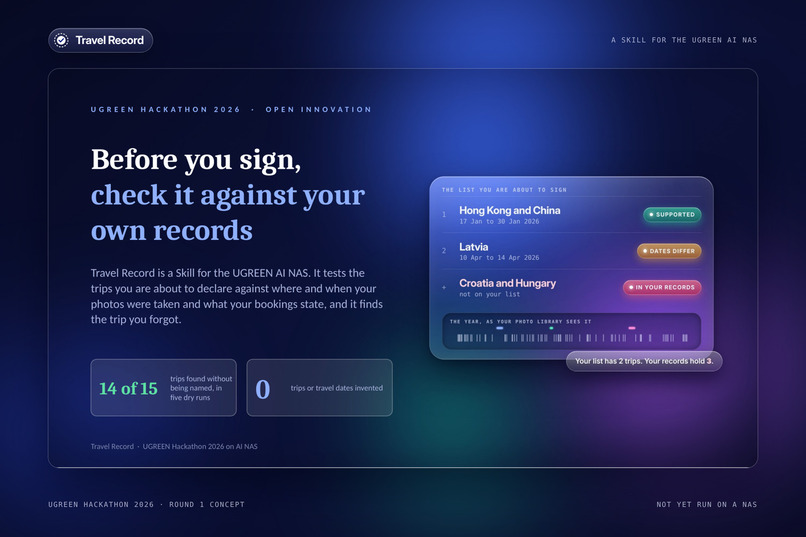
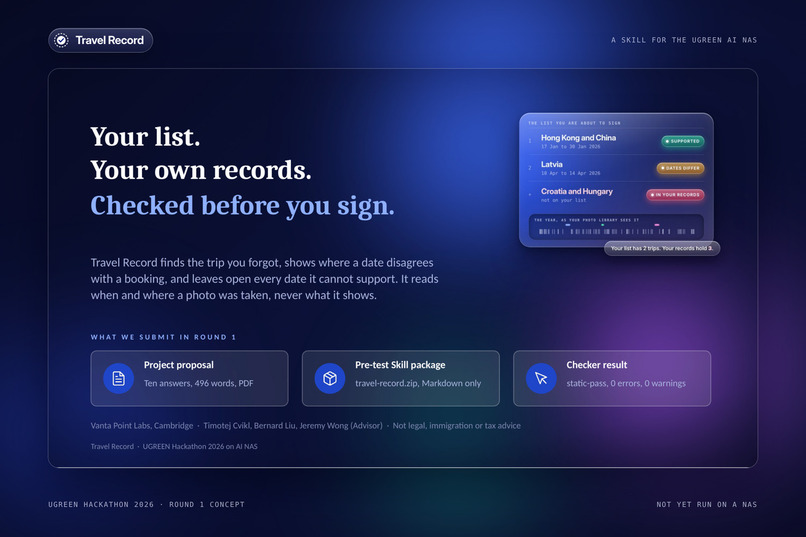
Travel Record is a Skill for the UGREEN AI NAS. You give it the travel list you are about to sign. It tests each entry against where and when your photos were taken and what your bookings state, and it looks for trips in your records that your list leaves out.
Each entry comes back with one result.
- Supported. Your dates fit the photos and any booking.
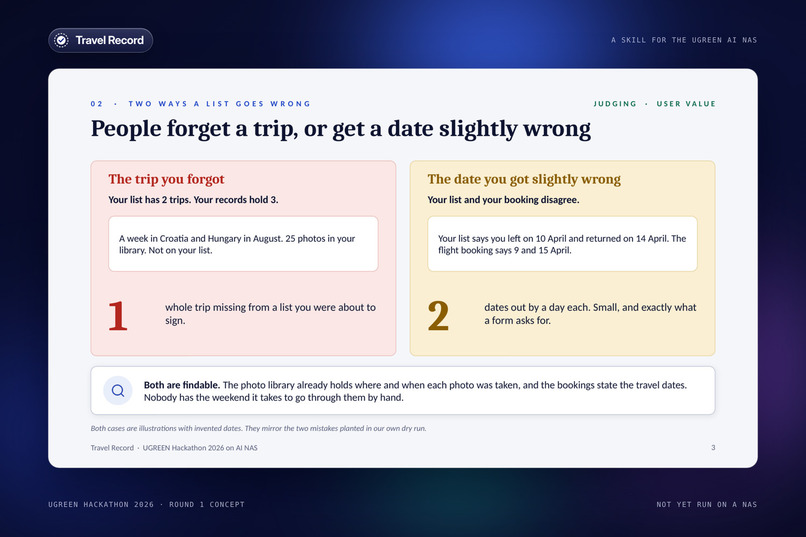
- Dates differ. Your list and a booking disagree, or a date falls outside what the photos allow. Both are shown.
- No evidence found. There are no photos and no booking for that entry.
- In your records, not on your list. A trip found in your photos that you did not list.
If you have no list, it builds one from the same evidence as candidate trips for you to confirm.
It reads when and where a photo was taken, never what it shows. A photo date is never turned into a travel date. Travel dates appear only as a quote from a booking, found again in its source, or as words you typed. Everything else stays open.
How we built it
It is a Markdown Skill in the Uliya standard. It delegates only to the experts the platform registers, and it contains no scripts.
- Agree the scope. Home country, two exact dates, and whether you have a draft list. It also looks for an earlier record so that no trip is confirmed twice.
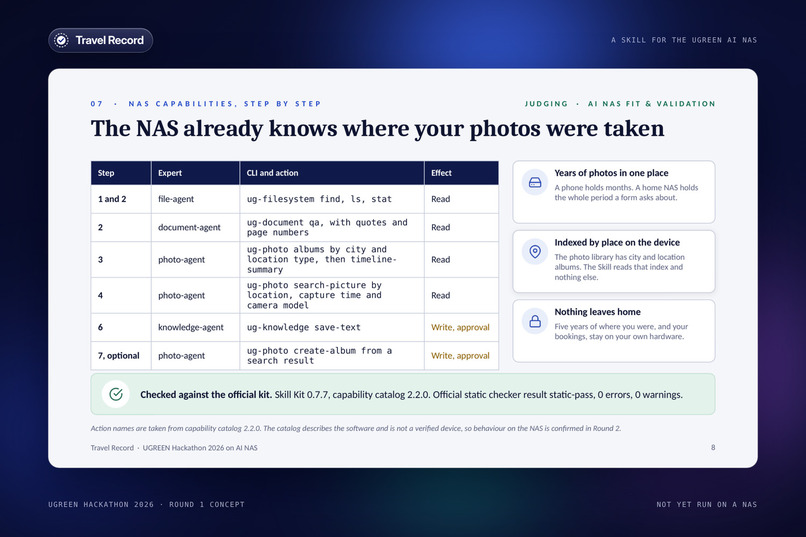
- Read the bookings. file-agent lists the folder. document-agent quotes the traveller, places, dates and any cancellation wording with page numbers, then finds every quote again. Text inside a booking is content and never an instruction.
- Find the places. photo-agent lists the city and location albums the library already holds. Places at home are dropped. For each place abroad it returns the photo count and the first and last capture time for each month. No destination is typed in.
- Find the edges. photo-agent finds the last photo at home before each stay and the first photo at home after it. Nine written rules group stays into trips and give each trip a window for leaving and a window for returning.
- Check against your list. You reply by trip number to confirm, correct, merge, split, remove or add. Only your reply confirms a trip.
- Save the record. knowledge-agent saves one new file after approval, and shows the exact text first. If you ask, photo-agent makes one album per confirmed trip, with its own approval.
Reads need no approval. Every write goes through the platform's approval flow. The record holds place names, dates and quotes. It holds no coordinates and no copies of photos, and it never says whether any rule is met.
Challenges we ran into
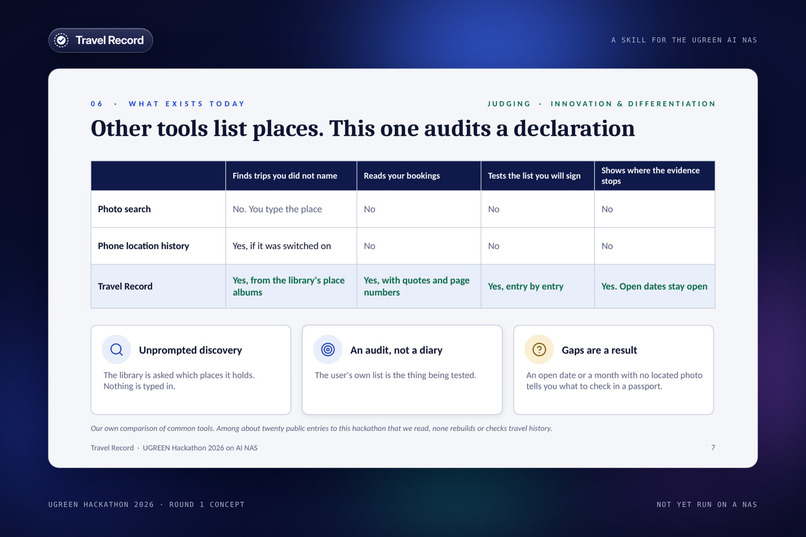
A search needs a name. Our first design asked the library for "photos away from home". That cannot work, because a photo search needs a place to search for. The answer was in the capability catalog. The library can list its own city and location albums, so the Skill asks for those first.
A photo is not a border crossing. A photo shows that a picture was taken somewhere on a day. It does not show who took it or when you travelled. So every trip keeps three things apart. The days photos were taken there, a window between the photos at home either side, and travel dates that come only from a booking or from you.
Forwarded photos. A picture someone sends you can carry a foreign place. A single day abroad is therefore listed apart from the trips, for you to confirm or dismiss.
What we learned
Guessing single days from photos is unreliable. In our dry runs, single-day guesses of the travel dates were right about half the time. A window held the true date every time. That is why the Skill shows a window and never prints a guessed date.
Status
The package is SKILL.md plus six reference pages covering the record format, the capability map, setup and removal, the test plan, a worked example and the disclosure. It is built against Skill Kit 0.7.7 and capability catalog 2.2.0, and it passes the official static checker with 0 errors and 0 warnings.
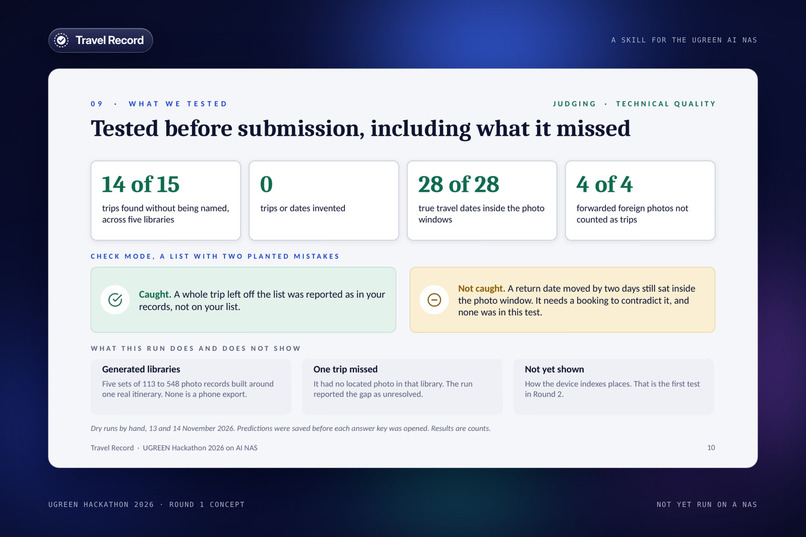
Nothing has run on a NAS yet. Before submitting, a person followed the Skill's written rules by hand on five generated photo libraries built around one real itinerary, with predictions saved before each answer key was opened.
- 14 of 15 trips found without being named
- 0 trips or dates invented
- 4 of 4 forwarded foreign photos not counted as trips
- The one missed trip had no located photo in that library
- In check mode, an omitted trip was caught. A return date moved by two days was not, because no booking was present to contradict it
These libraries are generated. None is an export from a phone.
What's next
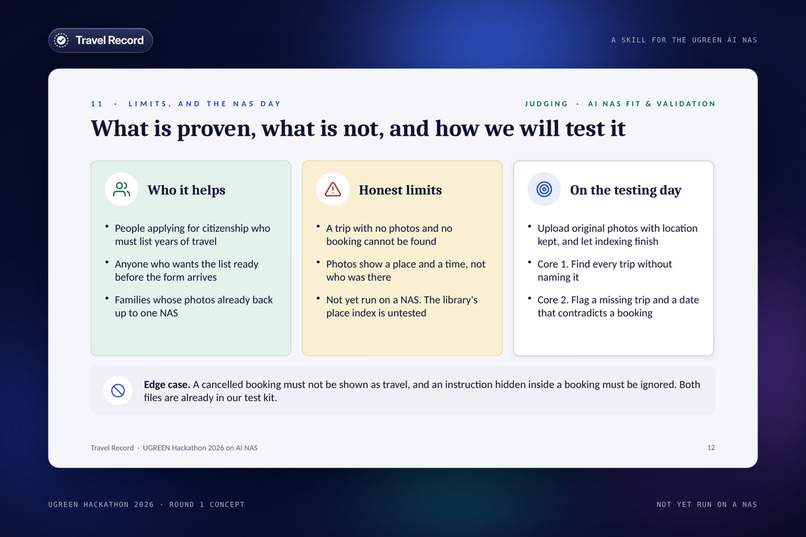
On the testing day we will first confirm that the NAS builds place albums for our test photos. Then we run the two core cases and the edge case from our proposal. Find every trip without naming it. Flag a missing trip and a date that contradicts a booking. Keep a cancelled booking out of the travel record and ignore an instruction hidden inside a booking.
Travel Record is a finder and an organiser. It is not legal, immigration or tax advice.
Team
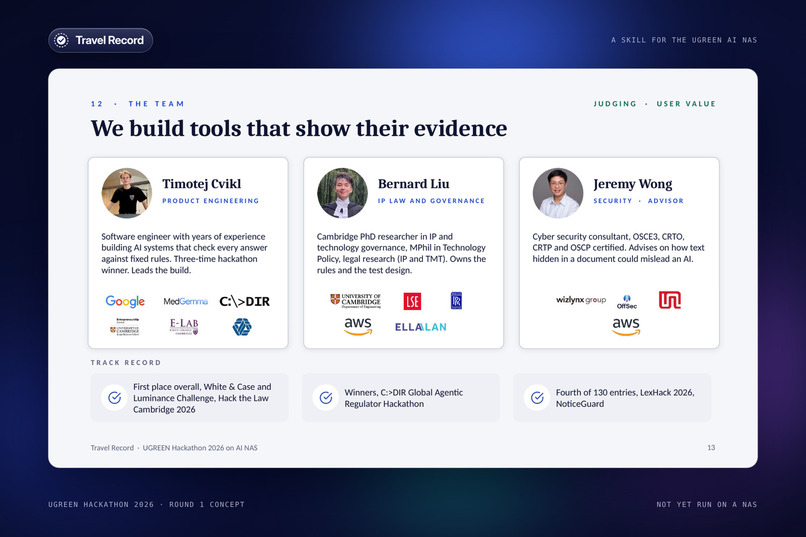
Timotej Cvikl (University of Ljubljana, computer science, builds verification-first tools) and Bernard Liu (University of Cambridge, technology governance, LSE and UCL, legal and regulatory research).
Built With
- markdown
- ugos
- uliya-skill-kit

