-
-
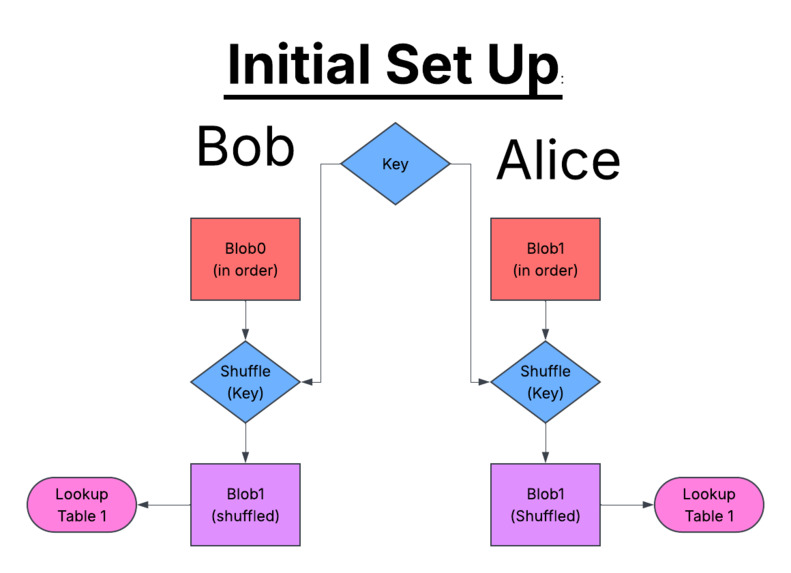
Initalize chat. Bob and Alice both have a shared blob shuffled with same key.
-
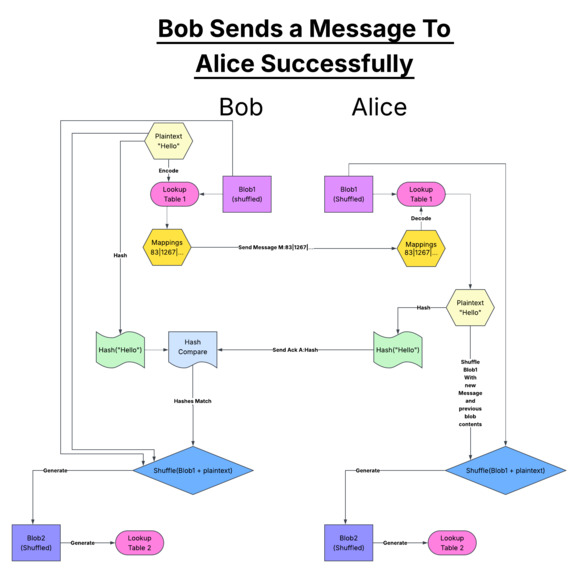
Bob sends a message to Alice with Synchronized blobs. The algorithm is sucsessful and ready for the next message.
-
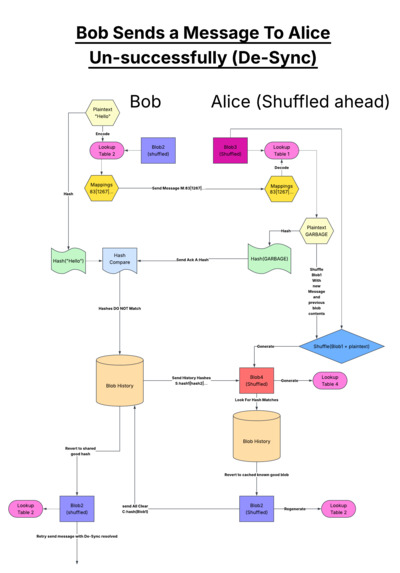
Bob sends a message to Alice with De-Synched blobs, so the recovery procedure reverts to a known good blob and Bob's message is re-sent
-
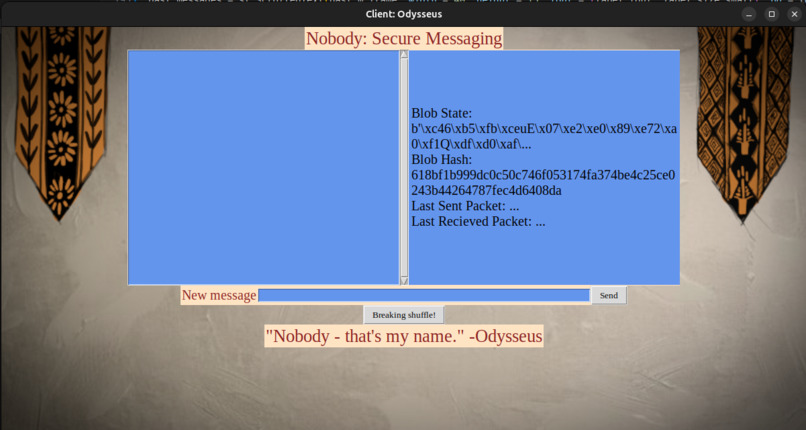
The client interface
-
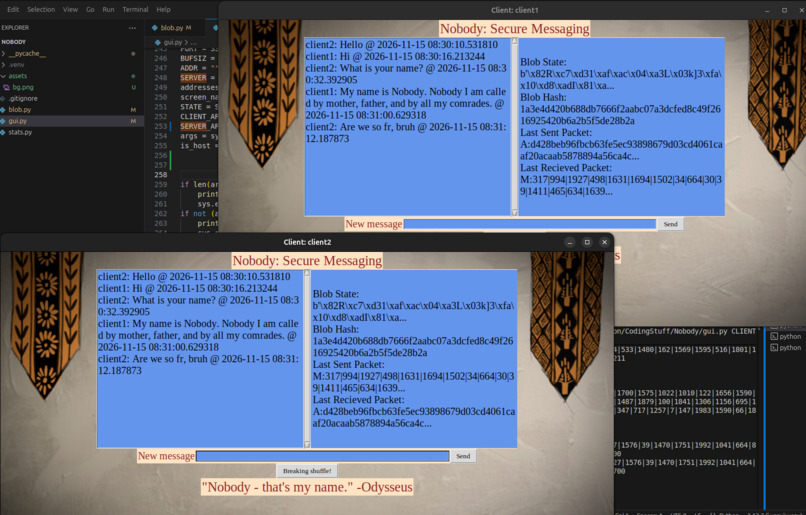
Two way communication synchronized and working as intended, notice the same blobs and blob hashes
-
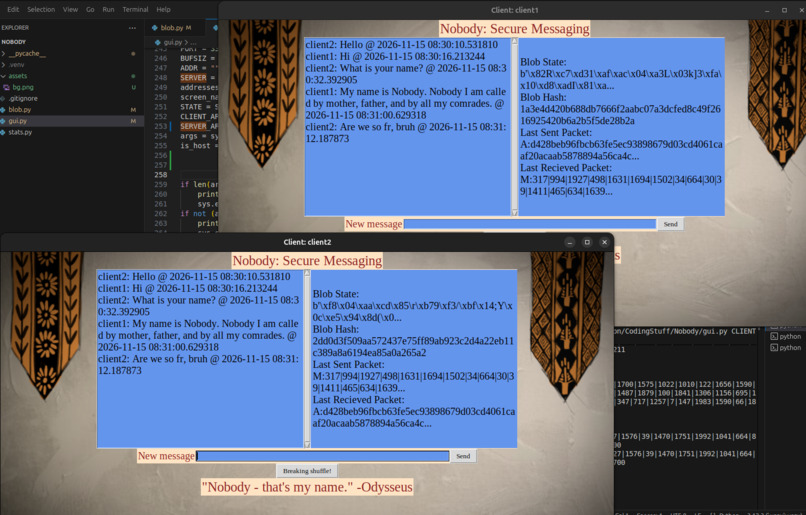
The "Break Shuffle" button was pressed on Client 2. This ruins the sync, notice the hash and blob are now different?
-
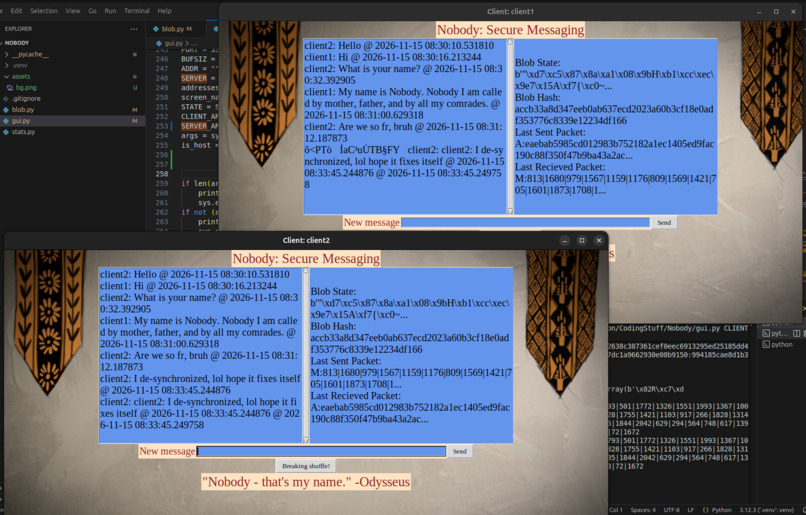
After client 2 sent a message with a bad blob, you can see the garbage it decoded on 1. It then resolved itself and sent the message again.
-
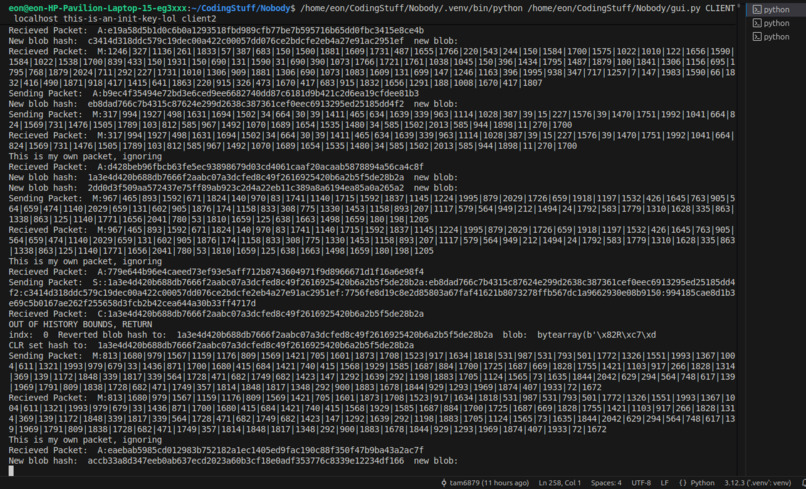
The console output of resolving the resolution. M packets are the message, A is the ack, S is the SOS, and C is the all clear.


The Nobody algorithm, named after the alias Odysseus gives the Cyclops, is a brand new encryption algorithm we developed that features.
Forward security:
Having an old key won't help you decrypt new messages
Automatic de-synchronization fault resolution:
If the keys go out of sync it can resolve and fix itself
Immunity to known plaintext attacks:
A known plaintext and the ciphertext it gives at one state won't help unless you also have every previous and subsequent message
Immunity to known key attacks:
The "key" changes after every message
Character frequency obfuscation:
Each byte can be randomly selected from any copy of that byte in the blob making it infeasible to use character frequency analysis
Fast Messaging:
The bulk of the algorithm's computation is after/before the transaction instead of while it's happening, so the time between encoding, sending, and decoding the message is short, with both encode and decode actions being O(n) time complexity using lookup tables.
To demonstrate our algorithm we created a simple text messaging app that allows you to see the blob contents, packets, and conflict resolutions that would normally be hidden.
The algorithm is called "Nobody" because it sends no BODY of the message, instead, it sends instructions to recreate the message given a different arbitrary common file.
Inspiration
The "Nobody" algorithm was inspired by an idea I had while learning about Steganography in a Cyber Security course I took last year. The idea behind Steganography is to flip bits of a file in a sequence that can be re-read with a key without noticeably corrupting the file. The idea I had then is what if instead of flipping bits, you just map out common sequences of bits to restore the file without changing the host at all? Then I realized any file with at least 1 of every byte expression (0 - 255) can recreate any other possible file if you mapped out common bytes. So why not use this to encrypt messages securely? Send the mappings to where you can reconstruct the message from a file and then change the file using itself and the plaintext as the seed.
What it does
The Nobody encryption algorithm works by having a "blob" file. This file can theoretically be anything, as long as it has 1 of every possible byte value and is shared by both parties. For this project we use a 2 kb series of bytes with each byte expression included 8 times, and deterministically shuffled with an init key.
When the blob is shuffled a lookup table is generated by finding every possible location of a byte expression in the blob for efficient encoding and decoding. This lookup table is regenerated with every shuffle.
When Bob sends a message to Alice, the timestamp is appended to the packet, and each byte of the packet is mapped to a location in the blob file, using randomization to select which character expression for frequency obfuscation. The mappings Bob generated are sent over the network to Alice, who should have an identical blob to Bob. Alice decodes the message, and returns an ack back to Bob with a hash of the plaintext, and then uses the contents of it's own blob plus the decoded plaintext to shuffle the bytes of their blob.
When Bob receives the ack, his client compares the hashes with the original message. If they are the same, then the message was decoded correctly on Alice's end, and the blobs are in sync. So Bob's blob uses its own contents and the plaintext to shuffle itself.
If the hashes do not match, a de-synchronization occurred somehow. In this event Bob's client sends an SOS to Alice with the hashes of the last few blobs in its stored its history. Upon receiving the SOS, Alice's client looks through its own history and finds a common hash, this is a known good previous blob they share. Upon selecting the blob, it restores it using the local history dict, and sends an all clear message back to Bob with the selected hash. Upon receiving the all clear, Bob's blob reverts to the same previous state and re-sends the message with the blobs back in sync.
How we built it
We built our project from scratch using Python and tkinter. The background art was drawn digitally, and all code in the project is human made. None of our project was generated via AI from the idea to the code.
Challenges we ran into
We got stuck for a while with the blob restoration. The issue was we were storing the blobs as python bytearrays, which are pass by reference and not pass by value. We forgot to use the copy() function so our history was corrupt and it would have a catastrophic failure every time it tried to resolve a conflict. But going to sleep for the night and seeing the problem with fresh eyes in the moring was all we needed.
Accomplishments that we're proud of
I'm most proud of how well it works. The conflict resolution, the obfuscation, the speed of execution. It feels like I've actually created something that could be potentially useful rather than a mere novelty, and I know it can be improved in the future.
What we learned
I learned a lo about networked applications
What's next for Nobody: Original forward secure encryption algorithm
There are several improvements that can be made on the algorithm. The biggest one is - dynamic blob content. This would have the actual contents of the blobs change to better obfuscate patterns in the packets sent. For instance, if the character 'e' is used very frequently, then over time the blob will include more instances of the byte code for 'e' and fewer of lesser used byte expressions. This would even further obfuscate character frequency and make the algorithm even harder to crack over time as the blob becomes optimized for its specific web traffic.
We could also make improvements to performance like rewriting the algorithm in a compiled language like C++ and introducing multithreading so it can generate lookup tables faster.
Built With
- neovim
- python
- tkinter
- vscodium


