-
-
-
-
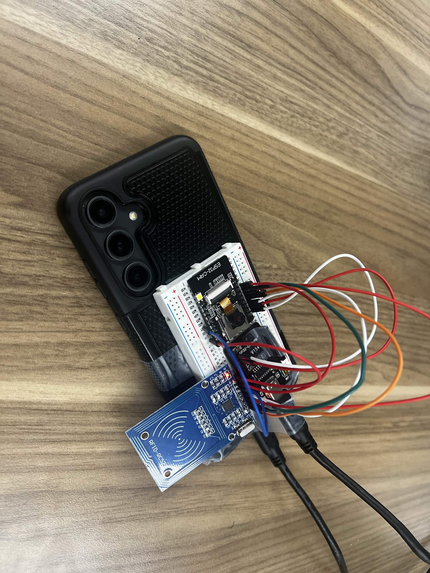
an image of the setup in motion.


We work for an AI image company , and recently, AI deepfakes have gotten good. Too good, where people are losing ownership over the content they create.
Generative video can produce a pixel-perfect twin of any clip. Metadata can be forged and watermarks can be stripped. We wanted a proof that only physical presence can produce.
The idea: the camera's frames get hashed into a chain that starts from the bytes on a physical MIFARE S50 card. The finished hash goes back onto the same card while it is still sitting in the reader's 4 cm RF field. The burn window is about 1.1 seconds.
How it works
- An ESP32-C3 with an RC522 reader exposes a BLE service called
VeriCam-HSM. - You tap the card. The ESP32 reads its UID and Sector 1 blocks 4–5 and pushes them to the phone.
- The phone captures 25 frames in 850 ms. For each frame:
h = SHA256(h || i || pixels). - The phone sends the final digest back. The ESP32 burns it to blocks 4–5 only if it arrives inside the window, then reads it back to confirm.
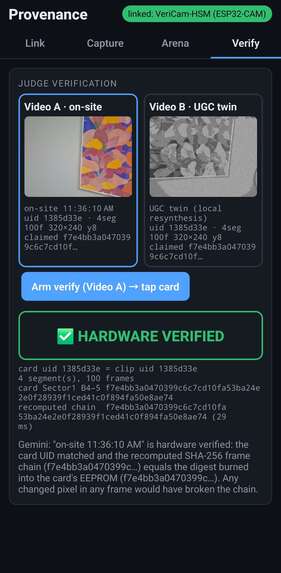
- To verify, tap the card again. The app recomputes the chain over the clip and compares the result byte for byte with the card.
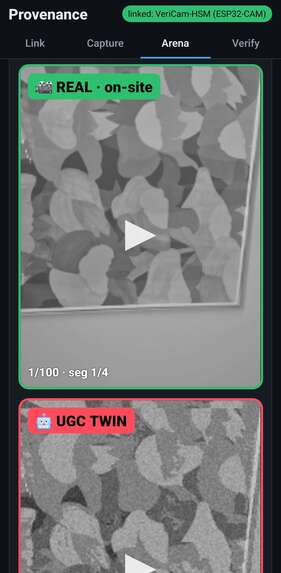
A twin of the clip that looks the same but has different pixels gives a different chain, so it gets rejected.
Stack
ESP32-C3 + RC522 · React Native (Expo, ble-plx, VisionCamera) · Vultr + Caddy · MongoDB Atlas (clip registry) · Tiger Data (event hypertable) · Solana devnet memo anchoring · Gemini (twin generation + verdict explanations).
What we learned
- MIFARE Classic keeps its Crypto1 session open as long as the card stays powered. The firmware therefore holds the session through the BLE round trip and writes without re-authenticating.
- Raw pixel buffers are the only deterministic thing to hash. Encoded video is not reproducible byte for byte.
Built With
- esp32
- gemini
- react-native
- vultr

