-
-
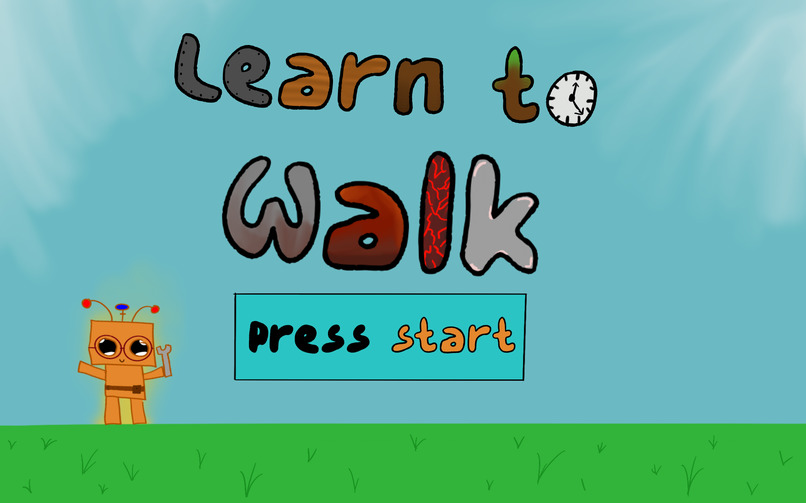
The title screen, displaying our hero in all their glory
-
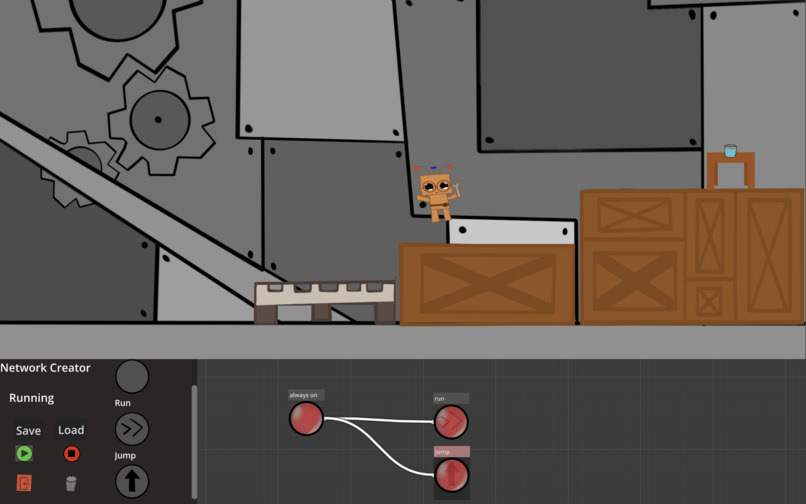
Even simple programs can have highly effective results
-
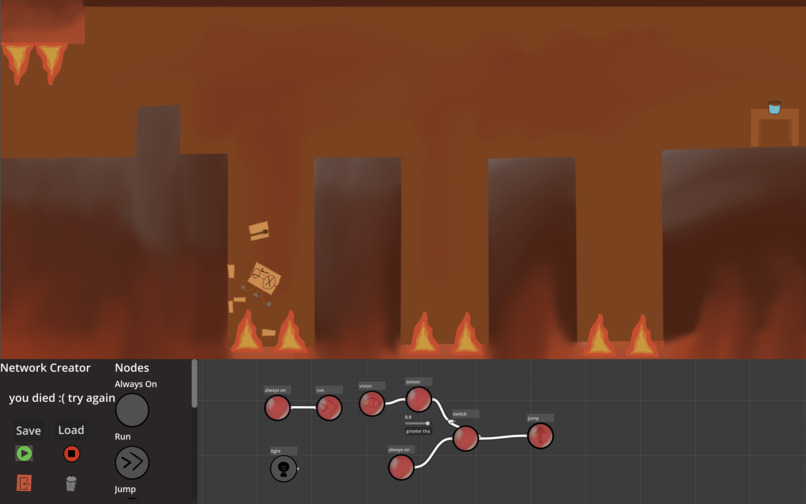
Our hero encounters a fiery doom thanks to a mistimed jump


Inspiration
Today we live in a high-level world. AI chat prompts can almost feel like a black box system. Behind the scenes of every form of AI is a system of billions, if not trillions, of artificial neurons forming a massive mathematical network.
The laws governing each neuron are very modest, but combined, many parts exhibit incredibly complex behavior. Our goal with Learn To Walk was to take this idea, dissect it, and make something fresh. We wanted to create an accessible way for anyone (even those completely lacking a CS background) to build their own intricate system of maximally simple parts.
Our goal was to frame the highly mathematical field of computation in an enjoyable and interactive medium, of which there is no better place than in a video game. By developing a game that tests vital problem-solving skills, we hope to prepare for an age where the simple parts are increasingly obfuscated.
What it does
The game would be a laughably simple platformer, except for one catch: you can't directly control your character. Instead, you establish a system of wires and nodes that define The Robot's movements, only having access to basic input and output nodes. When the play button is pressed, The Robot is set free into the level, armed only with the instructions you supply, with the goal of reaching a glass of water.
Note that the water has significance in the lore of this game, as The Robot's motivation for pursuing the levels is its debilitating dehydration
Inherently, this game is educational. It takes the mathematical field of computation and transforms it into a puzzle game. It teaches how to assess a problem, break it down into smaller parts, and then break those parts down into their most basic components.
Every level begins with observation, where the challenge is assessed, and a plan is made. Then comes setup, where the hypothesized system of nodes is constructed. Following setup is experimentation, where The Robot is released into the level, and the results of the hypothesis are made evident. Often (especially initially) this ends unfortunately for the robot, spewing parts across the screen. When this happens, do not fear! The Robot always comes back, with an opportunity to improve on your hypothesis. Thus, the cycle repeats itself, with a slightly modified challenge, and a step closer to the goal.
How we built it
We used the open-source, C-based game engine Godot for the app, and we relied on GitHub for version control and collaboration. We used Procreate for asset building, Monster for energy, and pencil and paper for planning.
Challenges we ran into
Making the experience intuitive but interesting was definitely a challenge. There is a fine line between user-friendly and user-boring when it comes to puzzle games. We wanted to have tricky logical solutions, but we did not want to make the levels impossible to solve. We knew our first few levels would be easy, showing users how to use the interface, while the later levels would increase in difficulty, creating a natural skill progression and a constant, satisfying challenge.
Another challenge we ran into was making the game visually appealing, and we decided that instead of using an AI image generator to create our artwork and designs, we would hand-draw and create all the assets ourselves.
Accomplishments that we're proud of
We are very proud that our final product is a complete, functional game, with a full, progressive level set. It was very satisfying to watch how the game took shape, with every level adding more complexity because of its challenge and charm with its art.
One of our favorite aspects of the game is how nodes are introduced only after you build their equivalent from nodes you already have. The switch node, for instance, is given to the player after a level where they have to use DeMorgan's law (not (not a or not b) = a and b) to build their own gate.
Having hand-drawn art, free of any generative AI, is also a huge win for us. While we readily accept and use these technologies in our daily lives, we staunchly believe that art should remain a human endeavor.
What we learned
We learned a lot about game development techniques, including level design, dynamic interfaces, gameplay balancing, and player psychology. We also gained significant experience working with GitHub in a high-speed environment with low margin for error. Dividing work to avoid merge conflicts--and quickly dealing with them when they arose--was vital to our success as a team.
What's next for LearnToWalk
We are super proud of how our project came out, and we intend to keep working on the game past the hackathon's end. We want to add more levels, new node types, and exciting gameplay mechanics! Someday we hope to go as far as to have a level where The Robot needs to perform rudimentary gradient descent to learn its way through a dark maze. We think The Robot's story has just begun. From first principles, he will keep learning new skills. He already knows about logic gates and bit storage, and the sky's the limit! He will continue to quench his thirst for water and knowledge.
Built With
- godot


