-
-
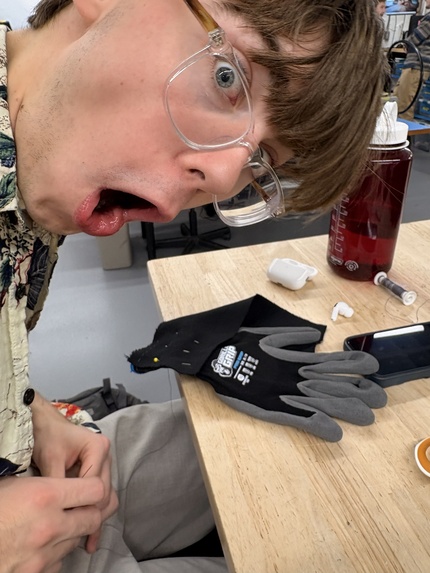
August very excited to be sewing
-
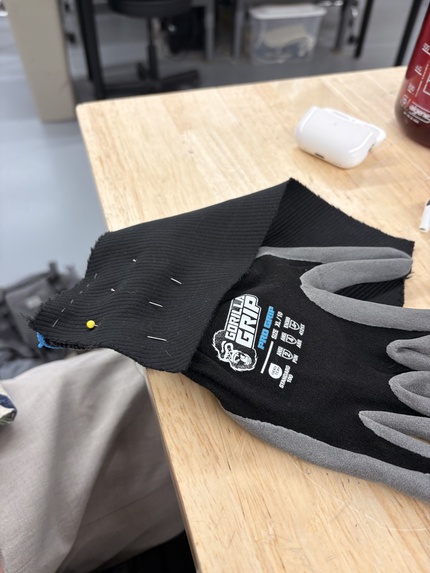
August sewing wrist strap
-
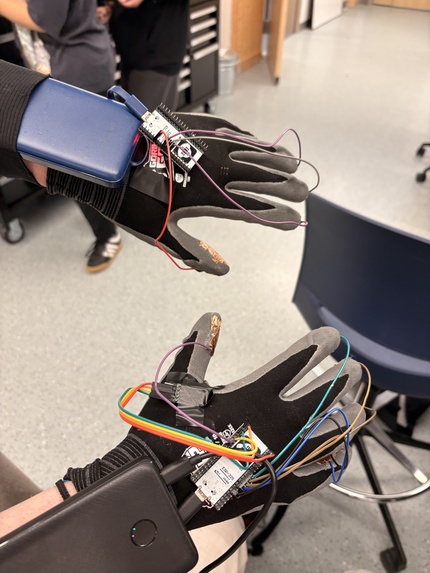
Final product back of gloves
-
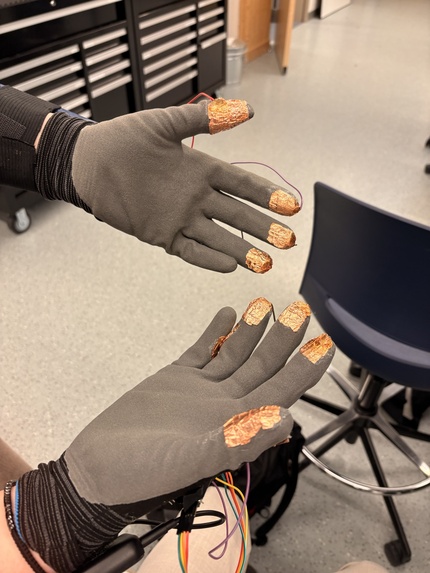
Final product front of gloves
-
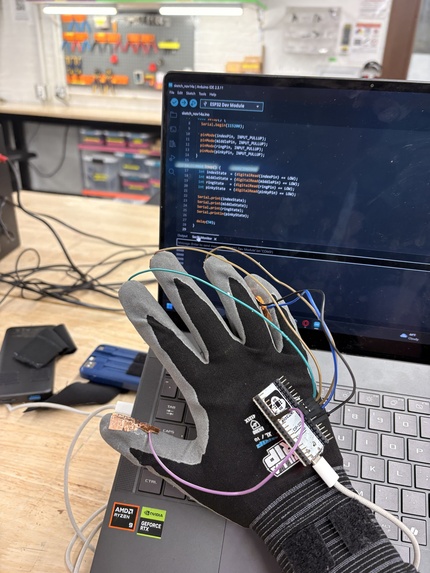
Programming the glove in Arduino IDE
-
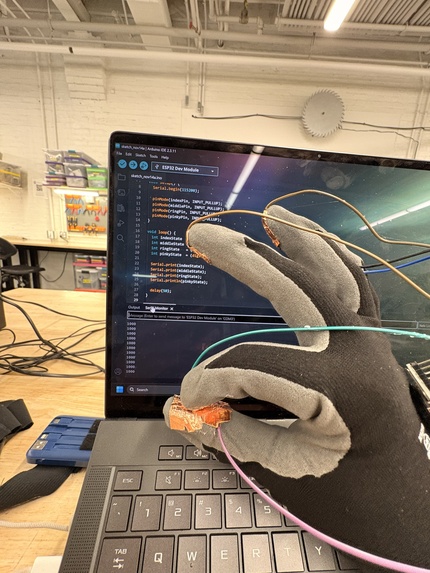
Glove working to detect contact
-
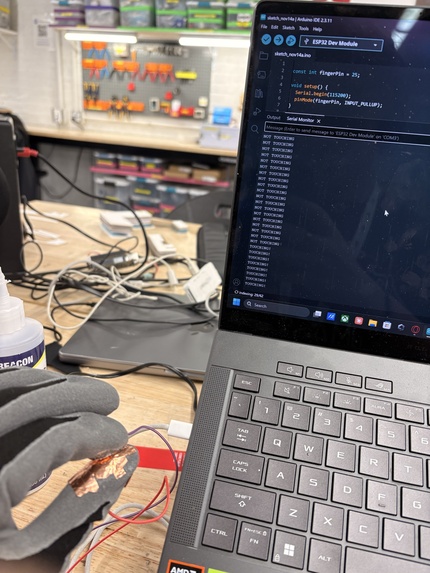
Glove contact test
-
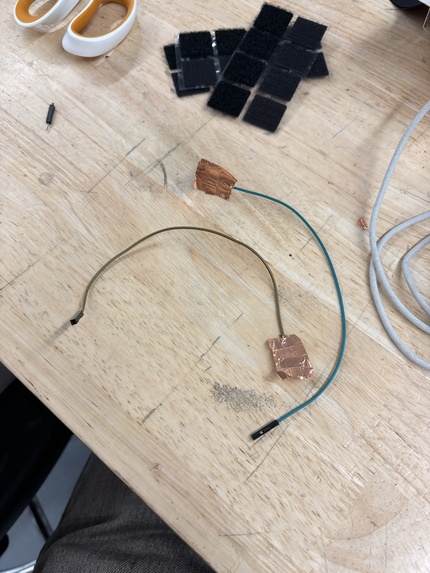
Copper pads with wires
-
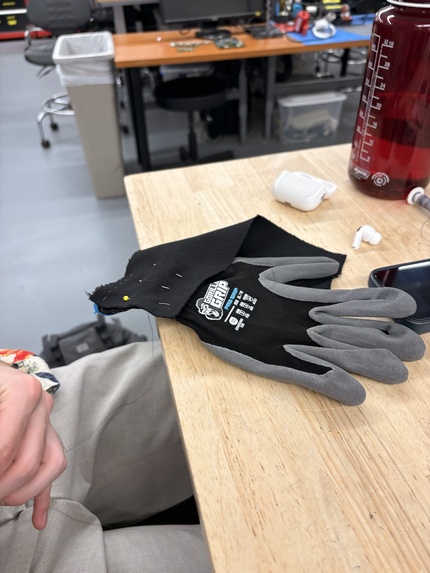
August sewing wrist strap wide
-
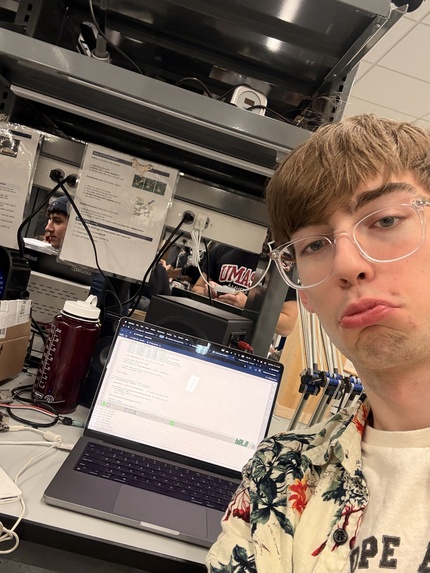
August programming bela
-
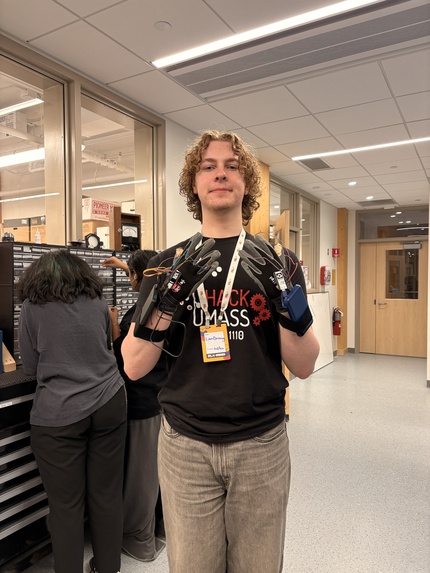
Liam wearing gloves showing back
-
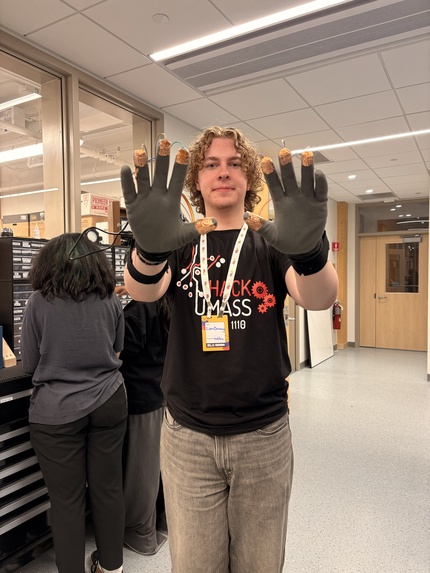
Liam wearing gloves showing front
-
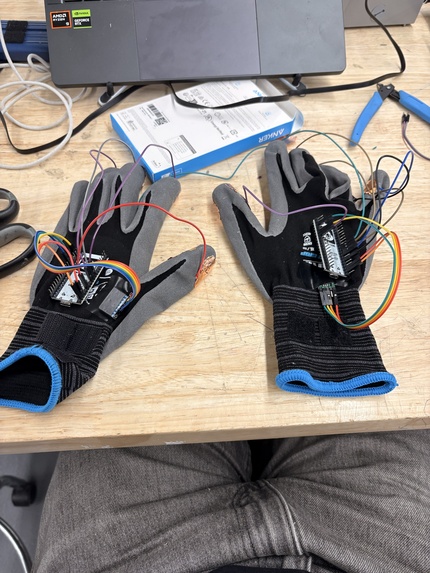
Gloves off hands


Inspiration
The Kinetone was inspired by all the various custom midi instruments that derive their concept from an analog instrument and expand on that thanks to the limitless potential of a digital fingering system. Simultaneously, it also originates from the habit that all instrumentalists have: idly fingering along to music during the day!
What it does
The Kinetone uses conductive pads on glove fingertips that are wired to ESP-32 GPIO pins which sense when individual fingers contact the grounded thumb. The ESP-32s then wirelessly communicate with another ESP-32 and a connected Bela controller for low latency audio generation. The right hand ESP-32 also uses an IMU to control pitch bending via hand rotation. The mapping of the fingerings can be altered to fit existing instruments, or even new ones! Also, the timbre (the quality of sound produced) can be adjusted to mimic a sin wave, saxophone, or trumpet, and the gyroscope effects can be modified to change octaves.
How we built it
We used gloves, created copper finger pads using copper foil tape and soldered jumper cables to each of them to connect to ESP-32s on the back of each hand. The right hand also has an IMU wired into the ESP32. The Bela works while plugged into a laptop, and has an ESP32 plugged into it that acts as a receiver and gathers data from the two gloves to use for the production of sound.
Challenges we ran into
Initially, we had slightly different visions for how the glove would look overall and especially how the battery would be attached, which led to some wasted time sewing material onto the length of the glove that served no real purpose. As a result, we had to pivot to securing the battery with just velcro and a strap, but it ended up working pretty well. On the design side, we wanted to make the contacts with conductive fabric, but we couldn't find that anywhere in enough time, so we found copper tape that we soldered jumper wires to, which was sufficient. However, we did have to resolder connections and repair the pads many times because the pad connections sometimes came loose and the pads would peel or tear. We had trouble implementing IMUs on both hands because they were slightly different models and one seemed to be producing a lot more noise than we were able to figure out in time. Luckily, we managed to get one IMU working on the right hand, which allowed us to add pitch bending and vibrato! On the code side, we had trouble implementing the IMU sensors and sound generation, but we split the coding evenly, communicated, and tested together so we got it done efficiently. We spent a lot of time trying to get the ESP-32s to transmit data with low latency, and because one of our team members was working on that the other had to spend time asynchronously developing other sides of the project. Overall, when we encountered issues that drained time, we made sure to split up work so that one of us was always making progress and maintaining momentum.
Accomplishments that we're proud of
Extremely low latency wireless communication between the gloves and the musical home base of the Bela. When playing the Kinetone, the latency between initiating a note and hearing it is imperceptible! Also, we are proud of integrating our software very well. With August working on the Bela code and Liam working on the ESP32 code, it was extremely important that the two systems interfaced properly, and we did that superbly.
What we learned
We learned how to sew in multiple different ways, use Bela to generate sound and alter timbres through harmonic and phase manipulation, how to use and interpret IMU data, and communicate across ESP-32s. We also learned about the UMass Makerspace and technical locations on campus!
What's next for Kinetone
The Kinetone would benefit a lot from specific parts that we couldn't get our hands on during the hackathon. We would love to replace the finicky copper fingertips with a conductive fabric sewn onto each finger, in order to increase the reliability of the contacts and decrease the likelihood of the device coming apart. We also want to widen the thumb tip to make it easier to get all of the fingers contacting the ground pad without crowding. Additionally, we would love to refine the software to increase the reliability of the tilt sensing for a more stable pitch bending experience!
Built With
- ai
- battery
- bela
- c++
- copper
- esp32
- gloves
- imu


