-
-
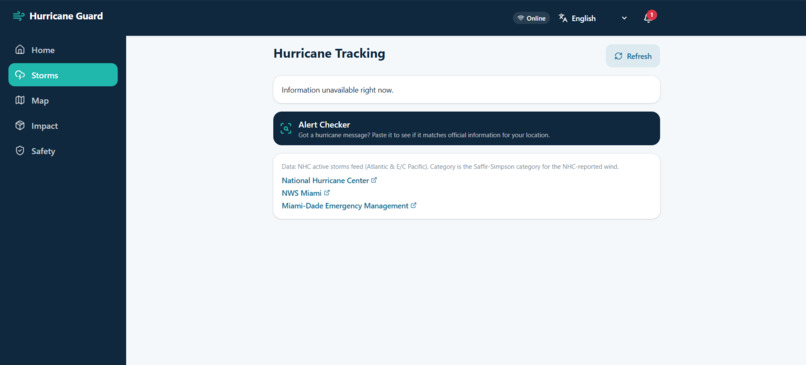
Storm Section
-
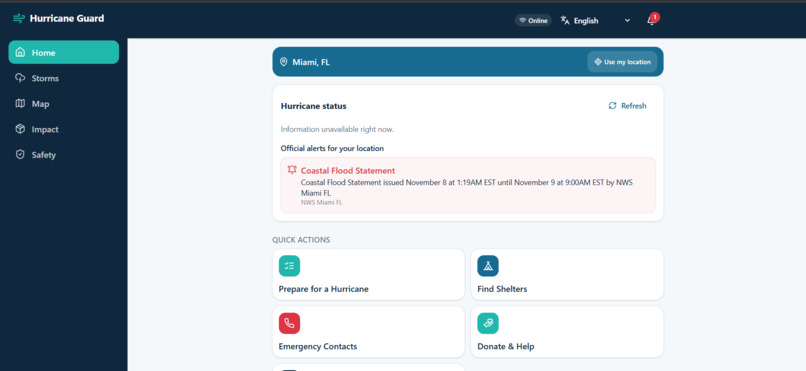
Home Section
-
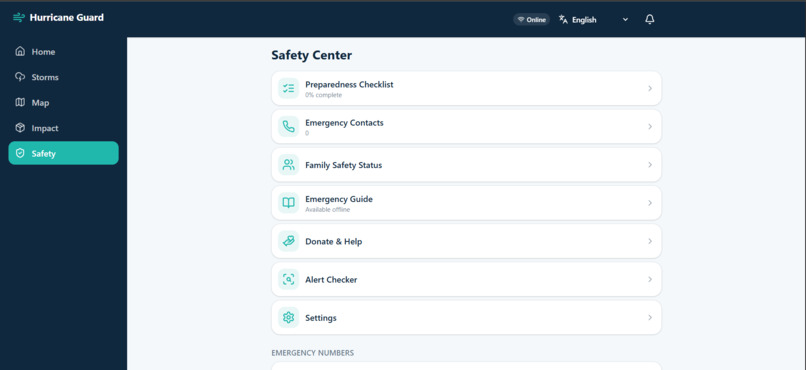
Safety Section
-
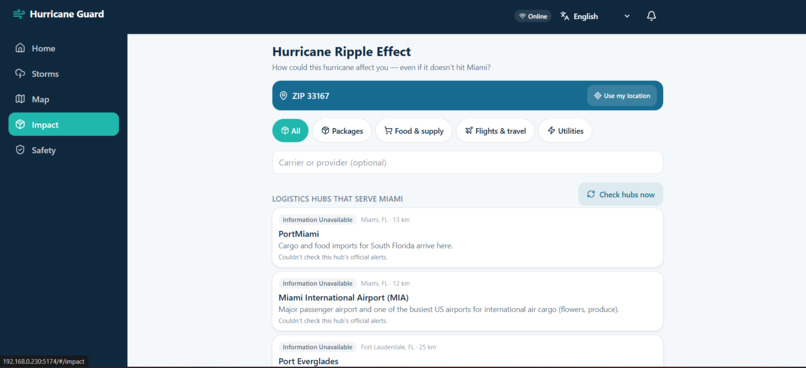
Impact Section
-
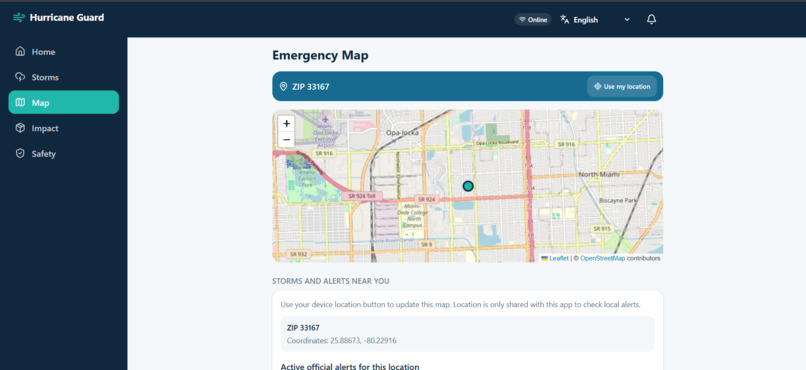
Map Section


Inspiration
Every hurricane season, Miami residents face two storms: the one on the radar and the one in their group chats. Fake evacuation orders, false shelter closures and recycled storm photos spread faster than official updates, and people make real decisions based on them. [Add a personal line here, for example a time you or your family received a fake alert, or what hurricane season was like growing up.]
When EC-Council challenged us to help people tell real hurricane alerts from fake ones, we wanted to build something simple enough for anyone to use: a grandparent, a tourist or a family with no power and one bar of signal.
What it does
Hurricane Guard checks incoming alerts and gives each one a label:
- ✅ Verified: it matches an official source like the National Hurricane Center or Miami-Dade Emergency Management
- ⚠️ Suspicious: it contradicts official information or shows common signs of misinformation
- ❔ Unverified: no trusted source confirms or denies it yet
Every label comes with a plain-language explanation, so users understand why an alert can or can't be trusted.
The app has five sections:
- Home: the latest checked alerts at a glance
- Map: storm path, shelters and evacuation zones
- Track: live hurricane tracking
- News: verified updates from official sources
- Help: emergency contacts and safety guides
Because hurricanes knock out cell service, Hurricane Guard caches verified alerts, maps and safety information so it keeps working offline.
How we built it
We based the interface on the City of Miami Trolley app because Miami residents already know that layout, and it keeps navigation simple under stress.
To classify an alert, we give it a trust score based on several checks:
$$ S = \sum_{i=1}^{n} w_i \, c_i $$
where $c_i \in {0, 1}$ shows whether check $i$ passed, for example a source match, consistency with the latest NHC advisory or the absence of known scam patterns, and $w_i$ is that check's weight. An alert is labeled "Verified" if $S \geq 0.7$, "Suspicious" if $S < 0.3$, and "Unverified" otherwise.
Challenges we ran into
- Defining "verified." Deciding which sources count as official, and what to do when sources disagree, was harder than writing the code.
- Offline mode. Without access to the internet there was no way it can update people of the news, for this that last news were saved in the app.
- Plain-language explanations. Writing reasons that are accurate but still easy to understand under stress took several revisions.
- Another challenge was the teamwork, having to divide the work among us and having to find a way our whole team can edit the code in one device and the rest being able to see does changes in another device.
What we learned
- We learn how API works, how we got the access to it and implemented it to our app.
What's next for Hurricane Guard
- SMS and push alerts for verified warnings
- Spanish and Haitian Creole support for Miami's communities
- Letting users forward a suspicious message straight into the app to check it

