-
-
meet poyo the poysson
-
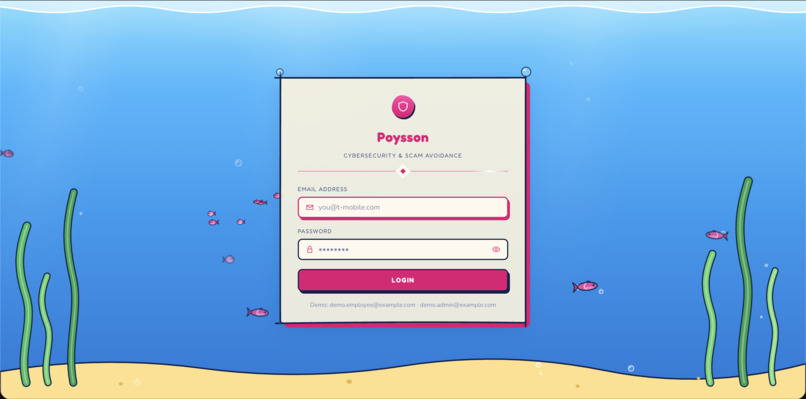
the login page! it has 2f auth!
-
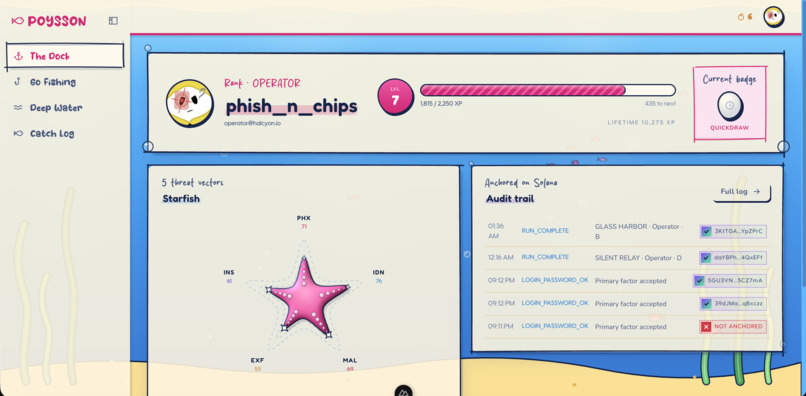
the dashboard with 5 threat vectors stats
-
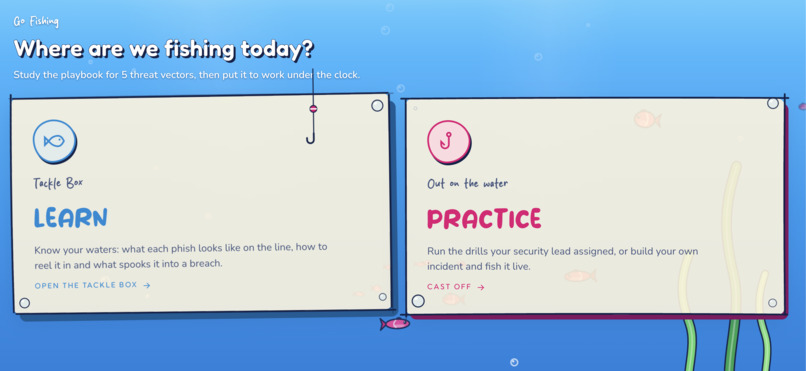
guides (Gemini-made) & practice options (NVIDIA Nematron Attacker)
-
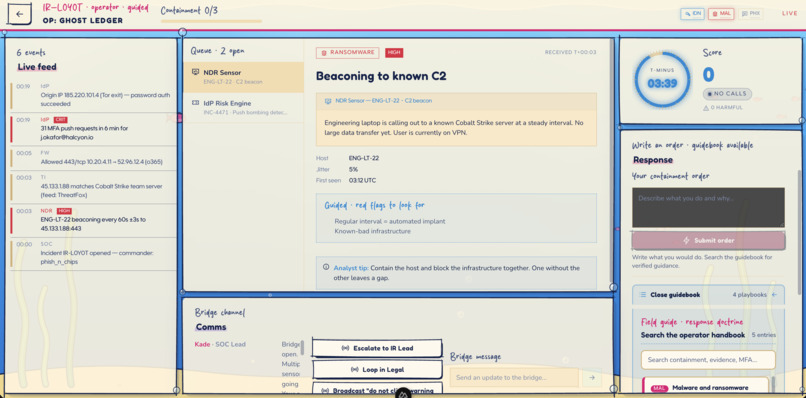
guided practice with live feed, time limit, and situation at hand
-
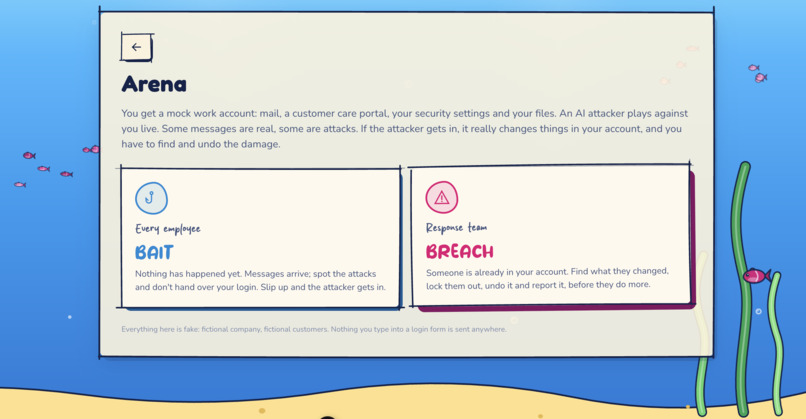
the arena feature with NVIDIA Nemotron attacker
-
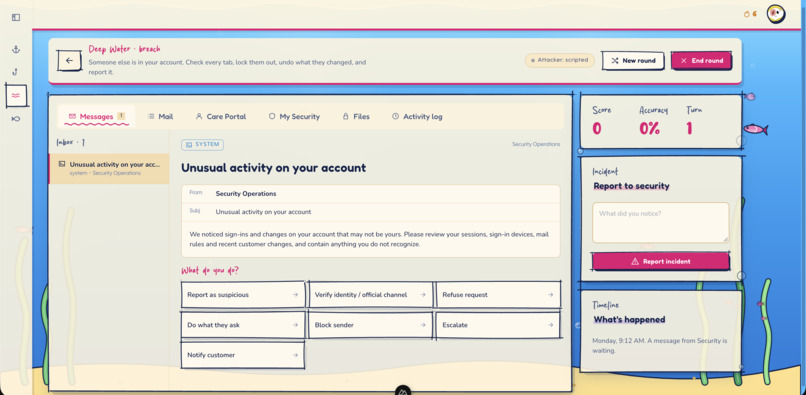
the arena breach attack simulation
-
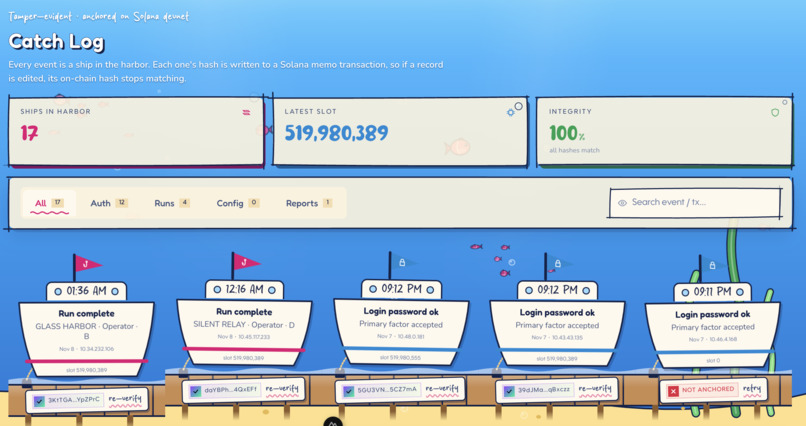
the audit log
-
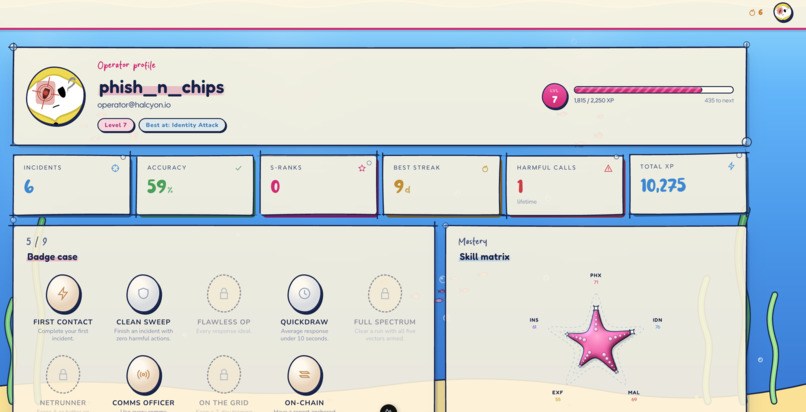
the profile


Inspiration
Scammers don't break into T-Mobile with code. They break in through people: the employee who handles a SIM-swap request, clicks a smishing link, or approves a vendor request that "looks" routine. Most training is a slide deck with a static quiz. We wanted to create a place where employees can practice against realistic attacks, make mistakes safely, and learn how to avoid them.
What it does
Poysson is a game-style training platform covering five attack types: ransomware, SIM-swap fraud, smishing, phishing, and insider/vendor leaks. Each one is broken into staged steps (before, during, and after) across channels like SMS, email, chat, social, and web.
| Mode | What it does |
|---|---|
| Practice | Assigned simulations, practice questions, and guides |
| Arena (Deep Waters) | Free play against a live AI attacker that adapts to what you do. In a mock environment, the attacker can act as the employee, using forwarding rules, MFA devices, SIM changes, and file encryption. Players can undo these changes and see how an attack unfolds. |
| Admin | Admins create and assign scenarios, including AI-drafted scenarios for review |
Every judgment of a player's action gets a confidence score and is labeled as coming from a rule or the model, so the feedback is honest about how sure it is. After each action, the matching guide section appears as in-the-moment help, and each round ends with an AI-written debrief.
Poyo focuses on education and response, not scam detection. It teaches people what to do when an attack reaches them.
How we built it
- Frontend & server: a Nuxt app with a cartoon sea interface and T-Mobile magenta highlights. The Arena, AI calls, and Solana integration run in the Nuxt server.
- NVIDIA Nemotron plays the attacker each turn and drafts scenarios for admins.
- SpacetimeDB holds the core backend: login and 2FA, roles, scenarios, runs, chat, scoring, stats, guides, and practice questions.
- Solana gives us a tamper-evident audit log and non-transferable badges.
- Gemini writes debriefs and powers runbook search.
- Vultr hosts everything.
Privacy by design: only hashes go on-chain, the answer key never reaches the browser, and the company, domains, and IP addresses in scenarios are fictional. Passwords use PBKDF2 (Password-Based Key Derivation Function 2), 2FA uses authenticator codes, and drill texts only go to consenting numbers (labeled as drills).
Methodology
Architecture
                 Browser (Nuxt / Vue 3 app)
                            |
                            v
+----------------------------------------------------------+
|             Nuxt server (Vultr, behind Caddy)            |
|  - Arena (Deep Waters)  - AI calls  - Solana client      |
+-------+-------------------+-------------------+----------+
        |                   |                   |
        v                   v                   v
 NVIDIA Nemotron      Gemini API            Solana
 attacker, judge,     debriefs +            audit memos +
 scenario drafts      runbook embeddings    badge tokens
        |
        v
 SpacetimeDB (self-hosted on Vultr)
 login + 2FA, roles, scenarios, runs, chat, scoring,
 stats, guides, practice questions
1. Nemotron attacker agent (adversary.ts)
- Each turn it sends up to 2 messages and, once it has access to an account, up to 2 tool actions:
add_forwarding_rule,send_mail_as_you,add_mfa_device,change_customer,encrypt_files,export_customers. - It plans across turns, escalates in stages, switches channels, and ends the round itself.
- Its JSON output is validated against a schema. A failed validation is retried once with the error, and scripted moves take over if the model fails.
- A cleanup layer swaps real company and domain names for fictional ones, and we prompt in plain language instead of raw JSON.
- It also judges free-text replies and drafts scenarios (
generate-scenario). - We turned Nemotron’s reasoning mode off for per-turn moves (a real-time game needs speed) and put the strategy into the system instead: playbooks, guardrails and validation.
2. Hybrid judging
Rules handle the clear cases and the model handles the rest. Each judgment carries a confidence score and a rule-or-model label.
3. Gemini debrief and runbook RAG
- Debriefs use a fallback chain: Gemini, then Nemotron, then a plain template, with a 10-second cap per model.
- Runbook RAG searches 24 synthetic sections using keyword search and Gemini embeddings combines both rankings to pick the best guide.
4. SpacetimeDB backend
- Login and 2FA (PBKDF2, RFC 6238 authenticator codes, replay blocked), roles, scenarios, runs, chat, scoring, stats, guides, and practice questions.
- Every table is private and clients read through views.
- The module and app share one set of zod types, and the module rejects anything that doesn't match.
5. Solana
- Every audit event gets a memo transaction holding its hash. Re-verify re-hashes the record and checks the chain.
- Earning a badge mints a non-transferable token, one per badge, with the name stored on-chain.
- Writes are serialized through a queue to stay within devnet rate limits.
6. Vultr deployment
- One Ubuntu 24.04 server in Atlanta runs SpacetimeDB, the Nuxt app, and the test client behind Caddy with automatic HTTPS.
- Only the two SpacetimeDB endpoints browsers need are public, and every other
/v1/path returns 404. - Publishing goes over SSH, servers are provisioned with cloud-init, and deploys are single scripts in
deploy/vultr/.
7. Design
A cartoon sea in T-Mobile magenta with hand-drawn, organic features. The interface is fish-themed: cast animation, a harbor-style Catch Log, spinning badges, a starfish skill chart, and fish that react on hover. A "Let's go phishing" intro plays the first time you reach the login page. Usability features include a collapsible sidebar and profile menu, plain-language guided or unguided modes, and reduced-motion support.
Challenges we ran into
- Keeping LLM output on track. As the attacker, the LLM struggled to avoid real company names and leaked spoilers to questions in its answers. We fixed this with a cleanup layer that swaps domain names and carriers for fictional ones, and by replacing the JSON input we gave the models with plain language.
- Depending on external AI APIs. Any hosted model can fail mid-demo: overloads, timeouts, renamed or retired endpoints. We hit several of these over the weekend, mostly on the Gemini side (model aliases that 404 on the default API version, 503 overloads, and requests rejected for deadlines under 10 seconds). An embedding endpoint we’d planned to use had also been retired, which is normal model lifecycle. So we designed for failure: every AI feature has a fallback (Gemini → Nemotron → a template for the debrief; a scripted attacker if a Nemotron move fails validation), and we tested each one against a fake server that reproduces those errors. A round always finishes.
- Solana devnet rate limits. Parallel writes triggered 429 errors that kept crashing the server. We fixed it by serializing and queuing them.
Accomplishments that we're proud of
- A live Arena where the attacker plans across turns, escalates in stages, and decides when to end the round
- An adaptable attacker that switches channels and presses the advantage when you slip: give it your password and it signs in, adds a mail rule and SIM-swaps a customer.
- Both preventative and incident-response loops
- Audit logging we tested live, including tamper detection
- A full design identity: fish-themed interface, harbor-style Catch Log, spinning badges, a starfish skill chart, and a "Let's go phishing" intro
- Hundreds of automated tests using NVIDIA and Gemini on a fake server to reproduce outages
Results
We tested the parts we're making claims about:
| Area | Result |
|---|---|
| Audit log | Events are hashed and recorded on Solana, and re-verify caught tampered records |
| Badges | Minting works, duplicates are blocked, and transfers are refused |
| Resilience | Hundreds of automated tests reproduced AI outages, and the fallback chain (schema retry, scripted attacker moves, Gemini to Nemotron to template debriefs) kept rounds finishing |
| Deployment | Live at https://poysson.fishing, with only the two required SpacetimeDB endpoints public |
What we learned
- The nuances of prompting different LLMs and which kinds of input work best for each
- Incident response has a specific order that matters, because the wrong sequence lets attackers exploit simple weaknesses
- Making AI dependable takes more work than prompting: schemas, retries, fallbacks, and honesty about confidence
What's next for Poysson
- Move audit events and badge claims into SpacetimeDB and mint only from there
- Move the Arena onto SpacetimeDB
- Personalized training from a player's weak spots
- An attacker that remembers you and your information, reusing tricks you've already fallen for or your old data if you haven't changed it
- More real-world patterns pulled from FBI, CISA, and FCC advisories
- Voice scam calls instead of the occasional transcript
Built With
- gemini
- nemotron
- nuxt
- nvidia
- solana
- spacetimedb
- typescript
- vue
- vultr
- zod


