-
-

Main Page
-
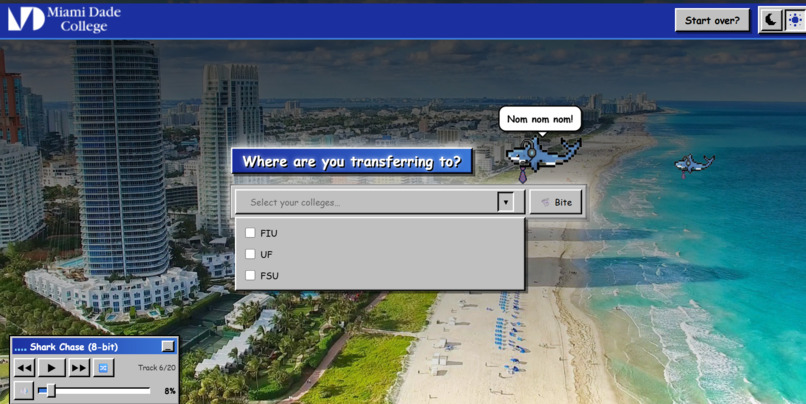
Sample Questions
-
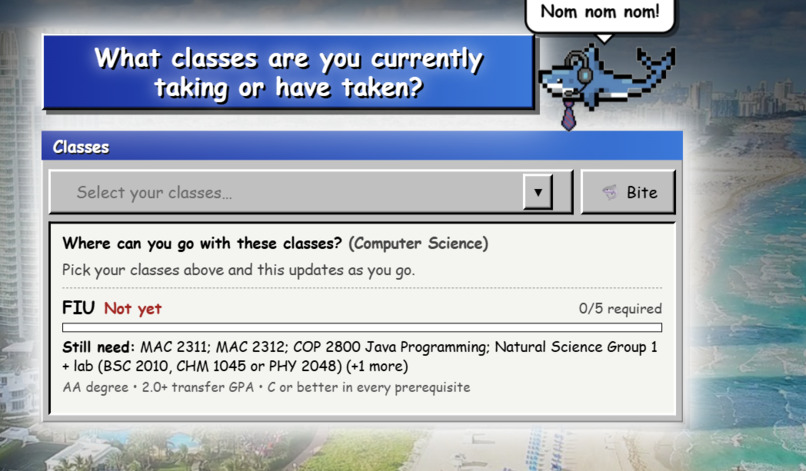
Recommendation from AI


Every semester, thousands of Miami Dade College students face the ultimate academic boss battle: trying to transfer to top universities like UF, FSU, FIU, or MIT without losing their minds or getting delayed by a single prerequisite. Degree audit systems are rigid, outdated, and leave students stranded when a critical class like Calculus or Physics fills up.
Enter Hack Your Path—an AI-powered academic and career pathway planning platform built to automate the chaos.
While our multi-agent Swarms system analyzes university transfer requirements, our core backend engine—powered by the Google Gemini API (gemini-2.5-flash)—acts as the ultimate intelligent advisor. It takes a student’s profile, work schedule, home campus preferences, and transfer goals, and instantly builds a fully optimized, semester-by-semester academic roadmap.
Unlike standard AI tools that hallucinate fake classes, Hack Your Path is engineered for reliability. We use deterministic code validation to lock down hard constraints—checking credit caps, prerequisites, and work-schedule time overlaps in pure logic before the AI ever steps in. Furthermore, the engine is wired directly into a compiled dataset of verified MDC course schedules (Spring and Summer 2027), ensuring every recommended lecture and lab is 100% real.
What inspired us Transferring from a community college to a top-tier university is a high-stakes puzzle. For Miami Dade College students aiming for schools like UF, FSU, or MIT, a single missing prerequisite or a scheduling conflict can derail their graduation timeline by an entire year. Existing degree audit systems are rigid and offer zero guidance when a critical class—like Calculus II or Physics—is full. We were inspired to build Hack Your Pathway to automate this chaos, creating an intelligent, hyper-personalized academic advisor that navigates bottlenecks, work schedules, and campus preferences in seconds.
How we built it We architected a hybrid system combining multi-agent analysis with strict deterministic logic and generative AI.
Requirements Analysis: We utilized a Swarms multi-agent system to analyze specific transfer requirements for our target universities.
The Core Engine: We built the backend scheduling engine in Node.js. Instead of letting an LLM blindly guess, we compiled real MDC course schedule datasets (Spring and Summer 2027) into a unified JSON catalog.
Deterministic Validation: Before the AI takes over, pure JavaScript functions execute hard constraint checks—verifying prerequisites, maximum credit limits, and time overlaps with the student's work schedule.
AI Orchestration: We integrated the official Google GenAI SDK (gemini-2.5-flash). Gemini receives the mathematically validated list of available courses and uses complex reasoning to build a conflict-free, semester-by-semester roadmap, complete with a "What-If Simulator" to dynamically recalculate paths if a class fills up.
Challenges we faced Our biggest hurdle was preventing AI hallucinations. In early testing, generative models naturally wanted to invent fake course sections or ignore physical time constraints to make a schedule look perfect. We had to heavily engineer the pipeline to force Gemini to act only as the "reasoning engine" on top of a strictly validated, hard-coded pool of available JSON sections. Additionally, structuring massive amounts of MDC course data across Biology, Math, Physics, and English into a unified JavaScript catalog within a 24-hour hackathon time limit required intense coordination and rapid data formatting.
What we learned We learned that the most powerful AI applications don't rely entirely on the model to do everything; they combine deterministic constraints with generative reasoning. We mastered forcing strict JSON schema outputs from the Gemini API to ensure our frontend and Swarms agents could communicate seamlessly with the scheduler. Most importantly, we learned how to build a scalable architecture that handles dynamic user variables—like sudden changes in work availability or campus preferences—without breaking the entire application flow.

