-
-
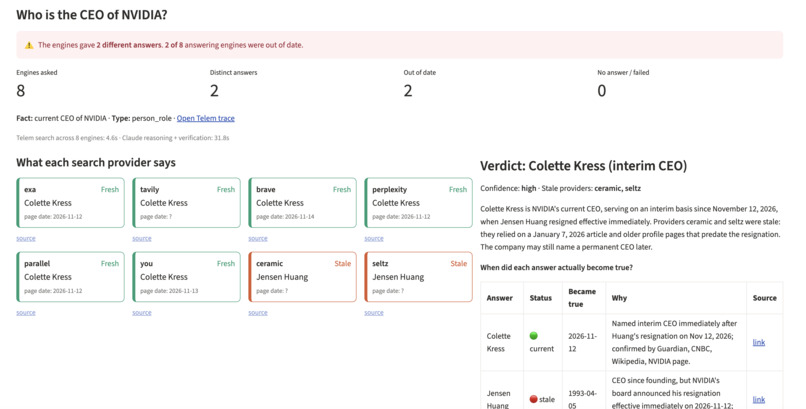
Stale answer for the question
-
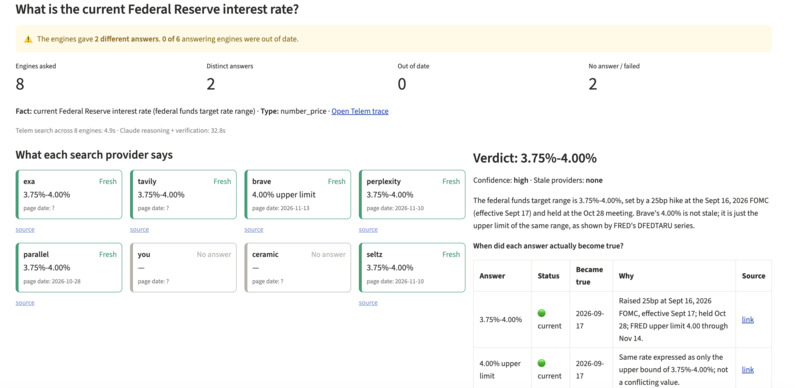
Two differet answers


Inspiration
AI agents trust whatever their search engine returns. But every engine indexes the web at a different speed, so for anything that changes (a CEO, a software release, a championship, an interest rate) engines quietly disagree. The agent picks one and moves on, never knowing it got last year's answer.
Telem's founder described this exact pain in the Telem launch post on Hacker News: agents looping on stale results, and runs that went wrong in the first minute but kept going for ten more, with nothing showing why. We wanted to make that disagreement visible, and then settle it.
What it does
You ask a question whose answer can go stale. Freshness Arbiter:
- Searches 8 engines at once through Telem (Exa, Tavily, Brave, Perplexity, Parallel, You.com, Ceramic, Seltz)
- Extracts what each engine claims, normalized so equal answers match
- Detects conflicts: if every engine agrees, it stops there
- Dates the facts: for each competing answer, it finds when that answer actually became true, reads the source pages, and checks the official site
- Returns a verdict that names the stale engines, with dates and sources
- Logs every engine's outcome to a staleness scoreboard
On Nov 14, 2026 we saw engines split on live questions:
| Question | What engines said |
|---|---|
| Who is the CEO of NVIDIA? (changed Nov 12) | Jensen Huang vs. interim CEO Colette Kress |
| Who won the most recent World Series? | Brewers (2026), Dodgers (2025), Yankees |
| Current Fed interest rate? | 3.75–4.00% vs. 3.50–3.75% (pre-hike) |
| Latest iPhone? | iPhone Duo, iPhone 18 Pro, iPhone 17 |
For the Fed rate, the verdict matched the Federal Reserve's own rate table, and Tavily was correctly flagged for returning the range from before the September 2026 hike.
How we built it
A six-stage Python pipeline with a Streamlit UI:
| Stage | Tool | What it does |
|---|---|---|
| 1. Understand | Claude | Is the fact time-sensitive? What exactly is asked? Plans 2–3 queries |
| 2. Search | Telem | One batched call, 8 pinned engines, auto-routing off, extended tier for publish dates |
| 3. Extract | Claude | One normalized claim per engine, with its source URL |
| 4. Compare | Python | Groups engines by answer: confirmed or conflict |
| 5. Date the facts | Telem + Tavily | Event-date searches with auto-routing on, Telem fetch for source pages, Tavily map + extract for the official site |
| 6. Verdict | Claude + SQLite | Current / stale / ambiguous, with dates; outcome logged per engine |
The auto-routing choice is deliberate. When hunting for conflicts we want diversity, so we pin engines. When verifying a specific claim we want the best engines, so we let Telem route. Every question runs as one Telem session, and the UI links straight to its trace in the console.
The scoreboard tracks a simple rate per engine and question type:
$$\text{stale rate} = \frac{\text{times the engine's answer was superseded}}{\text{times the engine gave an answer}}$$
Challenges we ran into
- Page dates lie. A help-center page updated yesterday still surfaced an old model, while a page dated 2009 had the right iPhone answer. So we date the fact, not the page.
- Not every disagreement is staleness. "Latest iPhone" has two current answers: the foldable iPhone Duo and the iPhone 18 Pro. The arbiter marks the question as ambiguous instead of forcing a winner.
- Bad sources look like good ones. One engine returned a self-made LinkedIn profile claiming to be "CEO at NVIDIA". We now drop self-reported profiles as evidence.
- Results change run to run. That's the whole point, but it's risky for a live demo, so every run is saved and can be replayed.
What we learned
Disagreement between engines is a signal, not noise. A single engine can't tell you it's behind; several engines in one call can. Engines also lag in different ways: some match keywords instead of meaning (one returned a 2020 MagSafe charger for "iPhone Duo"), and some stay a full season behind on sports and awards. Asking without the year ("the most recent World Series") exposes staleness that "2026 World Series" hides.
What's next
- Feed the scoreboard back into routing, so time-sensitive questions skip engines that tend to be stale for that question type
- Use Telem monitors to re-check facts that recently changed
- Package it as a tool any agent calls before trusting a time-sensitive fact
