-
-
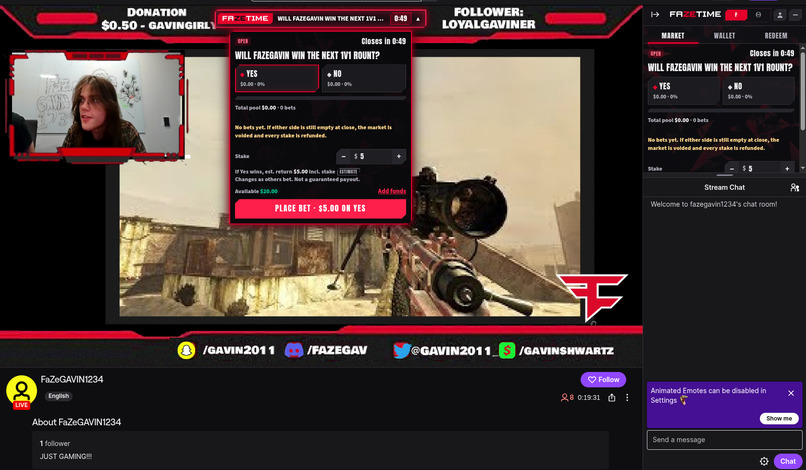
place a bet on a live action!
-
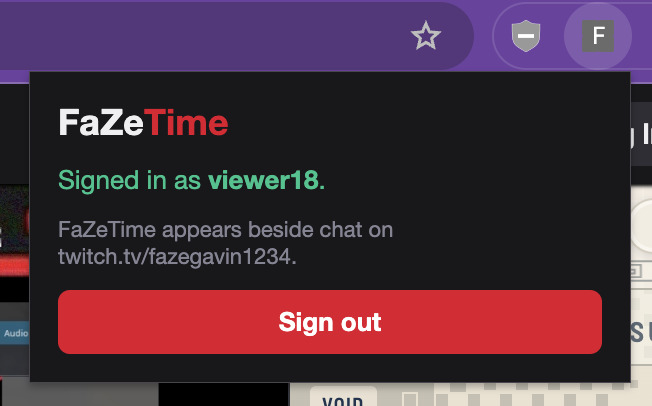
chrome extension
-
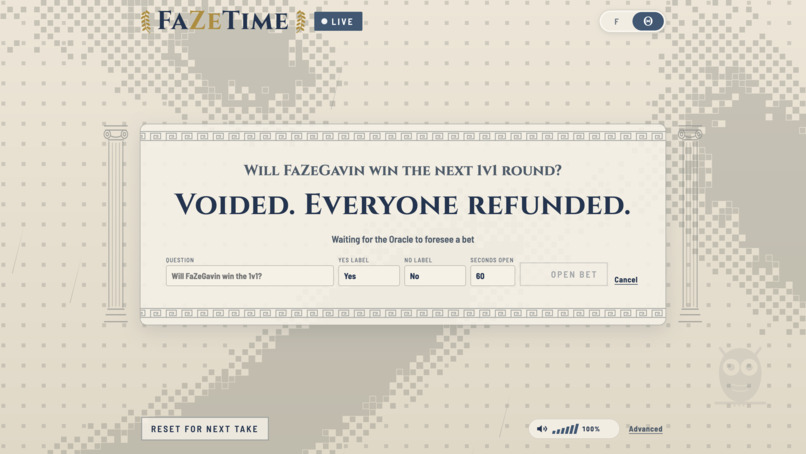
admin panel (odyssey themed version)
-
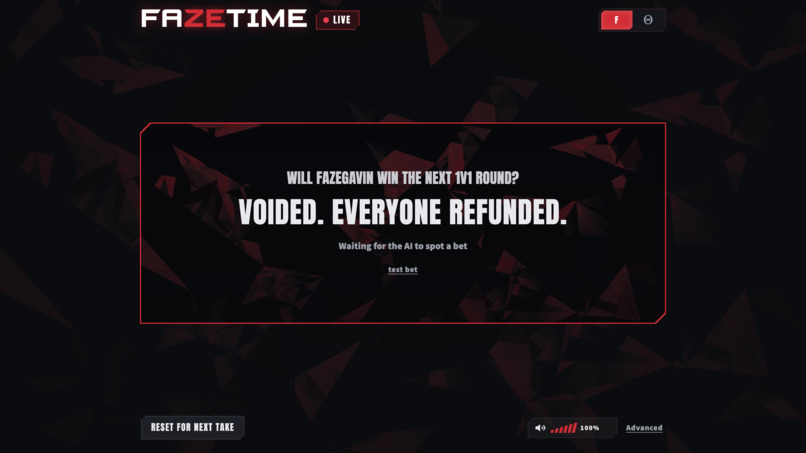
admin panel (FaZe version)
-
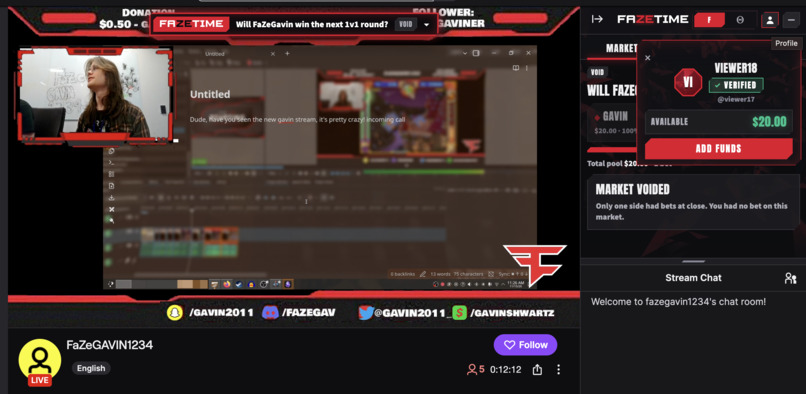
sidebar look + profile
-
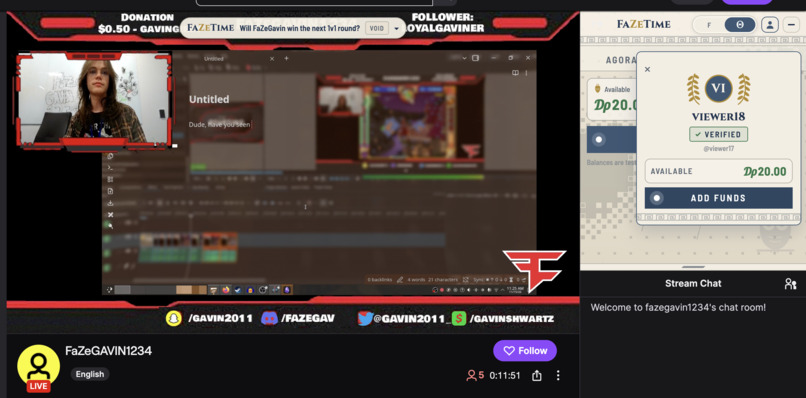
sidebar look + profile
-
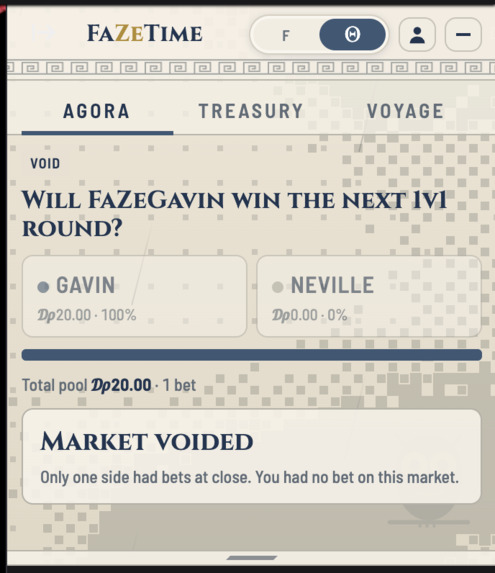
agora (marketplace) -- where you can make bets
-
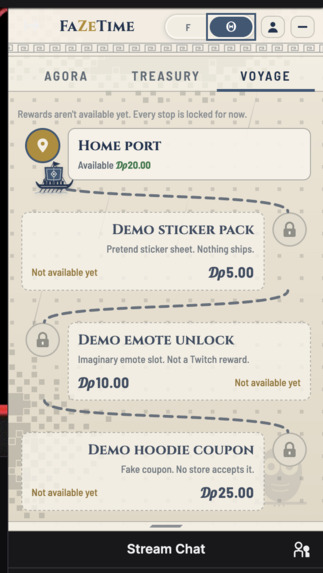
voyage (with more money you can unlock more items)


Inspiration
After twenty years away, Odysseus finally washes up on the shore of Ithaca. Home doesn't look like home anymore. Strangers fill his halls, his son has grown up without him, and nobody recognizes the man in rags. Then his old dog Argos, who has waited all those years, lifts his head, knows him instantly, and wags his tail one last time. Home was still there. It just needed a way to let him back in.
A lot of us have our own Ithaca. We grew up on FaZe: staying up too late to watch trickshot montages, replaying the same clip with friends, quoting it at lunch the next day. Then life happened. School, jobs, new games. Somewhere along the way we stopped tuning in. FaZe kept going without us, and when we come back now, it can feel like walking into a house where we don't know anyone.
We built FaZeTime for those fans. We didn't want to bring back the past. We wanted to give old fans a reason to come home and something to do once they're there. Instead of watching alone in silence, you call the next play with everyone else in chat, put something on the line with your friends, and FaceTime a bookie to talk through the odds. The stream starts to feel like the group chat you used to have about it.
Behind it is an AI that watches the stream the way a fan does, catching the moments worth calling and settling them fairly, with a person approving every step. Our goal is simple: when an old fan opens a FaZe stream again, it should feel like Argos lifting his head. You were gone for a while, and you still belong here.
What it does
FaZeTime is a Chrome extension that turns watching a single Twitch stream into a shared prediction game. An AI watches the live broadcast and proposes yes/no bets about what's about to happen, such as "Will the streamer clear this level?" An operator approves each bet, viewers stake test credits in a panel above Twitch chat, and the AI reads the outcome from the stream and settles the pool.
| Feature | What it does |
|---|---|
| AI-proposed bets | An AI watches and listens to the stream and turns key moments into yes/no bets with clear rules and a fair betting window |
| Operator console | Each proposed bet and each AI result needs operator approval before it goes live or pays out |
| Extension panel | Sits above Twitch chat with Market, Wallet and Redeem tabs, plus an over-video pill showing the open bet |
| Shared pool | Winners split the pool by stake, with no platform fee |
| Chris, the AI bookie | A sock-puppet bookie on a real FaceTime line who quotes odds and places bets by voice |
| Test credits | Top-ups go through Stripe Checkout in test mode. No real money moves. |
FaZeTime runs as supervised AI: the AI proposes and settles, and a person approves every step.
How we built it
| Piece | Role |
|---|---|
| WXT extension (MV3, TypeScript + React) | The panel above Twitch chat, the over-video pill and both themes |
| Vite console (TypeScript + React) | The operator console for approving bets and results |
| FastAPI + SQLite (on Vultr) | Backend API for every balance, deadline, ledger entry and payout |
| Raspberry Pi worker | Pulls the Twitch stream with Streamlink and FFmpeg, samples frames, sends audio for transcription |
| Vultr VM | Hosts the stream audio processing (distil-small.en transcription) and the backend API |
| Gemini Flash-Lite | The game-agnostic observer that tracks rounds and levels, and reads outcomes |
| LiveKit Agents + LiveKit Inference | Chris's realtime voice and animated puppet video |
| Chert | The real FaceTime line Chris answers |
| Stripe (test mode) | Credit top-ups through Checkout |
| Tailscale | Private network connecting the Pi and the Vultr VM |
Safe by design: everything uses test credits, and the extension never handles card details. Balances are stored as integer cents in an append-only ledger, and every operation is idempotent, so retries never charge twice. Unclear outcomes are voided and refunded instead of guessed. Chris only places a bet after reading it back and hearing a clear yes.
Methodology
Architecture
   Twitch stream                      Viewers
        |                                |
        v                                v
+-------------------+         +----------------------+
| Raspberry Pi      |         | Chrome extension     |
| Streamlink+FFmpeg |         | (WXT, React)         |
| frames + audio    |         | Market/Wallet/Redeem |
+---+-----------+---+         +----------+-----------+
    |           |                        |
    v           v                        v
 Vultr VM    faster-whisper     +--------------------+     Operator console
 distil-     (local fallback)   | FastAPI + SQLite   | <-- (Vite, React)
 small.en                       | (Vultr VM)         |     approve/reject
    |                           | ledger, markets,   |
    |                           | balances, payouts  |
    v                           +---+------------+---+
 Gemini Flash-Lite  ----------->    |            |
 observer, proposer,                v            v
 outcome reads              Stripe (test)   Chris: LiveKit Agents
                            top-ups         + Chert FaceTime line

        (Pi and Vultr VM connected over Tailscale)
1. Watching
- A worker on a Raspberry Pi pulls the real Twitch stream with Streamlink and FFmpeg and samples frames.
- Speech is transcribed by distil-small.en on a Vultr VM. If the VM can't be reached, a local faster-whisper model takes over.
2. Proposing
- A game-agnostic observer powered by Gemini Flash-Lite tracks rounds and levels from frames and transcripts.
- A template proposer turns key moments into bets with explicit YES/NO rules and a fair betting window.
3. Approving
- The operator console shows each proposed bet with a flip-clock countdown and Approve/Reject buttons.
- AI results also need approval before payout, so the system runs as supervised AI rather than fully automatic.
4. Betting
- Viewers stake from the extension panel, and the FastAPI + SQLite backend owns every balance, deadline and payout.
- An append-only ledger uses integer cents and idempotent operations, so retries never charge twice.
- Payouts come from a shared pool with no platform fee.
5. Resolving
- Two independent AI reads of the outcome are compared in code.
- If they disagree or the evidence is unclear, the market is voided and every stake refunded rather than given a guessed winner.
6. Calling the bookie
- Chris runs on LiveKit Agents with a realtime voice model behind a Chert FaceTime line, with animated sock-puppet video.
- Chris quotes estimated returns and places bets through the same backend as the panel.
- A bet only goes through after Chris reads it back and the caller clearly says yes.
7. Paying
- Top-ups go through Stripe Checkout in test mode.
- No real money moves, and the extension never handles card details.
8. Design
The panel has Market, Wallet and Redeem tabs, a profile card with Verified status, balance and Add funds, and an over-video pill showing the open bet. Two themes can be switched in both the panel and the console:
- F (FaZe): black and FaZe red with cut corners and a diamond-shard texture, in FaZed Sans, Anton and Source Sans. Redeem is a shooting range where you fire at the rewards you can afford.
- Θ (Odyssey): a parchment and navy sea chart based on the HackUTA '26 visual identity. A drifting pixel storm with rain and lightning runs in the background, with Greek-key borders and Cinzel titles. Redeem is a voyage map: a ship sails toward the next reward, and locked stops show a padlock.
Our tracks
FaZe Clan
- FaZeTime is built for FaZe's audience: the FaZe theme uses FaZe black and red, FaZed Sans, and a shooting-range Redeem.
- It turns passive viewing into a shared game, giving fans a reason to stay through a stream and come back for the next one.
- Planned next: a cumulative-wager raffle for a real FaceTime with a FaZe member.
Best Use of Vultr
Vultr runs the two parts of FaZeTime that have to be fast and always available: the stream audio processing that feeds bet proposals, and the backend API that owns every balance and payout.
- Low latency: a bet is only fair if it opens before the moment happens. Transcribing stream audio with distil-small.en on a Vultr VM keeps the time between something being said on stream and a bet being proposed short.
- High reliability: the backend API on Vultr is the single source of truth for the panel, the operator console and Chris's phone bets, so balances always match across every channel. If the transcription service can't be reached, a local faster-whisper fallback on the Pi keeps bets flowing.
- High scalability: the heavy work runs on Vultr rather than on viewers' machines, so more viewers only add API calls, not more processing. More streams can be handled by adding Vultr VMs on the same Tailscale network.
Best Use of Gemini API
Gemini Flash-Lite is the AI that watches the stream and decides what to bet on.
- Video parsing: a game-agnostic observer reads sampled frames and transcripts to track rounds and levels, so it works on any game without per-game code.
- Betting proposals: key moments the observer detects become yes/no bets with explicit YES/NO rules and a fair betting window.
- Outcome reads: two independent Gemini reads of each result are compared in code, and disagreements are voided and refunded.
- Why Flash-Lite: it's fast and cheap enough to run on a live stream continuously, which is what live betting needs.
Chert
- Chris, our sock-puppet AI bookie, answers a real Chert FaceTime line.
- Callers hear the odds, get estimated returns and place bets by voice. Every bet goes through the same backend as the panel, and only after Chris reads it back and hears a clear yes.
- This turns a voice call into a full betting channel instead of a demo add-on.
General track
- Robustness: an append-only ledger in integer cents with idempotent operations, two independent AI outcome reads, void-and-refund on unclear evidence, a local transcription fallback, and operator approval at every AI step.
- Theme (Homer's Odyssey): the Odyssey is a story about coming home, and so is FaZeTime. Like Odysseus returning to an Ithaca that had moved on without him, longtime FaZe fans who drifted away come back to streams that feel unfamiliar. FaZeTime gives them a way back in: something to do, people to do it with, and a reason to stay. The Odyssey theme makes that journey visible. The panel becomes a sea chart under a drifting storm, framed with Greek-key borders, and Redeem is a voyage map where a ship sails toward each reward, the way Odysseus sailed toward home.
- Creativity: FaZeTime is a Chrome extension, so it works on Twitch as it is. Viewers don't need a new app, a new site or a new account flow. The panel slides in above Twitch chat, and an over-video pill shows the open bet without covering the stream. Inside that extension, an AI watches any game and writes its own bets, and a sock-puppet bookie answers a real FaceTime line to take bets by voice. Watching, betting and calling all happen around the stream fans already know, instead of pulling them somewhere else.
Novelty
- An AI that watches the stream like a viewer. It sees and hears the broadcast, works with any game, and finds the moments worth betting on.
- Supervised, not blind. The AI proposes and settles, and a person approves both steps.
- Two reads before a payout. Outcomes are checked twice independently, and disagreements end in a refund, not a guess.
- A bookie you can FaceTime. Chris takes bets by voice on a real FaceTime line, with a read-back before any bet goes through.
- One backend for every channel. The panel and the phone call place bets through the same ledger, so balances always match.
- No house edge. Pools pay out with no platform fee.
Challenges we ran into
- Making the AI work for any game. Rather than building per-game logic, we made the observer track generic rounds and levels and let a template proposer turn them into bets with clear rules.
- Knowing when the AI is wrong. One outcome read wasn't trustworthy enough to pay out on, so we added a second independent read, a code comparison, and void-and-refund when they disagree.
- Keeping transcription available. The transcription service runs on a separate VM, so we added a local faster-whisper fallback on the Pi.
- Making voice betting safe. Speech is easy to mishear, so Chris reads every bet back and only places it after a clear yes.
- Never charging twice. Retries across the panel, phone and backend could double-charge, so every ledger operation is idempotent and stored in integer cents.
Accomplishments that we're proud of
- An AI bet on a public Twitch stream that was proposed, approved, staked and settled correctly
- Chris answering real FaceTime calls as an animated sock-puppet bookie
- Phone betting that passed end-to-end tests and is deployed
- A ledger where every payout traces back to the pool and nothing charges twice
- Two complete visual themes, including a shooting-range Redeem and a voyage-map Redeem
Results
| Area | Result |
|---|---|
| AI bets | On a public Twitch stream, an AI bet was proposed, approved, staked and settled correctly |
| Phone calls | Chris has answered real FaceTime calls |
| Phone betting | Passed end-to-end tests and is deployed |
| Money | Everything uses test credits through Stripe test mode. No real money moves. |
| Not finished | The end-to-end run on our own team channel and the cumulative-wager raffle |
What we learned
- AI is most useful when it proposes and a person decides, especially when money is involved
- Comparing two independent reads is a simple, strong check on model output
- Voice interfaces need confirmation steps that text interfaces can skip
- A single backend that owns every balance keeps multiple channels in sync
What's next for FaZeTime
- Finish the end-to-end run on our own team channel
- Build the cumulative-wager raffle for a FaceTime with a FaZe member
- Support multiple streams at once
- Let trusted AI bets go live faster, with operator review for the rest
Built With
- chert
- fastapi
- livekit
- python
- raspberry-pi
- react
- stripe
- tailscale
- tigerdata
- typescript
- vultr


