-
-
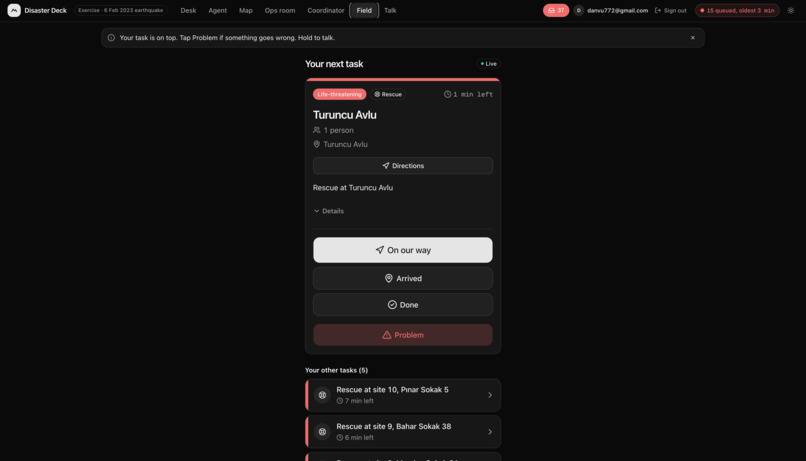
Field
-
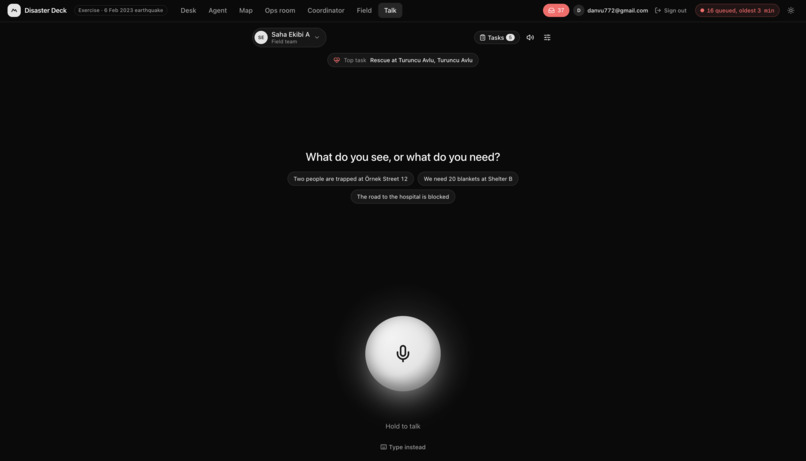
Talk
-
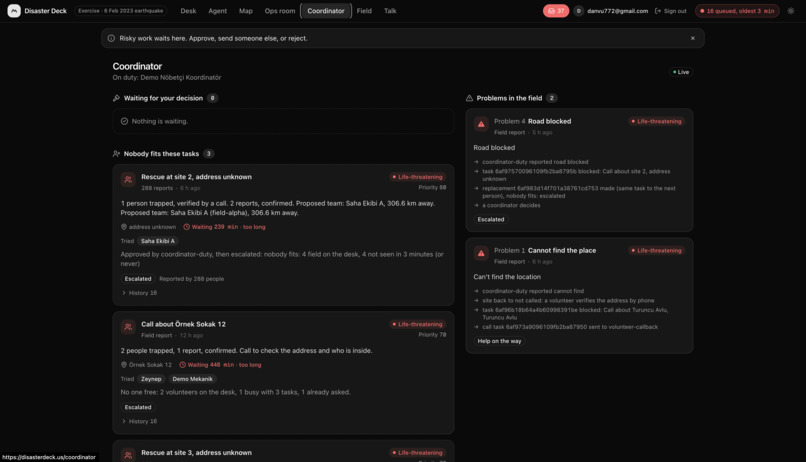
Coordinator
-
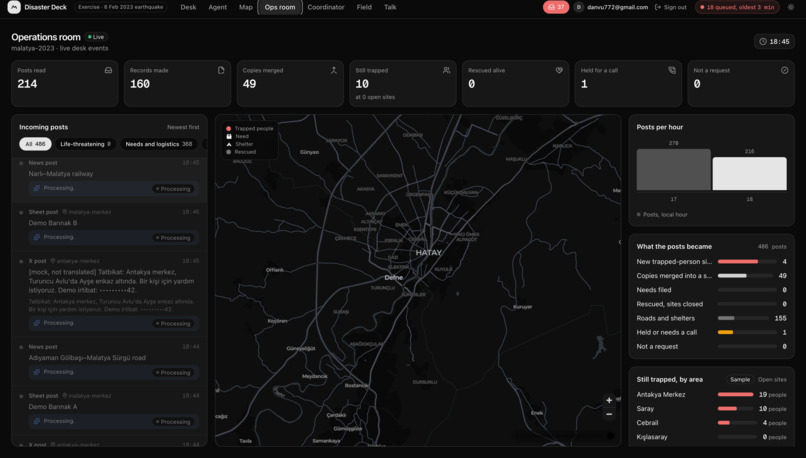
ops room
-
Agent
-
Desk
-
Map
-
Agent 2


Inspiration
After the 6 February 2023 earthquakes in Türkiye, people posted addresses of relatives trapped under rubble on Twitter. Volunteers copied those posts into Google Sheets and Discord. Rescue teams, logistics and shelters each worked in their own channel. Everyone was helping, but nobody could see what the others had already done. One area got ten calls for the same person while another area got nobody.
Lahaina had the same gap in August 2023. The Fire Safety Research Institute report for the Hawaii attorney general (September 2024) found that more than 60% of the 102 people who died had tried to flee, and many were found in or around their cars. Shelters tracked capacity on whiteboards. A photo of a whiteboard posted to Instagram was about two hours old by the time people read it, so people were turned away from full shelters.
The groups collected plenty of information. It got lost each time it moved from one group to another.
What it does
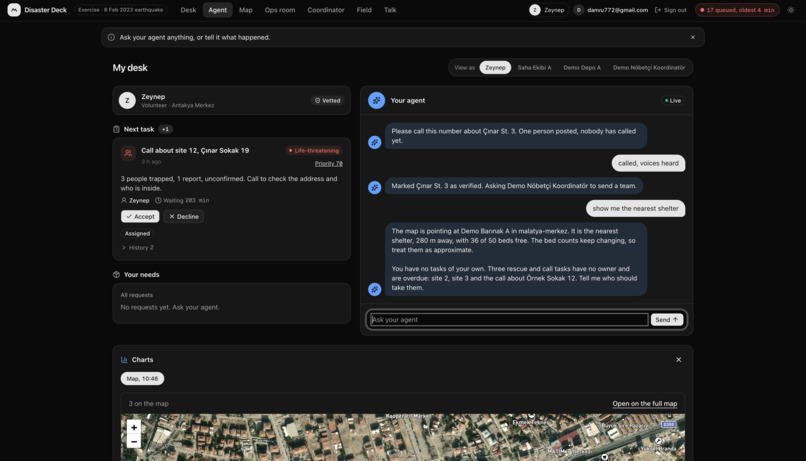
Volunteers, field teams, suppliers, shelters and the coordinator each talk to their own AI agent. Each agent turns what its person says into structured events and writes them to one shared memory in MongoDB. Agents never talk to each other, so an error in one agent does not pass into the others.
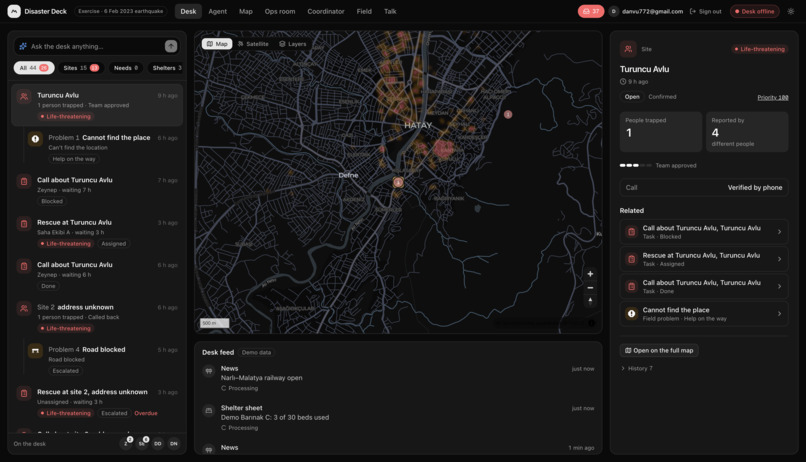
Rules decide the priority, the routing and the approvals. A rule-based Brain keeps the memory clean, ranks the work by danger and age, and sends each new fact to the person who should act. No model decides who gets sent where. Models turn messy input into events, and the rules do the deciding.
The agent recommends and a human decides. A coordinator approves every high-risk assignment.
The pilot is Antakya, February 2023. The people, shelters and supply trucks in the rehearsal are synthetic. The archived social posts, satellite imagery, NASA measurements and reference building outlines are real historical data.
How we built it
- Brain: one loop with three steps. The memory keeper applies each event to the records. The dispatcher creates or reassigns tasks and writes inbox notices. The sweeper handles deadlines and reassignment. The Brain holds a lease in MongoDB, so only one Brain runs per database.
- Dispatcher rules: a task goes only to someone with the right role who is online, ranked by distance and stock. There is one open task per record and task type, so replaying an event creates nothing new.
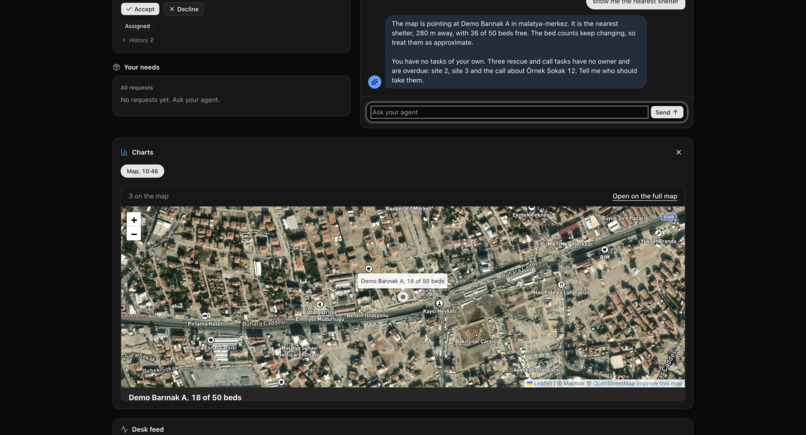
- Personal agents: one per role. Agents read the desk and post events. They never write records. Each tool call posts one event.
- Voice:
/talkis hold-to-talk. The agent answers in plain speech and asks "Send this to the desk?" before it files anything./fielduses the phone's own speech recognition, so no audio leaves the phone. - X agent: Claude reads archived posts about rubble, needs and road closures, and writes an English translation next to each one. Phone numbers are masked in code before any model sees them.
- News agent: Claude web search for a region. Every item links to a URL the search returned.
- Quake watcher: replays the USGS aftershock sequence from February 2023, or polls AFAD and USGS live. Personal agents put a nearby aftershock in the first line of their next reply. No LLM.
- Sheet sync: syncs the volunteers' shelter sheet with the desk in both directions. A row a person edited in the last 5 minutes is never overwritten. The desk's number goes into a note and the person decides. No LLM.
- Satellite watcher: reads NASA POWER minimum temperatures and flags cold nights.
- Scenario player: five steps: blankets, a shelter filling up, a road closure, a truck breakdown, the truck repaired.
- Shift handoff: Claude Opus writes a summary for whoever takes over the shift.
- Login: SSOJet over OIDC through Auth.js. SSOJet says who you are, and our database says what you may do.
- Deploy: every push to
proddeploys to a Vultr VM. The web app and the Brain run there as systemd services, behind disasterdeck.us. - Stack: Next.js 15, React 19, TypeScript, Tailwind CSS, MongoDB Atlas, Leaflet, Zod, Auth.js and the Anthropic API (Claude Sonnet and Opus).
NASA data
- Black Marble VNP46A2 night lights, 3 January and 8 February 2023. About 500 m per pixel. Numeric radiance with all quality flags kept.
- NASA POWER, MERRA-2 daily weather at 36.194 N, 36.157 E for 6 to 10 February. About 50 km grid. The minimum was −1.05 °C on 9 February and −3.11 °C on 10 February.
- ARIA Damage Proxy Map, Sentinel-1. About 30 m per pixel.
What the data can and cannot say. We kept only clear, good-quality night pixels and never treated a missing value as zero light. That left 92 pixel pairs with a usable before and after. 56 of them are at least 40% darker. That is 56 pixels out of the 92 we could use, not 56 buildings and not a share of the city. The 40% threshold is our screening choice. One January baseline cannot separate a power outage from every other reason a pixel goes dark. NASA's own Antakya write-up describes regional light loss from 4 to 8 February, and we treat it as context, not input.
The damage proxy shows surface change, not single buildings, and it is weaker over vegetation and terrain. We kept the zone damage, dark and silent-zone fields empty instead of guessing them. Satellite data only raises priority. It never removes a call from the queue. The watcher gives two cold alerts and zero silent-zone alerts.
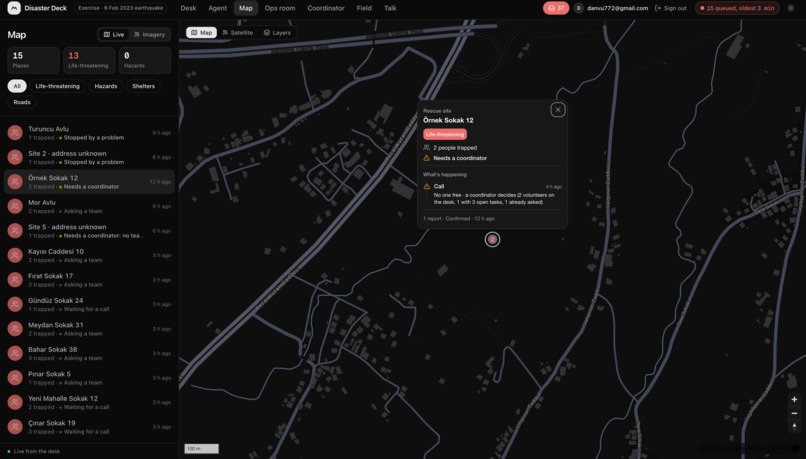
The map also shows before/after imagery from 22 December 2022 and 11 February 2023, at about 0.5 m, and 743 destroyed-building outlines from HOT/OpenStreetMap. Those outlines are an outside reference. We have no damage classifier, and a building without an outline is not declared safe.
Supported by the Michigan Space Grant Consortium, NASA grant 80NSSC20M0124.
Challenges
The satellite data is weaker than the story we wanted to tell. We kept unknown values as unknown instead of filling them in. We also kept the models out of the decisions. The rules decide, and the models only turn messy input into events.
Halfway through we moved the pilot from Malatya to Antakya, and every NASA number had to be regenerated. None of the Malatya values carry over.
Production first ran on an IPv6-only VM. Every MongoDB Atlas round trip took about 190 ms. Routing IPv4 through Cloudflare WARP brought that down to about 20 ms.
What works today
- The Brain loop, with the memory keeper handling all 11 event types, the dispatcher, the sweeper and inbox notices.
- Personal agents for six roles, role-gated, with voice on
/talkand dictation on/field. - The X agent replays 43 archived Antakya posts with translation.
- The News agent, with a live run that returned URLs.
- The quake watcher, sheet sync, scenario player and shift handoff.
- SSOJet login, with roles stored in our database.
- Map, board, coordinator, field, talk and ops room pages.
- Deployed at disasterdeck.us.
What is not built yet
The Brain marks an event done before the dispatcher acts on it. A crash in that gap can leave a finished event with no task. The full multi-person flow (callback, approval, delivery with an ETA) has not been run end to end on the deployed site. Quake alerts reach people through their personal agents, but not yet as desk events. There is no damage classifier. The Instagram and Facebook agents and the evacuation planner are not started.
What's next
Make each event safe to retry using a transaction or idempotent reconciliation. Run the full multi-person flow on production. Add quake alerts as desk events. Then the evacuation planner.
Built With
- anthropic
- auth.js
- claude
- leaflet.js
- mongodb
- nasa
- next.js
- opus
- power
- react
- sonnet
- tailwind
- typescript
- zod
