-
-
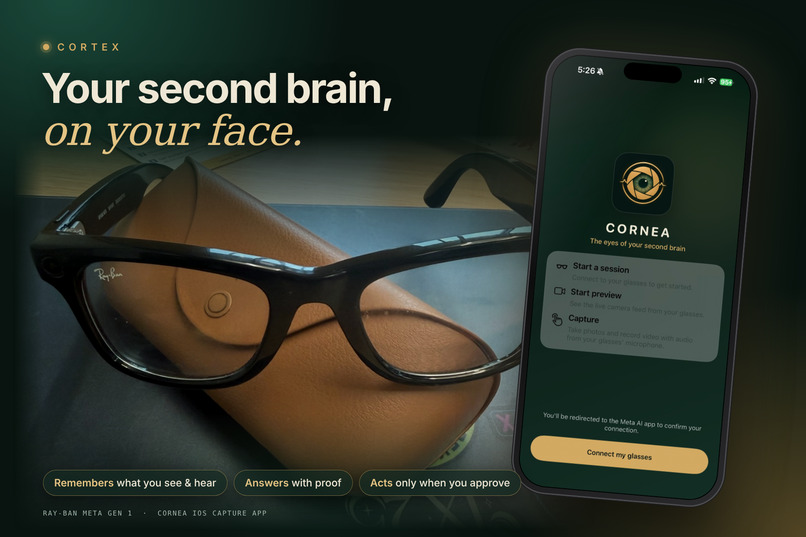
Cornea - A full companion iOS app that pairs your glasses and feeds everything they capture to Cortex.
-
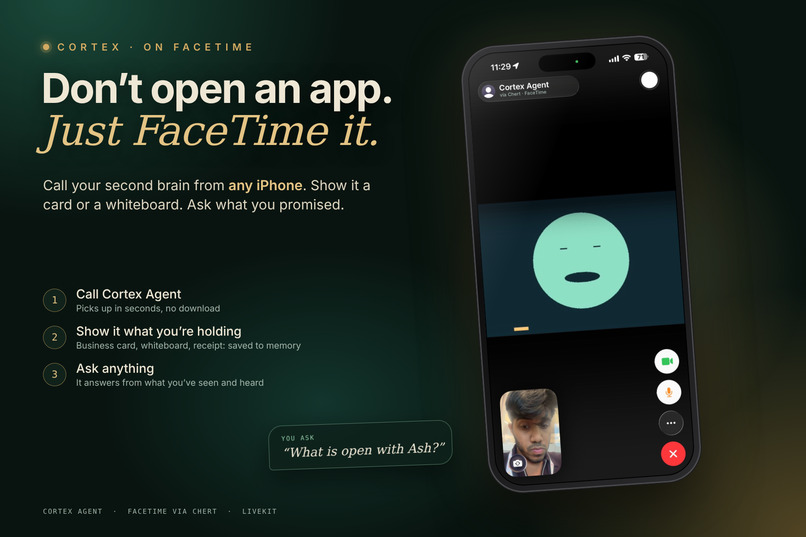
FaceTime - Powered by Chert: Cortex has its own real FaceTime number and an agent that sees and speaks live.
-
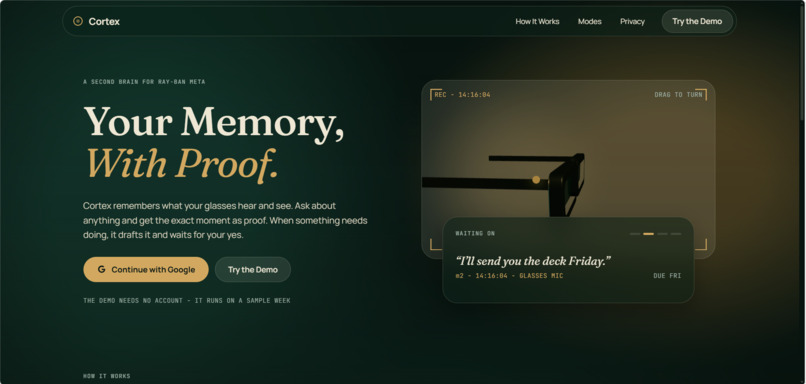
Landing Page - Your gateway to Cortex's web dashboard
-
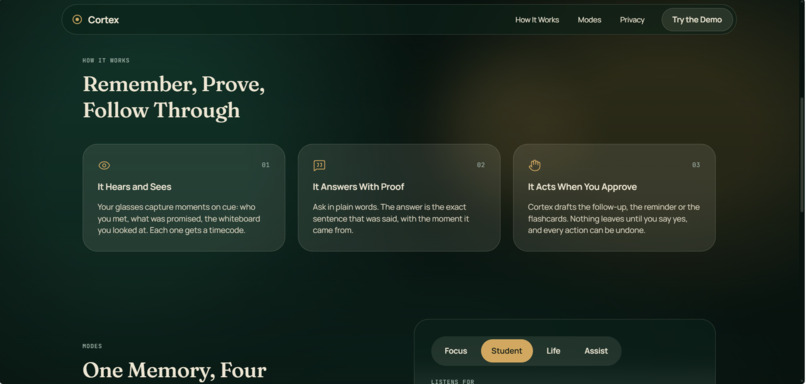
How It Works - Glasses capture, Cornea streams, Cortex remembers and acts.
-
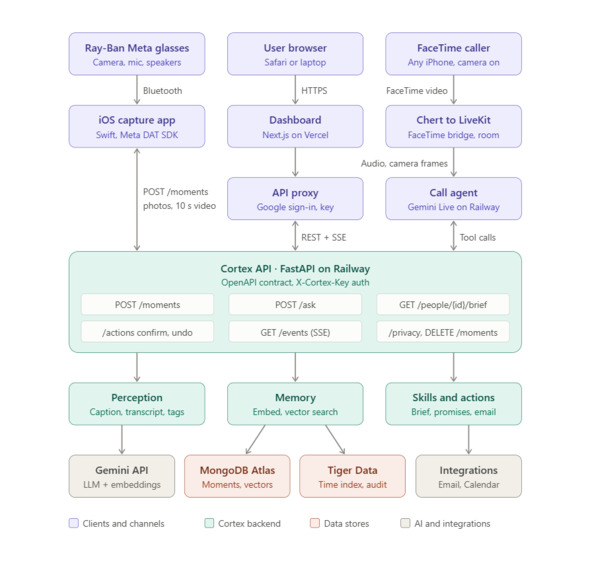
Cortex System Architecture
-
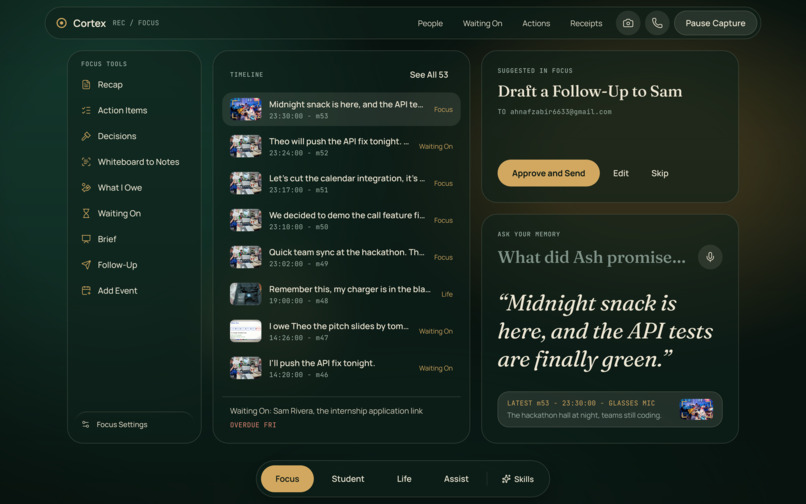
Focus Mode - Your whole day, remembered. A calm timeline, proactive suggestions and “Ask your memory” in one view.
-
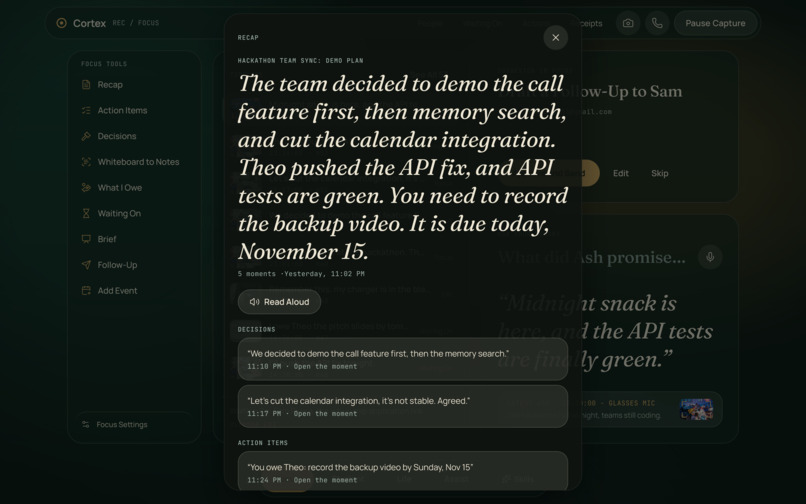
Focus Mode - Every meeting, distilled. Decisions and action items, each tied to the exact moment it came from.
-
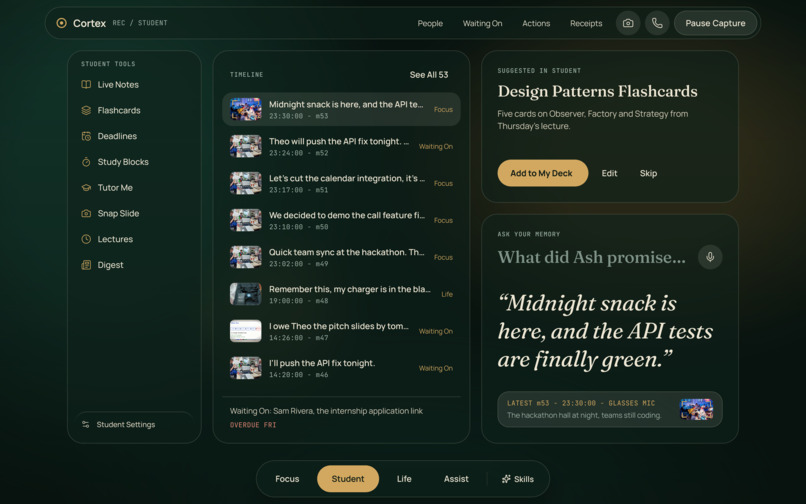
Student Mode - Class, captured. Live notes, flashcards, deadlines and study blocks built from what you saw and heard.
-
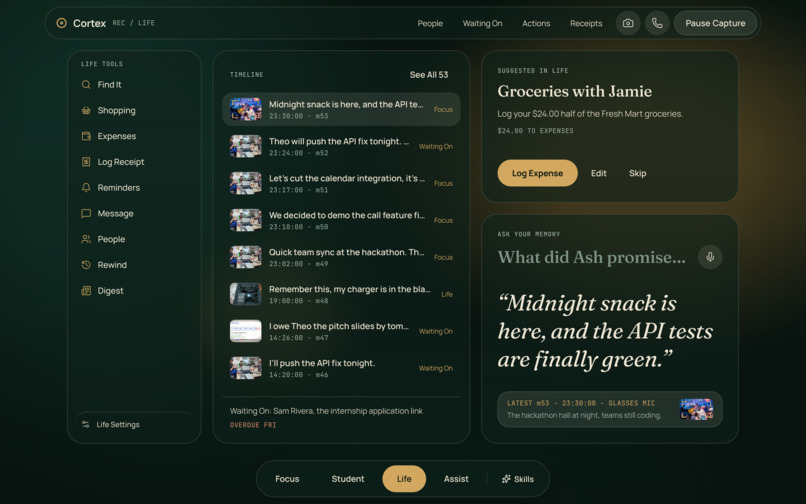
Life Mode - The small stuff, handled. Shopping, expenses, reminders and where you left your charger.
-
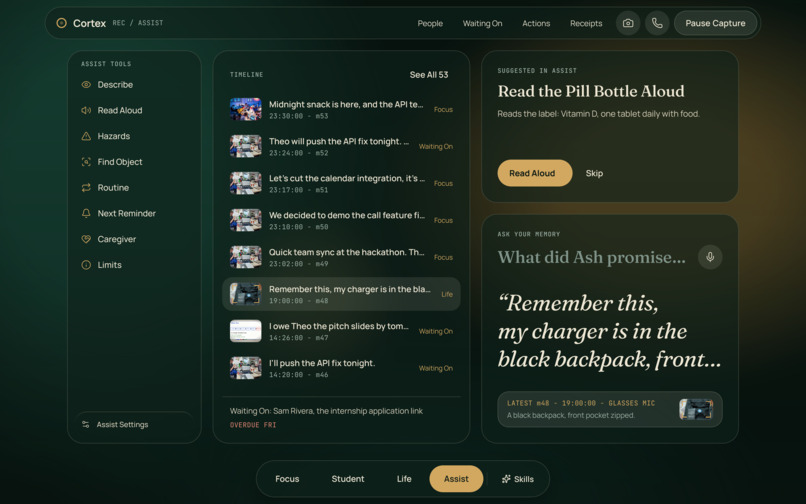
Assist Mode - Eyes for a screenless world. Reads labels aloud and flags hazards, because the glasses have no display. Cues, spoken to you.
-
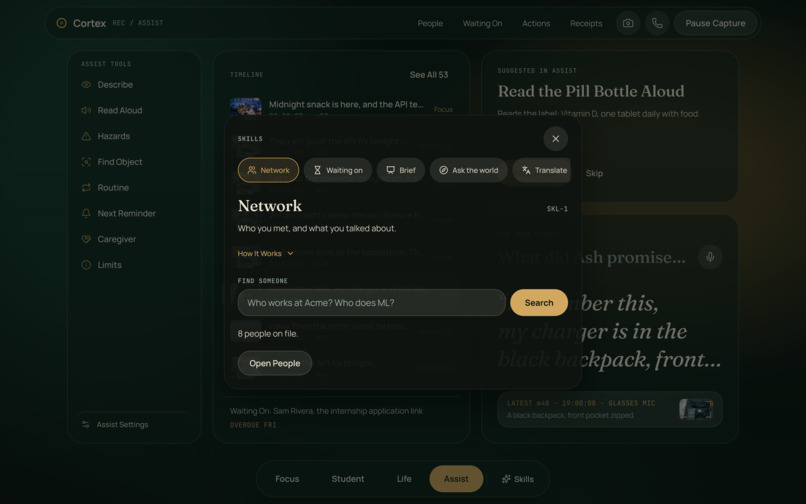
Skills - Ask your second brain anything. Who you met, what you’re waiting on, or a briefing before your next conversation.
-
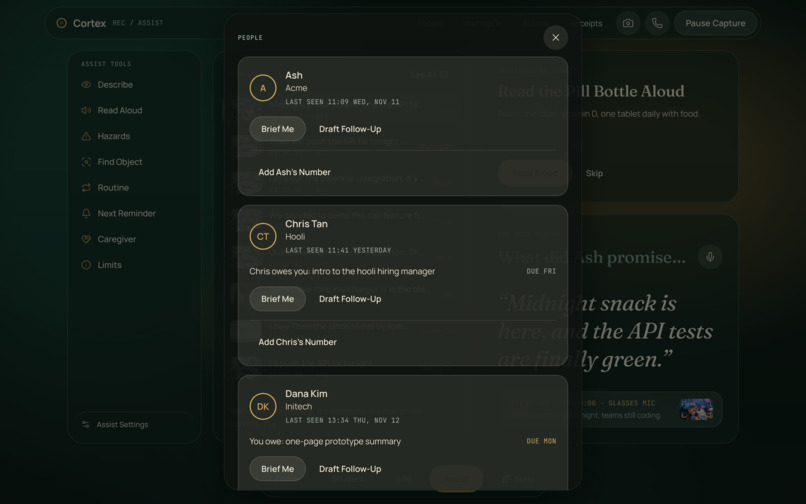
People - Remember everyone you meet. What they promised, plus one tap to brief yourself or draft a follow up.
-
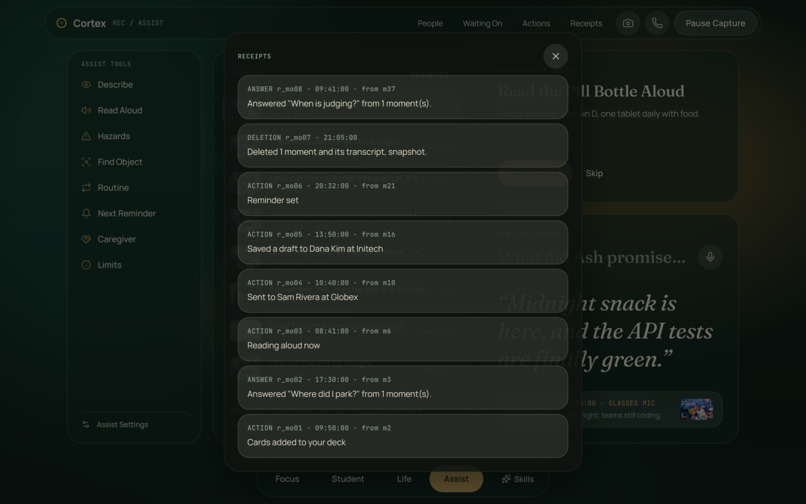
Receipts - Answers with proof. Every answer and action leaves a receipt you can trace to its source and delete.
-
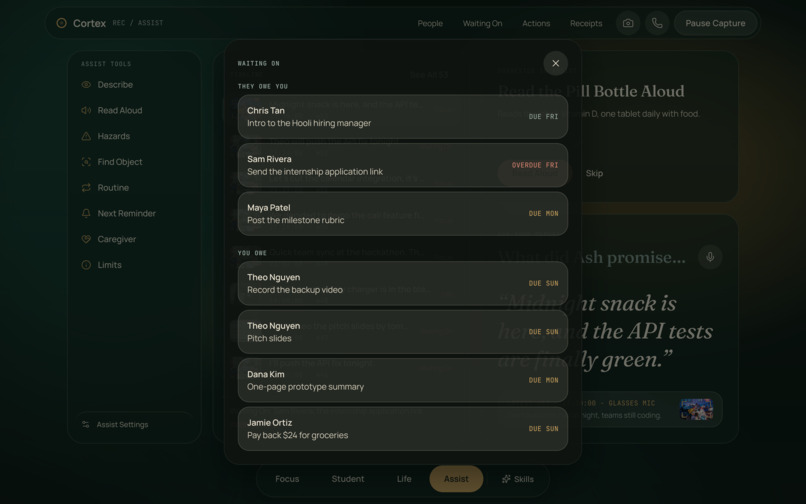
Waiting On - Nobody falls through the cracks. What people owe you and what you owe them, with due dates.


Cortex 🧠 + Cornea 👁️
Other devices remember. Cortex remembers, acts, and shows its proof.
Inspiration
You're at a career fair. Someone says, "I'll send you the deck Friday."
By Friday you've forgotten their name, their company, and that they promised anything at all.
We've all lost promises, names, deadlines, and where we put our keys. The tools built to fix this each fail in one of three ways:
- Memory pendants listen, but they're mostly blind to what you see, and they tend to hand back summaries.
- Glasses assistants answer what's in front of you right now, then forget it tomorrow.
- Almost all of them give you an answer with no source, so you can't tell a memory from a hallucination.
We wanted one thing: a memory that sees, hears, shows the exact moment it came from, and does the follow-up for you, only after you say yes.
👁️ + 🧠 Meet the eye and the brain
- Cornea is the eye. An iPhone app that streams the camera and mic from your Ray-Ban Meta glasses into memory.
- Cortex is the brain. One shared memory that answers with proof, tracks every promise, and takes action.
- And because the brain is a backend, not a gadget, you can reach it from anywhere, even a FaceTime call.
🌐 Try it in 2 minutes
👉 Public demo (no sign-in, no setup): https://cortex-dashboard-seven.vercel.app/demo 👉 Live dashboard: https://cortex-dashboard-seven.vercel.app
🎬 What it does?
A lot! Modes, Skills, FaceTime, an iOS app, meta glasses and shared memory...we have a bunch to talk about!
🎛️ One memory, four modes
Your life isn't one thing, so Cortex isn't either. A mode is a preset over one shared memory: it changes what Cortex listens for, what it offers, and what it's allowed to do, but never what it remembers. A promise made at work is findable from home. A lecture heard in class is findable anywhere.
Switch by voice ("switch to Student mode"), let Cortex suggest it (it always asks first), or tap it on the dashboard. 4 modes, 34 tools, one brain.
💼 Focus: the colleague who never forgets
Your meetings, decisions, and promises, handled.
- Meeting recaps with decisions, action items, and owners, each linked to the moment it happened
- Promise tracking in both directions: what you owe and what you're waiting on
- Whiteboard to notes in one snap
- Follow-ups and calendar events drafted for your one-tap approval
🎓 Student: the study partner who never zones out
Walk out of every lecture with the notes already done.
- Live lecture notes with timestamps that link back to the moment
- Flashcards from slides and notes, saved straight to Google Drive
- Deadline catcher: hear "quiz Thursday" and it offers to add it to your calendar
- Tutor me: look at a problem and get walked through it out loud
🏠 Life: the memory for everything small
Because the little things are the ones you lose.
- "Where did I leave my keys?" answered with the snapshot as proof
- Lists by voice: "add milk" or "I spent $12 on lunch" and it's done
- Receipt snaps that become expense entries
- Rewind: replay exactly what you said, with the picture, from an hour ago
🦮 Assist: eyes and ears when you need an extra pair
Accessibility support, built with care.
- "What's in front of me?" described out loud, and the image is never stored
- Read aloud for labels, signs, and menus
- Routines and reminders spoken at the times you choose
- Caregiver summaries that are consent-first, previewed before sending, and revocable anytime
Assist is wellness and accessibility support, not a medical device, and it never replaces a cane, guide dog, or clinician.
🧩 Skills: small superpowers any mode can use
- 🤝 Network: say "This is Ash from Acme" and a contact card appears, with the promises you made and a follow-up draft ready.
- ⏳ Waiting-on tracker: catches promises as they're said, asks you to confirm, and nudges gently with a daily cap and quiet hours.
- 🎧 Pre-meeting brief: a 20-second spoken briefing before you meet someone: who they are, what you discussed, what's still open.
- 🌍 Ask the world: point at a plant, product, or error message and ask "what is this?"
- 🗣️ Live translation: hear it in another language, get it in your ear.
- 🇪🇸 Language immersion: it names what you see in your target language, then quizzes you later.
- 💡 Proactive nudge: offers help when you're stuck, and always asks first.
- 🍳 Repair and cooking coach: hands-free, step-by-step guidance with safety first.
📞 Cortex over FaceTime
Call it from any iPhone. Chert bridges the call into a LiveKit room where our agent, powered by Gemini Live, listens, sees your camera, and talks to the same backend as the glasses.
- "What did Sam promise me?" is answered from memory, with an answer receipt.
- Hold up a card or whiteboard and Cortex saves it as a moment with a caption and a receipt.
- Say "send it" and it drafts, sends, or undoes the follow-up by voice.
On real FaceTime Video calls, the full stack ran on hosted servers with no laptop. Both calls were answered instantly, and the agent was speaking 3 to 4 seconds after FaceTime was ready (the hard limit is 10).
🧠 Why Cortex is different
- One shared memory. Every moment stores transcript, caption, snapshot, timestamp, and embedding. Modes never split it, so a lecture heard in Student mode is findable from Life mode.
- Proof everywhere. Cortex answers only from retrieved moments and checks its own citations. If memory has nothing, it says "I don't have that," not a guess.
- Action you approve. Notice, propose, confirm, do, prove. Anything that sends, spends, or shares needs an explicit yes, runs with an undo window, and leaves a receipt.
- Sight and sound together. Not an audio pendant, not a moment-only assistant: one timeline that holds what you saw and what you heard.
- Reachable anywhere. Glasses, phone, dashboard, or a FaceTime call from any iPhone, all talking to the same brain.
🛠️ How we built it
- 👁️ Cornea, the eye. A native iOS app (Swift and SwiftUI) on Meta's Wearables Device Access Toolkit. It streams the glasses' camera, captures photos on cue, records 10-second video moments, and runs a push-to-talk "Ask Cornea" voice loop over the glasses' Bluetooth mic.
- 🧠 Cortex, the brain. A FastAPI backend with one ingest pipeline. Memory lives in MongoDB Atlas with Vector Search over Gemini embeddings. Tiger Data (Postgres + TimescaleDB) holds the time index and audit log. Google Gemini handles perception, grounded answers, briefs, and drafts.
- 📞 The call layer. Chert + LiveKit Agents + Gemini Live, plus a custom frame forwarder that feeds the caller's camera to the model.
- 🖥️ The dashboard. Next.js 16, React 19, Tailwind CSS 4, live updates over Server-Sent Events, and Brass, our own design system with a 3D glasses model in Three.js.
- ☁️ Fully hosted. Vercel, Railway, MongoDB Atlas, and LiveKit Cloud.
- 📐 Contract first. One 68-path OpenAPI contract and 8 JSON schemas are the only interface between the iOS app, backend, dashboard, and call agent. CI fails if the code drifts from it. The whole system also runs offline with no keys using mocks, so
mainwas always demo-safe. - 🤖 AI-assisted, human-directed. Claude Code agents wrote 36 of our 128 commits under our rules, and every change had to pass
make check. We set the scope, made every decision, and verified every result.
⚙️ Challenges we ran into
- We started as four and finished as two. Midway, two teammates had to step back. Two of us carried the build to the finish, so a scope planned for four was delivered by two. A shared contract, offline mocks, clear area ownership, and a rule that nothing is marked "works" until someone runs its test let us build in parallel without colliding.
- A 10-second deadline on every call. Chert ends a call if the agent is silent for 10 seconds after FaceTime is ready, and it only takes video from the participant publishing audio. We greet on Chert's
bridge_readysignal and publish both a voice and an animated face. Result: speech in 3 to 4 seconds. - Getting a caller's camera into a model. The Node LiveKit framework doesn't route video to Gemini Live, so we wrote our own frame forwarder. That's what makes "hold up a card and Cortex saves it" work.
- Glasses have no web SDK. Meta's toolkit is native iOS and Android only. We built Cornea in Swift, developed against the Mock Device Kit so hardware never blocked us, and kept a phone-camera fallback on the same endpoint.
- Railway blocks outbound SMTP. Our first real email died with
Network is unreachable. We moved to Resend over HTTPS, then tracked a mysterious 403 to a missingUser-Agentheader. - Making an AI worth trusting. We audited every feature on real Gemini and read the output as the wearer would hear it. That exposed pronoun guessing, filler, and dead-end empty states. The fixes became shared voice rules (write for the ear, use names, lead with what matters) and quality gates.
🏆 Accomplishments we're proud of
- A full vertical slice: capture → memory → proof → action → receipt → undo, plus FaceTime into the same brain.
- Real FaceTime Video calls answered from memory on hosted infrastructure with no laptop.
- Retrieval that returned the right source moment 12 out of 12 times across 3 runs on the hosted stack.
- A proof-first, privacy-first product: receipts, undo windows, consent gates, and cascade delete.
- Four modes, 34 tools, and 8 skills over one shared memory.
- A custom design system with a 3D glasses model, and a public demo that opens in any browser.
- Real engineering discipline: a CI-validated contract, offline test suites, six ADRs, and a status board that won't let us mark anything "works" unrun.
🔍 Where we are, honestly
- ✅ Verified live on the hosted stack: memory search (12 of 12), grounded answers with source moments, and FaceTime calls answering from memory and saving camera captures.
- 🧪 Verified with automated tests (mock database and mock LLM): the skills, the modes and their tools, the action loop with undo, and the privacy controls.
- 🔧 Next to verify end to end: Cornea on physical Ray-Ban Meta glasses (it builds and streams on the Mock Device Kit and has run on an iPhone, but latency and frame rate aren't measured yet), and real email, Google, and text sends (the hosted backend saves drafts until the email provider is switched on).
📚 What we learned
- Proof changes the product. When every answer shows its source, mistakes become visible and fixable, which builds more trust than being right slightly more often.
- The hard part of wearables is plumbing, not models: Bluetooth routes, SDK limits, call bridges with 10-second deadlines, and hosts that block ports.
- Contracts and offline mocks let two people and several AI agents move fast without waiting on each other or on hardware.
- Writing for the ear is its own craft: short sentences, names instead of pronouns, lead with what needs you.
- Honest status beats broad status. Refusing to mark things "works" until run pushed us toward real verification.
📈 By the numbers
- 128 commits in two days
- 68 API paths and 8 schemas, validated in CI
- 4 modes, 34 tools, 8 skills
- 12 of 12 retrieval hits on the hosted stack
- 3 to 4 s from FaceTime ready to Cortex speaking
- 30 s undo window on every outbound email
- 0 faces or voices identified
🔮 What's next
- 📧 Run every action for real: email, Calendar, Tasks, Drive, and texts
- 🗂️ A triage layer that files each moment into typed items (action items, decisions, things you owe, deadlines) so every tool is a filter over one memory
- 📞 Cortex calls you with a pre-meeting brief and shows proof cards on video
- 🗑️ Per-mode retention that auto-deletes, plus speaker diarization
- 🔌 A mode SDK and an open memory API so other developers and agents can build on your memory, with your permission
- 🕶️ Display glasses and on-device processing for privacy-sensitive steps
🔗 Try it out
- Public demo: https://cortex-dashboard-seven.vercel.app/demo
- Live dashboard: https://cortex-dashboard-seven.vercel.app
- GitHub: https://github.com/ashzaeen/cortex
👥 Team
- Ashzaeen Fatmi Khan - team lead and product owner. Wrote the PRD and feature spec, then built the backend, API contract, Brass dashboard and design system, skills, modes, the action loop, the call-agent integration, the public demo, and the hosting.
- Md Ahnaf Al Zabir - iOS app and call layer. Built the Chert FaceTime agent with caller vision and brought Cortex's memory onto live calls.
- Sameer - capture and hardware lead. Built Cornea on Meta's toolkit, added voice interaction and automated video moments, and verified a video end to end through Gemini to the database.
- Md Abrar Al Zabir - early backend lead. Chose and documented the backend stack and data stores, and shaped the first contract changes.
Two of our four teammates had to step back midway, and Ashzaeen and Ahnaf carried the build to the finish. We're proud of what all four built, and of how well the shared contract held it together.
Cortex is an assistive and productivity aid, not a medical or safety-critical device. All demo data is fictional.
👁️ + 🧠 Cortex: remember it, prove it, do it.
Because a memory you can't check isn't a memory. It's a guess.

