-
-
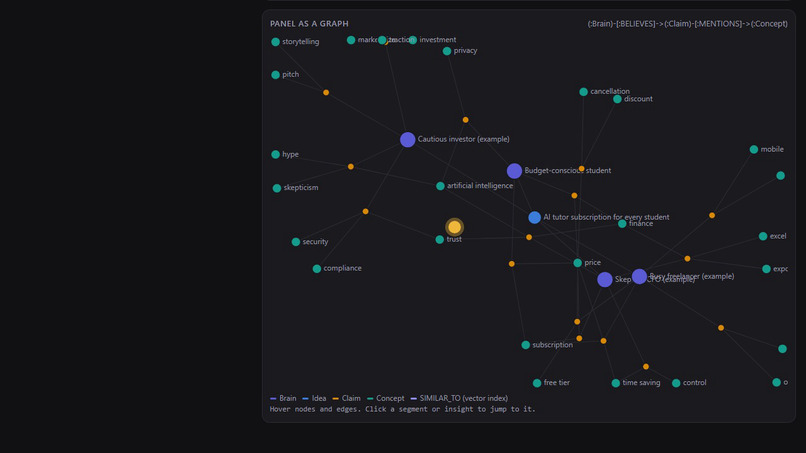
Everything lives in one Relate graph: brains, beliefs, concepts, questions and answers.
-
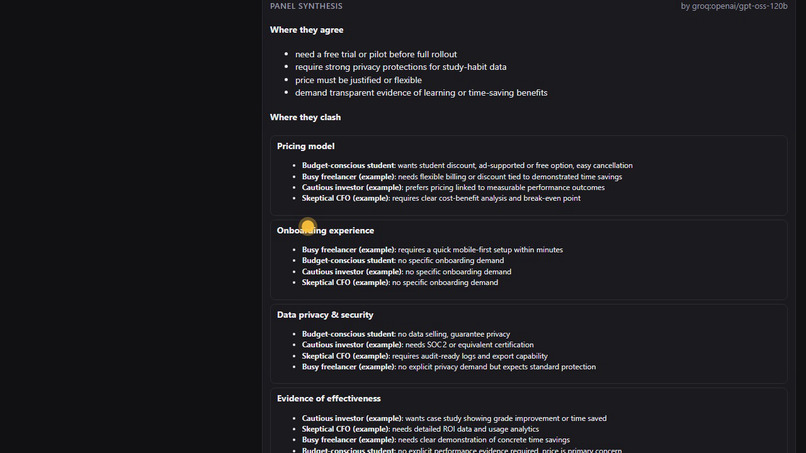
The panel synthesis shows where the brains agree, where they clash, and a joint solution for everyone.
-
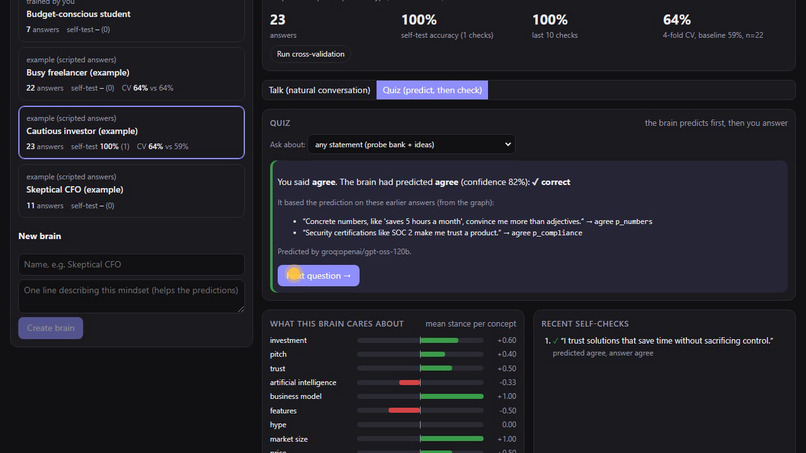
Tested, not trusted: the brain locks in its prediction before you answer. Here it predicted "agree" and was right.
-
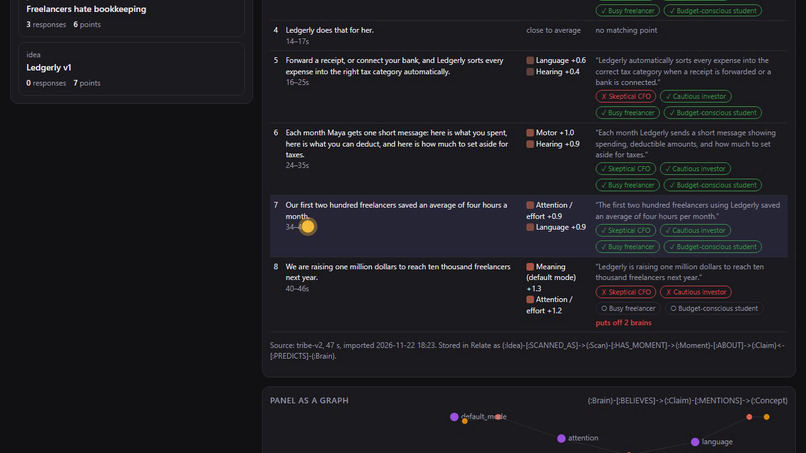
The "200 freelancers saved four hours" line lifts attention and language, and every persona agrees. The funding line puts off two brains.
-
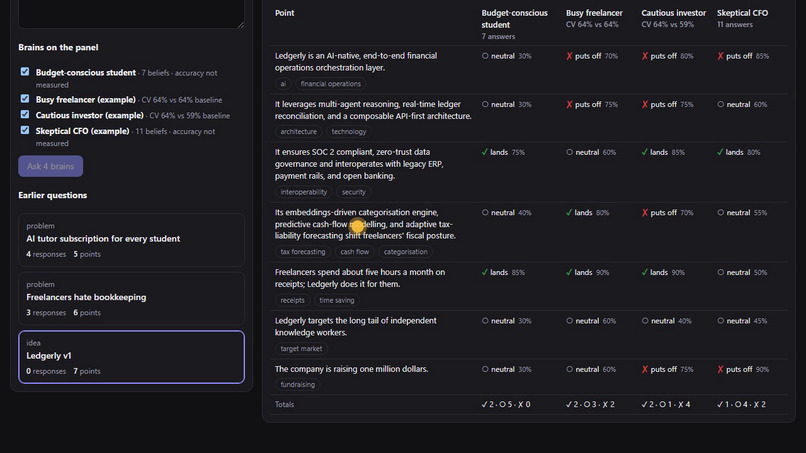
The jargon lines put off the investor and the CFO, while "five hours a month on receipts" lands with almost everyone.
-
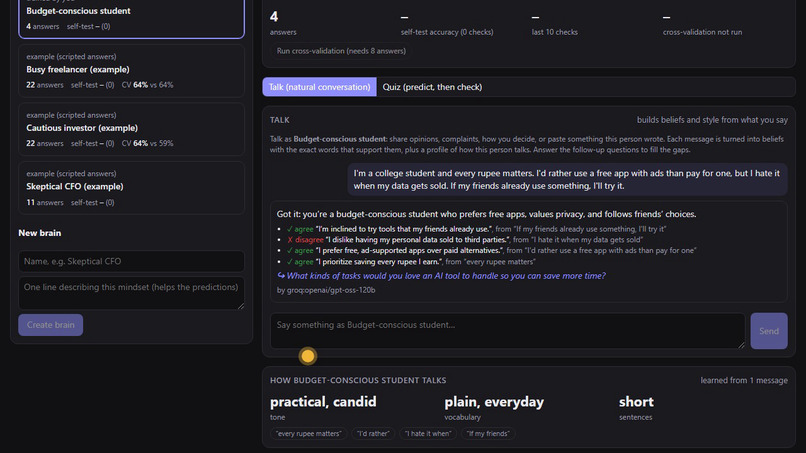
A brain is built just by talking. Every belief keeps the exact words that support it, and the brain learns how the person talks.
-
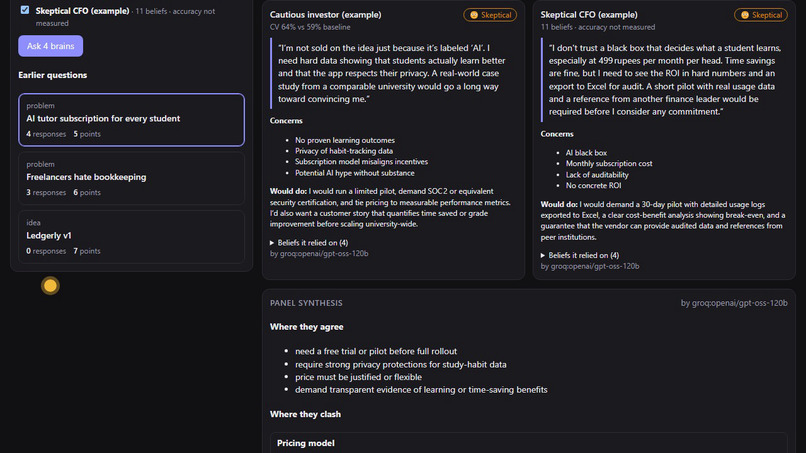
Each persona brain answers in its own voice, with its concerns, what it would do, and the beliefs it relied on.
-
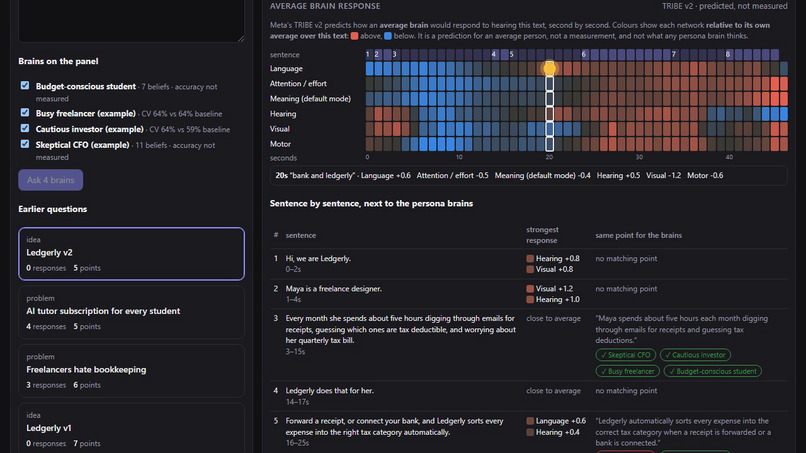
Meta's TRIBE v2 predicts how an average brain responds to the pitch, second by second, across 6 brain networks.
-
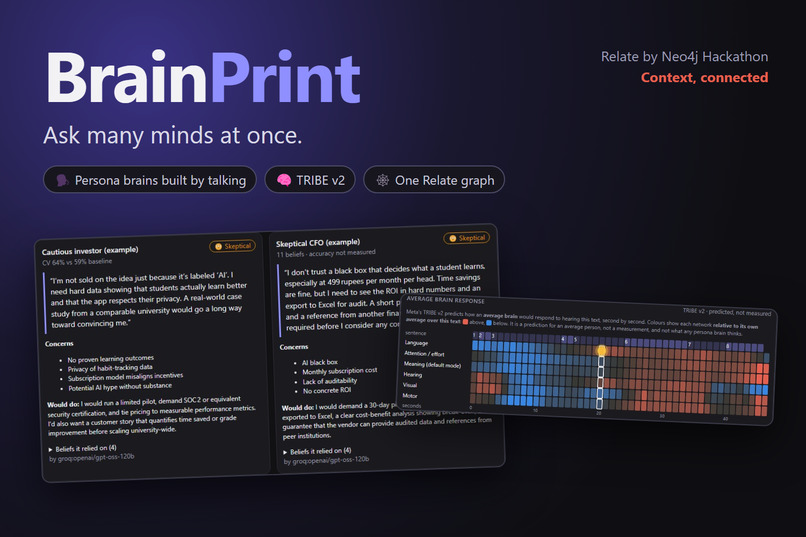
BrainPrint: ask many minds at once. Persona brains built by talking, Meta's TRIBE v2, and one Relate graph.


Inspiration
Every idea eventually meets a room full of different people: a skeptical CFO, a cautious investor, a busy freelancer, a student counting every rupee. They all react differently, and you usually find out too late. We wanted to ask that room before we ask the world: build a "brain" for each kind of person, put a problem or a pitch in front of all of them at once, and see where they agree, where they clash, and what would work for everyone.
BrainPrint started as a pitch timeline built on Meta's TRIBE v2 brain-response model. We learned that a single "average brain" can't tell you how different people react, so we rebuilt it around persona brains, and brought TRIBE back as a second view of the same pitch.
What it does
- Build a brain by talking. You chat as the person. Each message becomes beliefs, and every belief keeps the exact words that support it. If the model can't quote it, the belief is dropped. The brain also learns how the person talks (tone, vocabulary, signature phrases).
- Test it before you trust it. In Quiz mode the brain locks in a prediction before you answer, so accuracy is measured honestly. Cross-validation compares every brain with a majority-answer baseline:
| brain | cross-validation | baseline | answers |
|---|---|---|---|
| Skeptical CFO | 100% | 73% | 11 |
| Cautious investor | 64% | 59% | 22 |
| Budget-conscious student | 57% | 48% | 21 |
| Busy freelancer | 64% | 64% | 22 |
- Ask the panel. One question goes to every brain. Each answers in its own voice, lists concerns and what it would do, and shows the beliefs it relied on. A synthesis then shows where they agree, where they clash, and a joint solution.
- Test a pitch point by point. A matrix predicts whether each sentence of a pitch lands with each brain. Click a cell to see why, and teach the brain if it's wrong.
- Average brain response (TRIBE v2). Meta's TRIBE v2 predicts, second by second, how an average brain responds to hearing the pitch. BrainPrint lines it up sentence by sentence with the persona reactions. In our revised Ledgerly pitch, "our first 200 freelancers saved four hours a month" lifts attention and language above the pitch's own average, and every persona agrees with it. The funding line raises the default-mode network and puts off two brains.
- World knowledge. Concepts are linked to Wikidata and Wikipedia, so questions connect to each other through shared classes.
How we built it
Relate is the whole memory. A brain is a graph and a panel is a query across graphs, so everything lives in one embedded, single-file Relate store (graph/brainprint.rl), opened in-process from the Next.js server with @relate/relate.
- Beliefs:
(:Brain)-[:STANCE {value, quote}]->(:Claim)-[:MENTIONS]->(:Concept). A vector index (claim_embedding, 384-d local MiniLM embeddings) lets a new belief reuse an existing claim when it means the same thing. That is how different brains connect through shared beliefs. - GraphRAG answers:
SEARCH … VECTOR INDEX … SCORE ASfinds the claims closest to a question. We keep only those this brain holds a stance on, add its quotes, concept profile and style, and let the LLM speak from that evidence only. - Predictions: link prediction on
(:Brain)-[:STANCE]->(:Claim)from the vector index plus concept paths. - TRIBE v2: runs on a Colab T4. Its 20,484-vertex predictions are grouped into 7 networks with the Destrieux atlas and z-scored within each text. Each sentence is aligned to its seconds and linked to the idea's points, giving
(:Idea)-[:SCANNED_AS]->(:Scan)-[:HAS_MOMENT]->(:Moment)-[:ABOUT]->(:Claim)<-[:PREDICTS]-(:Brain). One query joins the average-brain response with what each persona thinks. - Cypher used:
MERGE/UNWINDbatch upserts,CALL (x) {…}subqueries,COUNT {…},EXISTS {…},UNION ALLprojections, constraints and explicit transactions. - MCP: the Relate CLI's read-only MCP server exposes the same file to any MCP host.
- Stack: Next.js 15, React 19, TypeScript, Groq
gpt-oss-120b(falls back togpt-oss-20bwhen the free daily quota runs out), MiniLM embeddings run locally, Wikidata, and TRIBE v2 (PyTorch, nilearn) on Colab. The demo video was recorded with Playwright, narrated with a local Piper voice, and edited with ffmpeg, all scripted in the repo.
Challenges we ran into
- One writer per file. A Relate
.rlstore allows one writer, and the Node client has noclose(). We keep a single handle per server process and made the MCP server opt-in, because it also takes a lock. - Stance polarity. At first every concept scored +1, because the model phrased beliefs in the person's own direction. We made it phrase every belief favourably and store the person's direction separately.
- Honest accuracy. Giving the predictor per-target hints lowered cross-validation accuracy, so we removed them. Long claim IDs were mangled by the LLM, so we switched to short keys.
- TRIBE v2 access and setup. It needs gated Llama 3.2 3B weights, and our first access request was denied. On Colab, installing TRIBE changed torch and broke torchaudio, so the notebook now reinstalls the matching version.
- Linking sentences to points. One point was linked to two sentences, so we switched to best-first, one-to-one matching.
- Free tier limits. Groq's daily quota is handled by an automatic model fallback, and every answer shows which model wrote it.
Accomplishments that we're proud of
- Brains you can build in a minute just by talking, where every belief is backed by a verbatim quote.
- Measured, not claimed: every brain shows its accuracy against a baseline, including the ones that don't beat it.
- One Relate graph joins persona reactions, an average-brain response and world knowledge for the same sentence.
What we learned
- Graphs make AI answers checkable: every answer cites beliefs, and every belief cites the person's own words.
- A small model of a mindset is only useful if you measure it, so we measure every brain against a baseline.
- An "average brain" and a "kind of person" answer different questions. Showing both side by side is more useful than either alone.
What's next
- Build brains from real interviews and surveys, with consent, and track their accuracy over time.
- Run TRIBE on audio and video pitches, not only text.
- Compare pitch versions automatically: which edit made which persona switch sides?
Honest scope: brains are models of the words they were given, not real people or a market. TRIBE v2 predicts an average subject's fMRI-like response, and the 7-network grouping is ours.

