-
-
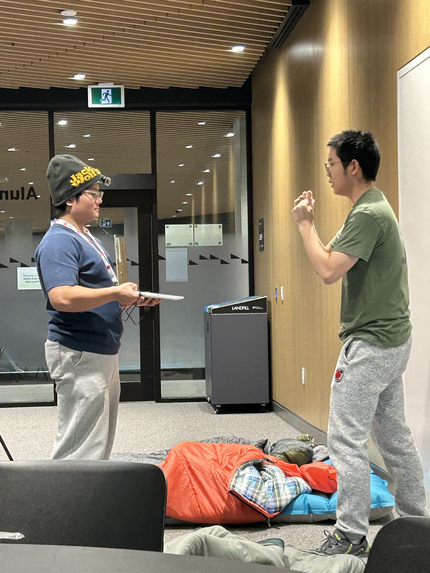
First volunteer
-
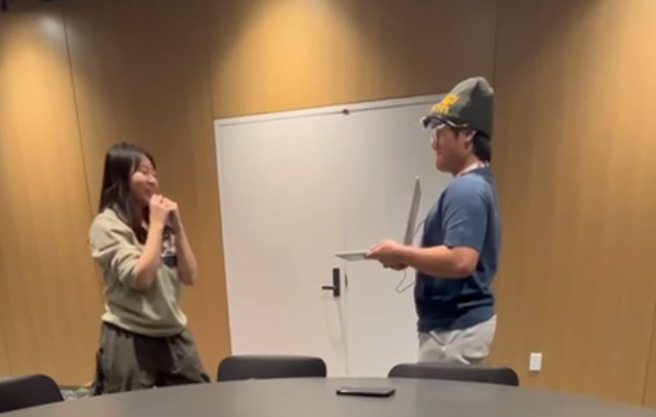
Apprentice of pro fighter volunteer
-
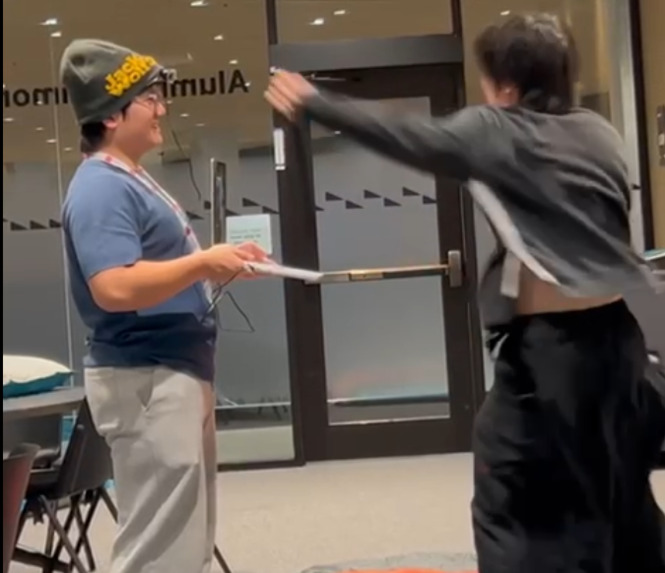
Pro Fighter Volunteer
-
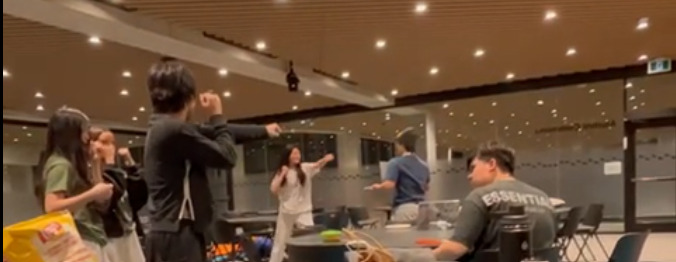
Boxing galore


Inspiration
Boxing is physical chess. Fighters set traps, disguise punches, and punish hesitation.
That made us wonder: could a wearable spot a punch early enough to help someone who can’t see it coming?
We built BlindBox to explore that question. Boxing gave us a demanding testing ground for a bigger idea: turning fast-moving visual threats into warnings people can feel.
What it does
BlindBox translates incoming punches into directional sound cues.
A hat-mounted camera watches the opponent, while three buzzers guide the wearer’s response:
- Hook from your left → left-ear buzz → dodge right.
- Hook from your right → right-ear buzz → dodge left.
- Straight punch → front buzz → duck.
- Uppercut → all three buzz → step back.
BlindBox is built on QNX, the real-time OS inside cars and medical devices, because a late warning is worse than none. If anything crashes, the hat sounds a fault alarm instead of going quiet: for someone relying on it, silence must always mean safe.
Our tournament mode scores boxing technique out of 100, turning data collection into a competition people want to join.
How we built it
Our target: deliver a warning within 100 milliseconds of a punch starting. At 30 frames per second, that gives us roughly three frames to work with:
$$ t_{\text{cue}} \le 100\ \text{ms} \approx 3 \text{ frames at } 30\ \text{fps} $$
We use YOLO11n-pose to track the opponent’s shoulders and wrists. Because the camera sits on a moving head, we measure hand movement relative to the opponent’s body rather than the screen. Each wrist position \(\mathbf{w}\) is measured from the midpoint of the shoulders \(\mathbf{s}_L, \mathbf{s}_R\), in units of shoulder width:
$$ \mathbf{w}' = \frac{\mathbf{w} - \tfrac{1}{2}(\mathbf{s}_L + \mathbf{s}_R)}{\lVert \mathbf{s}_L - \mathbf{s}_R \rVert} $$
That way, the wearer turning their head doesn’t look like a punch, and a near or far opponent looks the same.
A classifier analyzes 24 motion features per wrist to detect punch starts, deciding in about 25–40 ms per frame. It fires when it is confident enough that a punch is starting:
$$ P(\text{punch} \mid \mathbf{x}_t) \ge \tau, \qquad \tau \approx 0.95 $$
where \(\tau\) is tuned to allow about 2 false alarms per minute. We trained it on 378 hand-reviewed punches from 10 people, ranging from complete beginners to a semi-pro Muay Thai fighter.
An ESP32-S3 drives the buzzers over USB with a 0.6 ms round trip. On QNX, vision, cue delivery and supervision run as separate processes that talk through QNX message passing. If vision crashes, the cue driver detects the missing heartbeats and sounds an alarm, and the supervisor restarts it automatically. Everything is cross-compiled with QNX SDP 8.0 for the Raspberry Pi 5.
Challenges we ran into
Telling a punch from ordinary movement. Our first speed-based detector triggered whenever someone moved their hands. Colored-glove tracking also struggled when glove colors blended with skin.
Working with a moving camera. Measuring motion relative to the opponent’s shoulders helped separate their movement from the wearer’s.
Getting the timing right. Retraining on footage recorded at the correct frame rate more than doubled our early-detection rate, from 17% to 44%.
Handling real conditions. Lighting affected detection, and wide hooks sometimes left the camera’s view. We added brightness and blur variations during training; a wider lens is next.
Accomplishments that we're proud of
- Seeing a blindfolded wearer dodge punches using our cues.
- Building a first-person dataset with precisely labeled punch starts.
- Designing fault detection and recovery into the system.
- Creating a tournament that makes people want to contribute data.
What we learned
Timing is part of correctness. Recognizing a punch means little if the warning arrives too late.
We learned to train in the conditions the device will actually face: footage from the hat worked better than footage from a desk. Adding different boxers also revealed weaknesses that more footage of the same person missed.
Above all, we learned to test our assumptions. Several ideas sounded convincing until we measured them.
What's next for BlindBox
Next, we’re bringing the full vision pipeline onto a Raspberry Pi 5 running QNX, adding a wide-angle lens, and expanding our dataset through tournament mode.
Beyond boxing, we want to explore whether this approach can help visually impaired people detect approaching hazards and help robots anticipate human movement.
We started with a punch. We’re exploring a new way to sense what’s coming.
Built With
- brain
- esp32
- pytensor
- python
- qnx
- raspberry-pi


