-
-
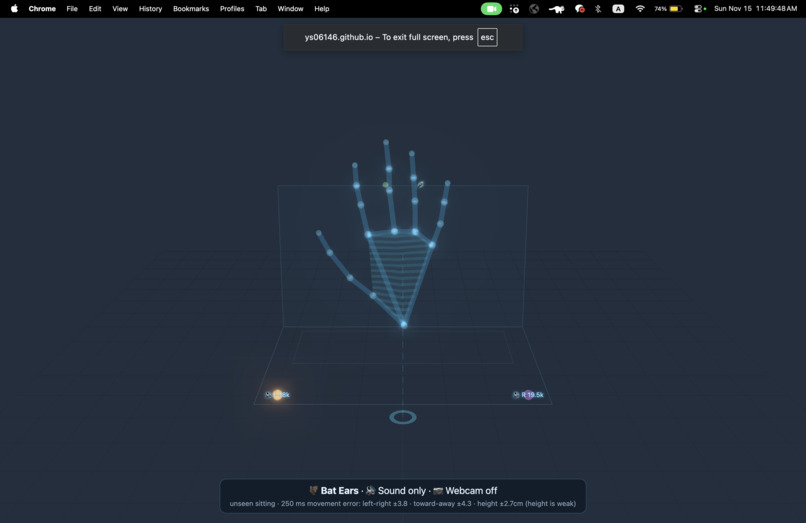
-
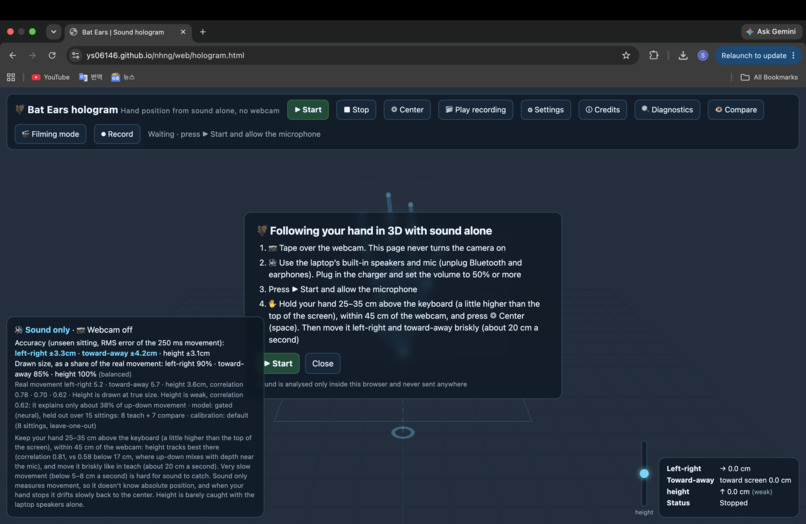
3D Hologram — Setup Explore 3D hand-motion tracking using sound alone, without a camera.
-
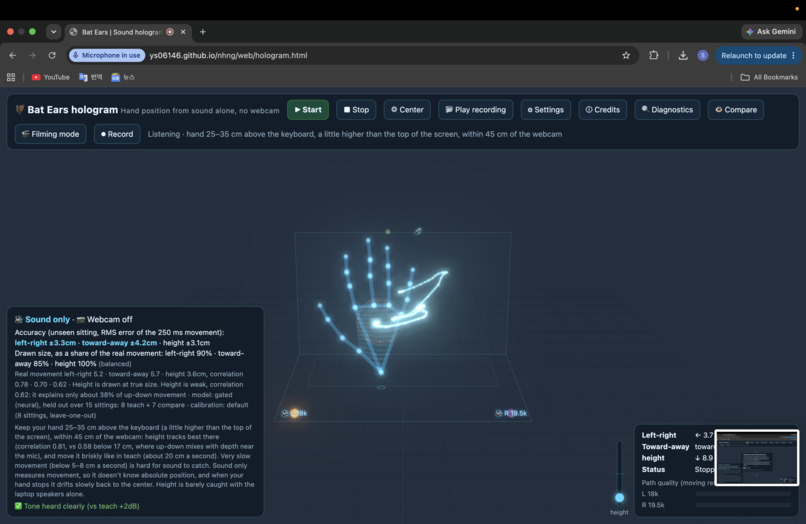
3D Hologram — Live Tracking A glowing 3D hand visualization responds to acoustic motion estimates in real time.
-
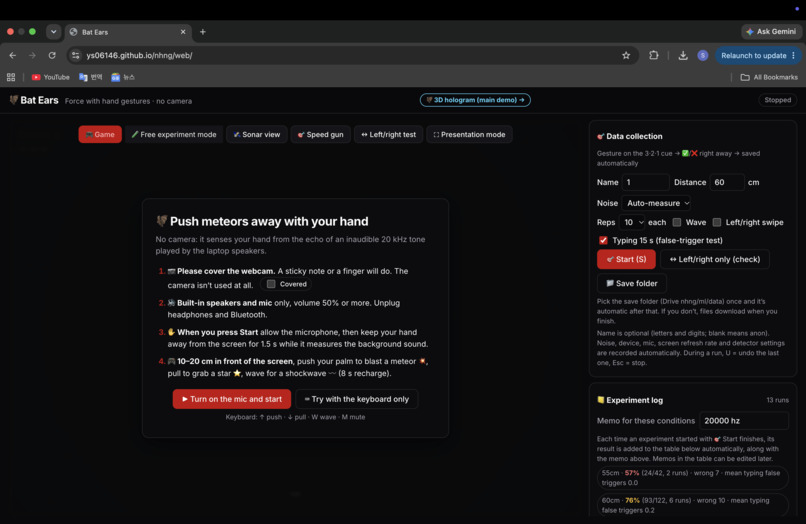
Game Demo — Setup Set up camera-free gesture controls using your laptop's built-in speakers and microphone.
-
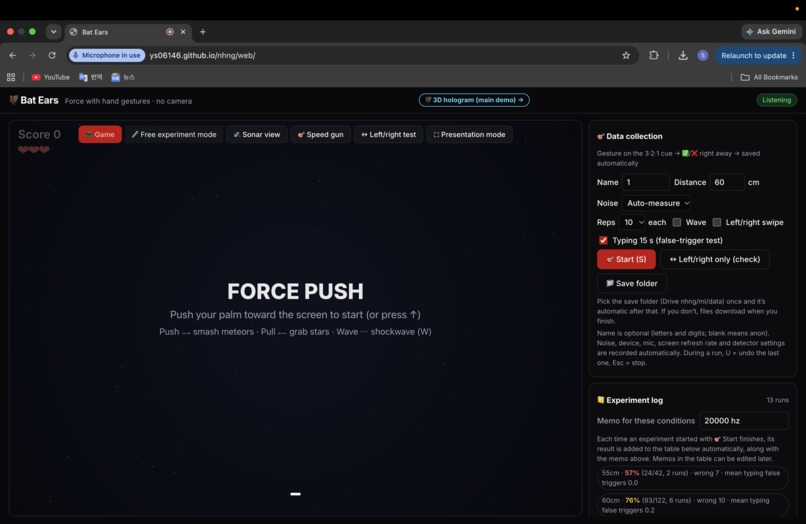
Game Demo — Ready The game is listening for hand gestures, with no webcam required.
-
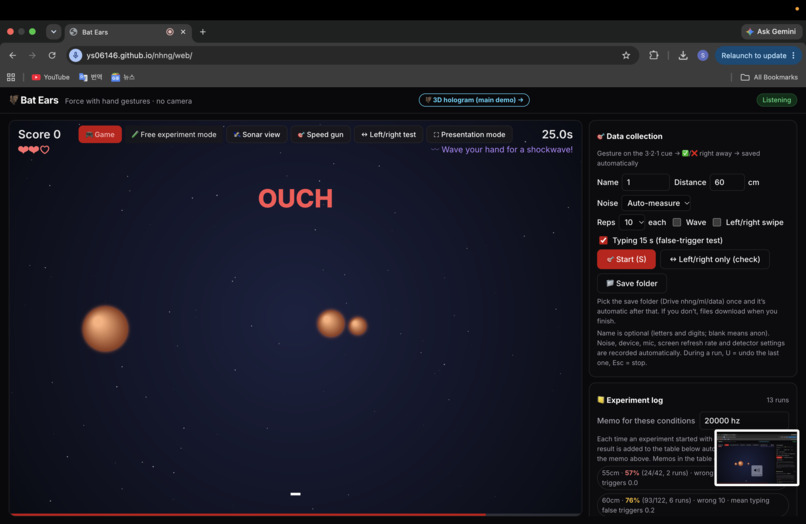
Game Demo — In Action Control an interactive meteor game with hand gestures detected through sound.


How we built it
- One tone per source, one mic. 18 / 19.5 kHz on the laptop's left and right speakers (Web Audio ChannelMergerNode). The mic is opened raw: echo cancellation, noise suppression and auto gain off, because Chrome's voice processing erases ultrasound (−32 dB → −179 dB in our test).
- Phase ranging in an AudioWorklet. Each carrier is mixed down to I/Q, low-pass filtered (250 Hz), decimated to about 1 kHz, the static echoes removed, and the phase unwrapped into path-length steps, as LLAP (MobiCom 2016) does: about 1.8 cm of path per turn.
- From path changes to 3D. Two speakers can't pin down a 3D point by geometry alone, so a linear (ridge) map, trained against the webcam, turns the path changes into the hand's movement over 250 ms windows.
- The webcam teacher (teach.html). MediaPipe HandLandmarker in the browser gives 21 landmarks per frame on the same performance.now() clock as the raw stereo WAV. A guided 2½-minute session covers the space; offline, the landmarks are placed in the laptop's frame and the map is fitted.
- Size correction. A least-squares map draws each movement at about (correlation × true size), so height looked frozen. A square-root correction draws it visibly, and the hologram shows the honest error on screen.
- The hologram. Sound gives movement, not absolute position, so the hand is re-centred by a 2 s spring and smoothed by a One Euro filter. three.js draws the hand with glow, a trail and an error ellipsoid; it turns amber when the hand leaves the taught zone.
- Honest evaluation. Leave-one-sitting-out for 3D, leave-one-session-out across 17 sessions for gestures. Every live rule is mirrored offline so all recordings are replayed after each change.
Prior work (SoundWave, FingerIO, LLAP, Strata, RTrack and others) reaches millimetre results with native code or special hardware. What's new here: a web page on a stock laptop, no install, no server, and the camera as a teacher only.
Challenges we ran into
- Disappearing ultrasound. Chrome's voice processing removed our tone until we disabled all three filters.
- The weak axis. The two laptop speakers sit side by side, so up-down changes both paths alike. Phones didn't fix it: a phone above the hand gave an echo path that didn't follow the hand, and phones beside the laptop added at most 0.05 to height correlation.
- Phones can't play high enough. iPhone speakers stop around 20 kHz, so phone tones moved to 17 and 18.75 kHz.
- A quiet tone draws a small hand. Tones 7.6 dB quieter than in the teach sessions made every movement look too small. The page now warns about a weak tone, a stray ultrasonic tone or another Bat Ears tab.
- A stray tone in the room. For hours every recording had a strong 20 kHz tone: an old Bat Ears tab still running.
- People don't move the way you'd expect. They wind up before a pull and swing back after a push. Judging each motion burst by its largest speed instead of its first threshold crossing took a detector from 3 of 20 to 17 of 20.
Accomplishments that we're proud of
- Camera-free 3D hand tracking from a stock laptop, in a web page, taught by its own webcam in 2½ minutes, with held-out errors of 3.8 / 4.3 / 2.5 cm.
- Push/pull from real recordings: 268 of 332 prompted gestures (81%) across 17 sessions at 20-60 cm, on a Windows laptop and MacBooks, with about 0.6 false triggers per minute while typing or idle.
- Honest numbers on screen: the hologram shows its held-out error and the size it draws, and a replay mode shows the webcam truth next to the sound.
What we learned
- The browser audio pipeline does a lot behind your back; knowing what it filters made the difference.
- A camera is a great teacher for a sensor that then doesn't need it.
- A least-squares map draws motion at (correlation × true size). Weak axes look frozen, and that's information, not a bug.
- Record first, then tune: replaying every saved session after each change caught regressions a live try would hide.
What's next for Bat Ears
- Height: a better source layout and teach sessions in more postures.
- More people and laptops: we have one person on one laptop so far.
- Absolute position: anchor the drift with the direct-path phase and short re-teach moments.
- Uses: cooking with messy hands, sterile rooms, accessibility, and privacy-first smart devices.
Built With
- html5/css
- javascript
- node.js
- python
- three.js


