Steve’s PAX AUS 2018 Timetable

This is a living document because oh boy is there a lot on and I’m just trying to keep it straight.

The PAX Panel Schedule is now up! 
The PAX RPG Schedule is now up!

Thursday the 25th:

12 noon: R-Dev Con, the convention of Australian RPG developers!

4pm to late: Dev Con, the convention of Australian TT game developers!

Friday the 26th:

10am-1:30pm I’ll be on the TGDA booth showing Relics to everyone who stops by! If all goes well I will have free Quickstart Guides to hand out!

11am-1pm:  Teja, my Lovely Assistant will be running Relics for me in the RPG area!

2pm-3pm: Panel: Let’s make a board game! A panel. Last year we made UNSTABLE the game of cybernetic psychic horses fighting and fucLOVING EACH OTHER in just one hour (and then I made a companion RPG, Stallions of Steel). Can we make a better game this year? You better believe it. Join us in the FRUITBAT THEATRE.

5pm-6pm: Panel: Cake or Death: Game Dev When You’re Dead Broke in the IBIS THEATRE. We talk about how to make it when you can’t make ends meet.

7pm-9pm: I’ll be running Relics in the RPG area! The maker’s touch!

Saturday the 27th

10:30am-11:30am: Panel: Not Just to Win: The Psychology of Tabletop. What are the reasons people play games? How do you know why you play game, and why does it matter? In the KOOKABURRA THEATRE. 

3pm-7pm: Find me demoing Relics at the Collabratory!

3pm-5pm: My lovely assistant Teja will be running Relics in the RPG area!

5pm – 8:30pm: Relics is on the TGDA booth again. Keiran will be staffing until I get there at 7. Booth number to be advised. Come on down and make up your Relics character!

9pm-11pm: My lovely assistant Teja will be running Relics in the RPG area!

Sunday the 28th:

10am – 2pm: Relics will be on display at the Collabratory! Showcased by me!

10am – 12:30pm: TGDA Boothing again! This time Phoebe will be on the booth!

1pm-3pm: Teja once again running Relics in the RPG area!

3pm – 5pm: Make Your Own Boardgame. Why not end the con by making your own game to take home? In the DIVERSITY LOUNGE.

And then I’m gone, on a flight by 7pm. Crazy…

Ten Things To Do Now You’ve Written Your 200 Word RPG

Gosh, wasn’t that exicting! It seemed impossible and then wow, you did it! Excellent! But don’t let it end there. You can use your experience to learn so much more. Here’s my thoughts on What Happens Next.

1. Don’t Get To Wrapped Up In the Winners

Once again, there were over 700 entries. Ultimately, although it has a prize, the 200 Word RPG Contest is not about the winners. That just ensures the judges read everything. Hooray! Your game is getting read! Eventually you might even get a comment! But there are other ways to get comments – the amazing Michael Wenman and Ivan Neville are both going to read every single one. Watch out for yours and get the thrill of feedback! But also just enjoy that someone, somewhere is reading it. That alone is amazing. Plus you wrote a whole RPG! ALSO amazing!

2. Read a Friend’s, and Give Feedback

Or a strangers. Most people put some twitter handle or email address in their submission. If every single submitted read just one other entry and tweeted about it or wrote back, the contest would be so much better. Go long with the feedback, talk about what you liked and didn’t, what worked, what needs work and what you’d like to see more of. Most people SUCK at giving feedback because they don’t know how. It’s a skill. Take your time. Write at least 200 words. The 200 word feedback competition is MUCH more important to enter.

3. Read Ten of Them

You can’t read 750 of them. So read ten. Read them at random. Read ones that catch your interest. Read ones that have silly titles. Read ones I share on twitter! Follow the 200 word RPG bot on twitter which shoots you a new one every day, and read some of those. You don’t have to write anything. Just read. You’ll get ten new ideas you never thought of, and that will make you a better designer. Read ten already? Go for 20. Go for 200. Eh no that’s too many. Or is it? Want to rest your eyes from the screen? Get a hardcopy and read one out at the dinner table every night.

4. Reflect

Have a look at what you wrote and why. Why did you choose that subject? Where did it lead you? In 200 words you don’t have much time to plan things. That’s the whole point, it helps you tap into your subconscious and just FEEL out the work. So why did it go that way? What kind of design did you go for, what choices do you make instinctly? What does that tell you about how you design? If you did one another year, are they similar? My last two have been very political. Guess that’s my thing right now. Let’s call it my Political Period. Now I feel like a real artist and you can too!

5. Break It Down

The other thing the competition helps with is completing something. Your RPG is finished, hooray! That means it is complete (or close). So what does an RPG need? Do you have all those elements? Can you separate them out? What is the setting? What is character generation? What are the core rules? Is there a GM section (is there a GM?)? Breaking it down into sections gives you insight into what you designed (for reflection, as above) but also gives you insight into RPG construction in general and how you ticked off all the sections.

6. Built It Up

Now that you’ve got it in sections, write out a table of chapters. Imagine what this game would look like if it were 2K words, or 20K, or 200K. The structure would still be the same, or close. Maybe there’s not much to say about some parts – you couldn’t expand the setting any further. Or could you? Imagine it. How COULD you turn that two sentence setting into two thousand words? Into a novel? How could you weave a whole game around that core mechanic? Jot down some notes. See the artwork. Think about the example characters and adventures.

7. Sell It

Want to practice another skill? Figure out how you would sell your game if it were real. Whether you do this with the 200 word version or the 200,000 word one you just imagined, the core is the same: it will be GMed or GMless. It will be for a certain number of players and a certain kind of player. What style does it support? Who kind of roleplayer would be most likely to play it? Newbies or old hands? Combat freaks or drama kids? What age group? And how would you sell it all to them?

8. Summarize It

Got the idea of who might want to play it? Now come up with your sales pitch. Not the dynamics you just worked out, the “a GMless one-off game for fans of Science Fiction and In a Bitter Age”, I mean the hook that grabs that market. What’s the beating heart of your game? What is the punch in the face that demands it be played? Is it cutting edge satire that tells a tale as old a stime? Will it make you cry as you peel back the layers of domestic harmony? You wrote it in 200 words, can you sum it up in 20? Or 10?

9. Double It

Cut it down to 20? Good. Now beef it up to 400. Seriously, try it. It’s a lot harder than it sounds. But it’s great because it lets you do all those things you couldn’t quite fit in. You can explain what was in comments. Better still, you can fill out those sections you identified in step 5, and make sure that byline in step 8 sizzles off the page, and the key demographic you spotted in 7 is made explicit. Add some GM notes to get that intent clear. Maybe go up to 500 words. You deserve it.

10. Publish It

I know what you’re going to say: but I can do MORE. I could make it 1000 words, or 10,000 so it would be a REAL(TM) ROLEPLAYING GAME. Sure. But the point of the 200 word RPG competition is to go through all the steps as fast as possible so you get the whole megillah without stopping, without the voice in your head saying “maybe not, maybe nobody cares”. Take that 400/500 word version, and stick it on the web. Or print it on a postcard. Hand it to your friends or strangers. Say “Free game!”. Oh it’s scary. But it’s a fear you have to face, and it’s easier to do a postcard than a 300 page book. And the fear of handing out postcards can actually stop you making the book. Beating that fear can HELP you make that book.

The other day, someone sent me a tweet saying a post-card game of mine had captivated their entire share house of ten hours. It wasn’t just that I had the idea. It was that I made it physical and handed it to someone – that’s what got it played (and later, put on the shelf to play more later). Print the thing out. Hand it to someone. That’s what gaming is. The virtual is a good start, and you should do that too, but games are about sharing. Look someone in the eye and give them your RPG, whether its 200 words or 400 or 10. That is a sacred and beautiful thing. That’s why we submitted these silly things online, but you can do more than just that. Take it further. It’s 200 words, but it can be so much more. For that game, for you, and for someone else.


200 Word RPG 2018

As usual, I can’t escape political satire. Last year’s was much the same. There’s some cutting stuff in here. It’s designed to attack society, not people. I hope that comes through.

aPeer

Got an important meeting and just can’t get there? Don’t waste your time with cyber-presence. Our hosts are waiting. Wearing special headbands linked to their phone, your face will appear over theirs. They see a real living person – no tiny screens, no being stuck to the wall. Make a “personal” appearance without leaving your couch. That’s convenience. That’s aPeer.

Everyone finds a picture of a celebrity, about A4 size. Ideally one they admire. Cut it out of the magazine or advertisement or print it out.

Gather. Pass your celebrity to the player to your left.

Pick up the picture and hold it over your face. That person is now using your body through aPeer. Talk to the other celebrities. You’re all at the same event, how exciting. Talk about how you don’t normally use aPeer but there’s a taxi strike, a fuel shortage or you had trouble finding a babysitter. They don’t have a union but you always tip.

Comment on how nice your aPeer host is. Perhaps the last one was a bit smelly or a bit fat? Commiserate others if they got a fat one.

Leave a comment for your aPeer host, and a rating out of five.

My Path to Gaming

People have been tweeting about their “path to gaming” this week on Twitter – meaning their path from being just somebody who might want to make games to being someone who does, and maybe even makes some money or a career out of doing so. I think it’s good to share stories, but I also think the very nature of these stories are tricky. They can be tools, but they can also be lies. All stories are, after all. And they only make sense after the fact. I could tell you that as a kid I was so desperate to own my own copies of games that I tried to make them from whatever I could, even trying to assemble thousands of trivia questions to make my own Trivial Pursuit. But it’s only now, looking back, that I can see that having anything to do with what I do now. To say that is part of my path is to suggest a cause and effect, and if there was one, it never felt like it. And that, I think, is what we’re really looking for. A sense of cause and effect. Of what we might do to get where we might want to be.

Or even more so, what we might be to prove we are who we hope we are. We’re searching for a Dumbo feather.

If you’ve not seen it, Dumbo is a Disney animated film from 1942 which depicts a large-eared elephant who turns his disability into his power when the ears grant him the capacity to fly. It’s a film that’s deeply important to me and, like most good stories, is about psychology. Dumbo can’t fly until some helpful crows give him what they call the “Magic Feather” which lets anything fly. While holding it, Dumbo can fly. At the climax of the film he drops the feather and his companion Timothy tells him the feather is a lie, it was a proxy to get Dumbo to simply believe he could do it. It was that belief that allowed him to permit himself to learn to fly, without self doubt getting in the way.

It’s a cliché, but we keep talking about it because permission, self-belief, self-conception, these are core concepts of who we are. Artists and writers who go to work for Disney are almost certainly looking back at their past and seeing a young creator who wondered if they are permitted to dream. So naturally it comes up a lot in their films.

For me, the place I sought the Dumbo feather was in pathways of other writers. When I maybe should have been reading more or writing more or going to art school – but couldn’t, because I could not permit myself – I still wanted to be someone great. I craved fame more than skill, always have. And the only way I could sympathetically align myself with that, permit myself to believe it was possible, was to read the histories of writers and look for similarities. It was vooodoo doll magic: if I found that Tad Williams or Douglas Adams had done this or that thing as a young person, and I too had done those things, why then…by association, I could be like them. It would be allowed. Or at the very least, I could see those parts of myself as not signs of failure or cowardice.

So when I think about my path, what comes to my mind is what it was like going through the story. I can tell you the story the way it seems to be now, from the end. Of course I can. It’s not very complicated or hard. I wrote a bunch of stuff for roleplaying games I wanted to work on, and when they put out open calls for submissions, I submitted that stuff. I made myself useful and a friend online. The two helped me get freelance work, and I’ve been a freelancer ever since. After about twenty years of doing that I finally had enough mental health to permit myself to design my own games, and I just put them on the web and hardly anybody has found them so far, but I enjoy it anyway. I like having permission to feel like they’re okay games and I love that a few people have played them and had emotions as a result.

But the story from inside it, that’s a story of a dark and brutal war with my self and my demons, of agony and fear and confusion, of never knowing where to go or why, of never knowing what would take me where I wanted to go and never knowing what I wanted to begin with. When you ask me about my path, I think about that. I think about the mental journey I had to go through. I think of Dumbo feathers.

If I can tell you something that is your feather, then that’s a miracle. And I can tell you that it’s okay to be confused, to not know where you’re going, to not know what you want or what to do when you get there. And I can tell you that not only are you allowed to dream, you can not dream also, you can just do whatever, life isn’t going to punish you for not reaching whatever goal the movies tell you to aim for.

In the meantime, do what makes you happy, learn what you can, ask questions, be a helper, show up often and take the leap. Forgive yourself, love yourself, and love one another. The road is going to be rocky and weird and unclear, but if you do those last three, it doesn’t have to hurt. And it shouldn’t hurt. You should be having fun. You should enjoy the bumps where you can.

It’s a stupid cliché, but we keep saying it because it’s true.

Elevator Pitch – Not Just A Game

So two weeks ago we launched our new game Eletumblr_nab5zuqvzh1skd4ego1_400vator Pitch!  It’s a hilarious party game of film cliches and cliched films. It’s ALSO a full RPG about genre-busting cops who bust genre crimes! Two games for the low price of twenty five dollars.

And it’s so much more. The cards are a writing tool, a creative prompt for writers of any kind, be they GMs, authors, film makers or comic crafters. Whatever you write, however you write, Elevator Pitch can help. By sharpening your skills on random draws you can get better at understanding your storytelling instincts, and trusting them. Here are some fun exercises and ideas that you can play with the game:

In A, With A, While A: Draw a Character, a Scene and a Plot. Explain why the character is doing that thing in that place. Speculate on what happens next.

Unlikely Bedfellows: Draw two Characters. Describe their relationship: how do they know each other, or why are they drawn together? What will they do about it?

From Here to There: Draw two Scenes. Describe a plot point that might take characters from the first to the second. What would carry the scene forward while they travelled, if it wasn’t a jump ahead in time? 

Three Act Story: Draw two Plots and an Ending. Lay out a three-act structure with the first plot as the first act, the second as the second act and the ending as the third. This also works with Character-Plot-Ending or Scene-Plot-Ending.

Genre Shift: Think of a film, book or TV show you enjoy. Then draw a Genre and try to re-imagine that story in the drawn Genre. 

Three Important People: A great way to develop a character is to think of three people who changed their life. Draw three Characters for those three people. You can do this to develop a character already in mind, or with a blank slate and then build the character from those influences.

But Then!: Draw a Character, a Scene and a Plot. Work out a narrative that involves all three. Then draw a new Plot. Explain why this makes sense in the story (even if the audience never saw it coming). This is also fun to do in the middle of other stories. Wait for an ad break or chapter break, and draw a Plot card, and extrapolate. What if in the middle of Pride and Prejudice Lizzie and Jane became bitter rivals? Justify it, then take it forward!

The Chain: Use the rules of Then What Happens from the games section, but by yourself. Start telling a story with a random element from a random card, and keep drawing cards and going through the numbers. Generate a new element every few seconds, or whenever you take a breath. See how long you can go. See if you can turn it towards a satisfying end point, whether after five, ten or twenty cards.

Now, it’s so easy to say “but that doesn’t apply here!” when you draw a card. With the cards right in your hand, it is easy to discard an idea as being inappropriate or poorly fitting and just pull another. Resist this temptation! Sometimes the best stories come from the unpredictable and unexpected. Also, card concepts can be interpreted metaphorically and expansively, adjusted to fit other genres – and genres are more rubbery than they might appear. Don’t fight the strange – embrace it. Follow it. It goes somewhere important, powerful and wondrous.

Getting my Game Jam On

This weekend is the Adelaide Tabletop Game Jam Weekend! I’ve been super busy and am house-sitting so have none of my tools with me. BUT! We soldier on. I have made the instructions for YOU to make the game. I can’t make it or test it but you can. All you need is some markers and cardboard, some pawns and 20 six sided dice. If you get it made, play it and get feedback back to me by midnight, you get a design credit! You can jam with me! I call it CROWD JAMMING.

Bad Day at the Office is a collaborative game of causing your office to destruct so you can all go home and not have to work any more. It taps into our shared fantasy of burning down the system. It supports 2-4 players, maybe up to 6, and should take about an hour I think?

Bad Day

Pandemic Series 2: January

The truth is that as stories, there’s not much in each game in itself. The pull back and forth, the tension of each turn, you can’t write those elements down and then turn it into fiction unless you wrote down every single card. We note down the major events and I’ll see if we can turn it into some kind of story. One thing we like is that apart from our victory being pretty good, a lot of what S2 assumes is true matches our S1, like the disease originating on the east coast of the US.

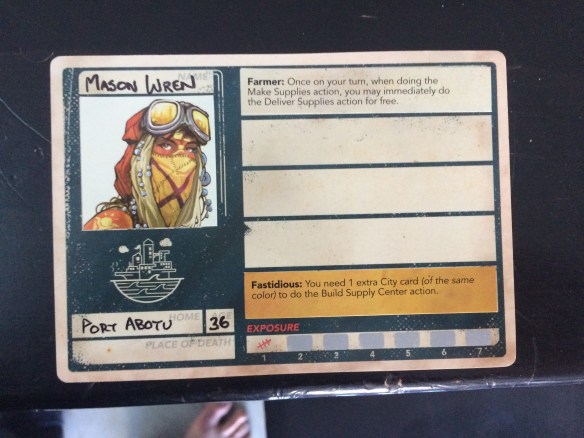
I am Wren, 5th degree Mason of the Green, and I am of the blood of the Builder.

It is the 71st year since the Fading Sickness ravaged the earth.  My great-grandfather, the one who is only ever called Mr Abotu, helped stop it from destroying everything.  What is left of the known world is a tenuous network of cities arrayed around what was once called the Atlantic Ocean, held together by the Havens he helped organise and build.  My home is named after him, and Port Abotu boasts the most beautiful habitats and most elegant hydroponics, and I am personally responsible for the design of the Great Desalination Plant, by the Grace of the Auspices.
2017-12-03 16.40.41
To the north lies Angel Station, who follow the lessons of Dr Knight, and pass them on to the rest of the Grid to keep the peace and quiet.  To the east is Aegis Island, who stand watch against the Hollow Men and the raiders, mindful of the warning of the traitor Colonel Jones.  Angel Station creates, Port Abotu preserves, Aegis Island destroys.  Thus we keep the world safe.

And yet, we have had no word from our leaders, who were due back after the annual meeting.  My nephew PT has urged me to take the lead and represent Port Abotu for, while I am yet to reach the Inner Circle, none question my standing in the community.  I am to join the record-keeper Tell from Angel Station and the administrator Charlie from Aegis Island, both solid friends, to form a new Alpha Team to investigate.  Tell’s knowledge of the network and Dr Knight’s lessons will be invaluable, and Charlie has always been able to organise travel routes regardless of resources and weather, and I am truly glad to be with them.  But supplies of vaccines and food dwindle across our whole network, and the Fading Sickness is always ready to come back.  The Grid has to be kept safe, even as we risk travelling back into the ashes of the old North America to find word of our leaders.

My heart skips a beat as I wave goodbye to my husband and to my little girl.  I am of the blood of the Builder, and I am bold and ready, but where we tread is where the Fading Sickness started, and despite the ashes that fire may not be out…


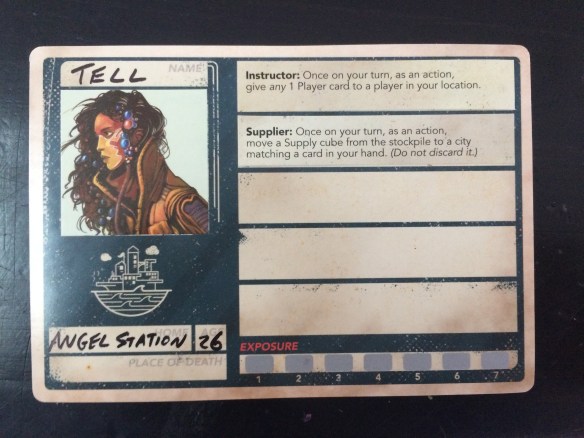
They call me Tell, for that is my duty. And our Leaders are no more today, because they failed to tell us the truth. Supplies are at catastrophically low levels, and they hid this from us for too long. Our only option is to rediscover our world, whatever the cost. The Hollow Men are out there, but so is what they used to call Amrica. It is not enough to simply stop the plague from spreading; now we must explore the forgotten land.

We established a base in Washington, named for one of the old kings, and where we know the Fading Sickness did begin and end in the histories. But this month the ocean was our enemy as it so often is: as we built our base we got word that Tripoli was collapsing, and London too, as raiders stole resources and sickness spread. Our back up, Team Bravo, shored up Tripoli, while Charlie was airlifted to London. Even as we prepared to build a base in Lagos, it collapsed from disease but thankfully the people were soon resilient. The Quiet was with us.

And then it wasn’t. The ocean, demon that it is, struck again. Seeing our base, the Hollow Men struck at Washington, burned all the supplies. Disease sprung up. Facing the exposure, Mason Wren came away changed. They became anxious and deliberate, and from now they would leave no box unchecked, consider no base fixed until it was perfect. Charlie raced back to pull them out, and when we looked for escape routes, we made contact with Chicago. A new city on our map. And from there, word of others, like Los Angeles and Atlanta, cities lost without roads to reach them.

Everything is about the tyranny of distance in this world, and the Ocean that keeps us apart. While we built a base in Istanbul, preventing its fall, and finished our work in Lagos, London began collapse. That ancient city almost fell to the plague. Cairo too, we saw the dead begin to pile up, just like in the stories of the old times. We had new friends in Amrica, but so many were dying in the east. Our world is not stable. There is no future guaranteed, no secure path. We are not building a new garden but once again saving a world teetering on a brink of survival. Just as the old ones fought, we must fight. Or the world will truly vanish forever.

But we are ready. Already I have learnt to be a Supplier, mastering the networks our Leaders used. The Ocean will not beat us. We will survive.
2017-12-03 16.40.31

(I’m a bit disappointed we can’t name the cities we find. Maybe later? Everyone wants to build the setting as much as possible.)

Pandemic Series 2: Prologue

There will be spoilers. For Series 1 as well, and as we go on, for Series 2. No spoiler space, read these links knowing you’re getting every thing we experience. 


2017-12-03 14.30.10

The world before

“I woke to the smell of Montreal on fire.” These words begin the diary of Dr Angela “Quiet” Knight, the great genetic scientist who was one of the key players of the fall. She saw the rise of the megaplague C0dA, the march of the Faded and the work of the conspiracy. She headed a team that fought all of that, and brought the world back from the brink. We know their names. Professor Cassandra Crow, the Researcher. “Lagos Bob”, the Medic with the local knowledge who broke the back of Lagos Fever, the two who started the journey, Mr Abotu, the African fixer who made the operations possible, Peggy Cassimatis the virologist who found the cure, and Heronymous Soto, the criminal who helped get the cure to the people. And of course Medusa Jones who betrayed them all.

Bob disappeared during the chaos and Professor Crow we think died in the Montreal riots. Nobody ever saw Medusa after she went back to her “friends”. But Mr Abotu was a builder and with the channels Soto set up, they were heroes beyond the incident: they helped rebuild the world. Or at least the havens that would preserve it. The havens produced vaccines and supplies and kept the coasts safe. And Dr Knight, they say, spent the rest of her life flying back and forth bringing hope and medicine to the remote communities. Here in Angel Station, we remember her like a kind of angel. She came bringing peace. Bringing quiet.

They call me Tell, because I have the job of remembering. I keep the records of the old ways. We were scientists and we will be again. We didn’t just survive, we thrived, and we cured diseases and fought them back. And we will again. On the air we hear the word of Crow, who I think lives here too. To the south is Port Abotu, named for its creator, where PT and Mason Wren live. The mysterious Charlie Jones is from Aegis Island, a vast shield against the plague and chaos of Before. You can see our Haven Cards below. As you can see we did not escape January unscathed or unchanged, but that we’ll cover in our next installment. Our leaders have been gone a few months and we have held down the fort fine; January we set out to find out what happened to them, and what they might have kept from us.

2017-12-03 15.07.55

The world now


The rules very clearly and specifically say to make all five characters and give them a home, and an age, and a job before you begin play, no matter how many people are playing. We will be playing a three player game as we did with series one; as you may have guessed I will be playing Tell to begin with. Every character has a spot to mark their Place of Death. That also feels ominous as hell.

Our experience with the Prologue games has been fantastic; we are mostly winning and enjoying the twist on regular Pandemic with the lack of control arising from multiple cards being in the Infection Deck, and the ticking down rather than ticking up. We are so goddamn excited. 

Momentum

If you turn a plant around perpendicular to the gravitational axes, it grows in a spiral. In other words, if you keep changing the definition of up and down, the plant just adapts, and adapts, and adapts. That’s what life does. If grass can do it, you can do it. Well, except for photosynthesis.

Let me tell you about the first card game I ever made. I was 23, it was 1999, and I had no real interest in game design before that. But Lunch Money and Chez Geek and Once Upon A Time and other such amazing new card games had just come out and the world was teetering on the edge of the golden age. So when my sister and I were watching Primary Colours and she suggested it could be some kind of game, I got out some cards and went to work. The game was called Election, and it was about building up Platform cards (like “Bomb Them Towelheads Back to the Stone Age!”) and Character cards (“I Triumphed Over Dyslexia”) before a random game card triggered the end, and avoiding attack cards that showed you to be a hypocrite. People played it an laughed at my flavour and setting (my biggest strength, already), but it became very obvious that putting down point cards was always a better strategy than attacking someone else.

I thought and thought and thought and thought and spend an entire year trying to figure out how to fix that. And I had no idea what to do next. I concluded I had no skill for game design and put it away and with it any intent of doing more.

Fast forward fifteen years. The Golden Age has raged and for me, RPGs have waned in my tastes, replaced by a love of the cardboard dream. The itch rises again. Some friends and I come up with hundreds of film tropes in an attempt to make an Apples 2 Apples type parlour game, but it’s not much of a game and we don’t know what to do next. One of those friends starts getting the bug and starts making cards. He takes them to unpubs and protospiels. I feel bewildered; surely I should be able to do this too. But there’s a block. I just can’t figure it out. It’s like I don’t speak the language.

So I go to conventions and ask questions about how to push forward. When to give up. How to get ideas. I study the process. But it’s slow. See, at every stage, it doesn’t seem to make sense. Not only do I not know what to do, I don’t know how to find out. Listening to podcasts doesn’t fit. Reading books feels off. And I couldn’t ever ask someone to playtest something for me. Not even my friends. It almost killed me asking people to play There Is No Spoon all those years ago. And I know I can make RPGs.

But I can make RPGs. So I start there. I write It Is Forbidden, but more importantly, I take it to an unpub. I stare down the barrel of hell and ask people to play a game I wrote. I get in fast and then run away shaking. I remember the first time I asked a business if they’d be interested in being interviewed in my old magazine PTGPTB. I had a car accident that day I was so nervous.

But then I get the game out again at PAX 2016 and amongst friends I run it again.

A few months later, I have an idea for a card game. And now I know enough about how to print pictures. How to sleeve things. It’s hard but I learn by doing. It’s ugly as hell but it exists. And at CanCon in January, I go to a publisher meet and play other people’s stuff. And right at the end, I bring out my baby. And it falls over and fails but a few people offer instant suggestions, and immediately it gets better.

You know the rest of this story. That was Baby Dragon Bedtime and everyone who plays it loves it. And it looks like it’s getting published. In the week leading up to PAX 2017 I saw how to coalesce one game and it may be optioned as well. I’ve made two whole card games since I’ve got home nine days ago. They’re not nearly finished of course but they exist to be tested which is what matters. And it wasn’t so hard because I can find the software now and can print and sleeve and make. My hands find the positions. Nothing screams in my head about the wrongness of it all. In fact it comes so quick I can barely stop. I listen to three podcasts while I go, and read my game dev books, and run unpubs.

IMG-2741Like I said, you know this story. It’s the story you always hear. Sucking at stuff is just the first step to be pretty good at stuff. But it’s not about skill, or not just about skill. Nature knows what is normal, and if you change anything, no matter what, the system screams. The plant realises up is no longer up and the system goes into shock. Everything it used to do is wrong.

And then, it grows upwards in the new upwards. As if nothing changed. As if it always had.

I’m cheating somewhat of course. Game design isn’t a physical skill like drawing or dancing, and I’d been studying it by osmosis my whole life. But there’s lots of skills like it. And those that aren’t like it – well, once you turn the pot, the learning comes much easier. Often in messy, ugly jerks and starts, other times in gushes, but once you know about changing your nature, the learning gets easier.

BDB_Basic_Cards_528

Nature does what it knows. Change feels like death. But once changed, doing it differently is life. Yes, there are skills, and that’s a barrier too. But there’s also the pain of change. Once you know it’s there, you can ride it out. And in a blur, everything is suddenly easy. Everything is suddenly just what you do. As easy as breathing. Turn the pot. You can do it.

Free Solo Storygame: Stallions of Steel!

If you were at PAX Australia this year you might have been handed a copy of THE DAY THEY CAME (my parlour game about refugees) or PUPPY DOG TALES (my parlour game of trying to guess the movie dogs want to watch). Meanwhile, Alex, Shannon, Rex and I made a board game in one hour (the amazing UN-STABLE, a game of psychic horse warfare).

IMG_3357

I did most of the MCing and none of the designing on UNstable so it made sense for Shannon to challenge me to add a stretch goal to our game: a story game about the cyber-psychic horse apocalypse. (We kind of lost the cyber in the board game, look shut up, this was all done at high speed).

It ended up being another solo game in the tradition of The Tin Star. Here is STALLIONS OF STEEL, a game about the terrible cyber consequences of winning the war for horse freedom against human oppressors.

23319216_10155920553858552_3970054684276628126_n

This is the only copy so I’m sorry it’s so blurry. I’ll write it out properly in the next few weeks if I ever get over this goddamn flu.

Anyway you too can make guerrilla one page RPGs it’s grate. It’s not just Grant Howitt and me.