A Big Fat Load of RPGs

Conventional wisdom suggests that making and selling and consuming micro RPGs is all going pretty well. People make them, publish them and sell them for zero, two, five, ten or twelve dollars and people are happy to pay that for those things.

I am never a fan of conventional wisdom.

So a suggestion for all my micro-RPG writers out there: a big fat load of micro RPGs in one book. I’m thinking of calling it something like 1d20 Games, and we try to have 20 games in it. Each between say 6 and 10,000 words. Then we kickstart the whole shebang and make it real purty and printable. Get your game out as something you can put on a shelf. And if it takes off like crazy well then hell, we do it again next year. Like how anthologies gather the year’s best horror and fantasy short stories and such, so as it ends up on the shelf next to novels instead of getting ignored.

I’m throwing this idea out very casually because it’s just an idea as yet, but I’m deadly serious about following it through. I’ll write all 20 RPGs myself if need be. On the other hand, maybe you’ve been looking for a reason to finish something. Maybe you’ve got a threeforged game you’d like to publish. Maybe you’ve made something for free and figure it’s worth charging for but never quite got over that hump of publishing. Maybe together is easier than apart.

If you’ve got thoughts on this, I want to hear them. If you’ve got games to submit to it, I want to know.

Review: Shadow of the Demon Lord

RPGs are a complex recipe, involving a lot of different aspects which require a range of skills. That’s why it’s always exciting when a designer who has been prolific in working on other games takes the helm of his own – we get a new window into their strengths, weaknesses, preferences and styles. Such is the case with Mr Robert J. Schwalb who has spent more than fifteen years working on a plethora of games from Warhammer to Numenera, not to mention three separate editions of D&D – and doing work so consistently good and interesting that it was worth notice even if, like me, you didn’t care about Dungeons and Dragons.

Yes, I’m one of those gaming snobs who finds no appeal in the Big Kahuna. I don’t even have any nostalgia for the old days, even though my introduction to roleplaying was losing Aleena to Bargle (spoilers) in the redbook Basic Edition by Frank Mentzer. And that’s important because there’s a lot of that book in Schwalb’s opus Shadow of the Demon Lord. So much so that Mentzer wrote the foreword.

So is Shadow a nostalgia piece or retroclone? Not really. Perhaps better to say that it identifies very clearly the things that were good about BECMI/Cyclopaedia – things like simplicity, streamlining and surprise – and replicates them in a modern, accessible, stylish game product, one that is accessible to all but unlike anything else, familiar to any D&D fan but matured from lessons learned by Shcwalb and gaming in general. The marriage between old and new isn’t perfect, but the tension is as interesting as it is problematic, and the shiny gems of genius outweigh the flaws.

So what is it?

It’s definitely an old-school fantasy RPG, in the sense that it assumes you live in a world of magic, elves, dwarves, fighters, thieves and clerics, and expects you to do a lot of killing of things, sometimes in dungeons. It’s also old school in that it doesn’t tell you anything about that world at the front of the book (apart from quick notes on tone) before we leap into chargen. And this is exactly what I mean about an uneasy marriage between old style and new sensibilities.

On the one hand, I’m hate reading endless waffling setting material, and doubly so if it is shoved on me at the start. I like learning the game through the mechanics; I think that’s how it should work. And I’m tired of too many games working to the formula of front loading the (ponderously explained) setting before I see the playing pieces. But the introduction here was too swift, too reminiscent of games where rules were the purpose, because of course you were in a D&D-like world because every game was another D&D clone. It makes it hard to actually understand what the game is about and where it takes place. Getting a grip on the face of this game is not easy. And the cover is no help; after reading the whole game I’m still not sure what monster is depicted on it (an ogre maybe?).

Getting a grip on the style, however, is helped by the example of play which gives us the usual Schwalbian grand guignol gorefest. If you didn’t want to see blood and faeces flying out of writhing, living intestines, you came to the wrong place.

Until we get to the gazetteer stuff at the end (and not even then), this is your basic fantasy world, except darker. World-destroying doom is consuming the land of Rul, and you are the only ones who can stop it, and the rest you have to work out for yourself in dribs and drabs. But those dribs reveal some lovely, extremely atypical stuff: elves are the terrifying child-stealing old-magic kind, and their changeling children are a playable race. So are the clockworks, mechanical objects given life by turning their cranks, and goblins, rejects from fairyland who prefer to live and work in squalor, and orcs who are tainted by dark magic, not just another race. Humans and dwarfs round out the list, and retain their usual roles of flexible and grumpy.

The inclusion of clockwork people, and goblin muckers and working pistols and rifles (and mages who use them) are all reminiscent of the Iron Kingdoms setting from Warmachine; while the clockwork people, artficers and changelings suggest Eberron, and the pistols, demons and encroaching corruption and insanity suggest Warhammer. And the truth is, there is a lot of references and keynotes in here, but Schwalb has the sense to steal wisely, well and often enough to create a patchwork that never feels derivative. You’ll also see references to major personalities like the Arch-Mage and the Dark Lady ala 13th Age, mechanics lifts from Pendragon and Warhammer and Dark Heresy and Call of Cthulhu, nods to Tolkein and Howard, and stuff from literally every single edition of Dungeons and Dragons. Every now and then there’s a choice that sticks out a bit in this, but overall the tone is maintained while at the same time showing us Schwalb’s greatest loves, a sample bag of his favourite things in every RPG he’s played.

Meanwhile, if I was trying to sum up the feel of the setting, I ended up being reminded of the 1985 film Return to Oz, in that sense of dark despair combined with the madly inexplicable, plus wind-up men. Return to Oz also has a late 70s-early 80s tight-angle horror feel to it like The Shining and Halloween and the Omen and that is definitely part of this setting. You don’t have to play the game for horror, but you certainly can.

Speaking of things from the 70s, chargen can be done entirely through random dice rolls, which is lovely to see, especially when it doesn’t result in unbalanced characters like it always has in D&D. Races (or ancestries as they are called) have a starting suite of attributes, and the rest are then fairly and equally assigned depending on rolls. As you might expect from the man who gave us the d1000 Chaos Mutation Tables, chargen also has random tables for age, build, personality, background, professions (which take the role of overarching skills) and 120 different strange items. All of this provides the kind of characters only random chargen can create, and an extremely flexible and fun class and level system helps keep you bouncing around life’s curveballs into paths nobody could have designed.

Lest talk of classes and levels turn you off, let me say this may be the best class/level system ever designed, for a variety of reasons. Firstly, because you don’t have a class at level 0, which allows your character to actually have a prologue experience before selecting a life role. Fantasy gaming has always suffered from a lack of prologue, perhaps because nobody wants to spend ten years in Hobbiton with Gandalf visiting occasionally or twenty years tied to the Wheel of Pain like Conan. But in gaming it’s often hard to know who you want to be until the first adventure sets the scene and tone for the campaign, so a prologue makes a lot of sense. And it’s not like picking your first class locks you in to a restrictive bind: yes you have it for the rest of the game but the low-level class choices are extremely general – Magician, Priest, Warrior or Rogue – and provide very general abilities. You want to be a book-reading wizard, or be a druid-priest not a cleric-priest, wait until you get to level 3 to pick your Expert Class and hone your concept down – or switch to book-reading wizard from warrior or rogue or cleric. At level 7 you can choose to narrow your focus again, or choose another Expert class, while all the time still gaining benefits from your first choice, your first instinct and general approach towards the world.

From four Novice classes we go to sixteen Expert to sixty four(!) Master, which is wonderfully enormous especially when you know you can pick any of them. Want to suddenly become a Chronomancer at level 7 after six levels of warrior stuff? That’s fine. You won’t however, be as good a Chronomancer as someone who spent their life preparing for it but you’ll have a better grounding in hurting people. It’s a system that is streamlined, simple and maintains total flexibility while completely balancing the specialist and the generalist better than anything has before. Scuttlebutt is Schwalb and his crew spent three years playtesting this, and it shows. This has the laser-like attention to balance that D&D 4E has, without the sacrifice of flavour and variation.

It’s also wonderful that everyone can learn magic. That plays into the dabblers of old school, pre-D&D fantasy, and by grouping them into 30(!) different traditions, each waiting to be unlocked through exploration and discovery, it provides a sense of a world infused with magic and mystery, without throwing a billion magic items at you like D&D. Indeed, as written, players will own at most three magic items in their lives, and maybe one powerful, story-changing relic, which still won’t have huge in-game power – but enough to swing things importantly in your favour.

It is a system where small changes matter, which is great at hammering home the knife-edge horror of the setting. Using a single d20, yes, makes it very “swingy” with the uniform distribution, but it helps that almost everything centres around the middle range. Stats range from around 8 to 14, they are also your target number, or, when you subtract ten, what you add to the die roll. Bonuses and penalties come in the form of boons and banes. For each boon, you roll an extra d6 and add the highest of those d6s, subtract for banes. So you’ll never get more than a +6 or -6 but more banes and boons shift the likelihood towards a big bonus. Yes, you could just make it +2/+4/+6 but the possibility of a single boost giving a massive +6 adds gambling excitement AND the randomness of that works to cancel out the randomness of the D20 roll, which is some elegant stuff.

If you’re not hitting someone else’s stat, you’re just trying to break ten which as I said makes every point matter, and that makes levelling up a huge deal, as it should be, especially when there are only ten of them. And for once, this is a levelling system that understands what levels do: they’re not just fun rewards for characters, they cause dramatic shift in the game’s tone. And as such, it has the best experience system ever, which is that characters level when that dramatic shift is appropriate, and not before. That usually means after achieving a significant story goal or ending an important adventure, which means you can use levels to structure your entire campaign in a rigid way (eleven adventures will do it) instead of a haphazard, guess-work way where you may or may not need filler. Campaigns are soon to be released to make direct application of this system.

With so many class and level powers, they take up the majority of the book. Combat and rules adjudication are sweetly simple; the rules are just complicated enough to have fun with them and have fun breaking them. What’s left is world description, GM advice and possibly the biggest bestiary in a corebook ever.

World design takes us on the whistle-stop tour of Rul in a confusing way – alphabetically by geographical features first, then nations and city states – which leaves us just as confused as we began until you’ve consumed the whole thing. It doesn’t help that the backstory about the elves and the world history in general doesn’t appear until we get to the zoomed-in section about the default campaign starting area. The feel of this Northern Reach is a nice combination of a frontier far enough from the Empire capital to be self-governing, cut with an Empire-born religious Crusader class because even further north is where the evil comes from. Props for making the evil tropical, too – the land of Rul is in the southern hemisphere, amazingly for fantasy gaming.

Some of the world building is derivative or uninspiring but it’s usually saved with some wonderful flashes of vividness and invention. Yes, there are fantasy Vikings but they’re made more interesting by being conquered years ago and blasted with dark magic to make orks. Yes orks are a mindless warrior race, but only until yesterday (setting-wise) when for some reason the magic ran out and they rebelled and murdered the Emperor who enslaved them. There’s a bunch of mercantile city states that are a bit the Hanseatic League and a bit BarterTown but one of them was built for an enormous population that then suddenly died of plague so the city’s architecture is ten times what its population needs. And so on.

These flourishes, these sudden moments of not just invention and colour but also revelation are for me the best thing about the book. They’re everywhere, too, little notes in classes power descriptions and random tables that suddenly open up some part of the world you never though about, and there’s a score of them in the bestiary, like the entire race of dwarf-like beings who have transparent skulls or the fact that mirrors are mistrusted because one-eyed demonic slimes can leak through them. Remember when I said that one of the best things about the old redbook D&D was surprise? This is what I’m talking about: these moments where you can turn a page and find a new entry and suddenly everything is new again.

That said, there are times when this approach lurches from wonderful surprises to appearing haphazard and even slapdash. It’s funny that there are Shrieking Eels from Princess Bride and graboids from Tremors but it can pull you out of the game. It’s nice to reference D&D and warhammer but were the amphisbaena and the beastman really worth including? And then there’s the reen which are basically the robot squids from the Matrix invading from another RPG and throwing the tone off completely. Listen, people: Barrier Peaks was a stupid idea. It will always be a stupid idea.

There’s also the fact that some of these things should be more integrated into the game. Like the the fact that most of the farmers of the Empire are Halflings but you only find they exist when you’re 80% through the book. Or that we only find out that the one and only dragon in the land lives on Mount Fear when we get to that location’s description. Or that rifles and pistols are a thing but no mention of whether cannons or greek fire exists. Too much ‘Rule of Cool’? Or just some chinks in development that will get more follow through in the next edition?

Lack of follow-through also haunts the whole concept of the game. The eponymous demon shadow is more than just a mood component: we’re told that his scrabbling at the edges of reality is already casting a pall over everything, his cults and agents are everywhere, the End Times are near. The GM chapter provides twenty different ways you can choose how this doom will specifically incarnate, with the suggestion that the orcs throwing off their masters (causing the likely collapse of the Empire) is the one operating in the default setting. And while that is cool, there’s not a lot of development about how it matters, or how to stop it. The other ideas have brief rules suggestions but only one or two lines. The bestiary has demons and demonic powers, and there’s dark magic in the spell list, but no real development on how such things appear. Shadow, in other words, is there in tone and feel but not as much in fact, in setting, rules or narrative structure. Call of Cthulhu doesn’t just have the Old Ones coming back, it gives you a road map to how they can be at least temporarily held back. This may be alleviated in soon-to-come supplements or campaigns, but at the moment this feels unfinished.

It could be an artefact of the Kickstarter: a whole series of PDFs were unlocked through the campaign which might give more insight, and a companion is on the way. These problems, therefore, may be likely on their way to being fixed. And they’re far from fatal flaws, just niggles. This is definitely a four-star game as it stands, you just might have to spend a little bit more on a companion or a campaign to get a five-star game.

Luckily, these supplements are coming and in no small measure. This is going to be a massively supported game that is also to be converted to a post-apocalyptic and SF setting in the future. Given that we see in Shadow of the Demon Lord Schwalb’s trademark vivid imagination, command of style and elegant mastery of rules, this is great new for roleplayers whatever their genre preference. In other words, I’m not just excited to play this game, I can’t wait to see how it develops.

Talking ThreeForged RPG Design

So a little while back I participated in Game Chef Design Challenge which is a RPG writing competition thingy that’s been running for over a decade now, inspiring people to get stuff down on paper. Hot on its heels came the ThreeForged RPG Design Challenge, conceived by one of the primarchs of indie design, Paul Czege. Game Chef is about coming up with something to fit a list of ingredients. Three Forged is different.

ThreeForged takes on something like “Exquisite Corpse” model: contributors create one game, up to 1200 words, and pass it on, and then get someone else’s first entry. Then they take that first entry and develop it into a 2500 word game, and then pass it again, and taking someone else’s second phase game, produce a final product. Unlike Exquisite Corpse though we weren’t adding blindly but taking what we were given and taking it further.

Starting with an enormous amount of entries 102 made it through to the final round, and everyone – yes, even you – can vote for the best. As long as you read at least five, you can nominate games for the final round, and all the games can be found here. The numbers beneath each game show the amount the game has been downloaded so we can share the love (make sure you review what you download!) but if you can’t decide a helpful fellow has put a randomizer up.

I’m not allowed to identify which game I worked on so that the judging is anonymous. I can reveal that my first stage game did not emerge at the end, which is a damn shame. Not just because it would have given me three shots at being a finalist instead of two (my third-phaser and my second-phaser) but because I think the 1-2 change over was the most interesting, and hardest part of the process. And where I learnt the most. And in both cases because it was when the rubber hit the road for the first time. By stage two we were used to it, but that first encounter was hard.

A thousand words is not a lot but it is enough to mark out clearly what a game is about and the main moving pieces. And the game I got was about something I felt I had no connection to. The mechanics were not my style and the stories uninteresting and the topic something I disdain. It wasn’t that I couldn’t see what to do with the game but that I didn’t want to do anything with it.

Luckily the most important rule Paul drummed into us was that we could change absolutely anything, as long as we kept what we believed was the core of the game. So I came at the question a different way: what was in the idea that I could connect to? Truth is there’s usually something in everything we can connect to, once you cast it through your own eyes. And then to find how to make it a game we would want to write, and more importantly, play.

And that was the revelation for me. As a freelance writer, your primary skill is to be the chameleon (yes, chameleons don’t do what they’ve been co-opted in language to do) – to be exactly like the style you’ve been hired to emulate. When you combine that with the general artistic pressure to fit into a culture and meet a level of quality, one of the biggest mistakes writers and creators do is try to emulate too much. “Write what you know” is not great advice, but “write what you want” is super important advice. Even though it sounds obvious. We get so caught up in trying to be what a writer appears to us to be we think we have to copy them, and write the way they do, about the things they do, and that means, almost always, you aren’t writing something you want to write. And there is no greater way to kill your love of art than to do that. Don’t try to tell a story if you don’t burn to tell it. Don’t try to write a game if you don’t keen to play it. It sounds so obvious, but I’ve been making that mistake all my life.

But having that lightning-bolt moment powered me into the contest like a new man. I took a game that was light and fluffy and made it a blood-soaked horror story. And when I got my 2nd stage game, I was ready. I found my hook, tore out everything, and wrote a new game. Not one word of the original survived, and I don’t apologize for that. That wasn’t the point. Or not the only point. Paul’s admitted his sneaky point was in fact to build a community and get people working together, and we will because once the voting is over and we can reveal our names I need to go back and thank my muses for handing me ideas. I hope they won’t feel hard done by when they see how much I changed, and here’s why: there’s no way I could have made either of the two games I created without getting their ideas. Because how could I? I would never make a game about some random topic I had no connection to. Unless, of course, I had to.

It’s like what I said a few weeks back about how artists are not singular people, and artwork is not done and should never be attempted to be done alone, because that’s not actually how it works. And now I have the perfect example. Some might look and see that I was given manuscript A, deleted every word and produced manuscript B and conclude that B had nothing to do with A. Others will see two manuscripts where you can clearly see how everything was kept and added to, and they will say that the second example is a clear collaboration and the first is total reinvention. And they would be totally, utterly wrong.

You know how in mystery stories, it always takes a minor character saying a random word or describing a completely unconnected experience that allows the mystery solver to see the truth? Writers always write that not just because it’s a genre trope but because that’s how WRITING works. And it is impossible without those people. You can’t make a quilt with one square. An artist’s job is to sew us all together. And you are part of that. If you talk to an artist, share with an artist, live, laugh and love with an artist, you are an artist, and we create together.

I got three games out of this. One I could have always created, but two I could never have. That’s the win.

Crazy Fun With Microscope, or Crow, Eagle and the Legacy of the Wurm

One of the key parts of RPGs and storygames is the interaction between diagesis – the story as it is told – and exegesis – the story that emerges from the telling. In most traditional narratives, the two are indistinguishable, but that changes as soon as you have achronological devices like time travel, retrospectives or flashbacks, or unreliable or non-omniscient narrators, or multiple viewpoint characters or countless other literary trickery. In most traditional RPGs (and most games, too), the two are close to indistinguishable, and certainly operate in parallel and simultaneously. And yet even there, as soon as we have the tellers and the avatars as separate concepts in the same body, there is an interesting friction between these things, where all sorts of fun metagaming issues reside. In recent times, more and more games have enjoyed playing with this friction in explicit and mechanical ways, but few in such an extreme way as Microscope.

Microscope’s name comes from the game’s ability to shift focus. The overarching goal is to produce a history perhaps millions or billions of years long, but players can zoom in on slices of that time to find key events, and then zoom even further to pure moments, of dialogue and interaction. For what is history but a series of moments?

But in writing up the game, I find myself in a quandary as the nature of the game is to record for posterity the exegetic narrative, the history created, but it is the experience of its telling, the diagetic creation, that has the most wonder, seeing how it formed so achronologically and so strangely. I will endeavour to give some sense of the diagesis first, so you can see the madness before the final creation, lest you think we somehow planned it or built it in logical stages. You might be tempted to think that because event B comes after event A that A caused B, but other times, knowing that B must happen, we would rather create an A that might be a due instigator. As the rules of Microscope say you cannot change the future, but the past is yet unwritten.

We began with a pitch: I envisioned a town in the USA in the modern day with a strange and chequered past, perhaps as violent and tragic as the city of Pawnee in Parks and Recreation, and definitely with as much strangeness and curious magic as the city of Night Vale from the eponymous podcast. I said that perhaps in modern day there might be touches of Wysteria from Desperate Housewives and Royston Vasey from the League of Gentlemen. I had also taken the liberty of providing the initial framework of the chronology, which is done by defining the first and last Periods (the largest unit of history) such that nothing can happen before or after. To leave our beginning blank, I’d labelled that “Ancient Aeons Ago”. To fix the end in a world of modern day US politics with a dash of satire and fear of the unknown, I dubbed the final Period “After Obamacare”.

Next we moved onto the Palette, an excellent naming advice useful for any shared creation: each player could add an element they would like to see in the history (but was not mandatory) or something they definitely did NOT want to see (and thus could never appear), to give us our palette of elements to work with. Our Yes list was: Family generations, Animism, Secrets and Dragons, and our No list was simply Lovecraft (too overused) and Parody (we wanted it to take itself seriously).

From here on in it becomes harder to tell this story because as I say, the end recording is of the exegesis. And if I tell you that story, from beginning to end, you’ll think I’m telling you the story of Eagle, Crow and the Green Dragon Legacy. Which was where we ended, but only at the very end did we know that. Although be the end of the first pass we did know that 1880 was the height of the Green Dragon’s Rule, and that at one point, ancient aeons ago, Animals Walked As Men. And then it got so much more strange, in the most wondrous sense of the word.

Chronologically in the diagesis, I can only list each of our Lenses, and the Legacies. Each round every player gets to add a Period, an Event in a Period or set up a Scene in an Event, but all of that stems from the Lens dictated by the head player (who also gets more additions), called a Focus. (Note: I have swapped the terms Lens and Focus here as they are written in the book because we liked to think of the Lens as being the lens through which we were viewing history, that made more sense on the day. And I encouraged everyone to think like historians.) After our first pass suggested the rulership of some over others, our first Lens was “Peasant Uprisings”. This cemented much about the noble families, so our second lens was “The Two Great Dynasties”. A throw-away comment in a scene in that round suggested we had robot automotons so our third lens was “The Robocracy of the Greater US”. Our last two Lensed brought us back to our theme, and the nature of Crow, with “Disruption Leads to Change” and “Towards the New Abyss We March”.

Legacies are determined by the player to the right of the Focus, and represent emerging themes, ideas, concepts, bloodlines, groups or aspects of history that are interesting and worth pursuing in the future – perhaps. The Legacy maker gets a scene about their Legacy (or another’s after the first) as well, to finish each round. Our Legacies were “The Preservation of Knowledge”, “The Ghost In the Machine”, “Knowledge versus its Application” and “Shadowy Badger At Work”.

And now: history – Periods in All Caps, Events within below, Scenes in brackets. Periods and Events are given Tones which determines roughly how they feel – but it’s up to interpretation.

ANCIENT AEONS AGO (Tone: Light)
– Animals Walked As Men (Dark) (in which Crow bargained with Thunderlizard so that Crow could make the Builders at the cost of Dodo)
– The Great Wyrm Rises From the Abyss (Dark)
– The First True Folk Are Formed To Till the Gardens of Paradise (Light)
– Eagle Pulls the Prophecy From the Abyss (Dark)

NOBLES HOARD THE SECRET OF FLIGHT (Dark)
– Invention and Production of Aerial Artillery Begins (Light)
– The Worm Vandykr Starts The Cult of the Knowledge Eater (Light)
– The Builders Turn to Worship of the Knowledge Waster (Dark)
– The Destruction of the Abyss Leads to War (Dark)

THE GOLDEN AGE OF THE BUILDERS (Light)
– Sparrow* creates the Chessmaster Armies from Abyss-Ash (Dark)
– The Difference Engine Defeats a Chess Grandmaster (Light)
– The Builders Sell Their Secrets to the World (Dark)
– Badger Teaches All The Animals How To Build Cities (Light)

*-was supposed to be Starling, but I got it wrong. It’s Sparrow now. In errattae veritas.

1680: THE HOUSE OF VAN DEKKER FOUNDS THE CITY BENEATH NO STAR (Dark)
– The Others Found the Great Library for the Common Man (Light)

THE RISE OF “UNCLE SAM” THE PRESIDENT MACHINE (Light)
– The First 100 Days (Dark) (In which reporters reveal Crow has meddled with Uncle Sam’s perfect programming to prevent war with the South, according, Crow says, to make the Prophecy become true)
– Uncle Sam Unveils the World Tree Broadcasting System (Light)

THE GOLD RUSH YEARS (Light)
– Wyrm and Raptor, the Two Bloodlines, Agree to Shimmer As Men (Light) (and in agreeing to do so, Mr Wyrm and his bankers bought control over the Pinkertons and the Town, much to the distress of Ms Starling)
– The Tutelage of the Green Dragon Begins (Light) (and Crow and the Green Dragon become enemies over whether information should be stored in books and studied forever to understand the prophecy, or if knowledge should be created by great men like Green Dragon)

1880: (THE PEAK OF) THE RULE OF GREEN DRAGON (Light)

– The Failed Rebellion of Crow (Dark)
– The Plague of a Thousand Hands (Dark) (which began when Crow took the Last Book from the Great Library to begin knowledge anew)

1913-1946: THE READING OF THE LAST BOOK (Dark)
– The Civil War Overthrows Green Dragon’s Control Of Midnight Meadows (Dark)

THE CIVIL RIGHTS MOVEMENT COMES TO MIDNIGHT MEADOWS (Dark)

– The Council of 12 Bans Secrets, Ruling That All May Know The Truth (Light) (in which Widdershins Starling unleashes the Emancipation Virus, despite this revealing she was bald as a cueball)
– The World Tree Is Destroyed In A Nuclear Blast (Dark) (sneakily launched by Crow, when Uncle Sam is distracted by a wish to end his own reign, now he is a freebot)
– The Witchhunts Begin: Wyrms Blamed For Allowing Secrets of Nuclear Technology to Go Free (Dark)

RAPTORS SEIZE POWER IN AMERICA: ALL GLORY TO PRESIDENT EAGLE (Dark)

– The Prophecy, At Last, Is Fulfilled (Light)
– Crow is Imprisoned (Light)
– Badger Chooses The Worthy To Join Him (Dark)

AFTER OBAMACARE (Dark)

– Age of Obamacare begins when Hackers Release the Obamacare Virus – then Lose Control Of It (Dark)
– The Hacker Known As “CROW.BAR” Leaks the Town’s Secrets, Ending All Government (Dark)
– Leaving the World Behind, Crow Seeks His Destiny In the Abyss (Light)

That’s it as it stands. The write-up below is my interpretation of it.

This is the story of Eagle, Crow and the Legacy of the Wurm. But it is also the history of the town of Midnight Meadows, the rise and fall of the great United Robotic States of America around that town and the wars that shook it, and indeed, the history of the whole world

Ancient aeons ago, there were animals as there are now, but they walked and spoke like men. And since they had arisen from the Abyss, they had known only two things: The Hunger, which the Abyss had taught them, and the Food, where they were forced to feed upon each other to quell the terrible Hunger. But then one day, Crow – clever, dangerous Crow – called a meeting with an idea. Present was foolish Dodo, terrible great Thunderlizard, cranky, shadowy Badger, wise Eagle and as always, the ever present voice of the Abyss itself.  Crow told those assembled that he had a plan, an idea to end the Hunger: to build a thing he called his First Children, who would make a great Garden of Paradise, and from it draw forth endless Food so there would be no hunger. Eagle feared change and warned against it – as always. Dodo said he longed for Food for without he and his wife could never have an egg. Badger wondered where the tea was, if it ever had been. They argued, but the Abyss warned that it knew all fates, forward and back, and that if Crow’s idea happened, one of those present would not live to see it finished, and would descend again into the Abyss. Crow knew this, knowing it would be the price of the others’ agreement – especially when Thunderlizard, as always, cared only for bargains. Roaring loudly he told Crow he may proceed with his project backed by Thunderlizard if, when Crow condemned one to the Abyss, Crow would help Thunderlizard bring one back. Crow made the compact. Quick as a flash, Thunderlizard snatched Dodo and threw him into the Abyss. True to his bargain, Crow designed his Children, and they tilled the fields and ended the Hunger.

True to his word also, Crow helped Thunderlizard free the great Wurm from the Abyss. Wurm was the last of creatures, whom the Abyss had kept from the earth because of Wurm’s great pride and vision – and hunger. Wurm was like an Abyss made flesh, and although Crow’s children produced food for all, the Wurm’s hunger continued and led him to feast upon all the creatures of the earth. Fearing the world’s destruction, and knowing of the Abyss’ great wisdom and foresight, Eagle did what no creature has ever done before or since: he descended into the Abyss and rose again from within. And in his beak he carried the Prophecy, ripped from the walls of the Abyss itself. And that is the day the laws began and time began to pass.

The Children – now known as Builders – and the Animals were so amazed by Eagle they sought to make him their king or god, and Eagle was raised up as a noble. Of course Dragon’s fearsome power and appetite had already caused many to worship it likewise. So it was that there began a great rivalry between the two great dynasties – Raptor and Dragon. But because Eagle had descended into the Abyss, he was immortal, so although Dragon passed his lineage down through countless children, Eagle’s children always gained the wisdom of him in person.

At this point, only Raptors and Dragons could fly, and intent on keeping their power equal to each other (and over the others), the noble bloodlines hoarded the power of flight and left all other animals on the ground. Thus Raptor and Dragon soon came to be prideful and arrogant. The solution came from the Builders who created the first aerial artillery allowing the common folk to threaten the noble houses. To keep the peace with the common folk and lore-loving Raptors, an olive branch was extended when the great wurm Vandykr formed the church of the Knowledge Eater, the cult that understood truth should be written down, like the great prophecy. However, as is so often the way with faiths, there was soon a counter-faith that rejected the Knowledge Eater. Most of this cult were Builders who felt the Prophecy and things like it were dangerous because they inhibited development. It was enough to invent new things, and then copy or improve those things. Kept knowledge – trapped knowledge, unused knowledge – was madness that could only hurt progress. Crow, we suspect, sided with the Builders in their love of the Waster and brought many to its fold, even Raptors that had once marveled at Eagle’s rescued prophecy. Eventually, the Wasters were so afraid of a second prophecy they destroyed the Abyss itself, an act that led to a terrible religious war.

But from the flames of war came a better age – or at least a stabler, more egalitarian one. The Builders blamed Dragon and Eagle for the division and war, so threw down the animal races and set up their rule. In this time technology was granted to all – although it meant many animals found themselves in lower positions, or cast out because of their faiths. Sparrow and some rogue Builders built the Chessmaster Armies with Builder tech and sought to destroy the Builder Equanimity, and it seemed like they would until the first Difference Engine was created – a Builder-built machine that could think and build as good as any Builder, and able to out think and out manoeuvre the terrible Chess Grandmasters. Content that they were no longer needed, the Builders became indolent and corrupt, selling the secrets of their designs to the whole world. Not all of Crow’s First People had been Builders, and they now covered the world, and with all the Builder technology they came to dominate it in massive numbers. The animals, used to depending on the Builders without money, were once again bereft. And if it hadn’t been for Badger teaching them how to build cities, they might have vanished from the earth altogether at that point.

Europe descended into a world of war, as men fought men over their religious schism using the Builder’s terrible weapons, and men fought animals out of general xenophobia. In the face of such strife, many looked to leave and found new cities across the sea. So it was that the foreign settlement of what would one day become the United States began when the worm Van Dekker and his house build the City of No Star. The name came from the lack of any constellations anywhere above the town which the wurm took as a good omen, knowing that it would prevent prognostication and prophecy – things, like writing, that were forbidden in the City. But the new land would soon incur the same troubles as the old as Biblioids fled the religious pogroms of the Knowledge Wasters and formed the Great Library also on that far continent, a shining monument to free knowledge for all.

Soon the land was full of men, and the two great houses of Raptor and Wurm came to dominate also in this far land. The City of No Star changed its name to Midnight Meadows as it expanded, and became the capital. The nation was split by political strife as the South which held the Great Library fought with the north which believed in the destruction of Knowledge. Eventually, the Builders presented a solution: a perfect robot creation in the shape of Eagle and programmed to do exactly what it was elected to do – or so they claimed. We know now that even before the election was over, Crow had sabotaged – or edited, as his supporters claimed – the programming of the bot, to follow Crow’s will and bring about the prophecy – and, no doubt, save the Library from destruction. Even with the execution of several reporters this scandal eventually broke destroying the Robot Uncle Sam’s credibility in his early days. As an olive branch he announced a great plan to convert the Library into spoken knowledge, expounded through the World Tree, his thousand-mile-high broadcasting system. Thus the knowledge would be transient, emancipated from books, but not destroyed. Although of course once a book was spoken it would be destroyed forever. It was not a system which the South would tolerate, but before war could break out, the Gold Rush arrived.

It was in this time that modern America began to be forged. Fearing that a time of beasts was done, Wurm and Raptor signed a great pact in Midnight Meadows that they would Shimmer as men from now on. However, the Raptor family (then under the head of Mrs Aguila Starling) that dragon magic still works when shimmering, allowing the wurms to easily control all the gold, a fortune they used to take control of the Pinkertons and from there much of the entire architecture of the United States Government. Green Dragon was born at this time, and he and his tiny cousin White Dragon were the last dragons to appear in their true form, hence they were known by their appearance. Green Dragon would be perhaps the greatest of all the Dragon line, deciding as a young man that he truly believed in the Knowledge Waster, that knowledge kept was knowledge of no purpose. He believed knowledge could only be made through great action by great men like himself, and hammered the point home by marrying Crow’s wife, Amelia Starling. By 1880, Green Dragon was the power behind the Presidency and working to destroy all knowledge in the United Robotic States. Crow tried valiantly to launch a rebellion with the biblioids but it was doomed to fail. Even the last High Librarian was killed, in the ashes of the Great Library, due to the treachery of the Rat Catcher, Dragon’s spy. Crow took the last book and fled. Desperate to save the last book, Crow visited upon the people the Plague of a Thousand Hands, forcing people to copy the book out again and again, but this too was doomed to fail. Eventually the last book was captured and destroyed, being slowly read out over the World Tree.

With Crow’s rebellions leading to the destruction of all books so quickly, the Southern Compromise no longer could stand, and the Civil War broke out between the States. Uncle Sam blamed Green Dragon for this outcome, and worked to remove his control over the capital and the country. A new government body was installed called the Council of Twelve to advise Uncle Sam. Meanwhile, the war led to much greater outcomes, as it soon became to turn on the issue of Roborepresentation. The head and driving force of the movement was the plucky young Widdershins Starling, who believed that all robots should be free, and was willing to break the Rule of Silence to make it so. (With all knowledge now solely oral, secrets were closely guarded, including the Emancipation Virus, a secret which would give all robots free will.) Ms Widdershins campaigned vigorously on the Council of Twelve to end all secrets, quelling the fears her opponents raised that the robots would rise up and destroy the country. To prove to the Council she could bear any secrets to be told she revealed to them that she was born bald and since then, social justice campaigners have typically shaved their heads in her honour. Such a bold gesture convinced the Council, and the Virus was released.

It has no greater effect than that on Uncle Sam, who, now gifted with free will decided he wished to step down from his weighty office, especially as the Civil War grew into a threat of nuclear armageddon. How could he, one man, decide the fate of millions by launching a nuclear strike? How could anyone? He begged Green Dragon to advise him, begged his Chief of Staff to take over for him, or even asked the man with his hand on the button to decide. A great philosophical debate about action began, while Crow pressed the button. The World Tree burned in the attack, and thus began the fulfillment of the prophecy. The country blamed Green Dragon for the war and its grisly outcome and for causing the nuclear arms race with their emphasis on knowledge application and building. So it was that wurms were hunted down (regardless of Shimmer) in a giant wych-hunt. Into the vacuum left by the departing President and the destruction of the other great dynasty came the return of the Raptors. Eagle himself took the throne, and taking revenge upon wurmkind for disposing his bloodline with an age of brutal paranoia and oppression. Crow explained to Eagle that this was the prophecy coming true, that it was written that Eagle would return Wurm to the Abyss where he belonged. Eagle had Crow imprisoned for daring to suggest that Crow had planned this all along. But Crow’s – and Badger’s – plans could not be so easily stopped. Badger had already dug the second Abyss, and echoed the division of the nation as he chose which animals would join him in returning to it.

Under the dark cyberrule of the Raptors, political rebellion happened online, most notably when hackers threatened the reign of President Eagle with the release of the Obamacare Virus, designed to give health care to all, even wurms and non-raptors. But they lost control of it and it evolved to grant health to humans – and death to animals. It was then that the hacker nicknamed “Crow.bar” revealed that that too was his plan, and released all the remaining secrets of Midnight Meadows. When people realized that almost all politics had been manipulated by Crow to fufill the prophecy at the appointed time (and the other parts were just Raptor and Wurm fighting), they abandoned the concept of the state and formed anarcho-syndicalist self-governing micro-societies. With no more nobles, and no more robots in charge, and with the animals now descending into the new Abyss and the religions of Wurm vanished, Crow saw his work was done, his creation of humanity was truly free, and he flew into the Abyss to seek his next destiny. Eagle sat alone and immortal on a throne that had no subjects and never would again.

And White Dragon, being bored, chased his tail in the corner, as he was wont to do.

Microscope and its expansion can be obtained here. But your mileage may vary, we had some really creative people on this.

Go Play Con: The Mini-Con Ascendant?

For those not stalking me, I’ve recently moved to Sydney, a thousand or so kilometers from my erstwhile home of Brisbane which is, as I’ve remarked often, the most gamingest city on the planet. When I had a chance to return for a friend’s wedding I almost didn’t stay the extra few days to coincide with our biannual convention, Go Play Brisbane, but I’m very glad I did because it works really well. In fact, it’s consistently the best convention I’ve ever been to, and I’ve been to conventions all over the world. Well, it ranks with Gen Con Indy and DragonCon, anyway. In the top three, in other words.

I could do a listicle about why but that would imply they are things other cons can learn from and that’s not really the case. For example, it’s wonderful that GPB is free because it means there’s so many things we don’t have to organize and you never have to worry about giving value for money. But it’s free because it’s small which allows us to use free venues. Door prices put pressure on attendees and organizers alike but they exist for a very valid reason: stuff costs money. Smallness also means organizing it is much simpler and easier so it’s less of a chore and more a labour of love, which keeps everyone going and reduces burn-out. And that’s kept us in the hands of some amazing people who’ve made it sing. And they in turn have attracted some amazing people to run games and support it. So let’s do some goddamn shout outs to those people also:gp7

The Loot Room came out and offered free board games for drop ins! I tried to do that a few times but these guys have waaay more stuff and can write it off as a work expense and frees me up to do MESSAGE stuff. They have a new game cafe in Beenleigh which is wonderful and the second in Brisbane (depending on how you count). They also provided prizes for the MESSAGE which is so lovely.

gp1

Another company promoting stuff but also playtesting was Jack Ford Morgan with Starblammo (left). This RPG-cum-card game is GMless and involves developing characters, space ships, galaxies and stories by the drawing of cards and rolling dice. In thgp2e afternoon I played a similarly-GMless, build as you go game of chronology called Microscope which we’ll talk about in a full write-up in the next post. Microscope (right) is very rules light and as such is a game that depends heavily on the creativity of the players. Luckily Go Play keeps attracting really creative, amazing people who are keen to experiment with new and exciting things (while also having plenty of old classics like D&D, Feng Shui and Fate).

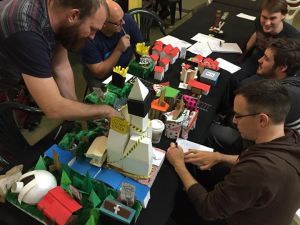
And speaking of experimental, my morning session was Jack McNamee’s Mystery Solving Teens (below). This was an actual game, where we had twenty turns to solve a mystery using our own player abilities, something that, as a fan of the reader-solve mystery genre, I adore. Added to the mix was the fact that Jack had constructed a massive three dimensional town entirely out of cardboard, and the clues were hidden amongst, under or inside these structures. The 3D reality of the town immersed us in the game while the sifting through clues as we actually would submersed us. This was also a first playtest which is to say it will only get better. I don’t know if it could ever be sold but it’s not always about markets. It’s about coming together and sharing experiences. Which we can do in our houses but we can do in differentt and larger ways at cons. gp3

And that’s what good cons are about, and that’s what Go Play has always delivered. People say over and over again that they’ve never had a bad experience at GPB, and never even had a bad game. Maybe it’s because we keep pulling the same people over and over again, and there’s too few of us to suck. Maybe big cons can’t do that. On the other hand, maybe if we ran smaller and smaller cons, this could be reproducible elsewhere. Maybe there’s room for a third tier of gaming between the massive hundreds to thousands to tens of thousands of people cons, and playing in your basement. Maybe the time of the mini-con is ascendant. It’s like a game cafe, but with social mixing, which is what I feel too many cafes lack. And fair enough, some times you just want to go hang out with your friends. And sometimes you want to do something bigger, more cross-pollinated, with afficianados – but not thousands of them. The mini-con. Is it a thing? Let’s find out.

The Hard Six Problem in Gaming

Tennis is ruled by the Rule of Three and Five, which states that whenever you try to organize a game of tennis, you will inevitably have three or five people, ie the wrong number. American Doubles (2 vs 3) was invented to try and fix this problem but it’s one of those solutions that instead of solving anything just highlights how prevalent the problem is.

Whist, Bridge, 500 and other four-player card games have the same issue, and similar poor fixes. 3-handed and 5-handed 500 are terrible alternatives. Luckily, there are whole genres of 3 player games using a standard card deck (“solo” games, they are called), and alternatives for 5, too. Board games are much alike. If aliens found nothing of our culture but our board games (or their outside boxes) they would rapidly conclude we gathered in groups of 2-4 players. 2 CAN be problematic but whole genres and classic games exist for such times (the oldest games like draughts, chess, backgammon, go and mahjong are all 2 player). 5 too can be problematic but there are enough entries in that field to keep things going.

And by the time you get to 7, you engage the party game space. 7 is enough so team size difference no longer matters (4 vs 3 works much better than 2 vs 3), and is enough for their to be a good rabble of shouting. 3 people feels like a team, not a partnership. 7 is also enough to split into two games of 3 and 4 without feeling like two people have to play the less attractive 2 player game. 7 is enough for Arkham Horror to feel epic. 7 is enough so even though you probably don’t talk to the other people at the other end of the table, they have enough people to talk to on their own. 7 is a party game, 5 is a board game.

Which means whenever you get people together to play board games you will inevitably have six people. This is the rule of Hard Six.

I’ve spent the last few years gaming every two weeks and the number of times we have hit the Hard Six goes beyond the realms of statistical likelihood and into the suggestion of a cruel and malicious universe. I have moved between cities and states and countries and this issue follows me everywhere. I have, over the years, bought several games precisely because they go to six (and I hit 5 often enough to not buy most euros). Betrayal at House on the Hill, Seven Wonders and recently Colt Express, were all bought because they allow 6 easily without the game suffering, and they get played the most because they work like this. Shadowrift and Yggdrasil and Arabian Nights are also on my shelf not least because they allow six. We even play History of the World more than Clash of Cultures because the former allows 6. I’ve made my own rules adjustments and player materials for Dead of Winter to allow 6 (and for things like Suburbia to allow 5) and will always pick up the extra-player expansions for games that tap out at 4 or 5. I’m also the guy who will offer to “GM” the game for 5.

The Rule of Hard Six is not necessarily a flaw in game design; it is dealing with social and mechanical constraints that are difficult to work around. Human beings have limited abilities to communicate. We run out of social energy around about five other people. We can watch about four things before we run into multi-task issues. It’s difficult to build an engine that allows six players to interact, compete and share mechanical and social space in an equal and interesting way; soon enough somebody will get excluded, or lost in the shuffle, or it will turn into a race. And heck, we run into this limit in racing anyway – there’s a reason most track events only host 8 people – our brains just tap out at that point.

And maybe I’m the only person who runs into the Hard Six. I know many couples or buddies who run into the 2-player doldrums (and me and my gamer buddy do, and I need to marry someone who will fix this, ladies, call me) but I don’t see a lot of people complaining about the Hard Six. Maybe I am under a dark curse to always have five other players. Maybe I have too many friends. Maybe there’s a genre of gaming I don’t know about. Maybe all the Germans are laughing at me because they have 2.1 children or have the lovely couple next door over. Maybe personal devices will help by keeping the sixth person occupied. Maybe we need to get better at dealing with the still somewhat taboo idea of splitting the group up for two separate games. Maybe we should not have rooms with one big gaming table but two smaller tables, as with the old days of Bridge.

Let me know if you run into the Hard Six issue so I know I’m not alone, or what solutions you’ve found to deal with it. Or let me know I’m crazy. Or if you know anything about the dark curse.

It Takes A Village to Paint a Masterpiece

It takes a village to raise a child. And in fact, also a barn. We put a man on the moon and we eradicated smallpox and we act as peacemakers and invaders. We win sports matches and we elect leaders and we build better worlds. But one man and one man alone painted the Sistine Chapel. One man painted the Mona Lisa.

Art, in other words, is almost singular in our assumption of it as an entirely solo pursuit. Oh yes we venerate individual sportsman at times, but we do so with an overt and explicit knowledge that they are not alone. Rocky has Burgess Meredith cheering him on in the ring, but we speak of Stallone writing the script as him locking himself in his room with a typewriter. The theory of the auteur runs deep; we reference art by one name, even if it is a film worked on by thousands. It is Peter Jackson’s Lord of the Rings even though the second and third company worked half a world away with their own producer, director and writers.

Obviously, some works are works of just one person in total isolation, and there’s nothing wrong with that and we should acknowledge it. But we talk as if every work of art is the same, and even in the same medium, that’s just not true. And we KNOW it isn’t true. War and Peace would never have been published if Tolstoy’s wife had not corrected, edited and transcribed his unreadable handwriting into eight pristine copies by hand. Andy Warhol’s work was literally done by a factory of people, and the classical artists had studios where their students would do some or even all of the work but it was still called a Rembrandt. Wifes, brothers, sisters, children, colleagues and conversants have completed works, expanded works, expounded works. There is no line between Spielberg and Lucas any more than there is one between Joel and Ethan Cohen.

Whenever we do acknowledge this, it is to play detective. We must know which parts belong to the true genius and which parts did not. We demand the Director’s Cut, the pure vision of the auteur, the original manuscript, which bits of Lennon/McCartney belong to whom. We’re fascinated too much by process because we think it reveals the genius of the end, and a singular genius. If we learn that Luke Skywalker was a girl but then wasn’t, we think we’ll figure out how to be George Lucas. Instead maybe we should figure out who lent over and said “try this character like that”. But capitalism loves purity culture, and it has many forms, and none stronger than the hallowed name of the singular artist – and all his helpers are worth nothing.

And that’s the point: our obsession with art as a solo pursuit is harmful. Not to mention cruel. Go and lock yourself in the cellar, we say, and come out when you’ve finished your manuscript. No, we don’t want to see “rough drafts”. Ew. That would imply artists aren’t Zeus-like Gods who draw genius out direct and full formed. That would imply that art is WORK, and then we might have to pay them or respect them or understand that it grinds the body and soul the same way working in a mine does. But art is work and it is messy and it is a hard, gruelling process, and – most importantly – it is a team effort.

That’s why we have editors, and critics and playtesters, and beta-readers and sounding boards. It’s why art flourishes in a scene of studios and cafes and cultures and communities and movements. That’s why artists who work in solitary tend to go mad: because nobody is there to help with the terrible rigours. We would never send one man down a mine or one cop to a crime scene. Don’t try to do art alone either; you may end up dead. It is dangerous to go alone, as the saying goes.

More importantly, once we understand this we understand that there are different ways to be creative and they are no less valuable. David Eddings ended up putting his wife down as a co-author because she was reading everything he wrote and commenting on it long before his editor saw it, and he finally realized that that was part of the work. And there are people whose creativity is not always best used at the head of a project, but in support. And there’s so many ways to support someone. Emotional and spiritual support, social support, and societal support – building those communities and making them work. Appollinaire was a mediocre poet but he was a FANTASTIC supporter of artists and without him building his studio there would never have been an Rousseau, a Duchamp, a Picasso or a Gertrude Stein.

All of this hit home to me this week for a few reasons. One, I realized it was the real point of the Game Chef competition. Oh yes, the deadline and the constraint of provided ideas forces you past the roadblock of doubt into publication, yes. But the real point is to build community and get reviews and feedback. It is extraordinarily hard to find readers and playtesters in this world, so much so I’ve been bugging Board Game Geek for years to have a Playtester Finder Forum, but apparently American and Europeans find them everywhere – although saying that, Klaus Teuber had only his own family to help him build Settlers of Catan. Those with money and prototypes do take drafts to Spiel, of course, but there’s much less of that for roleplaying, and we forget too that that is part of the process, and everyone who plays the game at Spiel theoretically deserves their name on the front of the box. That’s why RPGs always list playtesters, too, btw. It’s not courtesy. It’s credit for work done.

But artists can’t always find feedback, connections and support and they need it the same way a painter needs paint and a writer needs a pencil. The rush of blood when someone reads your work and responds to it as a vital as the ink in the pen and the film in the camera. You literally cannot make art without it. And that means someone needs to be around to build the tools to get feedback and connections and support and criticism and collaboration. And that is a kind of creativity, a kind of art creation. I am not the best game designer. I am not even a good one. But my friends games leap into being because I tell them how to find their way. I link them to publishers and competitions and help them find protospiels and unpubs. I respond to their ideas with my knowledge and expertise.

And we need to know that as artists it is okay to ask for help from people good at developing and supporting. I was spitballing an idea the other day and thought James Wallis might know something about turning parlour games into print and I foolishly hesitated to ask – but of course he responded brilliantly, and brought in all his expertise as a support artist. And he turned around and asked me for the same support with his art, where he is the lead artist. Because he too, knows it is a team effort, and that I have support skills.

And I beat myself up on this, and I know lots of people do. We play the impostor game. I’m not an artist; they are an artist. They have their name on the book and the box, and took lead on the project so nothing I did counts, not really. But art does not work that way and we should feel entitled and confident to declare ourselves artists. As a part of the thing. Small, perhaps, but ESSENTIAL. Crucial. As important as ink in the pen and film in the camera. Neil Armstrong walked on the moon but every single person at Mission Control and NASA in general put him there. They are part of that achievement. Art is exactly the same.

And we can and should take this as widely as possible. Professional artists have the highest rate of homelessness of any profession. When Van Gogh couldn’t get help from his brother to afford new canvases he painted over his own work. Schubert’s Unfinished Symphony is unfinished because he lived in a hovel and got typhoid and died at 31. If you feed an artist, if you clothe an artist, if you bring in an income to fund an artist, if you pick up the kids while they finish a chapter, if you bring them cups of tea and rub their sore shoulders, you are – and I say this with not a drop of facetiousness – an artist. You are creating art. It cannot happen any other way.

So, if you are a supporter, take pride in it. Advertise it. Sell it. Like Sean Smith and James Wallis are clever enough to do. Talk about it. Develop it. Share skills and teach skills in it. Build things to bring support together and direct it outwards. And if you’re a leader (and you can move back and forth all the time), don’t think you are supposed to do this alone. Reach out for support, it’s how the process WORKS. Art will literally kill you if you try to do it alone, and, what’s more, your art will not be as good as it should be.

It takes a village. Embrace that. Seek it. Build it. Share it. Art is life, and both are inherently, unavoidably, collaborative.

Game Chef Finalists Part Two

Much talent! So exhaust!

Redream by Ron Langton

A simple idea with lots of potential. Players write down a dream they actually had (or make one up), listing a character, a setting and a goal, called a dreamheart. Then these are shuffled and redistributed. Each player then takes turns telling the dream they’ve been given (character/scene/goal), using a hand of playing cards like the cards in Once Upon A Time, one per scene, to trigger ideas. Players can jump in with their own cards but not to steal as in OUAT but to contribute, which is a nice sharing idea. At the end of each scene the other players reward the teller with chips based on how much they liked the story. If it seemed like they were just phoning it in to easily get their goal, a player can object to the story and make an argument as to why. If he wins a vote on this motion, the next scene in the teller’s dream will be narrated by the objector, and make things worse.

This could be pretty harsh and critical, especially since the objector gets an extra turn so has a fun reason to object. It may also go against the whole idea of improv, which is to shut down criticism. I don’t mind competing in principle, though, and it’s balanced by the collaborative nature of the whole process: you have to impress others, but also, someone else is carrying your dream – and at the end of the game, you get much of the points they won for your dream. And theoretically, you may get closure on a dream you once had, which is an ambitious idea. There’s definitely a sense of accomplishment to this game I just think maybe the central mechanic needs a few playtests to get the sharing right, and the ideas are very strong.

Sisters of the Hive by Jordan Saxby

Great minds think alike, and there’s a lot of ideas like Redream in this, in that once again there’s a sense of competitive storytelling, with hidden goals and players are able to block if they feel someone else cheated. On the other hand this game is full of some very different ideas indeed. The setting is the future where everyone buys dreams from a Hive of Sisters, all of whom want to leave the band and go solo but to do that they need to be a really famous dream-weaver. And to do that they have to secretly fulfill contracts from advertisers or additional stakeholders. Theoretically, Timmy is getting a dream about ponies but maybe his parents have paid extra for the dream to actually be about him really knuckling down and practicing the clarinet.

Each of exactly four players contributes to who the dreamer is and what he’s dreaming, but each also writes a secret contract that is then shuffled and distributed. The story is then narrated piece by piece, using formalized structure (three acts of developing narrative) and formalized behaviour (ritualistic phrases and HAND GESTURES (which is a GORGEOUS idea). Too many people trying to violently shift the story towards their needs instead of following logic, or too many breaks of disbelief and the dream ends without resolution. Theoretically, everyone can win together if the stories finish neatly. But one person can win on their own if they twice fulfill their contracts. Again, some super strong ideas here and I love how people are dancing around this fun idea of story-war, but again it risks crushing improv and forces people to distinguish between a natural continuation and a “change” of story, and I don’t know how to do that. But there is a nice long example and (especially with the theatrical elements of this) I would love to watch people TRY.

Stay, Still by Heather Silsbee

Now we’re REALLY talking. This is a freeform LARP of mythmaking and speaking in code. It’s after the apocalypse and everyone but the GM is trying to decide if they stick with their current Leader for safety or abandon him and make their own destiny, because the Leader has issues. After designing the nature of the Leader collaboratively, that character is handed to the GM who acts in a dominating way while also helping the story along. The players are handed character cards (there’s only six but I think more would be easy to add) and then start roleplaying. They are each telling a fireside story at the end of the day in the wasteland, but they are also trying to encourage the group to Go or to Stay, and perhaps make their own mind up too. But the Leader can’t hear them talking about leaving or he’d punish them – so they must talk in parables. After each story. players can vote with counters in the Go or the Stay bag, and at the end the decision will be made.

That alone is a great idea – roleplaying is already about moving between levels of truth, and I’ve always found it fires up the most when it’s about metaphor, cultural coded expression and things which are known but cannot be said. Combining within a parable about safety versus freedom makes it even juicier, adding a terrible threat that enforces the use of metaphor. The simplicity of it also means this really would appeal to any audience willing to play a dramatic kind of game, and it could be used as a psychological exercise. And there’s even one more level to the game: the Leader is always male and white (and is coded with stereotypical “masculine” imagery of strength and control through strength). This is done as a contrast to so many stories where white men are saviours of a group and the group never really gets a say in it. That makes it extra interesting and important, although I wish there could be a nod to how this is stereotypical male, not actual male, but that’s just my personal bugbear. Meanwhile this is complete, fully functional, interesting, open to a different audience, clever as hell and probably should win.

Tea Ceremony by Niamh Schonherr

This is not really a game so much as a social ritual or passtime. The Host brews tea and fills cups and encourages their guests, one by one to discuss a dream they have for their future. The Host keeps the focus on each person one at a time, although others are allowed to speak and contribute to help the Dreamer explain. New pot of tea, new speaker, until everyone gets a turn. The rules also suggest it could be done with pints of beer or anything else.

I like the idea of teaching the world cultural rituals to improve socialisation and if we have to parcel them as games to do it, that seems like a good way to do it. Makes just as much sense as doing it via a lifehack or thinkpiece. And as a social ritual it doesn’t need much rules or structure, because it’s not a game. On the other hand, it’s an inch away from “take turn listening”, and I feel like it might need something more, or something less to really click. But I definitely like that it’s in the Game Chef competition. I want people to think more about games like that, as rituals, as cultural activities, as things we might just do without thinking as them as games, like picking up a stick and rattling it against the bars as we walk by, or flipping bar coasters, and so on.

The Long Sleep by Bill Templeton

The Long Sleep is definitely what (these days) is a traditional RPG, which is to say something not at all like D&D, but in the mould of storygames: there’s a well decribed and developed setting (although here with lots of blanks) that is frontloaded, players make up whoever they want to be, then they call for scenes with other characters or new characters to slowly elucidate a narrative, and mechanics take a back seat except to resolve scenes. Here that setting is a world-wide disease is leaving millions in unending sleeps, where dragonflies seem to lead people towards Epiphanies but the Undermind, which taps into the dreamer’s unconscious and subconscious, wants to lead them away. Characters don’t have stats, just story hooks of Locations in their life, important People, a short backstory and three Motifs that colour their dreams, all of which give a nice palette for the story. At the end of each scene, a card is drawn: red you get an epiphany, face card you have triggered the Undermind.

The Long Sleep is (comparatively) long, well written, polished and quite complete, it feels like a finished RPG. The setting is intriguing despite being a bit vague and it is clear about what it wants to do, even if it lets you fill in the blanks about why dragonflies and what it all means. It’s only problem is it is comparatively not very different or creative. It doesn’t really suit the theme of A Different Audience except that it actually explains calling scenes and such as most RPGs do these days. All of that puts the emphasis back on the setting…and it too, is not particularly – innovative. It’s not quite developed enough to be truly deep, either (not enough time, it’s already as I said quite long for the competition, quite the achievement) – but its motifs ARE rich and vivid as hell, backed up by excellent writing and imagery. As Robin Laws says, fluff ain’t so fluffy and the style of this game is importantly evocative. I may not have been excited by a genius new way to roleplay but I most definitely WAS transported to a summer lake where dragonflies whisper secrets and the Undermind is watching. And frankly, in 9 days, creating this good an RPG is great work, and who cares if it’s not the New Millenium?

Wings by David Rothfeder

This is the game that made me cry this year. Which makes it hard to review, with the subject matter so on the nose and so important, a topic we never talk about yet defines so much of our lives. Wings suggests that when fairies are small they have no wings so have to be carried everywhere by dragonflies. One day they get their wings and don’t need their dragonflies any more – which dragonflies want, but also fear. I love metaphors and they don’t get any clearer or more perfect. Each player makes a fairy with a Quirk and describes their dragonfly – a bit more help and structure could be useful there, especially since everything else, helpfully for younger players, comes from cards and stones draws. Your dragonfly has a hope for you which the other players can see but you can’t. Scenes rotate, with the current player drawing from an Opportunity Deck which basically sets up a conflict between parent and child, and then the players take different roles in playing it out. The outcome is determined by drawing stones, as is the lesson learned, all of which leads to ticking boxes under Fear, Independence, Defiance and Respect. The stones themselves are themed around trust, individuality, compromise and secrecy, so you can see the theme of outcomes or read them off the handy table.

I love that there’s all this lovely infrastructure to this game. You don’t need a GM to set up conflicts or ask questions or set the scene because the cards do that. You don’t need to just imagine how it ends because the stones do. There’s no confusion about how to play each role because there’s a handy guide. But it is still a creative game which will reveal a complex and difficult relationship, with insight into both sides. With the use of fairies and in-built story mechanics this could indeed be good for young girls who are just about to hit this issue, and not just good but SUPER GODDAMN HEALTHY. Nobody ever explains to kids why their parents are grieving and confused; here children will get to discover that themselves by taking on the role OF their parents, which is the best way to learn anything.

It’s not perfect – it’s still a bit confused on some of the stones and needs a tidy-up edit – but it is complete, ready to run and very creative and uses the ingredients and definitely targets a different audience in a really clever way. It’s also the most important work on the list, I think, and one I want every child to play. So maybe I am biased, but Wings should really REALLY win.

Game Chef Finalists Part One

A quick appraisal of the 12 finalists of this year’s competition. You can download and read them all yourself here.

One overall trend I’ve noticed is a general laxness of using the four ingredients. Most only use one, some none at all, and some of them are just name checks. The two most common are dragonfly and dream; they are more evocative perhaps than abandon and stillness. Nobody seems to have known what to do with abandon at all, haven’t seen one game use it except Wings (more on that in Part Two).

Dragon, Fly by Paul Beakley

A cheat on the ingredient but an interesting take on the different audience theme, this game can be played entirely as a card game. Players deal some cards to the dragon and then move cards around six locations, following instructions based on the narrative choice they make at that location, and the character they are currently playing, which is determined by suit. A dragon plagues a village and a hero must try to kill it, and the finally outcome, after the game is played, will be a series of in-character written pieces about four people in the village: the hero’s spouse, the village leader, the priest and the outcast.  Each has conflicting thoughts about the coming threat, and you explore those as they make choices linked to each location. You can keep drawing cards to determine story elements until you’re happy with your high cards in each location, but certain cards go towards powering up the dragon, so there is a push-your-luck element.

What I like about this is it really highlights the tension between game-victory and storytelling decisions which a lot of RPGs have seen as a bad thing. You may really want to add cards to the Church or the Forest but to do that you might decide something that feels just wrong for how you’ve played the character so far. Yes, you need to discard that low card but are you willing to violate your sense of narrative truth to do it? It also is specifically tailored to be a solo creative writing exercise which I think would really fit different audiences (although it does have rules for multiplayer). I can’t say how well the game works mechanically (partly because it’s hard to visualize and partly because the explanations are very unclear as they stand), but the sense of setting and character are strong, the idea is clever and it makes me want to try it to see what I get.

Dragonfly Brewing Company by Michael Wenman

I have discussed this little gem elsewhere.

Dreams of Dragonflies by D. X. Logan

This shares much in common with Dragonfly Brewing, in that it is about tile laying and similar kind of player interaction. Players collaborate to lay down a seaside landscape of tiles from start to finish, and then do roll-and-move to move their dragonfly markers along the spaces. Depending where they land, they draw cards from different decks which show a thing you discover. It’s a game on the level of Candyland, and that’s the point. The nod to roleplaying is that at the end the players gather their cards and tell a story about their dream and perhaps what it meant. The dream element is tacked on but the idea of tile laying, discovery and improvising a story is excellent for say, 5 to 8 year olds.  Some “bigger” words are also included on the cards for older players, and there are some tips for adult helpers.

All in all this feels like the right idea – kids telling stories about stuff they found – but I think it’s been done before, and this feels a little undeveloped. The tiles are a nice idea but don’t seem to mean anything, they’re just kinesthetic creation which is enough on its own I guess. Sitting next to DBC, it kind of feels like a simpler version of the former, which is a great idea FOR DBC to use. But despite my criticisms, if it came with lovely art I would give this to any kid over Candyland any day, so that’s impressive for 9 days.

Far Away From Home by Aleksandra Samonek

This reads like a fever dream, and in part that’s deliberate. Deliberate in that it appears to want to describe a fever dream of sorts, and because it’s trying to be as bare bones as possible. Players take the role of vaguely drawn characters (your only characteristics are handed to you by others in short sentences) on some kind of ship stuck somewhere after some unspecified disasters. Players take turns filling in the blanks which will lead to interesting collaborative stories. Before you’re on the ship though you write down what you – you the player – want in life and everyone else decides four steps you need to do to get it. I think the point is that the terrible ship escape is supposed to be a dream for some of you, giving you insight into your goal? Except in the dream you’re not you at all…yet you still have exactly the same goal. Which could get weird as hell.

The story-building mechanics involve each player starting a scene and it being resolved by the player on their left, then a “but then” added by the player on the right. The scenes are supposed to remove goals from your list, and then add new ones, so nothing really gets resolved unless a player hijacks a scene, which seems to have no penalty except speeding the game up. I think there is supposed to be a drive to betray each other by stealing scenes or entering scenes in a way to hand off your secret Destiny card which tells you if you’re in a dream or if this is really happening. There’s also a bizarre rule about holding eye contact and making “the Dragonfly Move”. I don’t know what the fuck that was about at all, but it sounds like something teenagers might do in a bad occult film.

Bare bones this looks like some of it could be a fun exercise but I don’t think the mechanics work and I don’t really understand the point of it or the fun of it, as it currently stands. Perhaps there are language issues as the designer is working outside his first language.

Good Night Fairy Theatre by Emily Griggs

This is a really clever piece of work, which uses a game idea I’ve been toying with for years: one protagonist, many GMs. One player takes the role of a child having a dream, the other players are dream fairies trying to make the dreamer have the kind of dream their fairy specializes in. Kids are better at competition than cooperation and instead of trying to fight this, it wires it right into the mechanics, using a dice-bidding system like Robin D Laws’ Pantheon to determine narrative truth in a scene – while the central player chooses how they react (they are of course in their own dream!). As the sole protagonist they kind of have a GM-like role, but like players they are there to be told stories by the players. Indeed, each fairy’s dream style is designed to create emotions, and if the dreamer is say, scared by a fear-dream-fairy-story or made happy by a happy-dream-fairy, they award chips (Dream Candy) to those players. In other words, the more evocative the GM the more likelier you are to win.

That’s harsh on kids who lack skills and confidence but for precocious young creative types (or with a generous, perhaps adult dreamer) this hits lots of notes for kid’s games. An instantly recognizable setting, a use of competition, and dice rolls to help generate ideas. Unfortunately that part of the mechanic is a bit vague and also uses a Rock-Paper-Scissors things I think most kids would struggle with, and the antagonism could get out of hand unless the dreamer takes control, which again, is a big deal to put on a young kid. But I think these are teething issues: another pass at the mechanics and for the right kids this would be not just amazing but also unlike anything else we’ve seen.

ISP Dragonfly by Kevin Omans

This is not unlike my recent Zombies, Probably in that it’s a game about people with terrible sins begging for forgiveness – but is about hope and redemption as well. Players take the role of prisoners who committed a crime bad enough to get exiled from all of earth, in the titular space station (phoned in ingredients here see). Once every ten years the inmates get to explain what they did, why they did it, if they’re sorry and why they should be allowed to go home – and then the inmates themselves vote on it. Unlike lazy old me in Zombies, Probably, the game comes with an excellent bunch of cards to give players their crime, the tie that binds them to earth and also what they Respect and are Repulsed By in others. The last is super clever and important because if enough inmates say, respect murdering your uppity wife, or respect not trying to go straight, or going home to wreak more chaos than a tearful apology will be far less likely to win you the game than an impassioned reasoning for why you should go back and finish the job on your wife’s sister.

To explore this part of the game, players spend the first half of it mingling around talking to each other in private conferences. They can’t reveal their crime but anything else is on the table and alliances can and should be formed (and backstabbing could happen). This adds a Survivor element to the whole thing, which makes it much more gamey and not just about who tells the best sob story. The only issue with that is the game says up to 12 can play and everyone should be allowed to pair off, which is some huge combinatoric and would take quite a while. A minor quibble obviously: this is a great and fun exercise, and the game is entirely complete and works right out of the box, and would work great for any drama class but also for a group of creative friends. If you’ve enticed them with social games like Two Rooms and a Boom or backstabbing like Battlestar Galactica, this would be a great step into a more dramatic space.

Game Chef Reviews Are In!

Reviews are always good for this kind of thing because it is unfinished; they give you ideas on where to go next. My responses in italics. Dragonfly is available here.

Review 1:

WHAT DID YOU LIKE?

The flavour and backstory for this game is very unique and really compelling. The medium of twitter is also very interesting and satisfactorily fulfils the theme. A micro-game with a smaller time commitment that can be played anytime you have an internet connection is something that would appeal to a lot of people, and could be easily played while other games are going on. The audience involvement also takes full advantage of this medium and adds a new level to it which has a lot of potential. The mystery and countdown mechanics also enforce narrative order and cohesion in a way that would be normally difficult to do through this medium.

WHAT DID YOU FIND CONFUSING?

I think the mystery mechanic could backfire. Establishing a mystery in every tweet and answering it in the next one seems like it would produce confusing and disjointed stories, though I suppose it would reflect the nature of a dream? Exactly how the mysteries work isn’t clear through the example of play either.

Good point, wish I’d had a chance to test it…maybe I will one day.

WHAT SEEMS LIKE IT NEEDS MORE WORK?

Maybe some play-testing would tighten up the mystery mechanic. I also feel like there could be a little more done with the backstory and flavour elements to get them across – I’m not sure how, but the flavour is so concrete yet has no real presence in the actual game.

I like this idea too – the dragonfly tech/corporation is neat and I’d love to find a way to explore it further. Maybe not in this game. Maybe it’s a TV show or something. Other reviewers mentioned this too.

Review 2:

What I liked: The setting, and the premise of the game both strike me as a world I would like to play in. It is well developed, and is enhanced by the choice of medium (Twitter). I also liked the clear-cut ritual phrases which called out the start, and end, of the game, and also the participation of the players. It appears very well thought out. The game is simple enough that anyone could pick it up, even without any story-gaming experience. It’s also presented very well – points for layout.

What I found confusing: The game’s text was quite clear, offering examples for any game mechanics that were not easy to grasp. The only part of the text I’m unclear on, is what the moderator’s posts between “I awoke…” and “… and they are remembered” are supposed to look like. Are they summary posts, which call out what truth the moderator is accepting from the submissions? Or are they “I dreamt…” style posts? An example would clear this up.

What I thought needs work: This game deserves a quick-start text that could fit in 140 characters (or maybe two tweets at the most), enabling players to run their own games quickly with as broad an audience as possible. Anyone should be able to post it to their feed, and start the game with little more than a hashtag at the end (or beginning: #IDreamt).

Yeah, I’d love to invent a continuous story mechanic/parlour game that everyone can play on their own feeds. That’s kind of where I wanted to go but it didn’t quite land.

Review 3:

I am always a big fan of games that try to integrate online play! I also like this take on asynchronous play. I also enjoy the setting, and the ritual phrases.

There isn’t any guidance for the GM on which posts to accept. I suppose it’s because this game belongs to you, and perhaps you have no interest in anyone running another one from a different handle. I’m also not a huge fan of games where the user may have to play to the GM to get their posts accepted, but I’m not sure if there’s a solution for that.

Very good point, I didn’t include that. The main point of the filter mechanic is to keep the story from fracturing from “hang on, which one is true?” which happens all the time when we do continuous story-telling online. I was coming from an assumption of only getting a few answers; if you got a lot and you were at risk of playing to the GM the answer would be to choose randomly.

Review 4:

I loved the concept of the game, and I think the random number in the first post is a brilliant mechanic for pacing, which was my first concern when I started reading it.

It is also a brilliant fusion of the “dream” and “dragonfly” ingredients, and a clever way to address the theme: it’s not common to roleplay/storytell in the social media.

If anything should be not perfect in this game, it is that the concept of a company developing this dragonfly technology is not exploited in the mechanics; I would’ve loved to see something like that the zero (0) post has to be an announcement of the company, echoing maybe the great Ubik novel, by P. K. Dick. The colour of that would’ve been awesome, and maybe some rules for starting paranoid threads about this ubiquitous company that manipulates this connection we have with this otherworld…

A great idea but it kind of goes against the whole everyone can play this parlour game thing. But it’s great how many people have loved the creepy setting I created in just a few paragraphs. If only that was a marketable skill, but it doesn’t appear to be. 

Review 5:

The idea to game over twitter is quite unusual and I must say it really fits the premise of this game. Although it might be hard to find players for this particular medium, I think that it has the potential to build a great community of storytellers.

The rules are simple and easy to follow, and the story-building potential is right there. It’s great to see example gameplay, as it makes it very clear how this game would look like and how the story should progress through mysteries and questions until some clear picture emerges. The idea of random numbers limiting the length of the story was a little bit confusing at first, it may be the phrasing of that paragraph (it is a bit overwhelming to a player who has never used twitter before, like myself), but it made sense in the end. Although the number does seem rather small – 17 sentences is not terribly much space to tell a complete story.

To sum up, it’s a great idea for a fun game, although it very much depends on a devoted community of players. I do like the choice of medium: the limitations of twitter tie really well with the in-game limitations of the in-game fictional technology.

Given how little time I had for this – like a day – and that I took the first idea I had and ran with it, I’m happy people are digging the idea. I think I’ve communicated how GREAT twitter is for storytelling, even if this isn’t the game to unlock that.

There’s also this lovely review by Mr Wenman (whose game Dragonfly Brewing Company I found quite excellent) touches on the same points: the setting is neat, twitter seems great for this, but it still isn’t 100% there – and it’s hard to know what the next step might be. I offer this to you, internet: figure out how to make a twitter parlour game of story building really sing.