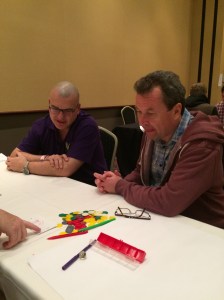
Iron Game Designer At Berkacon

For the second time in a month (and third time in three months) we ran Iron Game Designer, this time at Bezerkacon (which was enjoyed by all). We almost didn’t get it played because numbers were low but Tony and Petr were so keen (and liked my talk) so we moved mountains to make it happen no matter how few we had. At the last moment it was five people, so I roped in two judges (who were WONDERFUL at short notice) and I decided to do Iron Game Design MYSELF for the first time. Scary scary. But it was very in keeping with the spirit of Iron Game Design that we threw the competition together at such short notice with limited resources.

After time and time again seeing AMAZING achievements come out, I think I was a little cocky going in. It is incredibly hard to use your brain at that pace for two hours straight, in terms of strong communication, problem solving and brain storming. We did the brainstorming really well, and within twenty minutes came up with a basic idea we loved. The theme was The First Day and our idea was gods working semi-collaboratively to create continents on an ocean by playing cards from four suits (Forests, Mountains, Basins and Deserts), and the end of the game would produce not just a winner but also a pretty world you could imagine using as a game or fiction setting. That gave us conflicting goals, and although we were in the ballpark quickly of what we wanted, finding a way to make a kind of two-dimensional UNO crossed with The Game – then we spent about ninety minutes straight failing to make that work. I was terribly disappointed we had no time for any artwork or any flavour (the stuff I’m good at), but looking back I’m happy with how close we came and how quickly we got clear goals to aim for. Four Corners of the Earth was a decent achievement (shown here with Charlie, who was also at the con and whom I want to come up in social media summaries of this post).

One table over may have gone slightly outside the rules by scrounging cardboard from an outside source but I allowed it for the dazzling physical spectacle. Battlepillars was a game about catterpillars eating the entire earth and then fighting to the death. Like the Very Hungry Caterpillar, on the first day the caterpillars ate one thing, then two, then three, the four, then five of the 30 available facedown cards, with peeks allowed to find the good cards and avoid or switch out the bad ones. After five days each battlepillar has fifteen cards, some of which helped him with the eating phase but the rest designed to help him in the final battle, where you rolled 15 dice, assigned hits, and triggered the powers you gathered in the eating. This was not greatly balanced but it was solid as all hell and the two phase fun of getting to build an arsenal then set it off was extremely engaging, plus the theme was adorbs. A masterful work.

Perhaps the only thing letting it down was use of theme, but victory in Iron Game Designer is always arbitrary and always splitting the tiniest of hairs and by one point it went to Pencil Pushers, a game about being a working schlub. A hand of cards contained achievements that gave you brownie points with the boss (like doing work or sucking up) and things that did not (staring out window, playing pokemon) and each turn you could do your job (put a card in your outbox), pass the buck (give a random card away) or take the credit (take the top card out of someone’s outbox). There were eight rounds, each with special rules temporarily altering play (eg if a Pointless Meeting was called, you cannot Do Your Job), for the eight hours of the day. Those with the best work in their outbox and least left in their hands win! The hidden and random elements made game play random but it worked and the choices were meaningful and the humour on the cards was great. I am so so jealous and am going back to just running these things you goddamn talented BASTARDS.


To Fail

Once upon a time, I summarised the difference between most theatre-sports/improvisational games/performances and RPGs thusly: “In improv, everything you say is true, but there are strict rules about who can say what, and when, whereas in gaming, everyone can talk whenever, but there are strict rules about whether anything is true.” I really like that. It’s not 100% true but the places where it isn’t are interesting enough to make it useful. I hope somebody someone quotes me on it.

It’s certainly a definition that gets to the heart of what RPGs do: mostly the game mechanics centre around answering a question of “did that happen?”. It’s been reworded in some interesting ways such as Wushu saying “it definitely happened, but it did it produce narrative scene closure”, or Hillfolk making it “do you get what you want by saying it” or Gumshoe making it “did that kind of success help or not?”. I once wrote a game where you always failed (it was a comedy game) but you rolled to see what character trait caused you to fail. It never quite worked though.

Shifting this question is hard because it’s a question so fundamental to RPGs. But on the other hand, it’s a question that is alien to the kind of narratives we want to create. Indeed, I’ve often been in the position as a writer where I’ve spent so long as a GM I have no idea whether the character I’m writing will succeed or not in the story because I’m waiting for a die roll to tell me, and when you get to that point, you have not written a good story at all, because you’re not making the right choices. Likewise, we all know at times we try too hard to make a story work and ignore successes or failures – or sometimes we accept successes and failures so much engagement or suspension of belief collapses, and it’s the fine art of GMing to negotiate those areas.

But I’m not here today to mess with failure, but to ask what failure means. It’s one thing a lot of RPGs forgot to define until recently. Does the system always determine the difference between no-and-things-get-worse and no-but-things-aren’t-so-bad, and do you have the narrative instincts to make sure you don’t accidentally set up situations where a no-and automatically happens even if you roll a no-but? For example, if the monster is reaching out to grab you and you fail to dodge, does that mean you are grabbed or you are grabbed and pulled towards its mouth? And does that happen if you fail to attack? ie does not succeeding at an attack also (as in things like Apocalypse World) mean the bad guy gets a shot in, or is that two separate narrative beats? And when you fail, do you lose a resource? Are you now tangled in the tentacle and in need of rolling to escape or is it HARDER to escape now you are tangled? If you fail to escape this time can you just keep rolling until you do, or are you bound to suffer? How much has the situation changed? How much agency remains for you?

It may read like I’m splitting hairs but these kinds of questions are the atoms of RPGs. They are the fundamental building blocks. And the reason we keep reverting back to games which measure strict simulation-esque blocks of time and actions available in that time is to answer these questions simply and easily. Because even breaking things down into no-ands vs no-buts is not simple and clear because it’s hard to get everyone at the table to see what those things are in every situation unless you end up breaking things down anyway into “if this action happens or does not, in this time frame, then this or this”.

I’m thinking about these questions because I’m finishing up an RPG which is all based around a simple mechanic of success/failure at a scene level, which means this is vague. As written, if you succeed on a random test (modified by simulated characteristics), you succeed at what you were trying to do, typically an atomic action broken down by the GM (eg escape a tentacle). If you fail, you fail, but you can acquire “damage” to succeed. Every time you take damage, though, you risk being taken out of the game. Thus, everything in this game tilts, I now realise, on what “failure” means. Is it being grabbed by the tentacle, or being pulled into the screaming chomping maw? I’ve left that hard decision to the GM.

I’m also trying to decide if I also have a hit point mechanic. Obviously, I kind of already DO have one, where you take damage to get successes. Adding a hit point mechanic allows a concrete measure of what failure looks like. In some situations, failure will mean damage. That provides the GM with a great resource. In situations where there doesn’t seem to be a logical way to make failure particularly meaningful or threatening, damage can be such a thing. But I also realise it reveals how there is no support for any other such failures. When the characters try to pick a lock, what does failure mean there? Does it mean try again immediately, but other things in other scenes become worse as time passes? Does it mean get caught by the guards and put in prison with much stronger locks? Does it mean you can never try again, find another door (or if there were fumbles, your lock picks break, never try picking locks) and is that kind of “buffet of story pathways” actually fun? Does it matter if the rogue picks the lock or the fighter smashes through the wall if the goal was to get into the room – did the rogue’s failure mean anything significant? Significant enough to take damage? Or was it just randomly choosing the style of victory?

The truth is a LOT of rpgs dodge these questions, really. Or they do like I do and provide different types of situations, ones where sometimes failures can be re-rolled (like swinging a sword at an enemy) and ones where it can’t (picking the lock), or ones where some rolls (or some results) can result in worsening situations or reduced resources and some can’t. Botches and crits fill some of this void as well, and I’ve got those in place. But without anything to lose except story, will people sacrifice themselves to avoid bad outcomes, since – and this is the lynchpin of this whole piece – MOST OF THE TIME YOU CAN JUST OUTTHINK A BAD OUTCOME?

Does failure mean something if you don’t lose hit points, since you can always roll again or find another way around? Some of it is undeniably psychological, even if every orc misses every time, players who miss five swings in a row will kill to hit the sixth time. Maybe if lockpicks fail and smashing down the door fails and digging under the door fails, then yes, tapping people out of their creative buffet of solutions is a price they would grow weary of and spend points to get success. And yes, maybe I need to just keep road-testing my mechanics. I know THAT. Don’t say that.

But DO say what do you think about the question. How do you feel about failure and what it means? How does your favourite game do it? What are some interesting examples you’ve run into, particularly ones where failure didn’t seem to slow anything down at all, or failure derailed everything, or failure was poorly defined. This is a “not sure what to do with my game” question AND a game philosophy question. Of course, the former almost always tend to be the latter, if you’re doing it right…

And if you’re interested in the game in question, you can get it be signing up to my new patreon account.


Iron Game Designer: Rum Rebellion Challenge

At the wonderful LFG convention this month we got to try out the wonderful world of Iron Game Designer, this time with semi-professional and soon-to-be-semi-professional game designers rather than a wider crowd. With such well-heeled designery types I gave them a much more specific theme: to remake the classic (as in old, not as in good) Australia board game Rum Rebellion, which is named for an important event in Australia’s colonial past, where the military was used by a local merchant called Macarthur to conduct a military coup on the head of state, Governor Bligh (yes the Mutiny on the Bounty guy). As one of very few mass-produced Australian board games, almost everyone had a copy of this along with Squatter (Monopoly but with sheep). But I digress. Their challenge: make a better game about the Rum Rebellion, in only two hours. Five teams squared off, and OH MY GOD Martin Wallace was there to help with playtesting and game advice, for their current games and design in general!

The pairs paired up, grabbed their implements and started brainstorming. I noticed that with more experienced hands, there was a lot more brainstorming and idea-work before prototyping began. Interesting. I wonder if previously though I’ve stressed the need to grab items too much lest the good stuff be taken.

The old hands were also quicker in general. These guys were very quick off the mark with and almost everyone had developed, playtestable stuff before the first hour. It was exciting to watch things literally develop before your eyes, from basic to polished.

And no, I wasn’t kidding about Martin Wallace stopping by and providing insight. That was GREAT.

2016-07-10 19.35.14

Our final games were:

Macarthur’s Sheep had players taking the role of the Marine Corps troops trying to decide if they should follow Macarthur and betray Bligh, or stay loyal. This was a card drafting bluffing game where each round you were passing cards to your fellow players. The goals being aimed for were like high-low poker. If you threw out low, people would know you were going for high, allowing them to go low and score the low “pot” alone with perhaps the high pot being split. Hedge your bets or try to double bluff too much and you would be left in the middle with nothing. The basic mechanic worked and I think if the cards had powers as well, or suits, this has potential for something very clever.

Wharves and Sheep was also a card game (card games are simple and easy so tend to be common) where players took turns drafting from a central deck like canasta then passing cards around as well (I didn’t get as good a look as I wanted, sorry guys), aiming to get sets of dockside wharves and farms of barley or wheat or sheep, which they could then trade in for rum (victory points). As so often happens at IGD, this was probably the most complex game with the least testing done on it, but it felt nicely complex, with lots of cards forcing players to weigh up different returns.

Rum Runners was mostly random but it came together quick, was super engaging and only took ten minutes to play so might be the fan favourite of the night. Random dice rolls put rum on boats one to four boats, with 5s and 6s bringing Governor Bligh closer and closer to the colony to end your boondoggling. Players then could choose between collecting rum from one of the four boats, or going back to their warehouse to safely move the goods to their hidden cache. Getting stuck with rum un-hidden when Bligh arrives means negative points, so pushing your luck could easily get you burned!

Control the Rum was even more like gin rummy – a two player game of set building, where players had to build sets of four different suits of colony needs, with rum as the wild card, drawing from the top of the deck or the discard pile. Twist was, like Takenoko, you could instead draw from the deck of goal cards, hoping to get an “order” you could more easily fulfill. Completing an order would get you a one off bonus as well as VPs. This group was running out of time so got the least playtesting – but more than one contestant lamented not being able to try this. I think this might be the most publishable of the five.

The Rum Districts was a riffing off of controlling-base games like Smash Up! and Brawl! and Lost Cities, except unlike Lost Cities cards are played face down, unless special cards forced reveals. Powerful cards (high colonial influence) would be more likely to win a base (districts of the colony) but lower cards had special powers to force said reveals or assassinate higher opponent cards. Although derivative and still a bit too luck based, this was strong and well developed and a derivative game has a pre-made audience, and was making people really think about card placement.

All of the games survived multiple play throughs by their designers, and not just because they had to – they were fun. Without time for judging, I declared everyone a winner for getting to that point, and we broke for real rum rations. Even for pros, two hours is a very limited time frame, and everything we saw was interesting and amazingly creative, as always.


Our Girls

The following is a true story.

In the late 1990s my parents decided to sell their by-then-ancient television, a TV so old it still gave a metallic clunk and static fritz when you changed channels and came in fake wood paneling lacquer. After putting an ad in the paper, one rainy Saturday night we got a call, and five minutes later a whole family was at our door. I was downstairs watching said television because, well, Aliens was on again, and you have to watch Aliens. Mum, Dad and three kids come in and start looking at the TV. They try a few channels, coming back to Aliens. There’s that kind of nodding that indicates sure, they like the TV. But they don’t move the conversation towards purchase. Mostly, they keep talking about Aliens. Then we realise there was a lightning strike during the storm and half the city is in blackout.

These people aren’t here to buy a TV, I realise. They’re here to watch Aliens.

And as they start to explain to my mother why Aliens is so great, because of the importance of a female protagonist in an action movie and a sci-fi movie, I realise these guys may be crazy, but at least they’re nerds. And I also think, well of course Aliens is ahead of the curve. Of course it’s enlightened. It’s nerd media. We’ve got this. Sigourney – that’s our girl.

And she was our girl. She still is, thank god, but she really was back then. She was ‘one of us’ at a time when we still didn’t know what that meant, before geek had really cemented into a media-controlled subculture and far before it had taken over the world. She was up there, though, with Linda Hamilton and Carrie Fisher and Nichelle Nichols. They were nerd girls. Kicking ass and taking names. We knew they were often in the back seat of the spaceship but we gave them equal place in our hearts. It wasn’t just about the gold bikini, it was about the guns and the high-kicks and the battle cries. We had pre-teen boners for Princess but we also expected her to Battle the Planets just as hard as the rest of her team.

So I saw Ghostbusters (2016) today.

Ghostbusters (1984) was a pretty important film for me. Not so much because I wanted to be a Ghostbuster but because it felt really well-written. It introduced me to the wonders of carefully built characterisation and team building, of wit and sharp dialogue, and of well structured film-making. When Winston Zeddemere yelled out “I LOVE THIS TOWN” something fundamental shifted inside of me. It wasn’t just that it was the perfect feel good ending of a perfect blending of sci-fi silliness, action and comedy. It was also because it combined those elements I adored in other media I was watching at the same time – the big-concept monster-punching action of cartoons and action movies and genre films – with something that felt adult. It wasn’t Shakespeare but it was a far more “adult” product than Transformers seemed to be.

And all of that combined to make young Steve feel something important. It made me feel-good so much I felt like I could change the world. And I recognised that it was doing that in a way nothing else had before. It made me feel something potent about stories and how they were told. About heroes and villains and struggle and victory and how all of that could be combined and shaped to make people feel like gods.

And I said to myself “I want to do that. I want to write stories that make people feel the way I feel now”

Twenty five years later, I’d forgotten that goal until today. (I’ve got some ways towards it, I hope.) And I wasn’t reminded just because of nostalgic invocations of the past, from seeing songs and signs I once held sacred. Because I’m less about symbols and more about stories and structures. And what sang to me in Ghostbusters, what carried it across the weak points and story gaps and weird bits, is the things it did right. And the thing it did right most of all is it got what those nerd stories were all about for young Steve.

A team of people. With cool names, cool powers and cool toys. Who get together, suit up, and kick all kinds of ass in the coolest ways imaginable. It felt – in the best, most sacred way – like a cartoon. Like a Saturday Morning Cartoon. And like nerd media. Right in the big-concept monster-punching wheelhouse.

If this world wasn’t insane, this should be the best news ever. Here they are, front and centre: our girls. Four new girls as bad-ass as Ripley and as tough as Leia and as sassy as Buffy and as unstoppable as River Tam. McCarthy, Wiig, McKinnon, Jones, these are our girls. Sure, their movie is a bit uneven but we didn’t stop liking Jean Claude Van Damme just because his movies constantly sucked. This is four Sigourney Weavers. Four Linda Hamiltons. Do you know what twelve year old me would have done for four Linda Hamiltons?

This should be the greatest news ever. Four new ladies in our wheelhouse. Four new geek girls walking over to us, sitting down at the nerd table and joining our fandom. We should be pretty damn happy. Most of us are. And some of us are trying to stop the film from existing or cripple its finances, to ignore it in the hope it vanishes because it is unworthy of ours sight. Others are trying to destroy its stars. To lynch them. And I do not use that word lightly. To string them up and beat them to death.

I mention River Tam in there to point out this is actually an extremely recent phenomenon. Eleven years ago River Tam mary-sued the big screen and nobody tried to murder her. Something changed. The sharp rise of neo-fascism and anti-feminism and their targeted recruiting of young men, for example. And the world of hyper-marketing that let this fester in dark parts of the fandom. The causes can be discussed elsewhere. The point is, things are wrong. Things are broken. The world is backwards. It needs to be fixed.

Don’t get me wrong, I’m not saying everything was fine in the halls of geekdom in 2005 or in 1985. Like I said, we knew women were sitting in the back seat of the spaceship far too often. We were working on turning that around. We still are. But there was a time when, I think, when there was something more important than the gender of our heroes. I’m not saying we didn’t see gender, but we were united by a theme and a structure. Everyone was on the team, and they teamed up and punched monsters with cool powers, and nobody gave a damn that two of the Power Rangers were women because they were goddamn Power Rangers first. They were nerds first.

We were nerds first.

Now, it seems, we have to be men first, and nerds a long way down the list.

And that makes me ache not just at the injust politics, but at what nerdiness has become.

To put it in terms we can really understand, there’s always that bit in the 80s nerd movie where the nerds find out the girl they like is a nerd too. And at first they’re stand-offish. They make her step back. Then there’s the tilt where they realise she’s just as bad-ass as they are. And then she’s like “Move over, buddy. I’m driving.” Because she’s better at it.

And at that point, the nerd-who-doesn’t-get-it-yet or maybe even the douchebag jock goes “what’s with the girl?”

And the nerd-who-gets it says “No, guys. She’s got this.”

And she does. She always had. We just couldn’t see it because we were wrapped up in our own bullshit.

This is that moment. Right now. You can be the nerd who gets it, or you can be the douche who gets left behind. Because you WILL be left behind. Where we’re going, we have no need of you.

We’re going to suit up, team up, kick ass and take names. We’re going to kill bad guys and then make out over a Kenny Loggins song. And it’ll be glorious. And team douchebag is not invited.

Choose.

The Games That Were And Almost Were

One thing I’ve been doing with moving cities this past year is going through a great sort and purge, trying to get rid of some of the things I carry around, or at least tie them up in a crate and put them on a shelf somewhere. Along the way I found a lot of old RPGs. Some of them were finished, sort of, like Lock and Load the first game I completed, an action game about teams of superhuman killing machines. Then there was the dragon RPG that was inspired by TMNT so I was going to model everything from a dragon the size of a butterfly to one the size of a jetliner. It can’t be finished because there never was enough there. There was scribbled notes on a torn page for an RPG about the Darksword trilogy (my own, not the one they later made). Later, there was an epic game based around espionage and superheroes with a Palladium-cum-Warhammer system, complete with careers. Too much of it is lost now, but I learnt a lot coming up with all the careers. And I loved the way damage worked: melee weapons did roll 2d6 take the highest of the two, guns did roll 2d6 and add. So guns were more damaging but also more unpredictable.

IMG_0474

I’m pretty proud of this, the tone is excellent. But that is my forte.


CmKPjdLVEAAltVH

Socialisation Score is the worst stat name ever, but everything needed two letters.

Those have been lost to history, and can’t be finished. Too much doesn’t exist to be anything but a restart. But others I clung on to. After There Is No Spoon happened in 2003 when my depression momentarily un-fogged, things seemed possible so I started keeping them, even unto eternity, on the chance I might come back and finish. Snapdragons and Backwards are still in my head, and may still see the light of day. Until this year, the second-oldest project that was unfinished was the Estalia book, Swords of the South. Now it’s finished. That left just one still in my Inbox. It was a Firely game, alternatively called Fire of Fly, or Walk The Line.

The great Stephen J Cannell said that the best writing advice is to finish everything you start. Even your terrible ideas, because you learn more finishing them and trying to redeem them then you do if you abandon them, and because it teaches discipline and writing when it doesn’t feel fun. It’s good advice but it’s not always possible. Especially not when you move beyond writing; games are structures and if the house keeps falling over because the frame is broken or warped or absent, you have to abandon the house and start fresh. Some things get lost, too, in the ravages of time or suffering. Some things, like the Estalia project, are so tinged with mental trauma they can’t just be finished easily. Even just time and place is an issue: you can’t cross the same river twice, and the game you were building in this case eleven years ago just doesn’t exist any more. At that point doing much more to it is effectively rebuilding it.

To be honest – and that’s why I’m writing this, to let people see inside how messed-up and chaotic and fraught the process is – I’m really bad at finishing games in general. For a lot of reasons. Firstly because the more you finish the closer you get to success, and evaluation, and both of those are costly when played upon by my particular mental demons. The closer you get to finished the less perfect any creation becomes, the further it gets from the archetypal idea you envisioned, making it less and less fun to work on. For some this eventually turns into the joy of creation coming real, and it does for some projects, but not all of them.

There’s also the problem that finishing a game requires playtesting and I have enormous trouble putting my games out there to be tested for the same kind of reasons I don’t want them finished at all. Plus I’m generally pretty tired of GMing after doing it for 35 years and have only felt very rare desires to go back, and if you can’t GM your game, it’s really hard to test it. It’s also really hard to design it, because you’re trying to build a tool you won’t use.

But they say you shouldn’t focus on the obstacles. On the other hand, you should at least know what they are and understand them. And think of ways to trick your brain around them. I’ve been successful with that with some of the mini-games I left in the ashes. Some of them will be coming soon. Some I will hopefully be able to get back to. But I’m not sure what to do with my Firefly almost-game. I don’t want to rewrite it. I don’t want to take out the setting so I can’t sell it. So all I can really do is throw the pieces into one file and put it on line somewhere. Or some of the pieces, I’m not going to retype the hard copies where the soft copies are lost.

Some assembly required. Or perhaps, here’s a game that didn’t make it. Like the weird Sigourney Weaver clones in Alien Resurrection. Would anyone even be interested in that? If not, I’ll just assemble the barest bones I have and get that out. If I can. If I can safely.

Either way, this is kind of the introduction or foreword, and the beginning of the process of assemblage. I thought you’d appreciate the insight, and it helped me think out loud.


Five Things Gamers Can Learn From The Fifth Element

Look, we can’t all hire Jean-Paul Gautier and Jean-Claude Mezieres to make our movie look truly dazzling and spectacular. But on top of the gorgeous visuals, Luc Besson’s sci-fi masterpiece Fifth Element has some of the greatest plotting you’ll see in any film, which means there’s always something to learn.

1. Everyone Knows the President

One of the great parts of storytelling is bringing characters together, and when you’re building a setting, you usually want to bring together characters from different parts of that setting to reveal different points of view. There are a few ways to do this: there’s the slow accretion of wandering stragglers along a journey, there’s the domino plot where Bob the homeless guy logically knows the social worker who knows the cop who knows the lawyer who knows the judge who knows the politician, there’s the random encounter where the homeless guy lands in the judge’s house do to unlikely circumstances, and then there’s the star plot, where everyone knows the important person in the center, whether they’re Nick Fury or, in this case, The President.

This is in fact a reverse of the trope we talked about last time – Everyone Knows Lo Pan. That’s villain-side, so today we learn that it works hero-side as well. You have to bend credibility a bit, perhaps – the rundown taxi-driver used to be special forces, the priest of the ancient cult has face time with the President, but that fudge lets you have the best of both worlds: everyone comes from vastly different walks of life, but it’s not that hard to get them all together, and, what’s more, to get them sent on the mission and be humanity’s last hope. That same end-game for an accretion of stragglers requires just as much heavy lifting of belief (more, if one of them just happens to be the chosen one) but it’s less talked about because it happens at the end when everyone is running through explosions, so we notice it less. We have a tendency in writing and gaming to pitch small, because we feel small is believable and small doesn’t abuse the storyline by calling the President “Old Slappy”. And small can’t call in the cavalry to save their butts. These things are all true but there are ways around all these problems, and the truth is players and readers alike feel empowered by powerful characters. Unless you really really want to tell an epic saga of zero to hero, let them either be in or connect to the corridors of power from step one. And even if you do want that saga, lay the lines in advance and put obstacles in it instead of trying to draw the lines in later.

2. Two Plots Are Better than One

Leonard Bernstein said “To achieve great things two things are needed: a plan and not enough time”. To achieve great plots, two things are needed: a question, and too many answers. Fifth Element has one of those lovely genre fiction macguffins: magic stones that contain the ultimate power to destroy (or maybe conquer?) the universe. In fact, it has TWO of them – Leelu and the other four. Two macguffins are better than one. And it has two bad guys trying to get both things – the Mangalores and Zorg. A lesser story would have had Zorg and the Mangalores fall out in Act Three, helping the good guys escape disaster. This story has them fall out in Act One, thus ensuring chaos reigns. There’s also the fact that the government has a plan, but Dallas has a better plan, meaning at the airport there are four people trying to be Korben Dallas. It’s not just funny, it’s exciting. It feels like the stakes are huge and that anything can happen, which means luck and coincidence and outlandishness can have more of a leash to play with for storytelling.

There’s an old GM saw that if you give players enough rope, they’ll hang themselves with it, and sometimes GMs worry about this. After all, if arguing over how to open a door can cause your game to come to a halt for three hours, giving them a complex, interwoven plot can be certain death. So there’s a tendency to go for simple, knowing the players will complicate things. That’s a decent instinct but the truth is that to a fair extent players LIKE being confused and, as shown in the film, narrative thrives in confusion. Crossed plots are full of an exponential amount of opportunities than uncrossed ones, and those opportunities are player handholds. Players adore playing one enemy off against the other, and knowing that one big fight is not the end because the other group are still out there gives them a sense of pacing and scope. Don’t fear confusion, it is the narrative equivalent of a target-rich environment. So always: don’t stop at one macguffin, one goal, one bad guy, one good guy: two are better than one.

3. Farce is Your Friend

The extension of crossed paths is of course the glory of farce. Now, this is a personal observation, to be fair: farce is my favourite genre of all time, and one reason I adore the Fifth Element is that it uses farce over and over again, from the aforementioned airport scene to the ticket argument with the beds and the fridge in Korben’s apartment (literally bedroom farce) to Zorg going back for the bomb to making out in the radiation chamber at the end. Farce is even in the Zorg strangulation scene and the little red button scene. Comedy is the sauce of the action movie’s hotdog, and most films try to do it with quips and dialogue stings, but farce is better. Why Hollywood doesn’t use it more is hard to say: it might be that America lacks a great cinematic tradition of farce, whereas the Europeans have it in their DNA. Let me know in the comments if you can think of great farce moments in American genre films. Hans’ impersonation in Die Hard is the only one I can come up with, and it only barely counts as farce because we the audience know (or think we know) more than the character. When John reveals he was Always In On It, it throws farce away.

So why is farce so important? It’s not just because it’s funny, but because of HOW it is funny. Farce relies on the audience knowing and seeing things that the characters do not – but of course the actors can. This plays at the tension between the fourth wall, encouraging us to enjoy our omniscience as we simultaneously insert ourselves into the characters’ experience, getting the dual effect of narrative at the same time. I brought up theatre before because RPGs are so close to theatre; theatre forces you to accept the story as true while also being aware of the inherent lie because you can see people a few feet away from you; RPGs take that one step further and make you both audience and actor at the same time. So naturally theatre ideas like farce flourish in it. (This, by the way, is one of the reasons GMs like to GM: we get all the farce because we get to see what the bad guys are doing as well.) You might think farce will cut into your sense of tone but there’s really no tone out there that can’t benefit from a joke now and then, and dramatic, tragic farce, where we know the horrifying outcome but the character is still hoping for the best has a special kind of sharpness. Use it.

4. Always Be Running Out – but Not Empty

The Fifth Element is epic, outlandish, grand-guignol, grandiose, but it still feels grounded. You can still connect to it. And it’s not done, really, with a blue-collar everyday schmo – Korben Dallas kind of fits and is confused by things, but it actually does it in other, more subtle ways. It does it with little moments of reality: going for McDonalds, getting a drink at a bar, having noodles from the noodle airship. We’ll talk a bit more about this in the next installment, but all of these tend to tie into another grounding trope: everything is running out and running down. This works on a setting level – the garbage strike at the airport adds so much depth to the setting in the same way the worn-out scuffs on Luke’s speeder made Star Wars – but it works on a character and plot level as well. We instantly sympathise with Korben because he’s only got one more spot left on his licence. He’s trying to cut out smoking. He’s only got one match left – and that is what sells us the miraculous save at the end. If the box of matches had been full, the movie would not have worked. (On an even wider level, everyone running out of things can give desperate settings real fire, see point 3 here.)

And it’s not just Korben: the Mangalores almost win by blowing up Leelu’s ship and all that’s left is a tiny hand. We often note that the bomb should only have a few seconds left to disarm it but forget that not just time is a resource. Likewise, in RPGs we often can’t rely on the dice to come through on that last second roll, or our last chip spent to give us the success we need, but remember there are other resources. That’s why it’s good to have crit failures be out of ammo or your weapon breaks. But a better idea even then that is leave them with one bullet or a sword that will break on the NEXT hit. Don’t have all their equipment be lost in the explosion or shipwreck when you can give them one torch and one ration instead. The wand of fireballs should never have more than 1d3 charges. The cop shouldn’t be kicked off the force but have one last chance. Scarcity makes you value things, not non-existence. Don’t take away their toys, limit them instead.

5. Let Them Take Out the Mooks

Mooks are the subject of much discussion. They’re one of the biggest tropes-turned-mechanic in gaming, the most visible example of narrative creeping into simulation. So let’s be clear here: I’m not talking about stats. I’m not talking about if things have low hit points. What I’m talking about is that some characters exist, or should exist in your games, to be taken down. The Fifth Element is actually one of the best examples of D&D (and D&D style roleplaying) put on film because it does this. The Mangalores are orcs. They’re big, dumb, stupid warriors who exist in the story to get killed by the heroes. People have written epics about how stormtroopers have families or back-justified them as clones but nobody cares about Mangalores. And maybe that’s because we’re never supposed to be intimidated by them. They’re written consciously as fodder. They’re not un-dangerous but they have a sense of the theatrical about them; their look and feel tells us they’re supposed to fall down. And the same is true of the guy at the door after the c-c-c-c-cash. We know straight away he’s supposed to fail. He is written and shot and performed as someone the hero will defeat. And he owns it. His performance is magnificent and we love him for it. (And I’m fairly sure Willis almost breaks character in the line about the hat.)

Why does this scene matter? It’s not just to establish Korben as a bad-ass and a guy with a military background. It’s a pressure release. Things are about to get hellish. Korben’s running out of everything and he’s about to get thrown into the worst day of his life and then into an epic space war. He needs story beats where he wins and wins EASILY. So do your players. The old serial westerns – which modern genre fiction are mostly based on even though we don’t know it – used to do this all the time: in the first act some nobody in the bar would pick on the hero to tell us about the hero but also to let the hero (and the audience) get one in on the easy setting. It’s the one-two punch: the first one being easy makes the next one being hard feel much harder. It’s tempting as GMs – and lots of systems encourage it – to hit the players as hard as possible. Especially since, with four or five brains against one, they ALWAYS have the upper hand. Be sure to lowball them sometimes deliberately, in an encounter or in bad guy design. They will thank you for it.

All of this is really about pacing. When farce and crossed plots are going on, pacing gets out of hand pretty quickly. Things happen fast and nobody knows what’s going on, and the next thing you know the president calls you to save the earth. You have to put in downbeats to make that all make sense and give the audience/players a chance to breathe. They breathe out when they get the easy kill on the mooks. And they breathe a big breath in when things are running out. Then you ramp up the confusion again so they forget to breathe for a while. That’s also what dice are for, of course: breathe in when the GM tells you the stakes, hold your breath as the dice rattles around in chaos, and then breathe out when you hit or the bad guy goes down. As with your dice, so with your narrative.


Five Things Gamers Can Learn From Big Trouble in Little China

At this point, this column is now entirely based on reader suggestions – assuming I’ve seen the movie or TV show, that is. But this was a lovely one to get because it’s one of my all time favourite films, and not just because I saw it at Just The Right Age (around twelve). Like most of Carpenter’s films it is sharply cut and skillfully built, building simply and elegantly from the smallest and most ordinary things to the end of the world. For roleplayers, we constantly have to face the task of taking big, complicated ideas and immersing our characters into it bit by bit, and there’s nobody better at that than Carpenter. Although his lightest film in terms of mood, it is as perfectly structured and intense as his horror work, and manages to do the most complicated world building at the fastest pace.

There’s so much I could talk about, but let’s focus on that last part…

  1. Genre Comes With A Sense of Place and Time and Culture

Big Trouble nerds know that Carpenter borrowed greatly from Hong Kong and Chinese pulp cinema to create this work, but more importantly, he also borrowed from those cultures as well. This isn’t like Face/Off where the style was kept but not the setting, this is absolutely a film about China. And immigration and multiculturalism. Little China isn’t just set dressing for kungfu fights, we learn everything about it. We begin in its seedy, polluted streets where Jack is welcome because he too is a working man – but he can’t just talk to any old Chinese lady he comes across down an alley, because he’s a stranger as well. Jack isn’t just a stranger to the mystical stuff he’s a stranger to Chinese ways, and this film is about that cultural exchange as much as anything. It’s also heavily political: the lift scene where they drink the toast isn’t just about jingoism for Uncle Sam, it’s another part of the immigrant experience, how the patriotism of the immigrant is unlike any other.

Wth our radio-play aesthetics and focus on action, roleplaying tends to focus almost exclusively on the structure of genres. Do mooks exist, can gun shots be parried, do bad guys get away, those kind of things. The problem with that is its inevitably shallow if its just on its own. Yes, you can put a genre in any setting, but you must still build that setting. Don’t ever make the mistake of resting solely on your structural tropes at the exclusion of look and feel (more on that in the Firefly entry) and build that look and feel on culture and society and nationality. Some say Call of Cthulhu is a game about shoggoths but if it’s not also about the culture and society of Jazz Age America then to me it’s half a game. Indeed, Cthulhu Now existed for a long time before Delta Green gave it more: a sense of 1990s paranoid government conspiracy culture. The Thing isn’t just about bodysnatching, everyone knows it’s that film set in the Antarctic Base, the weather is basically a character in itself. China is in the heart, and your setting should be likewise in the very DNA of every part of your story.

2. Don’t Be Afraid To Be The Fool

Again, Big Trouble nerds will fall over themselves to tell you that the opening sequence was added on to help Western audiences feel more that the white guy was the hero since he falls over a lot. But in fact, fallible, foolish heroes were everywhere in the 80s; a huge part of the lasting appeal of John McClane and Han Solo is how they constantly fall on their ass, get hurt and make mistakes. It not only makes them more likeable, it makes their successes so much more bad-ass when they happen. And let’s be clear; Jack Burton is an unstoppable bad-ass. The moment he’s put in a cell he breaks his bonds, grabs his knife and starts plotting an escape, which he pulls off with a killer knife move. Then he almost rolls down a well on an out of control wheel-chair. Yes, he leaves the safety on, but then he plugs three guys in one second. Yes, he misses the knife throw at Lo Pan, but then he literally snatches a knife clean out of mid air and kills the bad guy. Newsflash: Jack Burton has a swingy dice system.

There’s a meme I’ve seen lately showing Boba Fett and Jar Jar Binks; Fett being what I want my character to be, Jar Jar what the dice made me be. Listen, people: when you roll a 1 you do what Jack Burton always does in a time like that: take the hit and be better for it. If you’re playing a swingy system, understand that 1s will happen and don’t make a character or play in a way that makes that feel off-note. Be the kind of person who trips over sometimes and has no idea what they’re doing but goes in any way (see point four), because you know life’s like that. Shake it off, get back up and try again. Love your fumbles. Enjoy them. They’re making you more awesome in the long run. Yes it sucks if you never roll any hits, but that’s unlikely to happen across the whole campaign. Chances are if you think you’re constantly rolling low, you’re actually forgetting your successes.

3. Everyone Knows Lo Pan

One of the best things about the heroes in they’re mad keen to throw themselves into the plot – they were born ready. Reluctant heroes are a fine trope but they get boring after a while, and they’re godawful for GMs. Jack’s almost naive, gung-ho insistence on going into the jaws of hell just to get his truck back is not transferable to all characters, but he’s far from the only one with stakes in this. Everyone has stakes in this, and that’s why they get so involved. What the hell is Gracie Law doing here? Well she’s at the airport because she helps people immigrate. And she’s at the restaurant because she heard about the massacre at the funeral. Because she’s got issues with Lo Pan. So too does Margo at the Herald. Margo isn’t even invited by Gracie: she’s at the White Tiger just following up the story. Eddie’s there because Gracie needs a lift to the Wing Kong Exchange. It may be a slightly racist trope, but every Chinese restaurant owner DOES know about the ancient sorcery battle with Lo Pan.

Actually, though everyone knows Lo Pan because he’s a well designed villain, and this is actually both a GM and a player issue. Players should be falling over themselves to be ready to adventure on the slightest motivation, but GMs should be sure to write villains that suggest this. Marcie’s writing the story because Gracie knows about Wing Kong’s involvement with possibly drug importing and sex trafficking and maybe more – they have a history. Lo Pan is the godfather of Little China, you can bet he collects rent on Uncle Chu’s restaurant, for example. The GM has to capture an important NPC and a truck to motivate Jack and Wu, but that’s not hard because the Lords of Death work for the Wing Kong. Robin Laws’ Gaean Reach makes this an explicit mechanic, which is also good, but it’s just a good rule of thumb when writing any plot element – everything leads to where you want it to go. There are no coincidences. Coincidences are boring.

4. Always Be Backstorying

Not only is everyone ready for action, everyone is ready to tell you why. There’s an enormous amount of exposition in this film and not just about the ancient chinese sorcery duel fought across the centuries. There’s also explaining all the characters who leap into frame, and developing them in seconds. And the script is perfect at this. In the smallest amount of words it tells you the most amount of detail about characters, giving depth and resonance to small roles like Uncle Chu and Eddie and Margo. And it never feels forced, even when Wu and Gracie start telling their life stories at the drop of a hat. Because we’re just as confused as Jack is and because it’s written with spark and verve and cadence so good it will burn your ears. Obviously we can’t all write that well but if you remember there’s always time for bickering (point 3) you’ll learn how to slip in your exposition.

And what are you expositing? As a player you might think you have nothing TO exposit. You’re completely wrong. You know who you are but your fellow players do not.  You’re on the radio when you roleplay, apart from a few hand gestures it’s all about what you say. So you have to tell everyone who you are all the time. Never stop giving people your resume, and that’s both past jobs and current skills. Never stop reminding people of why you’re in the dungeon, how you got there and how you’re going to get out. Yes, this can end up being an annoying character tic if every time you roll to hit you say “this is how we did it back in my log cabin where I grew up with four baby sisters” but understand this: an annoying character tic is a thousand times better than a mysterious cipher who rolled a fourteen. The only traits your character actually has are the ones the other players can remember a year later. Make them remember. It binds the story together and makes playn stronger. ABB: Always Be Backstorying.

5. Accept Half Answers

The GM corollary to Always Be Backstorying is understand that the GM will be too (or should be) and it works better if he does it bit by bit. Big Trouble has an enormously complicated backstory and setting to tell you but it never actually has one big scene of exposition. Instead you can set your watch to it: every ten minutes, another bit of setting is revealed. In between is an action scene or some more glorious dialogue and character backstorying. Sometimes there’s literally no reason why someone doesn’t finish explaining some part of the backstory but we don’t notice because the scene and the people in are moving so fast. And that works better. We find it a more natural and exciting way to learn, and it makes a film rich and worth seeing again and again. Plenty of other great genre films do the same trick, and we love them equally for it; someone once said Star Wars did so well because it moved too fast to keep up with, making people see it again.

But RPGs have this tension; they exist between a game which you can win and a story which you can enjoy, and in a game, people need to know the stakes and the risks. Hiding information feels like cheating and getting screwed over. Nothing annoys a player more than the GM telling them they were rolling to not fall off a cliff and die, say, when they thought they were making a boring old climb check. So players have a tendency to demand to know everything, and ask lots of questions, and probe deeper, and to get the jump on how they’re likely to be double-crossed and plot-twisted. Yes, for some people part of the point of rpgs is to NOT act like narrative characters, to do the things story characters don’t do because winning by being boring is awesome. But even if you do enjoy that style of play, it can really ruin good exposition delivery. Understand that the GM is going to tell you everything you need by the time you need it, and accept the barest minimum you can stand to feel like you can be safe and get that jump. And try, if you can, to explore your boundaries on that issue, to understand that your GM wants to entertain you not hurt you so you can not know things.

Again, it’s probably more memorable if you ALMOST fall off the cliff because you weren’t sure what you were rolling for, and you rolled a one then when you knew the stakes and took ten on it and climbed the slope successfully. Especially if you make it more memorable by talking about how you got your fear of heights and how you’re going to kill the enemy who made you climb the mountain, while you are dangling off the edge. And that literal cliffhanger will be even more memorable if you’re hanging there because you were fighting pulp villains in the 1930s and Fu Manchu is screaming at you from his zeppelin. It’s the details that matter, they are the spice that make the flavour rich, but you have to remember to put them in. Bit by bit, drop by drop, till they fill the whole dish with flavour.


Your Character Sheet, By Facebook

Recently, Facebook has added topic tags to everything you and your friends post on your feed. As a result it then gives you four top channels to click on, which represent the majority of your posts. In other words, it has a list of twenty six defining attributes for your life, and it picks from that list the four that most describe you. That’s a character sheet. Marketing has broken you down into a list of abstract notions. If you’d like to build other characters, here’s the full list. There’s 14,590 possibilities so everyone is Unique(TM).

Science and Tech
Thoughts
Funny
Arts and Culture
Music
World News
Spiritual
Work and Money
Health and Fitness
Food
Relationships
Education
Style
Sports
Celebrations
Travel
Families
Home and Garden
Scenes
Parenting
Friendship
Selfies
Politics
Animals and Pets
TV and Movies
Games

Gamification is not always fun, alas. But at least we can have fun with it.


Five Things Gamers Can Learn From Firefly/Serenity

Joss Whedon has fallen out of favour among some nerds lately, who felt there were some problems with Avengers 2. Don’t let that convince you he’s not a ridiculously good writer, and here’s a few reasons why.

1. Talk in Designators

One thing I love about how Whedon writes, particularly post-Buffy is he nudges up against the edge of meta-fiction by bringing strong character archetypes from the subtext and into the text. It’s obvious when he’s doing it with things like Vampire Slayer and Zeppo, but it’s more subtle when he weaves it into dialogue and hides it in the strange faux-western cargo-culture dialect of Firefly, but it is still very much there (and adding flavour to said dialect). Let’s be bad guys, and do crime, they say. Characters are constantly referred to be their profession and roles – you’ll find captain being said more times on a rough trading boat then on the Enterprise, and for different reasons: it’s a psychological position and a cultural one, not just a title. You’ll see the same with obvious ones like doctor, shepherd, companion, browncoat, miners, mudders and criminals but also sister, husband and grandpa. It’s done so often that you notice it when it doesn’t happen – Kaylee is always called by her name and Inara never uses Mal’s title and Jubal Early never, ever refers to himself as anything but his name.

It’s a Whedon trademark not everyone likes but it can be punchy and subtle at the same time. It communicates both a lot of textual information and exposition while being great for setting up subtextual and metaphorical stakes. And it’s extremely well suited to RPGs. There’s an old D&D idea that there are game terms and in-setting terms and never the twain shall meet: the characters should never refer to people as fourteenth level ranger-clerics because how would they know that. But games are all about coded information, where words have enormous amounts of meaning behind them, and not bringing that meaning into the setting world, into the mouths of our characters, that’s an enormous waste. So much so that plenty of games went out of their way to make game mechanics explicit setting concepts, but you can do this with any game you’re playing. It’s not about getting meta and letting the characters know they are narratively powered, it’s about language choice being used to add punch to every line of dialogue. I mean, why live in a world where Detect Evil is a spell and not speak in those weighty, epic terms?

2. Use Visual Metaphors

Joss likes subtext, and it’s not just in his language like point one. What’s great about Firefly particularly is the whole thing was sculpted from the ground up to reflect that love of metaphor, and it begins with a horse-shaped ship and it ends with using the lighting techniques that blend light and dark around a morally dubious character. There’s a long line of literary analysts waiting to tell you that the sci-fi genre, for the most part, instead of replacing the Western in American culture simply reskinned it in borrowed robes but kept the same stories of frontiersmen and gunfights. It’s not true, though, and the way you can generally tell is the lighting. Westerns are fundamentally gothic novels about moral delineations, but instead of a creeping darkness of the Old World they have a starker, more brutal colour to them reflected in the light and the landscape, sepia tones cut with pitch black shadows and blinding suns. Long before the internet lost its mind about JJ Abrams’ lens-flare fetish, cinematographer David R. Boyd was using light and shadow and the camera lens to make the kind of visual poetry you barely even see on the large screen, let alone the small.

But what about roleplaying? Well, we all remember the passage in the “how to GM” guide that reminded us to not just to tell our players what they see, but also what they hear and smell and feel. But they usually forget to tell the players HOW they see it. How does the light fall? What highlights and shadows does it pick up? What stark tones or subtle shades? What’s the visual language of your setting? You don’t have to use movie terms to describe it, but it helps if you’re emulating a film genre. But if you’re of a literary bent, use your words. But remember that metaphors hide everywhere, not just in plot and dialogue, and, as we explained in the first of these, metaphors are your friend. It’s also not just for metaphors – the more you describe exactly HOW the shots are framed, the more you can put people into the mind of the film they are in. Playing a Matrix game without describing the fashion is madness. Yes, I just made your job harder but you have these tools available and they’re actually not that hard to apply once you learn they are there. Step up and paint with style, not just scope.

3. Poverty is the push

I complain about D&D a lot. It’s not so much because of what D&D is itself, but the fact that we’ve let it define so much of the hobby, often completely invisibly. It took us decades, for example, to move beyond making shopping the most important part of the game. Heck in some versions experience was directly linked to gold-coin-acquisition. It did make sense if you want to drive every single character to be hunting for treasure like Conan (a thief, mostly) but it often made games impossible to balance. A few good rolls on the loot table would leave the average adventurer richer than Croesus, and more importantly, never needing to adventure again. Yet every adventure module assumes they’re hungry for more. But I digress. The point is, rich people usually don’t make great stories. It’s Conan the King, not Conan the exceedingly well off who can now retire to his fine house. And in fact, this doesn’t just go for heroes; it goes for everyone in your setting. One of the reasons Warhammer is such a beloved setting is it feels tried, rundown, gritty, smelly and poor. Fantasy nerds like to (partly for the pun on short) quote Hobbes about life being “nasty, brutish and short” but forget that the first two words of that list are “solitary” and “poor”. And what Hobbes was describing was the Mad Max universe, specifically the 2nd film when there’s nothing left but (ahem) tiny points of light going out and wandering amoral murder hobos between them.

Yes, old-time religion, mad kings, terrifying wars and sneaky land deals can drive narratives as well, but all of those things tend to also produce poverty. The point is that very few good stories (not to mention realistic ones) start with everyone having their bellies full and their children safe. Bad stuff happens – narrative causing bad stuff – when people lack the basic assuredness of survival, the regular source of food and drink and shelter, and that poverty of existence not only drives every single plot in Firefly, it sets the tone of the whole universe. It feels like a bigger deal when Mal risks everything to sell not gold or guns but food to Patiences’ men. And you don’t think for a moment that the hillfolk’s paranoia or Jayne’s betrayal is unjustified when people are going hungry. Even universes that are about epic battles and ancient prophecies, like Star Wars, gain potency by at some point focusing on the poor dirt farmers and the smugglers in debt. The point is that poverty is the push for almost every strong emotive story. Wire it into your setting, point the camera at it regularly, and try as hard as you can not to give your PCs enough cash to be fed every week. They will fight ten times harder for a sandwich then they ever will for a gold limousine.

4. The Past Overshadows Everything

Stop me if you’ve heard this before. Long ago, it was bad. Then it was good, then a new shadow arose. Whole lot of adventures begin like that. It’s part of the episodic nature of adventure modules, of course, but it’s crept into a lot of setting design as well. And for similar reasons – if things have only just begun to go bad again, then people can be from anywhere and the story can kind of start wherever. Plus, it’s always exciting to start at the beginning of the story, just as things are going bad, with bright new heroes, not the shaken veterans of the excitement that’s now sputtering out, lest we feel like the story is already told. So there’s this tendency for games to expect people to read buckets of history of the world but rarely for that history to leave a dark shadow, and recent and painful scars. But a lived-in, realistic and passionate story benefits from the shadows of the past. Ancient grudges break to new mutiny, and civil wars make civil hands unclean. If poverty makes people do bad and crazy things because they can’t be sure they’ll live to see tomorrow, this is the flipside – the other reason people will do bad and crazy things is because of the hurts that fell yesterday.

In Firefly, this is of course war, and the same goes for Star Wars. War tends to leave great, deep wounds that take decades to heal. And it doesn’t matter if you fought or not, because war drives the kind of deprivation that produces point 3 and not fighting is just as important in a war. Plagues, natural disasters, historic tilt moments, they don’t have to be just beginning or in full flight to be interesting. Sometimes it’s better for people and history to have already decided how they feel about them on the surface but not underneath. Of course, that’s the tricky part with this rule: wait too long and you’re back to the original problem, act too soon and it’s not history but current events. The solution is to remember that however long it was ago, to make sure the shadow is still there. It’s finished, the dust has settled, but people are still angry and sad about it. It’s good advice for characters too, not just settings. Ultimately, we’re all stuck in the past, still catching up with who we thought we were yesterday, and angry at the people who stopped us from being that.

5. Lay Lines to the Future

These days every show on television is planned and written around being an ongoing saga that leaves you always wanting more. It’s easy to forget that outside of soap opera, hardly anyone was doing series arcs in genre fiction before Joss Whedon. But this isn’t about slowly revealing the big bad or slowly tracking the moral rise and/or fall of a character. This is about using the future the same way you use the past in point four – to drive character action, set up current and future plot points and most importantly, to give PCs something to talk about. Just as we’re all shadowed by our pasts, big and small, we’re all shadowed by our futures, as well. Which is why every character on Firefly is often talking about where they’ve come from or where they’re going to, or where they can’t. The wheel never stops turning, as Mal tells Badger. Jayne says the money wasn’t good enough this time. Inara has her hidden needle, and talks about if she can’t do business on Serenity she’ll go elsewhere. Zoe wants a baby. Simon can’t go home.

And like I said, the point isn’t to give the GM ideas for future adventures or provide insight into your character’s hopes and dreams. The real purpose of the future, just like the past, is to key your character into the adventure that’s going on around her. It’s Zoe’s wanting to have a baby that makes Heart of Gold much more personal. It’s Simon’s longing to be a doctor that makes the subterfuge in Ariel sting. It’s Inara’s need to consider her working relationship with Mal that makes Atherton Wing’s offer in Shindig so potent. We often talk about how it’s the GMs job to build the world and story around the characters but it’s 100% your characters job as well. If the GM brings in an adventure element, it’s up to you to work out why it’s personal, and the two simplest ways are past hurts or future dreams. That’s the point of having all these scars and complexes, after all: to hang drama and action on them. Designing a series of traumas and then waiting for the GM to specifically engage them is just as stupid as designing an mystery and sitting back and doing nothing until the PCs stumble on exactly the right person to talk to. If you want drama, you have to go out and hunt it with a stick.

Firefly did a lot of things right but what it did best of all was setting up deep personal stakes with each adventure, so as to play up the moral landscape of the western, but also to draw us in very quickly to the characters so we wouldn’t get lost in the world. If you want to know why we still feel the Browncoat ache for what might have been, it’s because of this. It’s because between the shadows of the past, the unpredicability of poverty, and the dreams of the future, 13 episodes let us feel every agonising inch of these characters and how they hurt and how they fought and how they played. And that meant that the visual metaphors and the linguistic designators could take their full flight, to make the show be about the balance between dark and light, and the long dark walk along the edge of damnation.

If you want a memorable game campaign in thirteen sessions, you’d be wise to do the same.


Iron Game Designer 2016: How Did We Get Here?

Iron (Chef) Game Designer lay dormant from 2009 to 2015; this was the first year we’ve had it run with such momentum from the last. And it worked again, and worked better – we had 50% more people, bigger teams, bigger games and bigger enthusiasm. We’re now looking at doing it again in Sydney in July and also talking to some teachers about running IGD in schools.

EDIT: Video now up here!

2016-04-10 11.28.01

Chairman Kaga welcomes everyone to Boardgame Stadium

But IGD would be nothing without its participants, the brave people who create the amazing work in so brief a time. I’m now cutting together the video we shot on the day (last year’s video is here) and this time I have a tripod to stop some of the shaking (although we had a much smaller, louder venue so the sound may be worse). In the meantime here’s a quick wrap up of the excellent work we saw. Last year’s games explored “Home is Not Safe”; this year’s theme was “How Did I Get Here?” and seven teams explored that in seven different ways…

What Went Wrong was a story-telling card game not unlike Once Upon A Time, where gangsters have to explain to the boss why the heist they just ran went wrong. Like OUaT cards represented ideas (and the teams , but unlike OUaT having a boss adjudicating things, rating responses and throwing out the heist components provide a different kind of concrete basis. That plus the crime theme and the frame of an argument shifting blame made it stand alone and be quite fun. It needed a bit more robustness but this was probably the most playable game of the day, and produced a lot of laughs in all its playtesting.

Journey was the opposite, probably the least developed and complete of the day because I think the boys on this team changed horses with under an hour left when their first idea collapsed. Their quick alternative was a card game about colour matching – each card had a colour of its own and one or two colours it could match to, and the idea was to play along those lines while trying to build up sets of matching locations and matching emotions. It might not have been more than the sum of its parts but the experienced folks in this team made the parts very good: each card had a power as well as a set, so you had to choose the best power, best set-match and make sure you could keep playing cards onwards with the matching. Plus the emotional aspect added something very new to storytelling. Why is the ocean serene or the desert sad? Suddenly things had power. I think this has legs.

The Hero’s Journey shared a name with the former but nothing else because the theme was just the right level of strength. And although the name and Joseph Campbell are very familiar, the angle of this game was like nothing else. Here the players took the roles of mentors guiding the hero through nine life challenges, hoping that he recalls their lessons they raised him with, not those of others. By playing cards to challenges they could direct the hero towards good, evil, chaos and law and hope he ended up in the quadrant that matched their hidden identity. This was still clunky at its core but the storytelling potential and the unique approach of character position made this my favourite game of the day and I hope it goes further.

2016-04-10 11.43.34

Hard at work figuring out how they got here

“I’ll Never Drink Again, Officer” was not unlike Journey in that it was about colour matching, only here your pattern was hidden and you were playing cards to your tableau from a shared deck being passed around, as you struggled to sort out your memories from everyone else’s after a bad night out. What sold this game was the outstanding quality of the cards in question, grouped into suits of meeting celebrities, eating food and breaking laws. The juxtoposition of the cards helped create stories; having “Let the Lions Out of the Zoo” next to “Ate Roadkill On A Dare” made you wonder about the fate of the lions. While the writing was first class, the flaw in this game came in the mechanics – there was no choice in what to play. The crew had spotted this and brainstormed on how to fix it, but never found it. How do you get past blocks like that? I think in 150 minutes, there may not be a way…

Voices in the Forest was hands down the strongest idea mechanically, providing a new twist on the hottest new genre, communication games. You’re lost in the forest with only a few items and three voices on your radio. One you can trust, but the other two want you to stay in the forest and die. Borrowing a bit from Codenames the speakers have a hidden diagram of safe spots and not-safe ones, and a start and an exit, but the 5×5 grid is full of information not for the wanderer but for the clue-givers, forcing them to limit what they can say or how they say it, like the rounds in Monickers. A bluffing hidden-role communication game is a perfect storm of hot new trends. These guys finished earlier, again stuck on how to really develop it to perfection, but also because they really nailed something strong.

Space? was the name and space was the subject, in the sense of travelling through it in tiny vehicles which had random levels of propulsion, trying to avoid crashing into randomly moving wormholes (or make them crash into others). The randomness of this was both a weakness and a strength; it was part of what made the game fun and I think would also help it appeal to younger gamers who like just having the experience. They also wouldn’t mind drifting randomly until a leader emerges to attack; for older players though the first act was a bit empty. This was also the game that would have the longest play time and the prettiest, most exploratory world, and so suffered most from a short pitch with low tech in this format. And super props for using the Trivial Pursuit pieces, turning a bad game into a good one!

2016-04-10 15.20.37

For a blue piece of pie, which bit of space holds my next artifact?

Lastly we had The Walk of Shame which returned to the theme of recovering after a hell of a night out and trying to piece together what you did. Unlike I’ll Never Drink Again, this was an old-school board game with roll and move, tracking back through Brisbane, complete with familiar landmarks on spaces. To balance out the luck of (the these days much-reviled) roll and move you could choose long or short paths, with longer paths allowing you to pick up (but in character spend) extra cash. The winner being the person who spent the most cash the night before and retracing their steps through vomit-stained gutters and prison fines. The reversal of players getting money to represent what their character spent made it nice and kinesthetic, and the Brisbane locations made it wonderfully atmospheric. It was simple but the kind of people keen to re-enact a pubcrawl LIKE simple. Thus I believe this was most marketable game on the day. You could sell it at pubs.

I say it at the start of every competition: I organize this event because participating would be too scary for me. But every year we see bright, enthusiastic faces, excited by the prospect and fearless to the core. Somewhere around the middle they get a bit weary and a bit worried but by the end I see those same smiles, that same enthusiasm and excitement, filled with awe at what they have created and eager to take it further. Is it crazy? Yes. Is it all a bit silly? Yes. Does it make people do things they never thought they could and create excited gamers dreaming amazing new dreams? Oh yes indeed.