Casting prop books and making ‘specials’

David Neat, props for stop-motion animation, cast and painted books c 1:6 scale

Continuing with the subject of prop-making for stop-motion animation, back in 2011 I had to make a small library full of books for one particular film. I made both the sets and props, including furniture, and the heads of the puppets for this one. The setting was broadly based on Horace Walpole’s Strawberry Hill so the books had to look ‘antique’ but with a little more freedom in the choice of colours. Most of the books on the shelves needed only simple surface treatment, and could be faked because they weren’t going to be taken out or touched, so for the most part it was sufficient to create ‘blocks’ of convincing frontage with some suggestions of depth at the sides and tops. But there also needed to be many piles of loose books on the floor and on tables, plus a proportion of loose books in the shelves, and a few of these actually needed to be opened! Below is a close-up of part of the shelf-book frontage with singles interspersed. Many thanks to Astrid Baerndal http://www.baerndal.eu for this and countless other excellent photos in the past!

David Neat, props for stop-motion animation, cast and painted books in shelves, c 1:6 scale

Since all of the books .. whether faked blocks, simple or more involved singles .. were made in polyurethane resin, the painting method was basically the same. The castings have to be left for a few days to fully cure; then they need to be lightly scrubbed in warmish water and detergent; then primed using a plastic primer such as Simoniz or Rust-Oleum; after which they can be painted with regular acrylic using whatever preferred methods. I used a mixture of my usual acrylics .. DecoArt ‘Crafter’s’ or ‘Americana’ also Rosco Supersaturated and in addition Vallejo Model Color for fine details and transparent glazing. Given the prominent ribbing and other textures the ‘worn’ look was easily achieved with a combination of careful sanding with a sponge-backed sanding pad and some dry-brushing. The film-makers agreed that any attempt even to suggest writing on the books would have been too overwhelming in effect .. quite apart from the effort, since there were many hundreds of them!

Library at Strawberry Hill, watercolour original by John Carter 1784

Above is the original watercolour by John Carter showing the library at Strawberry Hill, published by Walpole in 1784. Below is a photo I took of part of the 1:6 scale set in progress, under natural light without the full decoration, just to rehearse how the first try-outs of the shelf books were going to look. In addition to the blocks of 4-5 books at a time I included a number of individual books which could lean against them and impart, I’d hoped, a less regimental, more informal and certainly less tightly packed look than most of the other ‘old library’ references I’d seen. The other reason was that there would be scenes where some of the books fell from the shelves and started flying around the room!

David Neat, set for stop-motion animation (in progress, unfinished) c 1:6 scale

To look more closely at the ‘singles’ first .. my plan for the more detailed individual books was to prototype a collection of different covers and ‘spines’ in various matching sizes, and assemble these around a Kapa-line foam core. This was because the books had to be as light as possible and it was also because I had a good technique for scraping the foam with rough sandpaper to look just like blocks of old paper. I had some sample swatches of embossed paper from the firm E.Becker and these, together with some vinyl wallpaper patterns, were just the thing for creating some variety in the book cover surfaces. I cut and sanded shapes in 2mm Palight foamed-PVC and spraymounted the patterned paper on. I sanded/impressed the ribbed spine parts in Kapa-line foam.

David Neat, props for stop-motion animation, book parts ready for mouldmaking, c 1:6 scale

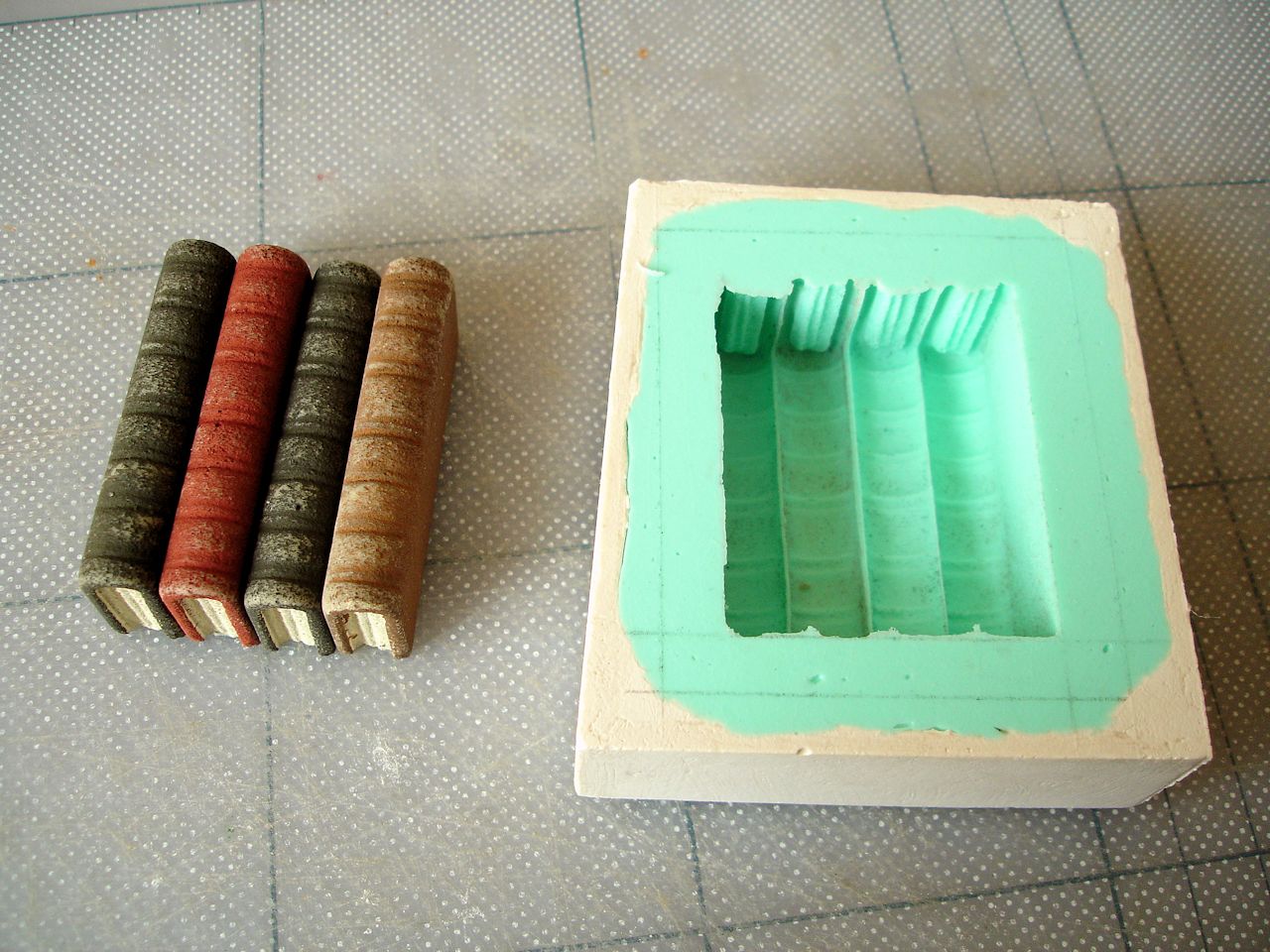
David Neat, props for stop-motion animation, moulds and casts of book parts, c 1:6 scale

I think I must have run out of my usual Lukasil 429 silicone rubber to make all of the moulds so for the spines I used some leftover paste-form silicone which involved completing the mould block with a plaster ‘jacket’. The casts above are made from Tomps Fast Cast Polyurethane. Below is a collection of individual books ready for painting.

David Neat, props for stop-motion animation, cast books unpainted, c 1:6 scale

David Neat, props for stop-motion animation, various 1:6 scale model books

Above is a selection of the individually finished books showing the range of sizes and different treatments. There are touches of gold, which I preferred to be very sparing with. Thanks again to Astrid Baerndal http://www.baerndal.eu for the beautiful photo!

The bulk of the shelf books needed also needed to be as light as possible. Because of the size of the model and the number of shelves to be filled I think I’d calculated that it would involve about 5 metres worth of miniature frontage!. For these ‘blocks’ I shaped individual fronts (only about 2cm deep) varying the heights and thicknesses, stuck them together and made moulds from them. These Kapa-line prototypes below are already simply painted because I wanted to test whether the detailing would be sufficient when dry-brushed to look worn.

David Neat, props for stop-motion animation, casting runs of books, c 1:6 scale

David Neat, prototype and mould for 'book blocks'

Shown above is one of the block moulds together with, this time, the painted resin cast. What is visible at the bottom of this is actually the top .. I’d realised I would have to detail at least the first centimetre or so at the top because this might be seen. Below shows the making of these complete blocks in progress, involving a short line of ‘frontage’ with a ‘complete’ book attached either side. This was necessary because the full depth would be seen when the loose individual books in between fell or flew out.

David Neat, props for stop-motion animation, 'blocks' of shelf books being made

David Neat, props for stop-motion animation, book moulds being filled with resin and foam

The parts of these book-blocks were cast in a resin/Fillite mixture (Fillite is a very light, grey ash filler commonly used in resin casting, especially where reduced weight is needed). As a further reduction to the weight I inserted blocks of Kapa-line foam while casting.

I’d made the range of individual, more detailed books first so I could make moulds of some of these to cast the larger end-books for the blocks, because for these it didn’t matter that one side would be blank.

David Neat, props for stop-motion animation, completed books ready to be moulded for re-casting

As I’ve said, there were a few special books that either needed to be opened and read in the course of the action or others which would flap like birds around the room. Luckily for me, I didn’t need to introduce tight hinges to animate this ‘flapping’, so I choice to make the practical books using cut portions of cheap notebooks, choosing only those in which the pages were firmly glued to a cloth spine which I could also attach to the cast covers. I could seal most of these pages shut, leaving a few free at the place of opening. These I covered with copies of minutely scaled-down text on especially thin cream coloured paper.

David Neat, props for stop-motion animation, making a 'working' book, c 1:6 scale

David Neat, props for stop-motion animation, c 1:6 scale practical books

I had a particular challenge coming up with a method of achieving the elaborate, raised cobweb design on the main book above. I wanted it to be as fine and sharp as possible so this ruled out drawing it on with a relief medium, even one of the relatively fine relief outliners used in glass painting. In any case, this might not have survived much handling! Luckily I had been thinking for a while about possible methods of ‘working in negative’ .. that is, casting into voids or depressions made to achieve certain effects instead of working ‘positive’ .. so I made use of the ease with which Palight foamed-PVC can be finely incised (a little like lino-cutting) as a mould for casting this very detailed form.

David Neat, props for stop-motion animation, carving a 'negative' for raised decoration on a 1:6 scale book


Small props for stop-motion animation

Back in 2011 I was making settings and props for stop-motion animation, and one particular scene I’d been asked to work on involved the eating of an apple down to its core. The film called for a kind of poetic realism .. I mean that its world was ‘ours’ to an extent, the puppets were recognisably human though stylised, furniture and props needed to be fairly accurate and believable, even though the action was often dreamlike. This was one of those moments in dream when reality is tugged a little more into focus, so although a loose approximation of an apple getting smaller in bite-shaped chunks could have sufficed I wanted to make the moment properly convincing.

So I modelled the whole apple first in Super Sculpey .. in two sizes because one would be needed for close-ups and the smaller for scene shots. I made silicone moulds from these, and then enough casts for about ten successive bites of the apple. My intention was to carve away each bite in the sequence, so I cast in thin Fast Cast polyurethane resin mixed with a third of Fillite (a light ash filler) which would make the material nicely carvable especially if using a Dremel.

I guess I knew from the beginning, or at least pretty soon after, that I would have to manually copy the ‘bites’ on each successive one down the sequence, but I didn’t want to make more than one mould for each apple size. I made the stalks individually out of white styrene rod, slightly carved and sanded (and the ends ‘crunched’ with something heavy). I used Vallejo acrylics to build up a nice glowing red in layers, and kept the surface detailing to a minimum since each stage would have to be exactly copied.

I made a very simple mould for both using my usual Lukasil 429 (from specialplasters.co.uk, a silicone rubber I’ve been using for years which has always been easy and reliable). For small and basic shapes such as these it was enough to tack them with a little more Sculpey to a baseboard, build a containment wall around them and pour silicone as a one-piece block around them. Once cured the silicone needs only to be lightly split with a scalpel to take the prototypes out and make the casts. This is what I often call a split-block mould. This is the easiest form of 3D casting, each cast needing just a little bit of clean-up work around the pouring hole.

Advice on making props etc. for stop-motion animation

This was an example of a special prop serving a visual sequence which had been properly thought through. In this case the way the prop would be used was very clear. This is not always so, partly because room has to be left for on-site decisions during animation and partly because it’s rarely possible to think of everything anyway, especially if props are commissioned at an early stage, long before animation begins.

In this situation it’s always good practice to allow for possible changes, and include these contingencies straight away at the making stage as long as they don’t lengthen the making time too much. One very good move, where there’s a choice, is to pick materials which are relatively easy to alter. Foamed PVC for example is very easy to cut and can be re-glued instantly using superglue. Another prudent habit is to keep parts which ‘may’ have to move separate until the last. As an example, even if something like a school-desk isn’t likely to be opened (according to the script .. and there should always be a script!)  it may be wise to keep the desk-top separate, and give the underside and the desk interior the same colour treatment as the rest just in case. On the other hand I would never go to the trouble of making working hinges for this kind of ‘what if’ because it’s often easier to animate a movable part like that just with a concoction of Blu Tack and bent wire.

If you’re asked to make props or furniture for someone else’s stop-motion animation you can only work as efficiently as the information you’re given .. or, more truthfully .. the information you’ve had the sense to ask for! I’ve never worked on anything where I didn’t have to tease out important facts by asking a lot of searching questions. You will of course want the principle design directives first .. the scale or dimensions, and the full visual appearance of each article. Then, just as importantly, you will need to know details of how each is used if at all, or whether they are just background dressing. These are the main questions, but there are many others that one may not think to ask at first, so here are just some of them.

If a prop is going to be used in the action, do we see the puppet holding it? If so, how easily can the puppet do this? For example, does the prop need to be specially light? Do holes need to be drilled in the prop to attach fixing wires, or if something like Blu Tack or ‘sticky wax’ needs to be used is the paintwork suitably resistant? In the case of pieces of furniture, do they need to be secured to the baseboard (partly to keep their position, but especially if sat in or leant against)? If so, legs usually need to be fitted with strong wires or bolts at the bottom.

Has the question of ‘relative size’ been properly considered when deciding upon the scale of a prop? To put it simply, just like dolls or cartoon characters puppets often have larger heads and hands in relation to their bodies and their overall height. If, for example, a retro style desk telephone is needed and this is scaled faithfully according to overall puppet height, it may look reasonable enough in the background but if ‘used’ the speaker/receiver part may look ridiculously small against the puppet’s hand or ear! The solution might have to be that two differently scaled versions are made, or just one slightly larger speaker/receiver part.

If you’re proud of your own work, if you’ve taken good photos and want to publicize what you can do, will anyone object if you do this before the film itself has become public? It’s important as a courtesy to reach an agreement, even if it’s not something dealt with in your contract .. or even if there isn’t a contract! You should consider the fact that an independent stop-motion film may be many years in the making and this is a long time, either to not be able to promote your own work or to feel a bit secretive or guilty when you do. Often this can be resolved, as I’ve done in this article, just by not mentioning the film by name.


Finally getting the hang of Instagram


I’ve been thinking about tackling Instagram for a while .. because I desperately needed more opportunity not to have to write that much .. if you can believe it!  But because I process photos quite ‘seriously’ on my PC before letting them loose, and because I have a Windows phone which I’m determined to keep until the bitter end .. there just didn’t seem much hope! But recently I did yet another search for alternative ways of uploading to Instagram, and finally I’ve found a way that works .. like a dream! It simply involves installing the free browser Vivaldi on the PC (no need to make it the default browser) and accessing Instagram through that! The extra piece of software doesn’t weigh the computer down like some other methods I’ve tried and failed with. The only drawback is that it only allows me to upload one photo at a time rather than grouped .. but this could change, and personally I prefer that anyway. Here’s the link where I found out about it ..

https://www.techradar.com/uk/how-to/upload-photos-to-instagram-from-a-pc

I’ll be posting on Instagram more regularly than here, I would imagine. WordPress will remain my serious ‘writing’ place, and I’ll be able to elaborate here especially regarding ‘instructional’ content but .. you might have noticed .. I seem to have less and less time to do that these days. Here are some images from the couple of posts I’ve put on Instagram so far .. and if you’re interested, have a look at

https://www.instagram.com/davidmeredithneat/?hl=en


Above .. works in progress. Green styrofoam ‘beasts’ shaped in two halves, ready to be sealed to make moulds and casts from, and polyurethane resin cast ‘Arpish Dancers’ which I’m testing on a mock-lacquer sushi plate.

Below .. I recently ‘re-vamped’ some pen drawings from the Thames Foreshore made a few years ago, converting them into transparent ‘layers’, colouring them in Procreate and finishing them in PaintShop Pro. This is ‘Base#1-1’ and below is an enlarged detail from ‘Base#2-1’

Below .. resin cast ‘eggs’ and foamed-PVC ‘twigs’ collection. I’ve given the PVC my usual treatment of ‘graining’ with sandpaper and staining with Spectrum Noir alcohol ink pens, to resemble bone or wood. I’ve surfaced the mat underneath with a laminated digital sketch .. part of my experimentation with different presentations, or ‘contexts’ as I call them, for the ensembles of small sculptural forms.


Coating styrofoam with polyurethane resin

These are the latest forms I’ve been making for my .. not-quite-working-title .. Ridiculously Organic Construction Toy. For this I’ve been creating simulations of eroded rock and driftwood cast in resin, twisted Pvc branches covered in fake moss and lichen, corals, leaf clusters and strands of seaweed made from latex etc. But I also wanted to include some play elements which are more obviously scaled down, such as these brickwork ruin pieces. The best way of picturing the whole idea is to think of aquarium or reptile tank accessories and then imagine getting a large collection of these instead of a box of Lego. I’m still working on the question of how exactly the ‘construction’ is achieved .. i.e. how such components will be fixed together when playing .. but as part of the system I’m working on an artificial ‘mud’ which I’m hoping will solve part of it.

ruin fragments in resin-coated styrofoam

The forms above were cut/carved in regular blue styrofoam, textured using a heavy-duty wire brush and then coated in polyurethane resin. There’s a bit more to the ‘painting’ process .. something new I haven’t tried before .. but I’ll come to that. If properly done the method of resin coating makes the forms unbelievably strong! .. perhaps not enough to survive little children, but certainly any adult wear-and-tear.

Making a brickwork arch in styrofoam

These two photos illustrate other forms intended for the collection and the process of making them. I’ve described this method of form-making in more detail in Shaping styrofoam. The arch piece above started with a Pvc template, which I used to help sand a block shape. I found I had to make a separate drawing template (the one at the bottom) just in order to inscribe the brick pattern onto the styrofoam shape. Then I used the special diamond needle files pictured to scratch out the brickwork divisions at the right thickness. I wanted these pieces to be 1:12, i.e. usual dollshouse scale, but I’ll eventually use a mixture of scales.

Making a brickwork niche in styrofoam

To make the ruined ‘niche’ shapes above I also used the method I described in Shaping styrofoam of using a curved sander to create the concaves. I roughed out very deep channels for the mortar lines, because these will become partially filled with coloured resin .. and this is what gives the pieces unusual strength. I found it was better to make all the channels before attacking with the wire brush, because I made the pitted texture mainly by hitting or pressing with the brush. This peppers the foam with deep holes and it may fragment a bit too much if the channels are made afterwards.

diamond needle files

Here is a close-up of the type of file I’ve found to work best for detailing foam. These have a ‘diamond coated’ surface which has more of an effect on relatively soft materials than the other, cheaper, form of needle file which is just ‘toothed’, grooved metal.

wire brushes useful for texturing rigid foam

I usually use the smaller brushes pictured above when working with the more delicate polyurethane foam in Kapa-line foamboard, but styrofoam has a tougher surface .. the heavier wire brush has more effect. Importantly, the action in this case is not a brushing or sweeping one, it’s more hitting downwards and rocking around .. I call it ‘scumbling’.

styrofoam 'ruin' fragments

Now to get to the main point of this article! Of the polyurethane resins I most often use (Sika’s Biresin G26 and Tomps’ Fast Cast) I know that both can be used in the following way, but Tomps Fast Cast is best because it’s a little thinner, powder pigment mixes better into it, and according to Tomps it is designed to cure properly in very small amounts or in very thin layers. This is not the case with all polyurethane resins. I’m basically making a very quick-setting paint with it, and because it’s quick-setting it has to be done a little at a time. To dose both resin parts I use disposable plastic pipettes (which are available from a few places online) and usually work with not more than 2ml of each part at a time. I can normally manage to use up to 4ml before it thickens too much. Because there’s usually no time spare to clean the palette surface before it sets I use a ceramic tile which can be scraped clean afterwards. There’s always just enough time to clean the brush though, and this can be quickly done with acetone.

Coating styrofoam with polyurethane resin and pigment

Here I’ve dosed 1ml of each resin part together on the tile, added a small amount of powder pigment, mixed the whole together with a synthetic-hair paintbrush and used the same brush to paint the foam. Synthetic is best because the hairs will be rigid enough to push the pigmented resin into deep pattern, but full and fine enough to hold a lot of the paint. Powder pigment is the best form of colour to use .. strong colour, inexpensive, available .. and I usually find that it mixes better into resin than it does with water!

The polyurethane resin has no effect on styrofoam (unlike polyester resin), it will cure hard and ‘fused’ to the surface, and it’s done .. that is, it’s touch-hard and ready for further work .. in about 15 minutes! Whereas regular paint such as acrylic will infiltrate more and contract as it dries, polyurethane resin does less of both so there will be a little ‘smoothing over’ of fine surface detail. It will also be a gloss finish! .. which I don’t like, would never choose, and at the moment I’m experimenting with the different  ways of dealing with this. There is no matting additive for polyurethane resin, and regardless of which pigment or filler is mixed with it, the top surface exposed to the air will always be glossy. Obviously painting over with another matte paint, such as a good acrylic, is an option .. but polyurethane needs a lot of preparation if the paint coat is to resist a lot of handling and this is made difficult by such a patterned/textured surface.

One possible solution is to use my own version of cold powder coating. If you google ‘powder coating’ you will find that this refers to an industrial painting process in which fine thermoplastic powder is melted onto metal to create a durable surface. It’s very like the enamelling that you might have done at school, with coloured glass powder on a copper plate, melted in a small oven. My version does not require heat, and it’s perhaps more related to the model-making practice of scattering granules into glue to create a surface .. but it does share some of the surprising durability of these other methods!

crushed brick

Below is a close-up of the styrofoam ‘ruin’ forms after coating. I first gave the bare styrofoam an undercoating of resin mixed with black pigment, and then a second coat without any pigment, covering a small area at a time. While each portion was still wet I sprinkled a mix of finely crushed brick and sand onto the resin. I’m fortunate in that, living close to the Thames beach, I can pick up fragments of any colour of brick, illustrated above. Since these have already been broken down by the elements they are much easier to crush to a powder using mortar and pestle.

detail of brickwork surface done with 'powder coating' method

While working I could see that the particles were readily sinking into the thin coating of resin, and when the excess is shaken off after a few minutes the powdery top layer still adheres strongly. Polyurethane resin is a strong adhesive, especially if the dust or particles are porous and jagged. Having tested the strength of the surface once the resin cured I have little doubt that it is permanent. I still have to do some paint finishing on these pieces, emphasizing contrasts and colours and giving more ‘speckle’, but I have no worries about regular acrylic paint attaching itself on top. The greatest bonus in this particular case is that these pieces have a lot of the look and feel of real brick .. because that’s what it is!


Using plaster as a filler in polyurethane resin

I’ve been asked this question a number of times now .. whether regular plaster can be used as a filler for resin, in place of the other ‘white’ powders more commonly used such as talc, chalk dust, marble dust etc. Don’t forget that these are all versions of calcium carbonate and are chemically inert, whereas plaster is calcium sulphate and certainly not as ‘inert’ since it reacts so strongly with water. I hadn’t ever considered it as a filler, and hadn’t heard of any cases of it being used in regular practice. My advice up to now had therefore been to avoid it, because I assumed that it could affect the curing of resins. Plaster is hygroscopic meaning that it will readily absorb moisture from the atmosphere however well it might be stored. Powder pigments are the same, and I have found that the slight moisture in them will cause polyurethane to foam and expand a little even when just a little pigment .. i.e. up to 10% by weight of resin .. is added. So I always assumed that adding a more substantial amount of plaster would cause bigger problems .. not only affecting cure but probably also thickening the resin too much to pour properly. Yesterday I finally found the time to do some tests using a couple of regular plasters with polyurethane resin and discovered that although there are some adverse effects these could also be turned into benefits.

Expansion of polyurethane resin when filled with casting plaster

For the first test above I made a control mix of Tomps Fast Cast polyurethane resin without any filler .. 15g of each part, so 30g total. The mix set touch-hard in just a few minutes as normal, becoming a pale ivory solid (the cup on the left). I then did the same but added an equal weight (30g) of Crystacal R which is a fine, hard, ‘alpha’ casting plaster. As per usual with polyurethane resin, the whole amount of filler has to be mixed thoroughly with Part A before adding the hardener Part B.

Whereas mixing is usually very smooth using conventional fillers such as Fillite, the plaster/resin needed a lot more stirring before the lumps disappeared. But after some effort the two combined making a smooth but thick liquid .. like treacle. As usual though, this thins down quite a bit once Part B is added, and the resultant mix was still very pourable. Far from the reaction being slowed down by the plaster I found that the cup started to get warm very quickly, and then the liquid started to expand. Once it had set touch-hard it had practically doubled its volume, as shown by the initial mark I’d made on the cup. The mass was solid, hard and ‘dry’ within 30mins .. there was no under-curing, failure to mix or greasiness on the surface .. all the indications of a good cure!

comparison of volume of 30g unfilled resin with 30g plus plaster filler

What was completely unexpected was the change in tone .. from the normal clean, pale ivory to something slightly darker, dirtier as shown here .. and I can’t really explain that yet! The test piece detached cleanly from the cup and the surface was smooth as shown below. The only indication of foaming was minute but noticeable pocking of the surface towards the top, none at the bottom.

I measured the volume increase compared to the control pour, both before and after foaming. The control pour measured 30ml in volume once solid, roughly consistent with the SG (‘specific gravity’ or weight per ml) of the combined resin parts given by the manufacturer as 1.1g. The volume of the same amount of resin with 30g of Crystacal R added .. before expansion .. was just 40ml. This is also consistent with the way plaster behaves in water, absorbing much of the liquid volume. The volume of the expanded mass once set touch-hard was 70ml.

effects of foaming visible on cast surface

I expected a roughly similar result when I repeated the test using the same proportions with pottery plaster in place of Crystacal R  .. but the result was more dramatic! Pottery plaster is a coarser, softer-setting ‘beta’ plaster, called ‘pottery’ plaster because it’s designed for making the absorbent plaster moulds ideal for slip casting. In the first place whereas the 30g Crystacal had combined with the 15g Part A resin eventually as a smooth liquid, the same amount of pottery plaster became a thixotropic paste rather like car body filler. Addition of Part B thinned it considerably but it was still a significantly thicker liquid than that obtained using the Crystacal.

expansion of polyurethane resin when filled with 'pottery' plaster

But more importantly, foaming was more ‘aggressive’ producing larger bubbles and until it set hard the mixture expanded to almost three times its original volume. As before though the mass became solid and hard within 30mins with no tackiness or other evidence of failing to cure.

larger-scale foaming on surface using 'pottery' plaster

However, as shown below there was more noticeable damage to the cast surface in the topmost area because the bubbles here had become much larger. As with the Crystacal the volume of 30g resin combined with 30g pottery plaster prior to reaction was 40ml, but this expanded to 115ml before setting firm.

larger-scale foaming visible on cast surface

I made a sectional cut through the upper parts of both test pieces and sanded the surface .. the fine casting plaster to the left and the pottery plaster to the right below.

cut sections showing foam structure

I can only account for some of this marked difference in behaviour. The fact that the pottery plaster appeared to thicken the mix more is predictable .. it is because of the shape of the particles. Commercial fillers such as Fillite are composed of minute microspheres which roll over each other meaning that quite a lot can be added to a liquid without affecting its flow too much. The particles of pottery plaster must be jagged, causing them to clump together whereas those of the Crystacal must be finer and smoother. As for the stronger foaming reaction and increased expansion .. the pottery plaster was older than the Crystacal and may have acquired more moisture; it may also contain an additive; or it could have something to do with the particle size. I’m not entirely sure!

I imagined though that whereas plaster would never be a sensible option for flawless casting, these results could have some uses. At the moment I’m making cast versions of pieces of driftwood to use as components in a sculptural project. So far I’ve been hollow-casting these in polyurethane resin, but using Fillite as a thickener. I’ve described this casting process in my article Making hollow casts in open or closed moulds in the ‘Methods’ section under ‘Mouldmaking and casting’. One difficulty with this technique is getting a thick enough build-up, especially on vertical surfaces, when using polyurethane resin because there is no way of making it truly thixotropic. I tried the pottery plaster/resin mix for coating these moulds below, with a little black pigment added. I found that because of the swelling it was much easier and quicker to build up a thick shell, even on the vertical parts.

making a hollow cast in polyurethane resin

I also found, as I’d observed from the cup tests, that since the foaming is largely directed upwards there was no damage or loss of detail on the cast surfaces. The intricate patterns of weathered wood have reproduced perfectly here!

hollow casts using filled polyurethane resin


Casting materials

I’ve updated prices, suppliers and added proper entries for principal materials in the casting section under Materials above. The ‘quick view’ comparisons page provides an overview for anyone not sure which of the various casting materials to use, while the other pages give more detailed information on the properties of each and how to work with them. Not all are there yet in detail, I am slowly working through them .. but so far the pages include polyurethane resin, polyester resin, polyurethane foam and polymer-modified plaster.

These more detailed pages begin with a summary ‘definition’; outline what the material is best at and not so good for; describe their ‘working life’ i.e. how to use them and how long for, and lastly what they cost and where to get them. At the end is a ‘worklog’ where I can add other bits of information as I have it.

Here is an excerpt from my page dealing with polyurethane foam. It’s the first one in this section to include photos, but I hope to do the same with the others.

Working life

Polyurethane liquids generally have a recommended shelf life of under a year, but I recently made a test with this flexible polyurethane foam bought at the end of 2012  .. so, more than two years old .. and it worked perfectly! For more advice on disregarding ‘shelf life’ have a look at the start of the ‘quick view’ comparisons page in this section.

self-skinning flexible polyurethane foam, old batch still usable

I always write the date or period when I buy materials, plus reminders if anything needs special handling .. as with part ‘B’ of the mixture here which needs to be shaken because the ingredients separate after it has been standing for some time. This is common with resins especially those that are pre-filled. Another thing .. not only common, inevitable .. is that the cap or lid for the ‘hardener’ component (usually part ‘B’) gets stuck because traces of the liquid crystallize. Something which has never failed me so far even with the most stubborn screw-caps is a strip of tough rubber to grip around the cap while turning.

strip of rubber to help unscrewing caps or lids

As with resins, polyurethane foams consist of two component liquids which are mixed together in a set proportion by weight, so having a good digital kitchen scales is essential. With this one from Tiranti the ratio is 2:1 part ‘A’ to part ‘B’. But in addition to being able to weigh accurately one also needs to judge the volume in this case, to be able to dose the right volume of liquid needed to completely fill the mould when it expands.

For example if the expanding foam has to fill a volume of 1,000 cubic centimetres (equivalent to a 10cm cube) and the foam is expected to expand up to 5-6 times its original liquid volume, then dividing 1,000 by for example 4.5 should ensure that the mould is filled, with a little surplus. This gives us close to 222 ml of liquid needed, of which two-thirds of the weight is part ‘A’ and one-third part ‘B’. So let’s say we need 148ml of part ‘A’ and 74ml of part ‘B’. We must now find out what these would weigh. Luckily the SG (specific gravity, written as the weight in grams of 1 cubic centimetre of ml of the substance) is often given on the containers. If not it will be on the MSDS (Material Safety Data Sheet) available online from the manufacturer or supplier. The SG of part ‘A’ of this expanding foam is 1.05 so 148ml would weigh 155.4 grams, and the SG of part ‘B’ is 1.13 so 74ml would weigh 83.62 grams. We need to round these figures off a bit but also adjust them back to a 2:1 ratio .. 156 grams of part ‘A’ to 78 grams of part ‘B’.

Below, I didn’t need to make a specific volume calculation in this case because I was just testing whether the material still functioned normally. I poured an arbitrary amount of part ‘A’ .. 17 grams .. into the cup first, then 10 grams of part ‘B’, a little more than half the amount. I did this because I’ve come to expect that with ‘old’ materials it’s the catalyst that’s most often affected, becoming weaker.

part 'A' polyurethane foam being weighed

polyurethane foam part 'B' added 2:1 by weight

Above, 10 grams of part ‘B’ has been added. It is always important to think ahead when preparing for this work! Make sure that you have all your necessary tools etc. to hand .. i.e. as here, a mixing stick .. so that you don’t have to hunt around for them at short notice. As soon as the part ‘B’ is added it should be quickly stirred in because the reaction will start within a few seconds. If the mixture needs to be decanted into a form mixing should not be more than c. 10 seconds before transferring it. I’ve tried mixing the material directly in the mould form a few times in the past but this has often resulted in an uneven result with parts not properly curing.

2-part polyurethane foaming within 10 minutes

The foam will have fully risen within about 5-10 minutes. Out of interest I calculated exactly how much it had done so in this case. There was 17g of part ‘A’ .. so 17.85ml in volume using the above calculation, and 10g of part ‘B’ being 11.3ml in volume .. altogether 29.15ml. The foam rose to fill the cup with a little more on top so by measuring water in the cup and adding a little I estimated 210ml. So the polyurethane had actually expanded to 7.2 times its original volume! I don’t know whether the increased expansion was due to the age of the material or the fact that I added a touch more part ‘B’ .. but it’s worth experimenting with!

When I bought the foam in 2012 it was for making these forms shown below (I’ve placed an old casting in its mould) .. and I recorded at the time that the polyurethane only expanded 4.5 times its volume. The mould is plaster-jacketed silicone rubber (made a long time ago when I was living in Hamburg and I can’t remember why I used a translucent silicone). The silicone doesn’t need any release agent against the foam but plaster certainly will if you want to keep it clean .. and Vaseline will be fine. The surface of the cast didn’t achieve the smoothness of the mould .. but one shouldn’t expect it to.

form cast in flexible polyurethane foam, showing silicone rubber mould

What this photo shows well is how much polyurethane discolours over time. In this case it was just discolouration though .. after three years exposure the feel of the surface was just the same.

freshly foamed and 3-year old polurethane cast compared

Test 19/12/2012  72g (48g part A to 24g part B) expanded to fill the ‘Koerper’ mould with just a little pushing out of the top, which cut then be cut off. The volume of the ‘Koerper’ form was measured as 325 ml so expansion was 4.5 times (weight to volume). The foam took c. 25mins to reach tack-free curing

Making hollow casts in open or ‘closed’ moulds – Part 2

This follows on from the previous post in which I mentioned that hollow casts can be made in ‘closed’ moulds i.e. without having to set up a pouring hole. The cast is achieved in exactly the same way as the puppet head .. by building up a sufficiently thick layer in both halves of the mould, then joining them together. In fact it can even be a little easier since the two mould halves often have a consistent rim to work up to. This method of casting is a big advantage when the prototype form offers no convenient area for setting up a pouring hole, as is the case with the form below.

silicone rubber mould of a light bulb

Chloe Allen moulded this lightbulb while participating in our Modelling, mouldmaking and casting course in 2012. She wanted to preserve the distinctive shape of the contacts at the base, which would have to be remodelled if this area were cut out to form a pouring hole.

light bulb casts in Sculptamold and PU resin

The cast on the right, which came out near-perfectly, was a thin shell casting using polyurethane resin (Biresin G26 in this case) and Fillite. Note how finely the silicone rubber and resin have captured the smoothness of the glass. When silicone rubber is used on glass the surface must be very thinly greased with Vaseline to prevent the silicone from sticking. The distinctly different result on the left was obtained using Sculptamold as a casting material. Sculptamold is a mix of casting plaster and cellulose fibres, bought ready-mixed in dry form, making a thick paste when water is added. It feels and looks very similar to papier-mâché pulp, except that it sets hard in about the same time as regular casting plaster i.e. around 30mins. One has to work fairly quickly and paste the mix into both halves of the mould to form a thick shell. The paste is very workable and has good thixotropic properties, meaning that it is non-slump. When working with polyurethane resin the shell can be left fairly thin at the rim, because this will be strengthened when more resin is rotated around the closed mould. But Sculptamold is too thick to do this with .. instead the walls of the cast need to be built up to a good thickness right to the rim, but preferably with the top edge sloping down towards the centre of the mould, so that the mould halves will close properly when they’re put together. Usually once this is done the Sculptamold has already set firm, the top edge can be trimmed with a knife if need be and excess Sculptamold cleaned away from the mould surfaces. A little more needs to be mixed and then ‘piped’ or troweled on one or both of those edges before the two mould halves are joined together. Since the edges were sloping downwards most of the fresh Sculptamold will be pushed towards the centre of the mould, though a little will be squeezed the other way and will form a thin flashing on the cast which can be easily removed.

Because of its mix of plaster and fibres Sculptamold traps a lot of air, and this is impossible to get rid of, resulting in the surface effect shown above. Although the plaster component becomes firm very quickly the fibres retain moisture so, like traditional papier-mâché pulp, the material needs many days (weeks even! .. for thicknesses over half an inch) to dry out completely. After the two mould halves have been pressed together the setup should be left at least for a couple of hours before the cast can be safely demoulded. Even then the damp Sculptamold surface is somewhat fragile, rather like slip-cast clay, but this can be an advantage because it means that the mould seam can be more easily cleaned up, even using sponge and water to blend it a little if need be.

A while ago I wanted to reproduce two interesting fragments of driftwood I’d found on the Thames shore (we live only a couple of hundred metres away). The one below was a fairly complicated form which I knew would be difficult as a poured cast because of air entrapment, plus the fact that I didn’t want to compromise any detail of the form by cutting out a pouring hole.

Thames driftwood hollow resin casts

Thames driftwood hollow casts

In each case the original driftwood is on the right, the resin copy on the left. The paintwork isn’t complete in these photos .. just a basecoat with the first, lighter dry-brushed colour over it. I’d scrubbed the casts with warm water and Cif to give a slight ‘key’ to the resin surface and to remove any remaining greasiness. I used Rosco SuperSaturated acrylic, a theatre/film scenic paint which dries especially matt and has a strong binder.

I made the silicone moulds in the usual way .. by embedding the form up to a half-way point all round in plasticine or wax; coating the first silicone half over that, followed by the first-half plaster jacket once the silicone was cured .. etc. See previous articles e.g. Making a supported silicone mould for a life-size head .. for details of this method. Again as usual I coated the two mould halves with a polyurethane resin/Fillite mix, building up a strong shell.

silicone rubber mould of driftwood

As with the mould above for the smaller of the two forms, it can get tricky to determine in some places where the object surface ends and the mould seam surface begins, especially if some parts of the object are flat and thin. Although I’m only thinking of this now, and am yet to try it .. it could help if the very first, thin layer of silicone on the object, the detail coat, is coloured differently from the rest to make the border of the form clearer. Silicone rubber will accept a small amount of powder pigment to colour it without affecting its properties, as I illustrate in the next example.

showing resin edge cleaned up

As always with this method, the edge of the resin shell needs to be cleaned up so that there’s nothing preventing the two silicone mould edges from fitting together. If in doubt or if the mould halves no longer meet properly when testing them together, it’s better to shave away a bit more than necessary. Usually the resulting gap in the shell is filled when the final batch of liquid resin is rotated around inside the closed mould. In the failed example below, either the resin/Fillite mix was a little too thick with Fillite to begin with or I’d waited too long before pouring into, closing or rotating the mould. The resin hadn’t travelled enough along the whole seam line.

faults in hollow casting

Here’s a brief account of making a similar mould .. at least, done for the same reasons .. but with some differences in the method. Once again, I used these found objects mainly as test pieces .. this time tackling a dryer ball. The original below is pink and the cream coloured one is the cast. Fairly obviously this form presents only one option for making a poured cast .. setting up a pouring hole in the space where the writing is. But I wanted to keep the writing, and in any case .. managing to fill all these little ‘horns’ without trapping air would be impossible without the assistance of a vacuum chamber to pull the air out. I don’t deal with these more commercial methods because most people, like myself, are unlikely to have one.

Dryer ball original and cast

I also wanted to try covering with a complete silicone layer first, without embedding the form and applying it in two halves as I’d mostly done before. I intended to cover it and then split the silicone skin with a scalpel. The problem though would be finding the right place to cut once the form is covered .. ideally I needed to cut around the middle exactly in between the rows, where the manufacturer’s seam line is. I thought I’d solved the problem with the following, but it didn’t work out as cleanly as hoped.

covering half-way with silicone rubber

I applied the silicone rubber layer in two stages .. the first one above, and once this had cured, I completed with the second half below. It doesn’t make any difference if it is applied in sections like this .. the second section will fuse completely with the first. My idea here was to colour the second half to make the cutting line along the mid-point clearer. This is ordinary, not especially finely ground powder pigment, used in theatre scenic painting. The best way to mix with the silicone is to combine it thoroughly with a very small amount of silicone first .. to wet it in other words .. before adding more silicone. I’ve found that powder pigment blends very readily with silicone rubber. Apparently up to 10% powder pigment by weight can be added to silicone without affecting its properties. For this I used roughly 3g Ultramarine for 40g silicone rubber.

Applying coloured second half

Below is the containment setup I made around the mould using modelling wax, in order to make the first half of the rigid mould jacket, also called the mother mould. This enclosing jacket is necessary, especially when making larger moulds, to keep the flexible silicone skin in its proper shape. There are more, step-by-step photos showing how to model this containment at the end of Modelling wax in the Materials section.

setting up for mould jacket_5

The mould jacket can easily be made using a hard casting plaster, especially if this is left for a while to thicken up so that it can be troweled on over the form. For this though I decided to use Jesmonite .. which is basically the same as plaster but using an acrylic polymer liquid in place of water. This makes the material much tougher, and if a reinforcement such as jute scrim is also used, a stronger but thinner shell can be made.

mixing Jesmonite

Jesmonite powder and polymer liquid can be mixed together in a ratio of anything between 3:1 to 2:1 powder to liquid dependant on the pouring consistency needed. 3:1 gives a thicker mix and is more economical since the powder (basically just a fine casting plaster) is by far the cheaper of the two. Contrary to the way plaster is normally mixed .. the polymer liquid should be added to the powder. This should be thoroughly and vigorously mixed until the consistency is even. This is possible by hand for small amounts but the manufacturer of Jesmonite recommends using a special power drill attachment for mixing larger quantities.

1st pour for mould jacket

Above, I have poured the first small batch of Jesmonite over the mould form and to fill the ring around it. Below, I’ve started pasting small pieces of jute scrim into the wet Jesmonite. More can then be mixed up to cover the scrim .. and the procedure can be repeated to build up a strong shell.  I used two layers of scrim for this small form, but one would probably have been enough .. even for much larger mould jackets such as the one featured in Making a supported silicone mould for a life-size head .. I only used 2-3 layers.

layering with jute scrim

finished mould jacket half

The Jesmonite took very little time, less than 40mins, to set hard and shortly afterwards it was safe to remove all the wax and turn the form over. The silicone will eventually be sliced using the Jesmonite rim as a guide.

cleaned up first mould jacket half

But first, shown below, I’ve set up a wax wall for making the second half of the Jesmonite mould jacket. This is exactly the same procedure as before except that the Jesmonite rim needs to be thoroughly Vaselined to prevent the second half from sticking to it!

preparing for second half

Here is the completed mould being dismantled. I had thought that applying the silicone in two colours would indicate the line I had to cut in the silicone (i.e. between the rows of ‘horns’) clearly enough. But it wasn’t accurate enough, and in the end I got some parts of the horns on the seam line.

completed mould halves

It meant that these along the seam were much more difficult to fill, and my first tryout using polyurethane resin and Fillite didn’t work perfectly.

making the hollow cast

But for the second attempt I used a very thin, unfilled resin .. Tomps Fast Cast .. manually filling each ‘horn’ bit-by-bit, including a lot of jiggling around with cocktail sticks to dislodge trapped air. It was quite a lot of painstaking work .. but here again is the perfect cast, just to prove that it’s possible!

Dryer ball original and cast

Making hollow casts in open or ‘closed’ moulds – Part 1

This post follows directly from the last one in which I featured one of the simplest ways of making a complete mould for a puppet head .. making a 2-piece block mould in silicone rubber. At the end of the post I included a couple of photos of a hollow casting using filled polyurethane resin and now I want to explain how to do this in more detail. I will also deal in later posts with making hollow casts using other materials such as Jesmonite and the advantages of being able to make a hollow cast in a ‘closed’ mould .. i.e. without having to set up a pouring hole at the mouldmaking stage.

mould with casting

Jumping forward for the moment above and below, the hollow resin cast is almost finished and just needs a little cleaning up on the seam line. Polyurethane resin normally cures a white-to-beige colour dependent on the type and this cast is light grey because I added a filler called Fillite when mixing it. Fillers are added to resins for many different reasons (see Common fillers for resin casting in the Materials section) but in this case it is specifically to thicken the resin to help it stay put on sloping surfaces. Fillite also makes the resin easier to carve or sand without reducing its strength too much. Unlike polyester resins, there is no thixotropic or ‘gelling’ additive available for polyurethane resins.

casting nearly finished

For this test piece I used Fast Cast Polyurethane Resin from Tomps (see Quick view comparisons of casting materials for current prices) which is particularly thin to begin with, but the slower version has the advantage of a slightly longer working time and the ‘turning’, i.e. when the resin changes from liquid to solid, is not so abrupt. Below is the equipment needed for correct mixing. Polyurethane resins come in two equal parts, almost always mixed 1:1 by weight but in the past I’ve often got by without any problems by judging equal volumes in two disposable plastic cups, even though the weights of the two parts are slightly different. Now that I’m even more grown-up I prefer to measure properly by weight, using a fairly inexpensive kitchen weighing scales. Because the cans or bottles resin comes in are never designed to assist the pouring of small amounts .. the manufacturers would prefer that we use it all up in one go! .. I always decant some of each part into plastic cups and then pour from those when measuring. To avoid knocking these over while working, I made the cup-holder shown out of foamed Pvc.

materials for hollow resin casting

I usually mix Fillite with resin in the proportion 1:2 .. that is, equal amounts by weight of all three parts. This is easiest to remember and it also usually results in a thick sludge which is still easily spreadable and which will still manage to fill fine detail. It’s best to mix the Fillite thoroughly into part ‘A’ of the resin first (which is the ‘resin’ part of most polyurethane brands). The resin will combine with the Fillite surprisingly smoothly, to form a thick paste, which of course becomes thinner and more manageable when part ‘B’, the hardener, is added. Mixing must then be both thorough .. and fast! .. but shouldn’t need more than 30 seconds or so for small amounts like this. I usually mix up 10g part ‘A’, 10g Fillite and then 10g part ‘B’. The best mixing sticks I’ve found are disposable chopsticks because they’re very resilient, clean easily and can be re-used.

mixing Fillite with resin

The best practice is to pour most or all of it into the open mould-half straight away and sway the mould to let the slushy liquid cover the surface naturally first. In my experience it’s rare that air gets trapped with this method and using this mix, but if you’re concerned about deep detail there’s always a bit of time to poke around with a cocktail stick or small brush to make sure air is freed. An alternative is to take the extra time to brush on a thin detail coat all over first and let this firm up before pouring in more. For a few minutes the resin will pool back into the centre, but I work round the mould with a soft but rigid brush (synthetic is good) pulling it back up the sides for as long as I can until it starts to change. I try not to take it over the mould edge i.e. the outline of the form, but it doesn’t matter if this happens because this line can be cleaned up before the resin is fully hardened. Obviously, with the mould I’m featuring the neck part is completely open .. I had to edge the mixture very carefully into this part at first, but as it congeals it’s easier to build up a thickness.

close-up of mould being filled

After about 5mins or so (though this will vary with different resins) it can no longer be distributed so easily with the brush .. and it’s very important to stop trying at this point! .. because in doing so one risks separating the now gum like resin from the mould surface. In this state it’s possible though to press it, almost model it, with the fingers. Also at this stage if you want to use the brush again you need to clean it quickly in acetone.

filled halves of mould

I never try to do the two halves of the mould at once, however simple the form is .. most often the quick curing of the resin doesn’t give enough time for this. It is inevitable that the cast is much thicker in the deeper parts, but I’ve always found that if I follow the procedure described even the thin sections end up strong enough. They’ll get an extra covering during the next stage anyway. Resins have a so-called green stage (polyurethane having a longer one than polyester) when the thinner sections of the resin remain quite flexible. This can be taken advantage of .. let’s say it’s been 20-30mins since pouring .. for going round the mould edge with a scalpel or fine wooden modelling tool and peeling away anything that’s crept over the line. If not, the mould halves won’t fit together tightly! Now that they’re ready, the two halves of the hollow cast are going to be joined together from the inside .. by closing the two mould halves together and pouring in just enough resin to fill the seams.

Vaseline between mould halves

Above, I am brushing Vaseline on the remaining silicone surface, but being careful not to get it on the resin .. not so clear in the photo above. Vaselining the ‘seam faces’ (that is, the parts of the mould which come together to form the seam) is not an essential move when using silicone, but I’ve found that it often helps a lot! It provides an extra seal which halts the seepage of resin (this time mixed with a little less Fillite, to make it more liquid) out of the mould. I’ve also found that the Vaseline helps the silicone halves to align better.

For this internal coating I mixed up a small amount of resin and Fillite in the same way as before, but this time 10g part ‘A’, just 7g Fillite and 10g part ‘B’. I poured most of the mixture immediately into one half of the mould, placed the other half of the mould on top, made sure that the mould was secure and then rotated the mould carefully along the axis of the seam line to concentrate resin in this area. Obviously I had to be careful not to tip too far when running the resin close to the open neck part. Basically one has to continue in this fashion, ‘see-sawing’ around the whole seam and back, until one’s fairly certain that the resin has become too thick to move much more. Here it helps to have some of the resin remaining in the cup, as shown below, to indicate how thick it’s become. Another option, for those who have a little less patience, is to accelerate the curing with heat. Below I’ve set up a small heat gun to blow into the mould. I’m holding the mould because it needs to be moved around .. if left static it would get too hot. Once there’s no more obvious movement of the resin I usually leave the mould alone for a while, only demoulding the form once the extra resin in the cup is completely hard to the touch. If you don’t have this as a control, it should generally be safe to demould 1 hour after pouring, whichever brand of polyurethane resin you’re using.

heating resin to quicken curing

Obviously the advantage of being able to make a hollow cast like this is that it is lightweight, while still being strong. It also saves on material. If strength is of particular importance, more than one coating of resin can be applied or strengtheners such as glassfibre matting or scrim can be integrated into the two halves before the mould is put together. This is not a method of speedy mass-production .. it takes considerably more time than pouring a cast .. but manually ‘applying’ the cast in sections, as it were, does ensure that you can make perfect, blemish-free casts every time. If for any reason a solid cast is preferred, it’s easy to fill the hollow casting with more resin .. although it may be better to do this in stages for forms larger than this one because the heat produced by larger amounts of resin could cause tensions during curing which have been known to crack the casting.

removing flashing with scalpel

As I’ve said in the previous post, there’s always a seam to be cleaned up .. but in this event the work was minimal. With polyurethane resin the flashing (as the excess is called) is particularly easy to remove .. but trimming and sanding is made even easier by the addition of Fillite. My preferred method is to scrape with a scalpel, in the direction away from the blade edge, because I find this easier to control.


‘quick view’ comparisons of casting materials

I’ve done quite a bit of work on my ‘quick view’ comparisons of casting materials in the casting section of the Materials menu. This is just text, and focuses on the essential technical information needed .. especially if in doubt as to which material to go for. It’s a lot of text! .. I’m working on posts with less text, and some nice pictures, which will be coming very soon, I promise! To be honest, my main reason for reproducing the whole thing here rather than just writing ‘go and look at it if you want’ is so that I can tag it properly for internet searches which one can’t do with ‘pages’ on the wordpress.com version.

The following is a combination of the easy-reference tech info sheets we provide for our Modelling, mouldmaking and casting course and for the mouldmaking/casting day on the Model-making Techniques course with a lot more added .. because there’s more space on digital paper! The ‘pros and cons’ for each material are generalised and, because there are many different brands with differing properties, they may not apply equally to all of them. The ‘featured materials’ are mainly those we either use or refer to on the courses. Example prices for the materials are from April 2014 and they are adjusted to include VAT. Full addresses for the suppliers can be found in the Suppliers section. Mixing ratios and properties are based on current use, but always check info supplied with product when bought in case of changes.

Prices will be updated each year and more information will be added when it’s significant.. for example, when I start using epoxy resin, which I’ve had to omit from this list for the moment.

See lexicon for explanation of special terms if needed (some anticipated ones are written bold). Often you will see reference made to curing rather than setting, ‘becoming hard’ or ‘drying’ in normal language. This is the proper term for describing the setting and hardening process when two or more parts of a material are mixed together and undergo a chemical change. ‘Drying’ is what water-based materials do when they just harden by the slow evaporation of water in them. ‘Setting’ is what jelly does when the long molecules start to connect, turning it from a liquid to a solid. With ‘curing’ .. usually once a material has cured the change can’t be reversed.

Manufacturer’s ‘use by’ dates just need to be taken with a big pinch-of .. ‘under advisement’! I wouldn’t say they can be ignored, but they are really just an indication of the general time period during which a material will behave as it’s supposed to. I regularly use materials twice, three times or even more than their recommended shelf life with no major problems. Often all that happens is that mixing/working time .. the pot life .. or setting/curing times are different. If in doubt or if the job is important always test some of the material first. Always date a material visibly on the packaging as soon as you buy it together with a note of the recommended shelf life, just so that you can anticipate if there will be changes.

Polyurethane resin

Advantages very fast-working (average 3-4mins pot-life and 30mins demould). Choice of unfilled or pre-filled brands (i.e. already with a certain amount of inert filler material). Stronger than plaster especially for delicate or hollow castings, safer than polyester for indoor work. Less brittle than polyester, good tooling .. i.e. sanding, cutting afterwards whether by hand or with machine tools. Opaque when set .. usually ranging from white to light-beige. Easy 1:1 mixing (can be by volume in some cases, but usually should be by weight). Low odour. Low viscosity (i.e. most types thinner than liquid plaster or polyester) making ideal for filling intricate moulds. Very good detail reproduction. Variety of types ( i.e. very low viscosity for detailed work, slow-set for ‘slush’ casting, semi-flexible versions etc). Useful longer ‘green stage’ before complete setting for trimming and bending. Some resins can be heated after curing for heat-bending, but usually only thinner sections. Fewer contamination issues (less tackiness). Good mixing with a variety of inert fillers if needed e.g. Fillite, marble dust, metal powders etc. Takes powder pigment well though colour is muted on curing. Clean-up uncured PU resins with meths or acetone. Higher temperatures (including deliberately warmed moulds) can speed up curing, lower temperatures will slow down.

Many polyurethane resins start transparent but turn opaque on setting. This has an advantage because trapped air bubbles can be spotted and dealt with in a shallow mould before the resin turns.

Mix using disposable plastic ‘party’ cups and hold the cup palming the bottom. Mix thoroughly but quickly and stop to pour as soon as there’s a hint of warmth from the cup. Small amounts should not need much more than about 10secs thorough mixing.

Not so good Very short working time and sudden cure .. practise needed in timing for mixing and pouring. Not cheap (av £15 per kg and not usually available in bulk amounts, except from Tomps .. although it does seem that more firms are offering larger amounts these days). Always necessary to thoroughly shake-up containers before use. Transparent versions exist but not really an option for home-work due to toxicity! Discolours in time (no UV blocker available). Cannot be made thixotropic (except through addition of fillers). Some resins have difficulty curing in very small amounts or cast in very thin sections. Cans or bottles supplied in are not suitable for pouring small amounts from! .. decant amounts of both parts into plastic cups first. Cans for parts ‘A’ and ‘B’ are usually identical except for labelling and with identical lids .. mark these ‘A’ and ‘B’ to avoid getting mixed up. Uncured resin is not regular domestic waste and has to be taken to recycling!

Using too much of the hardener part (this is most often part ‘B’, the thinner of the two liquids. With EasyFlo it’s part ‘A’ though) can lead to persistent greasiness on the surface of the cast. Always try to dose accurately 1:1 by weight unless the product directions state otherwise. The greasiness can go in time or the cast needs to be scrubbed in lukewarm water and detergent.

Featured materials

Fast Cast polyurethane resin £9.59 per 500g kit, £25.18 per 2kg, £97.08 per 10kg (tomps.com) Extra-fast and extra-thin PU resin (Tomps claim that the viscosity is as low as 40cps but it’s actually a little over 50 .. still very thin though!), pot-life 3-4mins, demould after 30 mins. Slower version pot-life 7-8mins, demould after 1 hour (this is unusual, patience is needed before demoulding). Cured colour pale beige. Has a low viscosity because it comes unfilled. Shore D 72 when fully cured. Manufacturer’s recommended shelf life 6 months. Read MSDS supplied on Tomps website .. Part ‘A’ classed Xi Irritant, Part ‘B’ classed Xn Harmful.

EasyFlo 60/120 £28.80 per 1.9kg (4D), £24.62 per 1.9kg/£96.53 per 10kg(mouldlife.net). Made by Polytek. The numbers in the names of the different types denote their viscosity in cps. EasyFlo 60 has a very short 2min working time and just 15min demould. EasyFlo 120, the thicker one, is specially designed for ‘slush’ or rotational hollow casting, 2min working time, 15-30min demould. Cured colour opaque white. SG when mixed 1.03. EasyFlo is noticeably more ‘plastic’ i.e. a little more flexible when cured than other polyurethane resins. The big difference to note with EasyFlo is that it can be mixed 1:1 by volume and if by weight needs to be mixed in the ratio of 100A:90B! Shore D 65. The manufacturer recommends meths as a cleanup agent and shelf life of 6 months. Read MSDS supplied on Mouldlife website .. Part ‘B’ classed Xi Irritant, Part ‘A’ classed Xn Harmful.

SIKA Biresin G26 £38.27 2kg (Tiranti) I’ve used this on-and-off for a long time and it has always been reliable .. keeps well, flows well for fine detail .. though it is not the cheapest or the thinnest. Unfilled, viscosity 70cps. Normally 3-4min working time and 30min demould but can be sooner especially if taking advantage of ‘green stage’ when resin is still partly flexible but can be demoulded. I’ve found that G26 has a longer green stage than other resins tried. Cured colour light beige, Shore D 70, SG mixed 1.1. Manufacturer’s recommended shelf life 12 months. Read MSDS supplied on Tiranti website .. Part ‘A’ classed Xi Irritant, Part ‘B’ classed Xn Harmful and ‘dangerous’ with some evidence of a carcinogenic effect .. hmm, this I keep forgetting!

Fillite with PU resin £4.56 1kg, £14.10 5kg (tomps.com); £43.20 25kg (specialplasters.co.uk) An expanded ash material, a popular filler for resins. Resin will generally accept up to 4x its volume of Fillite without affecting setting process but the mixture starts to become too thick to pour easily after about 2x. If using any filler with resin, care should be taken to keep the filler completely dry i.e. always in sealed containers, away from atmospheric moisture, otherwise it can cause the resin to foam. Fillers are commonly used with resins for various reasons .. to economise; to make the casts either lighter or heavier; to make resin harder or softer; to impart a colour or appearance; to thicken for making hollow shell casts, etc .. Normally the filler is mixed thoroughly into one part of the resin, part ‘A’, before the measured amount of part ‘B’ is added. If you are adding filler to achieve a specific thickness and want more control over that, measure out both resin parts and mix filler into both before putting them together. Mixing filled resin parts needs more thoroughness to properly distribute them!

Polyester resin

Advantages Inexpensive (esp 5kg upwards, as little as £6 per kg). Available (many suppliers), and good literature/info on the web. Versatile (different types e.g. general-purpose, gelcoat and clear casting) and can be made thixotropic. Very strong (esp. with glassfibre reinforcement .. its most familiar use). UV blocker available to combat discolouration. Longer pot-life (compared to polyurethane resin) gives more time for mould-filling or coating (excellent choice for PU foam coating). Takes powder pigment and small amounts of standard artist’s oil paint well for colouring without affecting cure. Choice of catalyst addition (standard 1% but more can be added when mixing small volumes to ensure curing). Some ‘GP’ versions are modified for less styrene emission. Best choice, because transparent, for colouring or filling with metal powder for ‘cold metal’ casting.

Not so good  Work should only be carried out when indoors under proper extractor fan conditions (never at home) and using respirator masks. Strong exothermic reaction may cause cracking in larger volumes (add less catalyst). Some types more prone to surface tackiness (oxidisation). Tends to be brittle on its own compared to polyurethane resin. Vaseline should not be used as barrier, and polyesters are affected by contact with moisture/water.

Featured materials

Tiranti’s polyester resins multi-purpose £9.26 per kg; general purpose £9.25 per kg; gel coat £11.39 per kg; clear casting AM £13.63 per kg (Tiranti). Gelcoat can be catalysed adding 2% whereas MP, GP and clear should use just 1% for large solid castings (but up to 4% can be used to accelerate small castings). Pot-life c. 20mins. At 2% catalyst MP can be safely demoulded in less than 2 hrs but allow 72hrs-1week for full setting.  If barrier/ release is needed (not normally necessary with silicone or vinyl) use polyvinyl alcohol or rape seed oil.

Cold metal casting metal powder c.£10-£12 per 500g average (tomps.com, Tiranti) Up to 4:1 metal powder to resin (by weight) can be mixed to make surfacing layer with either MP or clear casting resin, catalysed 2% (always add catalyst to resin in this case before mixing in metal. If proper gelcoat resin is used less metal can be added, c.2-3 parts metal by weight. Less than 2:1 is ineffective. Wait until rubber-hard, then fill rest with normal resin catalysed 2% for small forms (1% for larger). This can either be unfilled or if preferred, dark pigmented. Wait at least 72 hrs before ‘cutting back’ and buffing (cutting back is abrading the surface i.e. with steel wool to expose the metal particles properly). Note: Tiranti’s ‘rule of thumb’ is same volume of metal powder to resin plus ‘a little more’ metal powder, and they advise that if measuring by weight the content of metal powder to 1 part resin is; Aluminium 1.25, bronze 6-7, brass 5-6, copper 4-5, iron 6-7

Fibreglassing

Chopped strand mat standard 300gsm £1.62 sq metre (specialplasters.co.uk) £2.94 sq metre (Tiranti). Matting used in conjunction with MP or GP polyester resin (do not use clear casting resin) for fibreglass lamination.

Just 1 soaked layer of 300gsm matting may be more than strong enough for a small form i.e. up to 20cm; over that 2 layers up to 40cm, and larger than that 3 layers. This is a rough estimation and it depends of course on whether the object will be load-bearing or not.

Plaster

Advantages Cheap (i.e. even a high quality plaster may be as little as c. £20 for 25kg from the right suppliers). Suitable for solid pouring of medium to large-size forms. Available (many suppliers), and good literature/info in print and on the web (established material with very long tradition). Reliable i.e. not easily contaminated and long shelf-life if properly stored. Easy to mix (with some care and practise). Health&safety friendly. Extensive range of brands with varying properties and uses (differences in fineness, hardness, setting time etc). Choice of fine, dense, hard ‘alpha’ plasters or softer, more porous ‘beta’ plasters. Best to use fine casting plaster (with recommended ratio 2.5-3parts plaster to 1part water, i.e ‘alpha’ plaster, for most work, i.e. not just casting but mouldmaking, except when doing absorption castings.

Not so good Surface air bubbles and water drainage lines on casts are often an issue (moulds can be sprayed with a surfactant to combat these). Not as ‘free-flowing’ as resins and certainly not as tough for casting small, slender forms. Not as easy to patch or repair. Weighing scales needed if following recommended ratios by weight. Small amounts sold in craft or hobby shops are vastly overpriced usually with no supporting information re. type (whether ‘alpha’ or ‘beta’) or optimum mix ratio etc.

Featured materials

Prestia Expression casting plaster £20.08 per 25kg (specialplasters.co.uk). Fine, hard ‘alpha’ plaster. Mix by eye (but recommended optimum mix 2.5-2.6kg per litre water). Water volume will constitute approx ½ final volume. Working time 8-10 mins. Can be demoulded after c. 30mins, or after top water has been reabsorbed.

Crystacal R casting plaster £24.49 per 25kg (specialplasters.co.uk). Similar to above but even harder and stronger. Recommended mix for maximum strength is 2.86kg per litre water, but this mix does not pour well (2.2-2.5 makes more pourable mix). Pot life 10+mins, setting 15-20mins, demould 30+mins. Slightly longer working time makes this a good plaster for building up mould jackets using its intermediate ‘cream cheese’ state, but one has to work fast.

Basic Alpha £8.29 per 5kg, £21.26 per 25k (Tiranti) Good quality casting plaster, fine and hard. Working time approx. 12mins, set hard in 25mins. Recommended mix 2.8kg per litre water.

Colouring of plaster For calculating beforehand how much pigment can be safely used, at max 10% by weight .. If 100ml of final mix is needed, this will require roughly 100ml of plaster and 50ml of water. Plaster has a generalized SG of 1.2 so the weight of the mixture will be 170g. So up to 17g of pigment can be added in theory before affecting setting. No special pigment needed .. standard powder pigment will do.

Polymer-modified plaster

Advantages A good ‘alpha’ plaster can be mixed with acrylic polymer liquid in place of (or occasionally in addition to) water which makes casts much stronger and even ‘weatherproof’ for outside sculpture. The resulting mix can also be used in place of resin with glassfibre matting or other reinforcement to build or cast very durable shells. The mix generally has a longer working time than plaster/water (i.e. can be 20-30mins as opposed to 10-15mins) and it can enable finer, more detailed castings. ‘Jesmonite’ is one popular brand, usually sold as a system, but acrylic polymer liquid can also be bought on its own, i.e. from Tiranti, for use with any alpha plaster.

Not so good More expensive than using the plaster on it’s own (i.e. Jesmonite ‘kit’ comprising 3kg plaster plus 1kg liquid is c. £25). Mixing needs to be very thorough (power-assisted mixing recommended for large amounts). Mix much more prone to air bubbles (leave to stand a little).

Featured materials

Plaster/polymer mix polymer liquid £9.25 per 1kg, £35.34 per 5kg (Tiranti) Only with ‘alpha’ plasters, generally 3:1 plaster:polymer by weight.  Up to 10% more polymer or water can be added to thin the mix.

Jesmonite £25.60 per 4kg kit (4D), £60.00 per 20kg kit (canonbury arts). Mix 2.5-3parts powder to 1part liquid. Different Jesmonite types e.g. AC100 (general-purpose)

Latex

Advantages As a flexible casting material in special cases but normally only when applied in thin layers and better using an absorbent mould such as plaster (latex is an ideal material for the absorption casting method). Also ideal for creating flexible ‘skin’ surface casts. Good detail reproduction. Relatively inexpensive (c £10 per litre). Can be used as it comes, no mixing needed. Durable and long-lasting, with a surprisingly high tear strength. Can be thickened (special additives available). Latex is readily available (many suppliers, inc. hobby and art shops). No serious health&safety issues. Can be coloured (using small amounts) with any water-based paint.

Not so good Cannot be poured as a ‘mass’ into a non-absorbent mould (such as silicone) because it sets by evaporation of water content .. it will never dry! Can only be applied in layers, each of which needs to dry first before applying the next. Drying is slow unless mould is absorbent. Will shrink up to 10%! Surface painting of dried latex poses some problems (best methods are either to mix acrylic paint with Prosaide or use Humbrol enamel paints). Latex casts need a good dusting of talc to stop them sticking together. Latex is not compatible with petroleum jelly i.e. Vaseline, so this cannot be used as barrier/release agent.

Featured materials

£11.30 per kg (Tiranti), £11.00 per kg (Canonbury Arts)

Prosthetic silicone

Advantages Very soft, ultra-flexible silicones (with a low Shore A value) such as Platsil Gel 10 or 00 can be cast to make prosthetic forms or bendable animation puppets. These silicones are usually translucent and will accept small amounts of acrylic or oil paint as colourant. Can be made even softer with addition of special ingredient i.e. ‘Smith’s Deadener’ for Platsil range. Usually addition cure (1:1 mix) and much faster curing. Usually high tear strength. No noticeable shrinkage.

Not so good These are generally more expensive than other silicones. Fairly viscous, may not be pourable (more likely ‘spreadable’). Not compatible with ..sulphur-based plasticines, latex, condensation cure silicones, set addition cure silicones, some resins .. i.e. fairly long list of known inhibitors, including garlic! If additional surface painting is required this is either not easy, or requires specially marketed sfx paints which are quite expensive.

Featured materials

Platsil Gel 10 £58.10 per 2kg (4D) also available from mouldlife.net. Mix parts 1:1 by weight or volume, approx. 6min working time, brushed into mould (too viscous to pour easily), 30min demould. Can be coloured with small amount of acrylic or oil paint mixed in (unbelievably, oil paint doesn’t affect it).

Polyurethane foam

Polyurethane foam is available to buy in the form of two liquids which when mixed together start to foam, expand and solidify to fill a space a number of times larger than their initial volume. There are so-called ‘self-skinning’ foams which develop a less porous outer skin, and there is also the choice of rigid, brittle-setting foam or flexible types similar to cushion foam. If the right amount is mixed quickly and poured into a mould which is then securely closed the foam will expand to produce a cast of the form. This works well for fairly simple shapes but not for constricted ones and there is a limit to how much surface detail is reproduced.

Featured materials

Self Skinning Flexible Polyurethane Foam £38.88 per 3kg (Tiranti) Mix Parts ‘A’ and ‘B’ in ratio 2:1 by weight. Expands 5-6 times volume. 5mins to rise, 15-20mins demould. Cures white. Special H&S care needed against breathing in Part B ‘harmful by inhalation and contact with eyes’.

‘Beginner’s Basics’ – Mouldmaking and casting

The following is a copy of an introduction I’ve put together to go in the Methods/- mouldmaking&casting section, for people who have never done any mouldmaking or casting before but would like to try. It describes the basic processes, lists all that is needed, but above all encourages starting simple! I may add to it or improve it over time.

using meltable vinyl

Photo Astrid Baerndal

What you can achieve if you know how to make moulds and casts

Everyone I’ve tutored so far has experienced a strong sense of achievement in making a successful casting, even if the original form is ‘found’ i.e. not of their own making. It’s curiously exciting, unpacking a mould for the first time to see how a cast has turned out. Even though the form itself will be no surprise, it feels like making something new.. it becomes one’s own creation!

With more practise it’s not hard to produce your own sculpture edition i.e. a series of casts, or it may open up ways of manufacturing your own functional product. It’s probably fair to estimate that at least 90% of the things we use in our daily lives have relied upon some form of casting for their manufacture. If you are, or intending to be, a prop-maker or model-maker, it is a fairly essential skill to have. Model-making often involves repetition of forms which make up the whole, whether the columns of a Greek temple or a set of replacement hands for an animation puppet.

Repetition is one thing, but mouldmaking/casting is not all about being able to repeat. It has been an inseparable part of sculptural or form-making methods for thousands of years and its importance hasn’t diminished with the development of new materials! It means for example that a form can be modelled in a material which makes modelling easy, such as clay or modelling wax, but which can then be transformed into something permanent such as metal or concrete. Also, during the process of creation, sculptors may wish for a way of ‘saving’ an important stage in their work rather like one can on the computer. Although more time-consuming, being able to make a cast will achieve just that!

It’s true that mouldmaking/casting can require quite a time-investment; also that it needs patience, planning, a methodical approach and a certain amount of prior knowledge. One needs these things if one wants consistently good results. But it’s also true that ‘trial and error’ are the best teachers; that there is room for spontaneity and invention, and that often a sequence of simple steps will achieve more than one complicated one!

fossil trilobite

If it can happen accidentally in nature, as illustrated by the fossil trilobite above, can it be so hard to achieve on purpose? What nature needed was the right conditions .. and plenty of time!

What is involved?

Mouldmaking/casting involves covering the object you want to copy in a material which will then become firm enough to be detached from it and keep its shape, so that a hollow space or negative of the object is left .. the mould .. which can then be filled with a casting material to make an exact replica of the shape. Either the mouldmaking material needs to be flexible to be easily released from the original object and any casts made in it; or a hard, inflexible mould can be made if instead both the original object and the casts are themselves flexible.

The most effective and most used flexible mouldmaking material today is silicone rubber which can either be poured as a liquid or (with a special thickener) brushed as a paste on the surface of the original object. If it is poured as a liquid temporary walls of cardboard or clay need to be set up around the object to contain the liquid rubber while it sets .. or cures as the proper term is. Many different forms of object can be reproduced in this simple way by just creating a block mould of silicone around them as long as they have one flat side (the side that’s secured to a board first and therefore not covered by the silicone) which then becomes the entry or pouring hole of the mould. If the flat side happens to also be the largest area of the form (for example, a rounded paperweight) when the cured block is detached from the board and turned over to take it out, it will be pushed out fairly easily by flexing the silicone. Often though that flat side will not be the largest part of the form, for example in the case of a modelled head with part of the neck. This form involves undercuts.

This is what ‘undercutting’ means! Imagine trying to pull someone’s head through a hole the size of their neck. The space around the neck ‘undercuts’ the size of the head so even if this space was filled with flexible rubber it would have to stretch a great deal to get the head out in one piece. ‘Undercutting’ is the commonly used term, but it’s really not a very helpful one! It’s the space around that undercuts or ‘underfills’ whereas it’s clearer if one thinks of the form itself as overhanging its base. These ‘undercuts’ are likely to occur not only in the overall shape but often in the details, in this case the ears for example.

But silicone rubber has the valuable property not only of flexing easily but returning exactly to its original shape without distortion. This means that if you do make a block mould form around a head shape and the sides of the mould are thick enough (i.e. around what will become the negative void of the head and neck) the silicone can be split with a sharp knife just enough to be able to take the form out. Afterwards you will have to coax the cut surfaces back into the right position, but the silicone should ‘marry’ again perfectly if it has set properly in the first place, so much so that you probably won’t see the cut anymore! With the right gentle support i.e. rubber bands or tape binding the outside but not too tightly, the mould can be filled as if it were uncut.

splitting a mould

A more ‘advanced’ method, often necessary for more complicated or larger forms, is to make a detachable plaster jacket (also known as the mother mould) to fit around the silicone part which ensures that it keeps its shape under handling. For an example of this method see the posts ‘Two legs good..’ parts 1-3 from January 2012.

Another important aspect that I haven’t yet mentioned is whether the original form can be covered in silicone just as it is or whether a barrier or release agent may be needed. Silicone will hardly stick to anything except itself (the other reason for its suitability) so usually if the original form has a sealed or dense surface (tight-grained or varnished wood, stone, plastic, soft or hard natural clay, modelling wax, polymer clay, etc.) there is no need for a separate barrier. One exception is glass, because silicone will bond with this as both share a silica base. But also if the surface of the original form is fragile or porous it will either need sealing, by varnishing if possible (or a coat of Pva wood glue can work well), or by greasing with Vaseline just prior to covering with silicone. Care must be taken to work the Vaseline into the surface but not use too much in case it fills surface detail.

An average silicone will need 24hrs to properly cure, though there are some special fast-curing ones which will cost a little more. Once cured the mould can be used. The most common way of making a cast is to fill the mould with a liquid which changes into a solid, as is the case with resins or plaster. Resins for casting are supplied in two liquid parts which when combined in the right proportion start to harden. These two parts need to be thoroughly mixed before being poured into a mould. For polyurethane resin these parts are mixed in equal amounts whereas polyester resin consists of the resin itself and a hardener or catalyst which is added in a very small proportion. Plaster is supplied as a powder which first needs to be mixed with water and this is done by first shaking the plaster into the water, never the reverse. Resins are often the best options for casting small, delicate or highly detailed forms for which plaster would be too brittle. Plaster is a much better option for bulkier forms, such as life-sized heads, since casting these in solid resin would be very expensive. Resin sets on the whole within 30mins and plaster can take a touch longer.

polyurethane resin and Fillite

Here above, polyurethane resin is being portioned out in equal amounts using disposable plastic cups. Parts A and B of the resin are different in appearance. The third cup contains an equal amount of grey ash filler known as Fillite. It is not essential to add this other ingredient to resin but various fillers are often used to add to the volume of the resin (making it cheaper), to make casts lighter or to change the surface appearance.

When you pour a liquid into a container you assume that the liquid will fill the whole of that container evenly, at least up to the level that you stop at. In casting, because the ‘container’ one wants to fill is rarely a straightforward shape, it can be rather different in practice. When liquid fills a shape it will push the lighter air upwards and out easily, but only if the air can escape. Air can become trapped in parts of a complicated shape, meaning that the casting material will not be able to fill those parts. Sometimes air can be helped out by tipping/rocking/tapping the mould while filling it but often this isn’t enough. The simplest and often the most effective solution is to give air extra means of escape by cutting little channels in the mould, leading from the problem parts to the outside.

That may be one major challenge solved but unfortunately there are other ones standing between you and a perfect cast. Casting materials are very pourable, but they’re not like water .. even the thinnest polyurethane resins are a little thicker. So they may bring air with them in the form of bubbles. Most of these air bubbles will rise during the filling of the mould but there are always a stubborn few that manage to lodge themselves where they can’t rise out. Again, a good deal of tapping, rocking etc. can help a lot! It also helps a lot if you can manage pouring in quick stages, especially with deep moulds, interspersed with the above. Resins will fill a mould very uniformly because they don’t separate out, whereas with plaster any excess water in the mix will be forced upwards and may collect in the same places that trap the air making ‘rivulet’ lines in the cast surface. The solution is .. if you want perfect casts in plaster you have to get the mix right.

air and water damage

The photo above illustrates what sometimes happens when casting a head shape in plaster. The overhang of the chin can trap both air and excess water, causing damage to the cast surface.

How expensive are the materials?

Unless you’re planning to cast in metal the most expensive materials you’re likely to use are silicone rubber which averages around £22 per litre and polyurethane resin which averages £13 per litre. Think of a litre in volume as a block 10x10x10cm. A lot of small forms can be made from this amount, especially if a filler is used to extend it as above. Moulds will always be much bigger in volume than the object itself so the main expense is silicone if this is used. Here I am confining this basic overview to the making of simple block moulds (which can be rather uneconomical in the amount of silicone used) but there are more ‘advanced’ ways of building up layers of silicone rather than blocks meaning a great deal less is used. After trying out small block moulds if you are interested to learn more about these further methods look at the posts ‘Making a hollow 2-piece cast in fibreglass’ parts 1-3 from August 2012.

silicone 'skin'

For example, above I am coating a modelled head with silicone rubber which has been made thixotropic or ‘non-slump’ by adding a special ingredient. A thick layer is built up in this way and left to cure. Before cutting the cured silicone layer into halves I made a plaster shell around the form, also in two interlocking halves so that it could be easily separated. In progress below is the mould being filled, showing another method of saving expense (and weight). Here I am making a hollow cast in filled resin by first building up a shell manually in two pieces which will later be joined together. The above mentioned post also deals with how to do this.

making a hollow shell casting

There is also a range of much cheaper alternatives to both silicone rubber and polyurethane resin which can work just as well dependent on your purposes and the quality needed. Polyester resin can cost half as much especially in larger quantities; Vinamold can be a third of the price of silicone and it is also reusable, by melting it down again; hard casting plasters are a small fraction of the cost of resin, and just as suitable for many larger forms.

Silicone cannot be made liquid again for re-use once cured but old silicone moulds can be granulated using a traditional meat grinder. The granules can then be added to the mix when fresh silicone is made up

recycling silicone

Where to get the materials?

If you get your mouldmaking and casting materials from a regular art or hobby shop you’ll get discouraged pretty quickly because of the expense. Here you will find versions of them at ridiculously high prices for impractically small amounts! If you live in London you will pay much less for better quality materials .. and get reliable advice! .. if you go either to Tiranti’s in Warren St or the 4D modelshop near Tower Bridge (details in the Suppliers list). If you live somewhere else both of these specialist suppliers have an efficient online-ordering service, and both conveniently list their prices including VAT. I have included a number of other nationwide suppliers in the suppliers list.

Is expensive equipment needed?

The most expensive piece of equipment I use is a digital kitchen scales which cost around £20. Professionals who provide mouldmaking/casting services for a living may well benefit from special ‘degassing’ or pressure chambers to eliminate air bubbles etc. but one can often achieve perfectly good results without them.

DSC02592_sm

What equipment do you need apart from the materials?

This list is long because it’s thorough! None of these accessories are expensive and some may not be needed dependent on what you’re working with:

some form of covering for the work surface (i.e. newspaper or polythene) because it can get messy

another level area (check with spirit level), out of the way, where moulds can be placed while curing

baseboards (size depends on the size of form you are working with. The baseboard should be around 5cm larger on all sides. I use offcuts of Palight foamed Pvc in various thicknesses; offcuts of smooth 5-7mm MDF or sometimes strong cardboard

something to make containment walls with (I use either scrap cardboard, any thickness or type strong enough to stay upright; foamed Pvc sheet; Lego bricks; plasticine, modelling wax or natural clay)

mixing cups or pots of various sizes (I use disposable plastic party cups £1 per 100 for mixing resin, and plastic milk bottles cut down for mixing plaster)

reusable clear plastic measuring beakers (these are essential for mixing silicone rubber. Available in different sizes, but I use medium-sized ones which hold 200ml, calibrated in 25ml stages. Available from Tiranti). Leftover silicone should be left in the pot and once cured can be easily pealed off

mixing sticks (‘coffee stirrers’ i.e. from Starbuck’s, Costa’s etc. are fine for small amounts of resin. Disposable chopsticks are excellent! Larger, broader sticks are better for stirring plaster .. better than using spoons. Mixing sticks should either be thoroughly cleaned or kept separate (i.e. those used for resin, those used for silicone etc.) to avoid possible contamination

digital weighing scales, as mentioned (mine is a Salter brand ‘Aquatronic’ which takes up to 5kg measuring in 1g increments, available online c. £20)

disposable plastic pipettes may be needed (dependent on the brand of silicone used) for dosing small amounts of additive. These can be found on ebay for 4p-10p each

a spirit level to check that moulds are left curing on a level surface (see below)

a small sharp knife, preferably Swann Morton surgical scalpel for slitting and trimming moulds, cutting cardboard for containment walls, etc

a cutting mat to cut on (A3 is more convenient)

UHU glue or similar will be needed to temporarily fix the original object to the baseboard and to fix containment walls if cardboard is used

Vaseline petroleum jelly is essential as a barrier between silicone and any porous surfaces such as soft wood or cardboard

white spirit and small brushes (you will need white spirit in case of silicone spillage. Uncured silicone rubber dissolves in white spirit. You will also need it to clean brushes afterwards if you use them for brushing a first ‘detail coat’ of thin silicone on the original form)

What sort of space is needed? Is it possible to work in the corner of a lounge or kitchen?

Yes, if you’re content to work on small things and you can keep children at a respectful distance. But often it can be difficult to simply clear things away at short notice. Some extra space is needed to leave moulds undisturbed for a day while curing; the room should at least have possibilities for ventilation; table-top and floor should be covered in case of spillages.

What are the health & safety issues?

There are relatively few materials commonly used for mouldmaking and casting that pose serious health & safety issues, but those that do need special measures. Polyester resin for example should never be used in the home because firstly the build-up of styrene emissions is harmful and secondly the catalyst (MEKP methyl ethyl ketone peroxide) is highly flammable and even explosive!. The clear version of polyurethane resin (different from the standard opaque versions) should not even be considered! Dust-masks should be worn whenever handling large amounts of plaster or any other substance, such as a filler, which becomes easily airborne. Good ventilation is essential to dissipate the vapour from solvents such as white spirit or acetone, which are of course also flammable. It is essential to read and act upon the MSDS (Material Safety Data Sheet) for any material you are using.

How should you start?

I’m often asked for advice from people wanting to make the most complicated moulds or casts before they’ve experienced even the simplest handling of the materials. It’s far better to start simple, building up an idea of what can be achieved by the simplest of means first and then, if one needs or wants, extend these means little by little.

For example, start by making the simplest kind of flat, 1-piece, open mould. Make or choose a prototype (the original form to be reproduced) which can be fixed down to a flat board, has an interesting amount of detail (to make the effort worthwhile) but fairly minimal undercutting. Start by exploring what’s possible by making simple block moulds first. Many complicated forms can be more achievable by making them in easily-mouldable parts (each requiring just a simple mould) which can then be easily filled and the parts then assembled. The following is an example:

chair prototype parts

The prototype pieces for this chair were cut and smoothed from 2mm Palight foamed Pvc and fixed to a flat Pvc board using small spots of superglue. The upholstered parts are cut and sanded foam from Kapa-line foamboard also superglued in place. The Pvc needs no barrier against the silicone rubber but the unpainted foam needs a light greasing of Vaseline because otherwise the silicone would grab into the porous surface too much. Catalysed silicone rubber (without addition of a thickener) will reach every detail when poured over the prototype. Standard silicones remain fluid for some hours and during this time usually all trapped air rises to the surface away from the prototype, but often as an extra precaution a first thin layer of the mix can be brushed on and left to settle a bit before the rest is poured. This is generally known as the detail coat. Because silicone ‘travels’ as far as it can before starting to harden it is important to ensure that the prototype pieces are secured without any gaps underneath them.   Below shows the cardboard containment walls for the mould block, fixed to the Pvc base using UHU. It is important to ensure that there are no gaps in the containment walls. These should also be Vaselined inside to prevent the silicone from sticking to the cardboard. When the box is filled it should be put on a level surface out of the way i.e. not just flat, but checked with a spirit level. This is important especially with very flat moulds because when they’re cast into they should also lie level, otherwise the liquid casting material will set at a slant.

preparing for the mould

This mould took 24hrs to cure and parted easily from the prototype pieces. The mould is shown below along with some castings in polyurethane resin (plaster would never be strong enough for the chair legs and arms). It would be very difficult to mix up polyurethane resin and then pour it exactly into these small, shallow shapes. Instead the resin is poured over the main parts, a little overflowing, and teased into the finer ones with a cocktail stick. Polyurethane resin is clear until it starts setting so air bubbles can be seen and teased away in the process. It’s best to fill generously and then, taking a straight edge of plastic or card, draw it steadily over the mould surface to remove the excess. Polyurethane resin can generally be demoulded (taken out of the mould) after 30mins, but small parts may still be pliable. This is useful because trimming them is easy at this stage. It’s usually better to wait a further few hours at least before the resin can be sanded. I needed to do this to get a perfectly flat finish on both sides, but this was not much work because polyurethane resin sands easily.

mould and cast parts

Polyurethane resin also bonds extremely well with superglue. Below are the assembled chairs which have been primed with Simoniz acrylic car primer, ready for further painting.

assembled chairs with primed surface

Some things I wish I’d understood better from the beginning

The original form can be made of anything which will hold together long enough for the mould material to set. The possibilities are endless!

One should always aim for exactness in dosing chemicals together as a general rule, but many are fairly forgiving. For example if by mistake too little catalyst is mixed with the silicone rubber, i.e. 75% of what it should be, the silicone will still cure but just take much longer (perhaps a few days instead of one).

catalyzing silicone

Photo Astrid Baerndal

It’s generally much easier to divide up a complicated original form into separate pieces that can be easily and perfectly cast, than it is to achieve a perfectly filled casting in a complicated mould!

Polyurethane resin needs to be mixed quickly ..but thoroughly! It’s difficult to judge how long one can risk continuing to mix before it’s too late to pour because when it changes this is not gradual but sudden. One reason why I use thin, disposable plastic cups for mixing is that I can then feel the slightest warmth through the bottom of the cup. At this point it should be poured! If polyurethane resin is not completely mixed, most will still set but there will be softer patches ‘bleeding’ unmixed resin which may remain like that.

When plaster is sprinkled or shaken into water a good ‘rule of thumb’ is to continue until pretty much the whole of the water volume is filled with settling plaster and there is little or no residual water ‘swimming around’ on the surface. The mix can be stirred at this point .. but one can wait! The plaster won’t start setting until stirring begins. Waiting a few minutes will release more air, help to dissipate lumps and therefore give a better mix.

Another ‘rule of thumb’ when wanting to mix the right amount of plaster for the job is that the volume of plaster mix will roughly double the volume of water you start with.

Small ‘pinholes’ in the surface of a plaster cast are often caused by bubbles of air attaching themselves to the mould surface during casting. This can be reduced by breaking the surface tension at the mould surface by using what is known as a surfactant. The easiest method is to use a detergent such as Windowlene, diluted with water and sprayed lightly into the mould prior to casting.