

Customer First. Value Next.
The Executive Playbook for AI-Driven Omnichannel Personalization and Customer-Centric Growth
by Mariusz Gromada



Key Terms & Definitions
| 3×MORE Analytics | Framework requiring analytics to be more insightful (predictive & prescriptive), dynamic (real-time), and contextual (360° view). |
| 4IR (Fourth Industrial Revolution) | Era of converging physical, digital, and biological domains, driving banking transformation via AI and connectivity. |
| Activation Rate (Survival) | Metric measuring retention of new customers as active users (e.g., at least one transaction/month) in early months. |
| Adoption Rate | Percentage of customers activating key digital services (e.g., mobile payments) within a set period, measuring habit formation. |
| Agentic Commerce / Banking | Future model where AI agents execute transactions on the user’s behalf, shifting interaction from clicking to talking. |
| AI (Artificial Intelligence) | Machines simulating human intelligence; used in the “Factory” to Predict, Automate, and Generate. |
| AI by Design | Principle embedding AI as the core of processes from the start, rather than as an optional add-on. |
| AML (Anti-Money Laundering) | Regulatory processes to prevent financial crimes, supported by behavioral analytics. |
| Analytical Sonar | Tactic using VoC Mining to scan unstructured data (calls, chats) for hidden needs and competitor offers. |
| API (Application Programming Interface) | Standard for software communication; essential for open architecture to avoid vendor lock-in. |
| Arbitration (Decisioning) | Process ranking and selecting the best actions for a customer by balancing propensity and business value. |
| ARPU (Average Revenue Per User) | Average revenue or margin per active customer in a given period. |
| Attribution Framework | Model assigning sales credit to multiple touchpoints (Originator, Assist, Closer) to resolve channel conflict. |
| Audit by Design | Logging every automated decision (input, model score, rules) for compliance and transparency. |
| Batch Processing | Processing data in large scheduled blocks (e.g., overnight), resulting in delayed context compared to real-time. |
| Behavioral Data | Data on customer actions (transactions, logins, clicks); primary evidence of needs and habits. |
| Behavioral Multi-Tagging | Assigning granular tags (e.g., “Pet Owner”) to build a dynamic profile for personalization. |
| Behavioral Segmentation | Grouping customers by observed behavior and mindset rather than static demographics. |
| Behavioral-Contextual Models | Models combining history with real-time context (location, journey) to select immediate actions. |
| Benchmark Fair Share | Comparing actual market share in a region with its potential based on local presence to find gaps. |
| BI (Business Intelligence) | Tools for analyzing business data and presenting actionable information. |
| “Blame Campaign” (Anti-Pattern) | Defensively blaming campaigns for poor results instead of examining product fit or processes. |
| Brain (Factory Component) | Central engine responsible for decision arbitration and continuous learning. |
| “Campaign Madness” / “Campaignitis” | Chronic over-production of messages and bombarding customers with irrelevant, disjointed offers to meet volume targets, causing fatigue. |
| Capping | Rule limiting the number of marketing messages sent to a customer to prevent irritation. |
| CDP (Customer Data Platform) | A System that collects and unifies customer data from multiple sources in real-time. |
| CES (Customer Effort Score) | Metric measuring the effort a customer exerted to use a service. |
| Channel Orchestration | Coordinating all channels through a single decision engine to ensure consistency. |
| Churn Rate (Attrition Rate) | Percentage of customers leaving (formally or via silent activity drop) in a period. |
| CI-RM (Customer Intelligence for Relationship Management) | Business process converting customer data into decisions to build value. |
| Cloud Computing (IaaS/PaaS/SaaS) | Delivering computing services (Infrastructure, Platform, Software as a Service) over the internet. |
| CLV (Customer Lifetime Value) | Forecasted total margin a customer will generate over the relationship; key metric for long-term value. |
| Conversion Rate (CR) | Percentage of customers completing an action after interaction; measures correlation, not causality. |
| CSAT (Customer Satisfaction Score) | Metric measuring satisfaction with a specific interaction or product. |
| CTR (Click-Through Rate) | Ratio of users clicking a link to total users viewing the message. |
| Customer DNA | Stable customer profile elements (e.g., demographics, products held). |
| Customer First, Value Next | Philosophy that prioritizing customer needs generates business value as a consequence. |
| Customer Primacy | Status where the bank is the customer’s primary institution (salary, daily use); a core CLV driver. |
| Customer Primacy Rate | Percentage of customers for whom the bank is the primary institution. |
| Customer-Centricity Index (CI-RM Score) | Self-assessment (0–100) measuring maturity across key CI-RM capabilities. |
| Data Boundaries | Framework evaluating analytics against ethics, law, risk, and trust before using data. |
| Data Chaos | Initial state of fragmented, uncoordinated data and campaigns. |
| Data Lake | Repository holding vast amounts of raw data in native format. |
| Data Lineage | Technical tracking of data origin and movement. |
| Data Mesh | Decentralized architecture treating data as a product with domain autonomy. |
| Data SWAT Team | Cross-functional team with business/tech skills and a disciplined, delivery-focused mindset. |
| Data Warehouse (DWH) | Centralized repository of integrated data optimized for reporting. |
| Decision Lineage | Ability to audit the logic and context behind a specific automated decision. |
| Declarative Data | Information consciously provided by the customer (forms, surveys). |
| Descriptive Analytics | Analytics describing what happened based on historical data. |
| Diagnostic Analytics | Analytics explaining why something happened. |
| Ecological Fallacy | Error of assuming an individual has the average characteristics of their neighborhood. |
| E2E Digital Sales | Percentage of sales completed entirely digitally without human intervention. |
| E2E Digital Service | Share of service processes customers complete independently in digital channels. |
| ETL / ELT | Processes moving data from sources to a warehouse (Extract → Transform → Load or Extract → Load → Transform). |
| EU AI Act | Regulation classifying AI by risk and requiring transparency. |
| Event-Driven Architecture | Systems responding to events in real-time. |
| EWS (Early Warning System) | Predictive indicators signaling problems like churn before they occur. |
| Explainable AI (XAI) | AI designed so humans can understand its actions; critical for trust. |
| Explorers…Operators (Role Map) | Five team roles: discovering, challenging, prototyping, refining, and running processes. |
| External Data | Context from outside the bank (credit bureaus, geo data) used to enrich profiles. |
| External Portfolio Reconstruction (Mirror) | Reconstructing customer portfolios at competitors using transfer data. |
| Factory (Personalization Factory) | Ecosystem (Senses, Brain, Voice) industrializing decision-making at scale. |
| Fatigue | Customer exhaustion from excessive contact; measured to prevent irritation. |
| Fintech | Tech companies offering innovative financial solutions, competing or partnering with banks. |
| Firefight / Bottleneck / Spam / Factory | Maturity states defined by analytics and process levels. |
| GDPR | Regulation requiring transparency; frames consent as an investment. |
| GenAI (Generative AI) | AI generating content; used as a “Co-Pilot” for creativity and strategy. |
| Geo-Intelligence | Using geospatial data to map potential and enrich profiles. |
| Goodhart’s Law | The Principle that a measure ceases to be good when it becomes a target. |
| GPMQ | Diagnostic tool mapping business processes by Analytics and Process Maturity. |
| Hallucination | GenAI producing false or illogical information; requires supervision. |
| Hand’s Law | Principle that manual modeling scales poorly, requiring automation. |
| Hyper-personalization | Delivering 1-to-1 relevance in product, service, advice, and content via real-time data. |
| Ignition | System listening for customer events to trigger decisions. |
| IDR (Identity Resolution) | Linking data from different channels to a single profile in real-time. |
| Inbound-First Marketing | Triggering interactions by customer actions/context rather than a schedule. |
| Incremental ROI | Financial return on incremental sales only, after costs. |
| IoT (Internet of Things) | Network of connected devices feeding data into the ecosystem. |
| JTBD (Jobs to Be Done) | Theory that customers hire products to achieve specific life goals. |
| KPI | Measurable value demonstrating effectiveness in achieving objectives. |
| Latency | Delay between action and response; key real-time SLA metric. |
| Lift | Performance comparison of a model-selected group vs. a random group. |
| Look-alike | Finding new customers sharing characteristics with high-value ones. |
| MAB (Multi-Armed Bandit) | Algorithm dynamically balancing exploration and exploitation of offers. |
| Market Benchmark | Comparing performance against competitors to identify gaps. |
| MGM (Member Get Member) | Referral programs where customers acquire new ones for rewards. |
| Micro-batching | Processing data in small batches to approximate real-time. |
| Minimum Delight Product (MDP) | Product mindset prioritizing delightful experience over bare functionality. |
| Mirror Engine | Tactic reconstructing competitor portfolios via transfer/credit data. |
| MLOps | Practices for deploying and maintaining ML models at scale. |
| MMM (Marketing Mix Modeling) | Statistical analysis of mass marketing’s impact on sales. |
| NBA / NBO (Next Best Action / Next Best Offer) | Optimal action/offer selected and prioritized by the decision engine. |
| NLP (Natural Language Processing) | AI understanding and processing human language. |
| NPS (Net Promoter Score) | Metric measuring loyalty; treated as a lagging indicator. |
| Obsession with Target Group Size | Anti-pattern equating success with larger campaign. |
| Omnichannel | Ensuring a consistent experience across all channels, unlike silos. |
| Open Banking (PSD2) | Framework giving third parties access to banking data with consent. |
| Paralysis by Analysis | Anti-pattern where endless questioning blocks decisions. |
| Persuadables | Customers who react positively to communication; source of incremental value. |
| Predictive Analytics | Estimating what might happen (e.g., churn, purchase). |
| Prescriptive Analytics | Suggesting optimal actions to achieve a goal. |
| Price Sensitivity Models | Estimating sensitivity to price changes for dynamic pricing. |
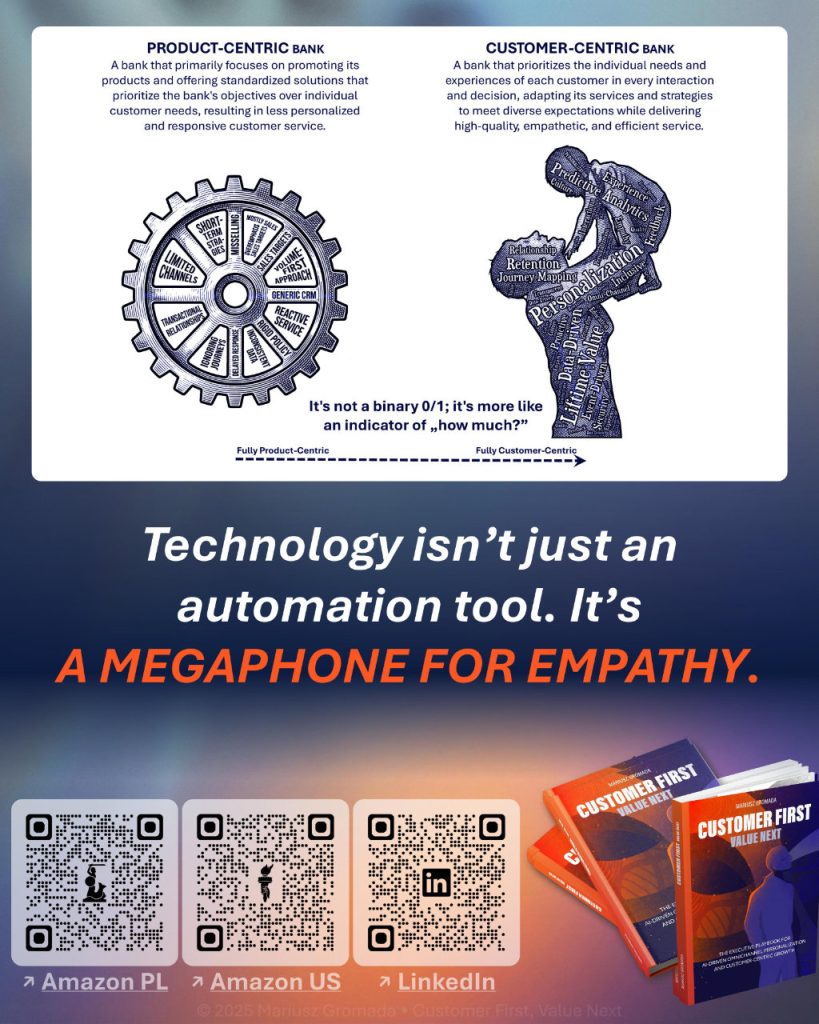
| Product-Centricity | Model focusing on selling products (Push) rather than needs (Pull). |
| Propensity Model | Statistical prediction of the likelihood to act. |
| Real-Time by Design | Architecture processing data in milliseconds for the current context. |
| Reach / Recommendation Coverage | KPI for the percentage of customers with a ready NBA. |
| Recommendation Engine | System ranks all offers for a single customer. |
| Relationship Quality KPI | Metrics measuring relationship health (Primacy, Activation, etc.). |
| Retention | Strategies protecting the customer base and reducing churn. |
| Return on Consent | Delivering value back to customers for their data trust. |
| Risk by Design | Embedding risk controls into AI development and runtime. |
| Rogue Database | An unofficial department-built “mini data warehouse” that exists outside the enterprise data architecture. |
| Rogue Spreadsheets / Shadow CRM | Anti-pattern of advisors using private data files, bypassing the central system. |
| RPA (Robotic Process Automation) | Software robots automating repetitive tasks. |
| Scalability GAP | Problem of data growing faster than analytical resources. |
| Senses (Factory Component) | Input layer collecting signals and identifying users. |
| Silent Churn | Stopping usage and moving activity without formal account closure. |
| Simple is Complex is Simple | Hiding internal complexity to simplify user experience. |
| Sleeping Dogs | Customers are likely to react negatively if targeted. |
| Super App | Single app offering banking, lifestyle, and third-party services. |
| Survival Models | Predicting time until an event (e.g., churn). |
| Team DNA | Hybrid business/tech skill mix for the CI-RM team. |
| Three Lines of Defense | Churn prevention framework: Engage, Develop, Retain. |
| Time to Value | Months until a customer becomes profitable. |
| Tribes | Customer groups sharing a common mindset/behavior. |
| Tuning | Automated experimenting and calibrating of AI models. |
| Uplift (Incrementality) | Net causal impact of an action vs. a control group. |
| Uplift Models | Models predicting behavior difference with vs. without treatment. |
| Value Next | Business value follows naturally from prioritizing the customer. |
| VAS (Value-Added Services) | Non-core services (e.g., parking) increasing engagement. |
| Vendor Lock-In | Dependency on a provider blocking evolution; requires exit plans. |
| Voice (Factory Component) | Output layer delivering personalized interactions. |
| VoC (Voice of Customer) | Data where customers declare intentions or needs. |
| VoD (Voice of Data) | Insights from quantitative behavioral/transactional data. |