
Focus & Insights

Ergonomic Assessment: When Should One Be Conducted?
The Short Answer: An ergonomic assessment is a structured review of how work gets done, and you should run one whenever a job, workstation, tool, or task looks like it is straining the people doing it. It measures risk factors like force, repetition, posture, and reach so employers can prevent musculoskeletal disorders before they turn into claims. The earlier you look, the cheaper the fix.
An ergonomic assessment should be conducted when a job, workstation, tool, task, or work environment may be creating unnecessary strain on workers. In construction, manufacturing, industrial, institutional, and office settings, these risks are not always obvious at first. A sore shoulder here, a repeated back strain there, and suddenly the minor issue has become a regular guest at the safety meeting.
An ergonomic assessment is a structured review of how work is performed. It looks at ergonomic risk factors such as force, repetition, awkward posture, reach, lifting, vibration, layout, and recovery time so employers can reduce the chance of musculoskeletal disorders, also called MSDs, which remain among the most common lost-time injuries in Canadian workplaces.
When an Ergonomic Assessment Is Needed
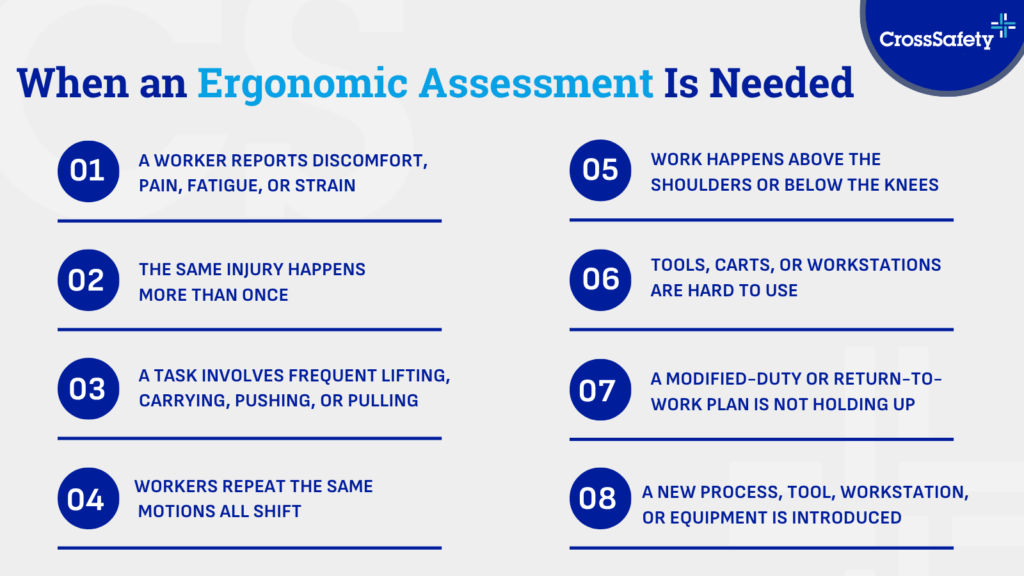
An An ergonomic evaluation earns its place whenever there are signs the work may not fit the worker, or that the task demands are simply too high. It can be proactive, done before injuries happen, or reactive, done after discomfort, incidents, or claims start showing up.
Common triggers include:
- A worker reports discomfort, pain, fatigue, or strain
- Similar injuries happen more than once
- A task involves frequent lifting, carrying, pushing, or pulling
- Workers repeat the same motions throughout the shift
- Work is done above shoulder height or below knee level
- Tools, carts, workstations, or equipment are hard to use
- A modified-duty or return-to-work plan is not holding up
- A new process, tool, workstation, or piece of equipment is introduced
The goal is not to wait until a claim proves there is a problem. The goal is to spot the strain early enough to do something useful about it. Repetitive tasks and awkward posture rarely announce themselves. They build quietly, one shift at a time, until a worker finally speaks up.
Why Ergonomic Assessments Matter for Prevention
An ergonomic assessment helps employers find the source of the risk, not just the symptom. When several workers report wrist, shoulder, neck, back, or knee discomfort, the problem often traces back to how the task itself is designed.
The causes tend to be physical and fixable. Materials stored too low. A workstation that forces constant reaching. A tool that demands too much grip force. A construction task that repeats overhead work because the staging or sequencing was not planned well. A thorough ergonomic assessment surfaces these patterns across the actual work tasks so they can be corrected.
Once the real work has been reviewed, the controls are usually practical. Employers can improve work height, change a layout, add mechanical assistance, shorten a carry distance, adjust task rotation, or select better tools. Each one moves the worker closer to a neutral posture and away from the positions that cause repetitive stress. As a CrossSafety professional puts it, risk assessments help organizations “prioritize their biggest exposures and take action before those hazards result in an incident.” That is the whole point of ergonomics as injury prevention rather than injury response.
How an Ergonomic Assessment Supports Return to Work

An ergonomic assessment also protects employee health when a worker returns after an injury or comes back with restrictions. A return-to-work plan can fall apart when the modified duties do not match what the job actually demands.
Return-to-work planning means finding suitable duties that keep a worker productive while respecting medical restrictions and lowering the risk of re-injury. A close look at the real tasks makes reasonable accommodation practical rather than guesswork, and it points to the ergonomic equipment or adjustments that let someone ease back in safely.
Key Considerations
Before booking an assessment, think about the scope. Is this one worker, one workstation, one task, or a pattern spreading across a department or site? For a single desk, an ergonomic self-assessment tool can be a sensible first step, giving the worker a simple way to flag obvious issues before an ergonomic specialist gets involved. A wider pattern usually calls for a professional review, and sometimes a Job Demands Analysis to document the physical and cognitive requirements of the role.
Requirements for occupational safety vary by province, industry, and employer type. Even so, employers are generally expected to identify hazards, assess risk, and take reasonable steps to protect workers. Ergonomics sits squarely inside that EH&S duty.
Earlier Assessments Lead to Better Decisions
Ergonomics should make work safer and easier to sustain, not become another box people only remember after something goes wrong. If you are trying to reduce strain, prevent repeat MSD claims, or support safer return-to-work outcomes, start with the tasks and work areas where discomfort, fatigue, or injury patterns are already showing.
To see how that support works in practice, read A Guide to Workplace Ergonomics for Construction and Industrial Workplaces.
Catch the Strain Before It Becomes a Claim

The cheapest MSD is the one that never develops. Sore shoulders, aching wrists, and nagging back pain are early signals, and the employers who act on them keep small complaints from turning into lost-time claims. Look at the tasks where discomfort keeps showing up, fix the setup that causes it, and check back to confirm the change actually helped.
That work is what CrossSafety does every day. Our team supports organizations across North America with consulting, workplace safety solutions, and training designed for complex, high-risk environments. Our ergonomics services help organizations lower their risk, and the injuries and costs that follow it, through a few core offerings:
- Workplace Ergonomics Consulting, Assessments & Programs to review the real work and recommend controls that hold up
- Safety Audits & Gap Assessments to catch the exposures your team has stopped noticing
- HSE Management & Safety Staffing to put experienced people on site and keep controls in place
- Workplace Safety Training & Learning Programs that build ergonomic awareness into daily habits
When you want an objective look at where your workplace stands, contact us and let’s reduce the strain together.
FAQs
An ergonomic assessment should be conducted when workers report discomfort, injuries repeat, tasks involve high physical demand, workstations change, new equipment is introduced, or a return-to-work plan needs better job-demand information.
No. Ergonomic assessments work best proactively catching risks before they turn into injuries, claims, restrictions or lost time.
It reviews how work is performed, including posture, force, repetition, lifting, carrying, reach, workstation layout, tool use, vibration, recovery time and environmental conditions.
A single workstation can often start with an ergonomic self-assessment by the worker. A recurring problem, a complex task, or a return-to-work case is better handled by an ergonomic specialist who can measure the risk factors and recommend controls that hold up.
An ergonomic assessment looks at the strain a task puts on a worker and how to reduce it. A Job Demands Analysis documents the full physical and cognitive requirements of a role, which is what makes it so useful for matching modified duties to a return-to-work plan.
Latest News & Insights
Focus & Insights
What Are Compliance Audits and How Do They Work?
Focus & Insights
Ergonomic Assessment: When Should One Be Conducted?
Focus & Insights
WSIB Changes: What You Need To Know About Proposed Benefit Increases