

The Graphite Digester is a laboratory instrument designed for sample preparation prior to chemical analysis across food, agricultural, environmental, and industrial applications. Utilizing infrared radiation graphite conduction heating, the system provides rapid and uniform sample digestion of diverse matrices including soil, grain, feed, plants, seeds, ores, and water samples for subsequent heavy metal and trace element analysis.
The instrument features PID intelligent temperature control with programmable heating profiles, supporting up to 200 digestion programs with 25 segments each. Available in 10-position and 20-position configurations, the system incorporates safety features including anti-corrosion treatment for acidic sample matrices, exhaust management, and comprehensive alarm systems for laboratory operation.
The Graphite Digester employs infrared radiation combined with graphite conduction heating to achieve rapid and uniform sample digestion. The infrared radiation heating tube transmits energy to the graphite block in the form of electromagnetic waves. When the graphite conducts and heats the digestion solution and sample in the digestion tube, the energy is absorbed by the sample molecules, greatly increasing molecular movement and collision, causing the sample to heat rapidly. Combined with the digestion solution, this accelerates sample breakdown for effective and complete digestion.
PID (Proportional-Integral-Derivative) temperature control continuously monitors and adjusts heating power to maintain precise temperature profiles. The system supports both curve and linear heating modes, allowing researchers to program complex temperature ramps optimized for specific sample matrices. Each digestion program can incorporate up to 25 temperature and time segments, enabling gradual heating protocols that prevent sample loss through violent reactions while ensuring complete matrix breakdown.
Ceramic fiber insulation combined with air duct insulation technology maintains thermal efficiency while protecting the instrument housing. PTFE sealing caps prevent acid vapor escape during digestion, while the integrated exhaust hood manages potentially hazardous fumes generated during sample processing.
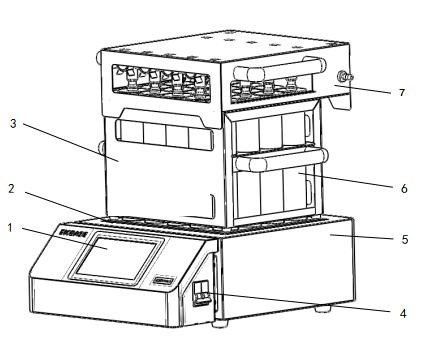
| No. | Component |
|---|---|
| 1 | Display screen (7-inch LCD touchscreen) |
| 2 | Digestion platform (graphite heating block) |
| 3 | Digestion tube frame |
| 4 | Air switch |
| 5 | Shell (with anti-corrosion treatment) |
| 6 | Digestion tubes |
| 7 | Discharge system (exhaust management) |
The Graphite Digester features an intuitive 7-inch LCD touchscreen for complete control of digestion programs.
The home screen displays four function buttons: Heating, Scheme, Setting up, and Help.

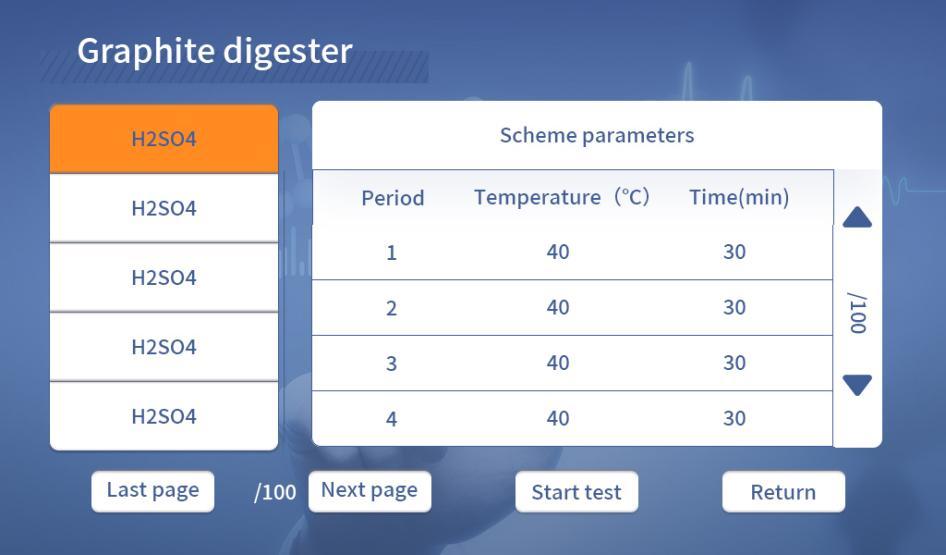
Select a saved digestion scheme from the list. The right panel displays scheme parameters (temperature and time per period). Click Start test to begin.
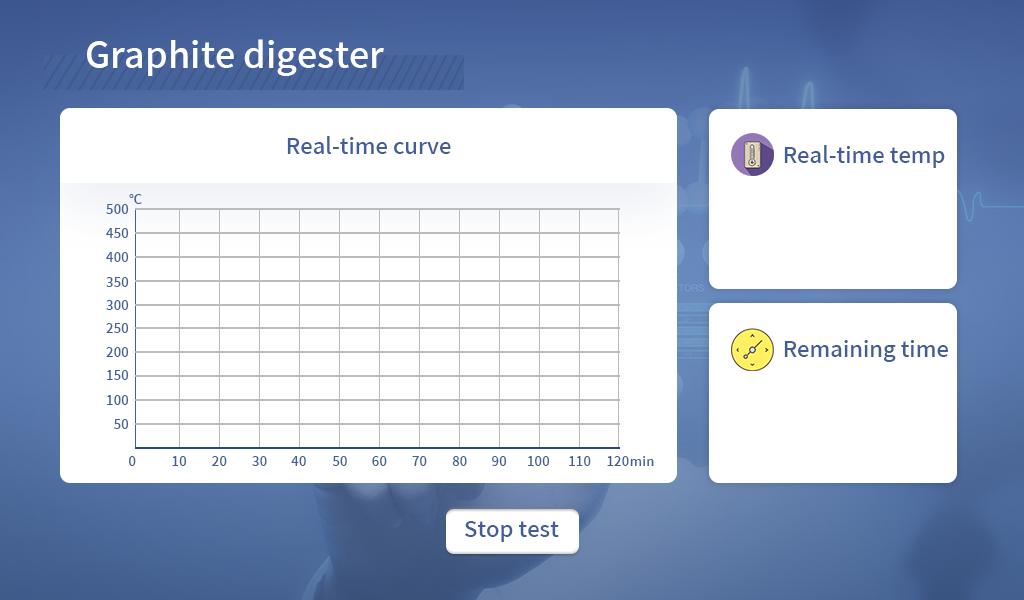
During digestion, the interface displays a live temperature curve and current readings including real-time temperature and remaining time. Click Stop test to interrupt at any time.
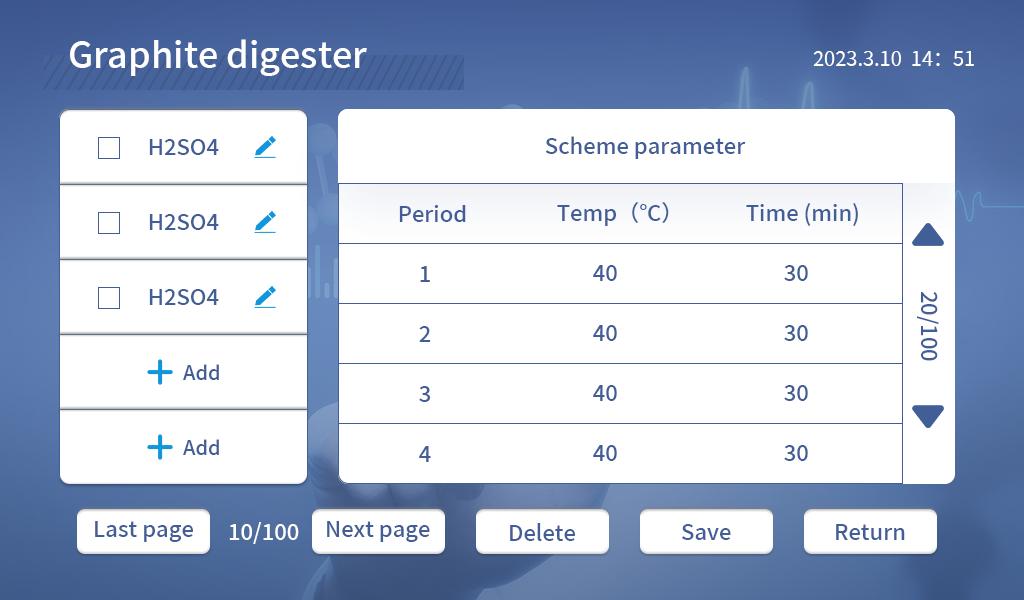
Create and manage up to 200 custom digestion schemes, each with up to 25 temperature/time segments. Add new schemes, edit existing ones, or delete unused schemes.
Configure instrument settings including temperature calibration, timing mode (count up or count down), timing start point (test start or preset temperature reached), and alarm switch.

| Fault | Possible Cause | Solution |
|---|---|---|
| Instrument cannot be powered on | Fuse is burned out | Replace the fuse |
| Instrument cannot be powered on | Internal fault | Contact after-sales support |
| Abnormal temperature display | Abnormal sensor detection | Replace with a new sensor |
| Abnormal temperature display | Poor wire connection | Check the wire connections |
| Instrument does not heat | Heating element is damaged | Replace with a new heating element |
| Feature | This Product | Category Context |
|---|---|---|
| Heating Technology | Infrared radiation graphite conduction heating | Traditional block heating or microwave systems |
| Temperature Control | PID intelligent temperature control algorithm | Basic on/off or simple proportional control |
| Programming Capability | 200 digestion programs with 25 segments each | Limited program storage with fewer segments |
| Display Interface | 7-inch high resolution LCD with real-time temperature curves | Basic LED or small LCD displays |
| Safety Features | Comprehensive alarm system with overvoltage, overcurrent, overheating protection | Basic temperature limits or manual monitoring |
| Chemical Resistance | Special anti-corrosion treatment for acidic liquids | Standard materials with limited acid resistance |
The Graphite Digester combines advanced infrared heating technology with intelligent temperature control and extensive programming capability. The system provides superior temperature uniformity and comprehensive safety features for demanding analytical sample preparation workflows.
Perform temperature calibration verification quarterly using certified reference thermocouples placed in multiple digestion positions.
Ensures temperature accuracy remains within analytical method specifications across all sample positions.
Clean graphite heating surfaces monthly with appropriate solvents to remove sample residue buildup.
Maintains optimal heat transfer efficiency and prevents contamination between analytical batches.
Develop matrix-matched heating programs with gradual temperature ramps to prevent violent sample reactions.
Minimizes sample loss and ensures complete digestion while maintaining vessel integrity.
Always operate with exhaust hood connected and verify PTFE cap sealing before initiating digestion programs.
Prevents exposure to acid vapors and maintains safe laboratory working conditions.
Include blank digestions and certified reference materials in each analytical batch for quality control.
Validates digestion completeness and identifies potential contamination or systematic errors.
Monitor real-time temperature curves during initial program validation to identify heating irregularities.
Enables early detection of heating element issues or program parameter problems before sample processing.
Allow complete cooling using the provided rack before handling digested samples to prevent thermal shock.
Prevents vessel breakage and ensures operator safety during post-digestion sample transfer.
Inspect PTFE sealing caps regularly for chemical degradation and replace when discoloration or cracking appears.
Maintains proper seal integrity and prevents acid vapor leakage during digestion procedures.
ConductScience provides a standard 1-year manufacturer warranty from the date of sale covering defects in materials and workmanship. The following are not covered: damage from improper use, unauthorized disassembly without manufacturer permission, or improper transportation and storage. Contact our support team for technical assistance with operation, maintenance, and replacement parts.
What sample volumes and vessel types are compatible with the digestion system?
Consult product datasheet for specific vessel dimensions and volume capacities. The system accommodates standard laboratory digestion tubes with PTFE sealing caps provided.
What is the maximum operating temperature and heating rate capability?
Temperature specifications including maximum operating temperature and heating rates should be verified in the technical documentation for your specific analytical protocols.
How do I validate temperature uniformity across all digestion positions?
Use certified reference thermocouples placed in each position during empty vessel test runs. Temperature variation should be documented and compared to your analytical method requirements.
What acids and reagent concentrations are compatible with the anti-corrosion treatment?
The system features special anti-corrosion treatment for acidic liquids. Consult chemical compatibility charts in the user manual for specific acid types and concentrations.
Can digestion programs be exported or imported between instruments?
Program transfer capabilities depend on the control system interface. Refer to the user manual for data management options and program backup procedures.
What maintenance schedule is recommended for the graphite heating elements?
Regular visual inspection of heating elements is recommended. Replacement frequency depends on usage intensity and sample matrix corrosivity as outlined in the maintenance section.
How does this compare to microwave digestion systems for similar applications?
Graphite digestion offers atmospheric pressure operation with visual sample monitoring, while microwave systems provide faster heating under pressure. Choice depends on analytical method requirements and sample throughput needs.
Enhance your setup with compatible accessories


