Posts tagged ‘learning sciences’
Graduating Dr. Briana Morrison: Posing New Puzzles for Computing Education Research
I am posting this on the day that I am honored to “hood” Dr. Briana Morrison. “Hooding” is where doctoral candidates are given their academic regalia indicating their doctorate degree. It’s one of those ancient parts of academia that I find really cool. I like the way that the Wikiversity describes it: “The Hooding Ceremony is symbolic of passing the guard from one generation of doctors to the next generation of doctors.”
I’ve written about Briana’s work a lot over the years here:
- Her proposal is described here, “Cognitive Load as a significant problem in Learning Programming.”
- Her first major dissertation accomplishment was developing (with Dr. Brian Dorn) a measurement instrument for cognitive load.
- One of her bigger wins for her dissertation was showing that subgoal labels work for text languages too (ICER 2015).
- Another really significant result was showing that Parson’s Problems were a more sensitive measure of learning than asking students to write code in an assessment, and that subgoal labels make Parson’s Problems better, too.
- She worked a lot with Lauren Margulieux, so many of the links I listed when Dr. Margulieux defended are also relevant for Dr. Morrison.
- At ICER 2016, she presented a replication study of her first given vs. generated subgoals study.
But what I find most interesting about Briana’s dissertation work were the things that didn’t work:
- She tried to show a difference in getting program instruction via audio or text. She didn’t find one. The research on modality effects suggested that she would.
- She tried to show a difference between loop-and-a-half and exit-in-the-middle WHILE loops. Previous studies had found one. She did not.
These kinds of results are so cool to me, because they point out what we don’t know about computing education yet. The prior results and theory were really clear. The study was well-designed and vetted by her committee. The results were contrary to what we expected. WHAT HAPPENED?!? It’s for the next group of researchers to try to figure out.
The most interesting result of that kind in Briana’s dissertation is one that I’ve written about before, but I’d like to pull it all together here because I think that there are some interesting implications of it. To me, this is a Rainfall Problem kind of question.
Here’s the experimental set-up. We’ve got six groups.
- All groups are learning with pairs of a worked example (a completely worked out piece of code) and then a practice problem (maybe a Parson’s Problem, maybe writing some code). We’ll call these WE-P pairs (Worked Example-Practice). Now, some WE-P pairs have the same context (think of it as the story of a story problem), and some have different contexts. Maybe in the same context, you’re asked to compute the average tips for several days of tips as a barista. Maybe in a different context, you compute tips in the worked example, but you compute the average test score in the practice. In general, we predict that different contexts will be harder for the student than having everything the same.
- So we’ve got same context vs different context as one variable we’re manipulating. The other variable is whether the participants get the worked example with NO subgoal labels, or GENERATED subgoal labels, or the participant has to GENERATE subgoal labels. Think of a subgoal label as a comment that explains some code, but it’s the same comment that will appear in several different programs. It’s meant to encourage the student to abstract the meaning of the code.

In the GENERATE condition, the participants get blanks, to encourage them to abstract for themselves. Typically, we’d expect (for research in other parts of STEM with subgoal labels) that GENERATE would lead to more learning than GIVEN labels, but it’s harder. We might get cognitive overload.
In general, GIVEN labels beats out no labels. No problem — that’s what we expect given all the past work on subgoal labels. But when we consider all six groups, we get this picture.

Why would having the same context do worse with GIVEN labels than no labels? Why would the same context do much better with GENERATE labels, but worse when it’s different contexts?
So, Briana, Lauren, and Adrienne Decker replicated the experiment with Adrienne’s students at RIT (ICER 2016). And they found:

The same strange “W” pattern, where we have this odd interaction between context and GIVEN vs. GENERATE that we just don’t have an explanation for.
But here’s the really intriguing part: they also did the experiment with second semester students at RIT. All the weird interactions disappeared! Same context beat different context. GIVEN labels beat GENERATE labels. No labels do the worst. When students get enough experience, they figure things out and behave like students in other parts of STEM.
The puzzle for the community is WHY. Briana has a hypothesis. Novice students don’t attend to the details that they need, unless you change the contexts. Without changing contexts, students even GIVEN labels don’t learn because they’re not paying enough attention. Changing contexts gets them to think, “What’s going on here?” GENERATE is just too hard for novices — the cognitive load of figuring out the code and generating labels is just overwhelming for students, so they do badly when we’d expect them to do better.
Here we have a theory-conflicting result, that has been replicated in two different populations. It’s like the Rainfall Problem. Nobody expected the Rainfall Problem to be hard, but it was. More and more people tried it with their students, and still, it was hard. It took Kathi Fisler to figure out how to teach CS so that most students could succeed at the Rainfall Problem. What could we teach novice CS students so that they avoid the “W” pattern? Is it just time? Will all second semester students avoid the “W”?
Dr. Morrison gave us a really interesting dissertation — some big wins, and some intriguing puzzles for the next researchers to wrestle with. Briana has now joined the computing education research group at U. Nebraska – Omaha, where I expect to see more great results.
Learning Curves, Given vs Generated Subgoal Labels, Replicating a US study in India, and Frames vs Text: More ICER 2016 Trip Reports
My Blog@CACM post for this month is a trip report on ICER 2016. I recommend Amy Ko’s excellent ICER 2016 trip report for another take on the conference. You can also see the Twitter live feed with hashtag #ICER2016.
I write in the Blog@CACM post about three papers (and reference two others), but I could easily write reports on a dozen more. The findings were that interesting and that well done. I’m going to give four more mini-summaries here, where the results are more confusing or surprising than those I included in the CACM Blog post.
This year was the first time we had a neck-and-neck race for the attendee-selected award, the “John Henry” award. The runner-up was Learning Curve Analysis for Programming: Which Concepts do Students Struggle With? by Kelly Rivers, Erik Harpstead, and Ken Koedinger. Tutoring systems can be used to track errors on knowledge concepts over multiple practice problems. Tutoring systems developers can show these lovely decreasing error curves as students get more practice, which clearly demonstrate learning. Kelly wanted to see if she could do that with open editing of code, not in a tutoring system. She tried to use AST graphs as a sense of programming “concepts,” and measure errors in use of the various constructs. It didn’t work, as Kelly explains in her paper. It was a nice example of an interesting and promising idea that didn’t pan out, but with careful explanation for the next try.
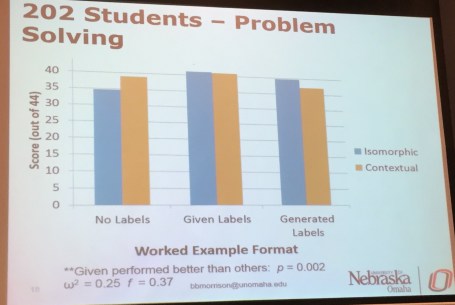
I mentioned in this blog previously that Briana Morrison and Lauren Margulieux had a replication study (see paper here), written with Adrienne Decker using participants from Adrienne’s institution. I hadn’t read the paper when I wrote that first blog post, and I was amazed by their results. Recall that they had this unexpected result where changing contexts for subgoal labeling worked better (i.e., led to better performance) for students than keeping students in the same context. The weird contextual-transfer problems that they’d seen previously went away in the second (follow-on) CS class — see below snap from their slides. The weird result was replicated in the first class at this new institution, so we know it’s not just one strange student population, and now we know that it’s a novice problem. That’s fascinating, but still doesn’t really explain why. Even more interesting was that when the context transfer issues go away, students did better when they were given subgoal labels than when they generated them. That’s not what happens in other fields. Why is CS different? It’s such an interesting trail that they’re exploring!
Mike Hewner and Shitanshu Mishra replicated Mike’s dissertation study about how students choose CS as a major, but in Indian institutions rather than in US institutions: When Everyone Knows CS is the Best Major: Decisions about CS in an Indian context. The results that came out of the Grounded Theory analysis were quite different! Mike had found that US students use enjoyment as a proxy for ability — “If I like CS, I must be good at it, so I’ll major in that.” But Indian students already thought CS was the best major. The social pressures were completely different. So, Indian students chose CS — if they had no other plans. CS was the default behavior.
One of the more surprising results was from Thomas W. Price, Neil C.C. Brown, Dragan Lipovac, Tiffany Barnes, and Michael Kölling, Evaluation of a Frame-based Programming Editor. They asked a group of middle school students in a short laboratory study (not the most optimal choice, but an acceptable starting place) to program in Java or in Stride, the new frame-based language and editing environment from the BlueJ/Greenfoot team. They found no statistically significant differences between the two different languages, in terms of number of objectives completed, student frustration/satisfaction, or amount of time spent on the tasks. Yes, Java students got more syntax errors, but it didn’t seem to have a significant impact on performance or satisfaction. I found that totally unexpected. This is a result that cries out for more exploration and explanation.
There’s a lot more I could say, from Colleen Lewis’s terrific ideas to reduce the impact of CS stereotypes to a promising new method of expert heuristic evaluation of cognitive load. I recommend reviewing the papers while they’re still free to download.
Preview ICER 2016: Ebooks Design-Based Research and Replications in Assessment and Cognitive Load Studies
The International Computing Education Research (ICER) Conference 2016 is September 8-12 in Melbourne, Australia (see website here). There were 102 papers submitted, and 26 papers accepted for a 25% acceptance rate. Georgia Tech computing education researchers are justifiably proud — we submitted three papers to ICER 2016, and we had three acceptances. We’re over 10% of all papers at ICER 2016.
One of the papers extends the ebook work that I’ve reported on here (see here where we made them available and our paper on usability and usage from WiPSCE 2015). Identifying Design Principles for CS Teacher Ebooks through Design-Based Research (click on the title to get to the ACM DL page) by Barbara Ericson, Kantwon Rogers, Miranda Parker, Briana Morrison, and I use a Design-Based Research perspective on our ebooks work. We describe our theory for the ebooks, then describe the iterations of what we designed, what happened when we deployed (data-driven), and how we then re-designed.
Two of our papers are replication studies — so grateful to the ICER reviewers and communities for seeing the value of replication studies. The first is Replication, Validation, and Use of a Language Independent CS1 Knowledge Assessment by Miranda Parker, me, and Shelly Engleman. This is Miranda’s paper expanding on her SIGCSE 2016 poster introducing the SCS1 validated and language-independent measure of CS1 knowledge. The paper does a great survey of validated measures of learning, explains her process, and then presents what one can and can’t claim with a validated instrument.
The second is Learning Loops: A Replication Study Illuminates Impact of HS Courses by Briana Morrison, Adrienne Decker, and Lauren Margulieux. Briana and Lauren have both now left Georgia Tech, but they were still here when they did this paper, so we’re claiming them. Readers of this blog may recall Briana and Lauren’s confusing results from SIGCSE 2016 result that suggest that cognitive load in CS textual programming is so high that it blows away our experimental instructional treatments. Was that an aberration? With Adrienne Decker’s help (and student participants), they replicated the study. I’ll give away the bottom line: It wasn’t an aberration. One new finding is that students who did not have high school CS classes caught up with those who did in the experiment, with respect to understanding loops
We’re sending three of our Human-Centered Computing PhD students to the ICER 2016 Doctoral Consortium. These folks will be in the DC on Sept 8, and will present posters to the conference on Sept 9 afternoon.
- Barbara Ericson will be presenting her results with Dynamically Adaptive Parsons Problems. I’ve seen some of the pilot study results from this summer, and they’re fascinating.
- Amber Solomon is just starting her second year working with me. She did the evaluation on the AR Design Studio classroom. She (and I) is fascinated by Steve Cooper’s results from ICER 2015 where spatial reasoning training influenced CS performance and reduced SES differences. She’s been doing a study on CS grades, SES, and spatial reasoning in a non-majors class. She’ll be presenting on The Role of Spatial Reasoning in Learning Computer Science.
- Kayla DesPortes works with my colleague Betsy DiSalvo on the learning that happens in MakerSpaces. She’s designing new kinds of physical interfaces to reduce cognitive load and improve learning when working with electronics, which she’ll be talking about at her poster: Learning and Collaboration in Physical Computing.
Seeking Collaborators for a Study of Achievement Goal Theory in CS1: Guest blog post by Daniel Zingaro
I have talked about Dan’s work here before, such as his 2014 award-winning ICER paper and his Peer Instruction in CS website. I met with Dan at the last SIGCSE where he told me about the study that he and Leo Porter were planning. Their results are fascinating since they are counter to what Achievement Goal Theory predicts. I invited him to write a guest blog post to seek collaborators for his study, and am grateful that he sent me this.
Why might we apply educational theory to our study of novice programmers? One core reason lies in theory-building: if someone has developed a general learning theory, then we might do well to co-opt and extend it for the computing context. What we get for free is clear: a theoretical basis, perhaps with associated experimental procedures, scales, hypotheses, and predictions. Unfortunately, however, there is often a cost in appropriating this theory: it may not replicate for us in the expected ways.
Briana Morrison’s recent work nicely highlights this point. In two studies, Briana reports her efforts to replicate what is known about subgoals and worked examples. Briefly, a worked example is a sample problem whose step-by-step solution is given to students. And subgoals are used to break that solution into logical chunks to hopefully help students map out the ways that the steps fit together to solve the problem.
Do subgoals help? Well, it’s supposed to go like this, from the educational psychology literature: having students generate their own labeled goals is best, giving students the subgoal labels is worse, and not using subgoals at all is worse still. But that isn’t what Briana found. For example, Briana reports [1] that, on Parsons puzzles, students who are given subgoal labels do better than both those who generate their own subgoal labels and those not given subgoals at all. Why the differences? One possibility is that programming exerts considerable cognitive load on the learner, and that the additional load incurred by generating subgoal labels overloads the student and harms learning.
The point here is that taking seriously the idea of leveraging existing theory requires concomitant attention to how and why the theory may operate differently in computing.
My particular interest here is in another theory from educational psychology: achievement goal theory (AGT). AGT studies the goals that students adopt in achievement situations, and the positive and negative consequences of those goals in terms of educationally-relevant outcomes. AGT zones in on two main goal types: mastery goals (where performance is defined intrapersonally) and performance goals (where performance is defined normatively in comparison to others).
Do these goals matter? Well, it’s supposed to go roughly like this: mastery goals are positively associated with many outcomes of value, such as interest, enjoyment, self-efficacy, and deep study strategies (but not academic performance); performance goals, surprisingly and confusingly, are positively associated with academic performance. But, paralleling the Briana studies from above, this isn’t what we’ve found in CS. With Leo Porter and my students, we’ve been studying goal-outcome links in novice CS students. We’ve found, contrary to theoretical expectations, that performance goals appear to be null or negative predictors of performance, and that mastery goals appear to be positive predictors of performance [2,3].
We are now conducting a larger study of achievement goals and outcomes of CS1 students — larger than that achievable with the couple of institutions to which we have access on our own. We are asking for your help.
The study involves administering two surveys to students in a CS1 course. The first survey, at the beginning of the semester, measures student achievement goals. The second survey, close to the end of the semester, measures potential mediating variables. We plan to collect exam grade, interest in CS, and other outcome variables.
The hope is that we can conduct a multi-institutional study of a variety of CS1 courses to strengthen what we know about achievement goals in CS.
Please contact me at daniel dot zingaro at utoronto dot ca if you are interested in participating in this work. Thanks!
[1] Briana Morrison. Subgoals Help Students Solve Parsons Problems. SIGCSE, 2016. ACM DL link.
[2] Daniel Zingaro. Examining Interest and Performance in Computer Science 1: A Study of Pedagogy and Achievement Goals. TOCE, 2015. ACM DL link.
[3] Daniel Zingaro and Leo Porter. Impact of Student Achievement Goals on CS1 Outcomes. SIGCSE, 2016. ACM DL link.
Are there elements of human nature that could be better harnessed for better educational outcomes?
I don’t often link to Quora, but when it’s Steven Pinker pointing out the relationship between our human nature to educational goals, it’s worth it.
One potential insight is that educators begin not with blank slates but with minds that are adapted to think and reason in ways that may be at cross-purposes with the goals of education in a modern society. The conscious portion of language consists of words and meanings, but the portion that connects most directly to print consists of phonemes, which ordinarily are below the level of consciousness. We intuitively understand living species as having essences, but the theory of evolution requires us to rethink them as populations of variable individuals. We naturally assess probability by dredging up examples from memory, whereas real probability takes into account the number of occurrences and the number of opportunities. We are apt to think that people who disagree with us are stupid and stubborn, while we are overconfident and self-deluded about our own competence and honesty.
Motivating STEM Engagement in Children, Families, and Communities
I’ve known Dan Hickey for many years, and got to spend some time with him at Indiana when I visited there a couple years ago. He’s dealing with an issue in this blog post that is critical to CS Education. If we want students to value computing, it has to be valued and promoted in their families and communities. How do we get engagement at a beyond-school level in computing education?
These issues of trajectories and non-participation in STEM learning have personal relevance for me and my own family. I was quite pleased a few years ago when my son Lucas enrolled in a computer programming class in high school. I never learned to program myself and these days it I find it quite a handicap. While I bought an Apple II+ computer in 1982 (!) and taught myself BASIC, an instructional technology professor discouraged me from delving too deeply into technology or programming (because “it changes too often”). While I still want to learn how to code, my non-participation in programming clearly helped define my trajectory towards a Ph.D in Psychology and satisfying career as a Learning Scientist.Unfortunately, the curriculum in my son’s programming class was like the typical secondary computer science instruction that Mark Guzdial chronicles in his Computing Education blog. The coding worksheets seemed to have been haphazardly created to match various videos located on the web. My son wanted to use the much more professional videos and exercises that we were able to access via my university’s account at Lynda.com, but his teacher insisted that my son complete the worksheets as well (so teacher could grade them).
Source: re-mediating assessment: Motivating STEM Engagement in Children, Families, and Communities
The Community of Practice for CS teachers? Suggestion: It’s not teachers
My Blog@CACM post this month is on the AAAS symposium I attended on undergraduate STEM education (see post here). The symposium set up for me a contrast between computing education and other STEM education. In math and science education, faculty are more likely to get continuing professional development and to value education more than CS faculty.
Why is it different in CS? In the blog post, I suggest that part of the issue is maturation of the field. But I have another hypothesis — I suggest that most CS teachers, especially at the undergraduate level, don’t think of themselves as teachers.
In my book Learner-Centered Design of Computing Education, I use Lave & Wenger’s situated learning theory as a lens for understanding motivations to pursue computing education. Lave & Wenger say every learner aims to join a community of practice. Learners start out on the periphery of the community, and work their way towards the center, adopting the skills, values, and knowledge that those in the center hold. They might need to take classes because that’s what the community values, or maybe they do an apprenticeship. The community of practice provides the learner and the practitioners a sense of identity: “I belong with this group. I do this practice. This is who I am.”
Lijun Ni taught me the value of teacher identity. Someone who says “I’m a math teacher” (for example) will join math teacher organizations, will seek out professional development, and will more likely be retained longer as a teacher. That’s their identity.
I believe that many science and math teachers (even at the undergraduate level) feel a sense of identity as teachers. Even at research universities, those teaching the intro courses in mathematics and science are likely teachers-first. They know that they are mostly no preparing future mathematicians, biologists, chemists, and physicists. They are preparing students for their chosen professions, perhaps in engineering, medicine, or computer science. The math and science teachers belong to a community of practice of teachers, e.g., they have a goal to be like the best teachers in their profession. They have an identity as teachers, e.g., they strive to be better math and science teachers.
I suspect that CS teachers feel a sense of identity as software developers. They see themselves as programmers primarily. They see themselves as producing future programmers. They take pride in what they can do with code. They have a sense of guardianship — they want the best and brightest in their field.
There’s a difference between CS teachers as programmers vs CS teachers. Programmers train other programmers. They learn new programming languages, new techniques of programming, the latest tools. Teachers teach everyone, and they learn how to be better at teaching. We need CS teachers to be teachers. It’s less important that they know the latest industry gadgets. It’s more important that they learn how to teach “all” about CS, and how to teach that CS better.
When Grady Booch came to SIGCSE 2007, I was surprised at how excited everyone was — people still talk about that visit (e.g., see the explanation for the BJC approach to computing). I realized that, for most of the people in the room, Grady was a role model. He was at the center of community that they most cared about. Note that Grady is not a teacher. He’s an exceptional software engineer.
There are serious ramifications of a teacher with an identity as a software engineer. I had a discussion a few months ago with one of our instructors, who told me, “I just don’t get why women would even want to be in computer science. Working in a cubicle is not a great place for women to be! They should get a better job.” I was shocked. I didn’t tackle the gender issues first. I started out trying to convince him that computer science doesn’t just lead to a cubicle. You could study computer science to become something other than a software developer, to work somewhere other than a cubicle. He wasn’t buying my argument. I realized that those cubicle jobs are the ones he wants to prepare students for. That’s where he imagines the best programmers working. He doesn’t want to teach computer science for whatever the students need it for. He prepares future programmers. That’s how he defines his job — a master software engineer with apprentice software engineers.
I am calling out undergraduate CS teachers in this post, but I suspect that many high school CS teachers see themselves as software developers (or as trainers of software developers), more than as teachers of computer science. I hear about high school CS teachers who proudly post on the wall the t-shirts of the tech companies who employ their former students. That’s a software developer focus, an apprenticeship focus. That’s not about teaching CS for all.
What would it take to shift the community of practice of CS teachers to value teaching over software development? It’s an important change in perspective, especially if we care about CS for all. Not all of our students are aiming for jobs in software development.
How did other STEM disciplines do it? How did they develop a culture and community of practice around teaching?
Transfer of learning: Making sense of what education research is telling us
I enjoy reading “Gas station without pumps,” and the below-quoted post was one I wanted to respond to.
Two of the popular memes of education researchers, “transferability is an illusion” and “the growth mindset”, are almost in direct opposition, and I don’t know how to reconcile them.
One possibility is that few students actually attempt to learn the general problem-solving skills that math, CS, and engineering design are rich domains for. Most are content to learn one tiny skill at a time, in complete isolation from other skills and ideas. Students who are particularly good at memory work often choose this route, memorizing pages of trigonometric identities, for example, rather than learning how to derive them at need from a few basics. If students don’t make an attempt to learn transferable skills, then they probably won’t. This is roughly equivalent to claiming that most students have a fixed mindset with respect to transferable skills, and suggests that transferability is possible, even if it is not currently being learned.
Teaching and testing techniques are often designed to foster an isolation of ideas, focusing on one idea at a time to reduce student confusion. Unfortunately, transferable learning comes not from practice of ideas in isolation, but from learning to retrieve and combine ideas—from doing multi-step problems that are not scaffolded by the teacher.
Source: Transfer of learning | Gas station without pumps
The problem with “transferability” is that it’s an ill-defined term. Certainly, there is transfer of skill between domains. Sharon Carver showed a long time ago that she could teach debugging Logo programs, and students would transfer that debugging process to instructions on a map (mentioned in post here). That’s transferring a skill or a procedure. We probably do transfer big, high-level heuristics like “divide-and-conquer” or “isolate the problem.” One issue is whether we can teach them. John Sweller says that we can’t — we must learn them (it’s a necessary survival skill), but they’re learned from abstracting experience (see Neil Brown’s nice summary of Sweller’s SIGCSE keynote).
Whether we can teach them or not, what we do know is that higher-order thinking is built on lots of content knowledge. Novices are unlikely to transfer until they know a lot of stuff, a lot of examples, a lot of situations. For example, novice designers often have “design fixation.” They decide that the first thing they think of must be the right answer. We can insist that novice designers generate more designs, but they’re not going to generate more good designs until they know more designs. Transfer happens pretty easily when you know a lot of content and have seen a lot of situations, and you recognize that one situation is actually like another.
Everybody starts out learning one tiny skill at a time. If you know a lot of skills (maybe because you have lots of prior experience, maybe because you have thought about these skills a lot and have recognized the general principles), you can start chunking these skills and learning whole schema and higher-level skills. But you can’t do that until you know lots of skills. Students who want to learn one tiny skill at a time may actually need to still learn one tiny skill at a time. People abstract (e.g., able to derive a solution rather than memorize it) when they know enough content that it’s useful and possible for them to abstract over it. I completely agree that students have to try to abstract. They have to learn a lot of stuff, and then they have to be in a situation where it’s useful for them to abstract.
“Growth mindset” is a necessity for any of this to work. Students have to believe that content is worth knowing and that they can learn it. If students believe that content is useless, or that they just “don’t do math” or “am not a computer person” (both of which I’ve heard in just the last week), they are unlikely to learn content, they are unlikely to see patterns in it, and they are unlikely to abstract over it.
Kevin is probably right that we don’t teach problem solving in engineering or computing well. I blogged on this theme for CACM last month — laboratory experiments work better for a wider range students than classroom studies. Maybe we teach better in labs than in classrooms? The worked examples effect suggests that we may be asking students to problem solve too much. We should show students more completely worked out problems. As Sweller said at SIGCSE, we can’t expect students to solve novel problems. We have to expect students to match new problems to solutions that they have already seen. We do want students to solve problems, too, and not just review example solutions. Trafton and Reiser showed that these should be interleaved: Example, Problem, Example, Problem… (see this page for a summary of some of the worked examples research, including Trafton & Reiser).
When I used to do Engineering Education research, one of my largest projects was a complete flop. We had all this prior work showing the benefits of a particular collaborative learning technology and technique, then we took it into the engineering classroom and…poof! Nothing happened. In response, we started a project to figure out why it failed so badly. One of our findings was that “learned helplessness” was rampant in our classes, which is a symptom of a fixed mindset. “I know that I’m wrong, and there’s nothing that I can do about it. Collaboration just puts my errors on display for everyone,” was the kind of response we’ve got. (See here for one of our papers on this work.)
I believe that all the things Kevin sees going wrong in his classes really are happening. I believe he’s not seeing transfer that he might reasonably expect to see. I believe that he doesn’t see students trying to abstract across lower-level skills. But I suspect that the problem is the lack of a growth mindset. In our work, we saw Engineering students simply give up. They felt like they couldn’t learn, they couldn’t keep up, so they just memorized. I don’t know that that’s the cause of the problems that Kevin is seeing. In my work, I’ve often found that motivation and incentive are key to engagement and learning.
LATICE 2016 in Mumbai: An exciting, vibrant conference with great students
I was at the Learning and Teaching in Computing Education (LaTICE 2016) conference in Mumbai in early April. It was one of my most memorable and thought-provoking trips. I have had few experiences in Asia, and none in India, so I was wide-eyed with amazement most of my time there. (Most of the pictures that I am including in this series of blog posts are mine or come from the LaTICE 2016 gallery.)
I was invited to join discussants at the LaTICE Doctoral Consortium on the day before the conference. LaTICE was hosted at IIT-Bombay, and IIT-Bombay is home to the Inter-disciplinary Program in Educational Technology (see link here). The IPD-ET program is an impressive program. Only five years old, it already has 20 PhD students. The lead faculty are Sahana Murthy and Sridhar Iyer who are guiding these students through interesting work. (Below picture shows Sahana with the DC co-chairs, Anders Berglund from Uppsala University and Tony Clear from Auckland University of Technology.) The Doctoral Consortium had students from across India and one from Germany. Not all were IDP-ET students, but most were.

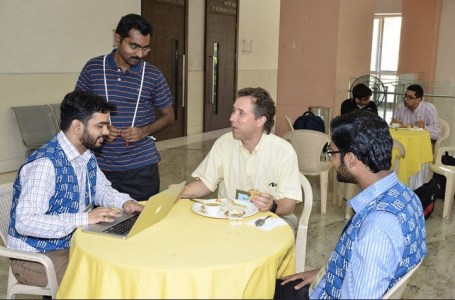
Talking to graduate students was my main activity at LaTICE 2017. Aman Yadav (from Michigan State, in the back of the below picture) and I missed a lot of sessions as we met with groups of students. I don’t think I met all the IDP-ET students, but I met many of them, and wrestled with ideas with them. I was pleased that students didn’t just take me at my word — they asked for explanations and references. (I ripped out half of the pages of my notebook, handing out notes with names of papers and researchers.) I feel grateful for the experience of hearing about so many varied projects and to talk through issues with many students.
I’m going to take my blog writer’s prerogative to talk about some of the IDP-ET students’ work that I’ve been thinking about since I got back. I’m not claiming that this is the best work, and I do offer apologies to the (many!) students whose work I’m not mentioning. These are just the projects that keep popping up in my (still not sleeping correctly) brain.
Aditi Kothiyal is interested in how engineers estimate. Every expert engineer does back-of-the-envelope estimation before starting a project. It’s completely natural for them. How does that develop? Can we teach that process to students? Aditi has a paper at the International Conference of the Learning Sciences this year on her studies of how experts do estimation. I find this problem interesting because estimation might be one of those hard-to-transfer higher-order thinking skills OR it could be a rule-of-thumb procedure that could be taught.
Shitanshu Mishra is exploring question-posing as a way to encourage knowledge integration. He’s struggling with a fascinating set of issues. Question-posing is a great activity that leads to learning, but is practiced infrequently in classroom, especially by the students who need it the most. Shitanshu has developed a guided process (think the whiteboards in Problem-Based Learning, or classroom rituals in Janet Kolodner’s Learning-By-Design, or Scardamalia & Bereiter’s procedural facilitation) which measurably helps students to pose good questions that encourage students to integrate knowledge. When should he guide students through his question-posing process? Is it important that students use his process on their own?
Yogendra Pal is asking a question that is very important in India whose answer may also be useful here in the US: How do you help students who grew up in a non-English language in adapting to English-centric CS? India’s constitution recognizes 22 languages, and has 122 languages spoken by many Indian citizens on a daily basis. Language issues are core to the Indian experience. CS is very English-centric, from the words in our programming languages, to the technical terms that don’t always map to other languages. Yogendra is working with students who only spoke Hindi until they got to University, where they now want to adapt to English, the language of the Tech industry. I wonder if Yogendra’s scaffolding techniques would help children of immigrant families in the US succeed in CS.
Rwitajit Majumdar is developing visualizations to track student behavior on questions over time. Originally, he wanted to help teachers get a sense of how their students move towards a correct understanding over multiple questions during Peer Instruction. Now, he’s exploring using his visualizations with MOOC data. I’m interested in his visualizations for our ebooks. He’s trying to solve an important problem. It’s one thing to know that 35% of the students got Problem #1 right, and 75% got (similar) Problem #2 right. But is it the same 25% of students who got both wrong? What percentage of students are getting more right, and are there any that are swapping to more wrong answers? Tracking students across time, across problems is an important problem.
Overall, the LaTICE conference was comparable to SIGCSE or ITiCSE. It was single track, though it’s been dual-track at some instances. LaTICE is mostly a practitioner’s conference, with a number of papers saying, “Here’s what I’m doing in my class” without much evaluation. I found even those interesting, because many were set in contexts that were outside my experience. There are some good research papers. And there are some papers that said some things that I felt were outright wrong. But because LaTICE is a small (< 200 attendees, I’d guess) and collegial conference, I had one-on-one conversations with all the authors with whom I disagreed (and many others, as well!) to talk through issues.
My keynote was based on my book, Learner-Centered Design of Computing Education: Research on Computing for Everyone. I talked about why it’s important to provide computing education to more than computing majors, and how computing education would have to change for different audiences. Slides are here: http://www.slideshare.net/markguzdial/latice-2016-learnercentered-design-of-computing-education-for-all
The most remarkable part of my trip was simply being in India. I’ve never been any place so crowded, so chaotic, so dirty, and so vibrant. I felt like I took my life in my hands whenever I crossed the street after noon on any day (and given the pedestrian accidents that some conference participants reported seeing, including one possible fatality, I likely was taking a risk). I went out for three runs around Mumbai and across campus (only in the morning when the traffic was manageable) and enjoyed interactions with cows and monkeys. I was shocked at the miles and miles of slums I saw when driving around Mumbai. I got stuck on one side of a major street without any idea how I could possibly get through the crowds and traffic to the other side — on a normal Sunday night. The rich colors of the Indian clothing palette were beautiful, even in the poorest neighborhoods. There was an energy everywhere I went in Mumbai.
I’ve not experienced anything like Mumbai before. I certainly have a new sense of my own privilege — about the things I have that I never even noticed until I was somewhere where they are not given. Given that India has 1.2 billion people and the US only has some 320 million, I’m wondering about how I define “normal.”
Brain training, like computational thinking, is unlikely to transfer to everyday problem-solving
In a recent blog post, I argued that problem-solving skills learned for solving problems in computational contexts (“computational thinking”) were unlikely to transfer to everyday situations (see post here). We see a similar pattern in the recent controversy about “brain training.” Yes, people get better at the particular exercises (e.g., people can learn to problem-solve better when programming). And they may still be better years later, which is great. That’s an indication of real learning. But they are unlikely to transfer that learning to non-exercise contexts. Most surprisingly, they are unlikely to transfer that learning even though they are convinced that they do. Just because you think you’re doing computational thinking doesn’t mean that you are.
Ten years later, tests showed that the subjects trained in processing speed and reasoning still outperformed the control group, though the people given memory training no longer did. And 60 percent of the trained participants, compared with 50 percent of the control group, said they had maintained or improved their ability to manage daily activities like shopping and finances. “They felt the training had made a difference,” said Dr. Rebok, who was a principal investigator.
So that’s far transfer — or is it? When the investigators administered tests that mimicked real-life activities, like managing medications, the differences between the trainees and the control group participants no longer reached statistical significance.
In subjects 18 to 30 years old, Dr. Redick also found limited transfer after computer training to improve working memory. Asked whether they thought they had improved, nearly all the participants said yes — and most had, on the training exercises themselves. They did no better, however, on tests of intelligence, multitasking and other cognitive abilities.
Source: F.T.C.’s Lumosity Penalty Doesn’t End Brain Training Debate – The New York Times
Notional Machines and Misconceptions in CS: Developing a Research Agenda at Dagstuhl

I facilitated a breakout group at the Dagstuhl Seminar on Assessment in Introductory Computer Science. We started talking about what students know and should know, and several of us started using terms like “notional machines” and “mental models” — and there were some strong disagreements. We decided to have a breakout group to define our terms, and came up with a fascinating set of issues and questions. It was a large group (maybe a dozen?), and I think there were some differences in attendance between the two days, so I’m not going to try to list everyone here.
Definitions
We agreed on the definition of a notional machine (NM) as a set of abstractions that define the structure and behavior of a computational device. A notional machine includes a grammar and a vocabulary, and is specific to a programming paradigm. It’s consistent and predictive — given a notional machine and a program to run on that machine, we should be able to define the result. The abstract machine of a compiler is a possible notional machine. This definition meshes with duBoulay’s original one and the one that Juha Sorva used in his dissertation (which we could check, because Juha was there).
Note that a NM doesn’t include function. It doesn’t tell a user, “Why would I use this feature? What is it for?” Carsten Shulte and Ashok Goel both found that students tend to focus on structure and behavior, and significant expertise is needed before students can discern function for a program or a NM component.
In CS education, we care about the student’s understanding of the notional machine. Mental model isn’t the right term for that understanding, because (for some) that implies a consistent, executable model in the student’s head. But modern learning science suggests that students are more likely to have “knowledge in pieces” (e.g., diSessa). Students will try to explain one program using one set of predictions about program behavior, and another program in another way. They respond to different programs differently When Michael Caspersen tried to replicate the Dehnadi and Bornat paper (Camel has two humps paper, and its retraction), he found that students would use one rule set for interpreting assignment in part of the test, and another set of rules later — and they either didn’t care or didn’t notice that they were inconsistent.
An early form of student understanding of the NM is simply mimicry. “I saw the teacher type commands like this. So if I repeat them exactly, I should get the same behavior.” As they start to realize that the program causes behavior, cognitive load limits how much of the NM students can think about at once. They can’t predict as we would like them to, simply because they can’t think about all of the NM components and all of the program at once. The greatest challenge to understanding the NM is Roy Pea’s Superbug — the belief that the computer is in fact a human-like intelligent agent trying to discern our intentions.
We define student misconceptions (about the NM) as incorrect beliefs about the notional machine that are reliable (the student will use more than once) and common (more than one student uses it). There are lots of misunderstandings that pop up, but those aren’t interesting if they’re not common and reliable. We decided to avoid the “alternative conception” model in science education because, unlike natural science, we know ground truth. CS is a science of the artificial. We construct notional machines. Conceptions are provably correct or incorrect about the NM.
One of the challenging aspects of student understandings of NM is that our current evidence suggests that students never fix existing models. We develop new understandings, and learn new triggers/indices when to apply these understandings. Sometimes we layer new understandings so deeply that we can’t reach the old ones. Sometimes, when we are stressed or face edge/corner conditions, we fall back on previous understandings. We help students develop new understandings by constraining their process to an appropriate path (e.g., cognitive tutors, cognitive apprenticeship) or by providing the right contexts and examples (like in Betsy Davis’s paper with Mike Clancy Mind your P’s and Q’s).
Where do misconceptions come from?
We don’t know for sure, but we have hypotheses and research questions to explore:
- We know that some misconceptions come from making analogies to natural language.
- Teaching can lead to misconceptions. Sometimes it’s a slip of the tongue. For example, students often confuse IF and WHILE. How often do we say (when tracing a WHILE) loop, “IF the expression is true…” Of course, the teacher may not have the right understanding.Research Question (RQ): What is intersection between teacher and student misconceptions? Do teacher misconceptions explain most student misconceptions, or do most student misconceptions come from factors outside of teaching?
- Under-specification. Students may simply not see enough contexts or examples for them to construct a complete understanding.
- Students incorrectly applying prior knowledge. RQ: Do students try to understand programs in terms of spreadsheets, the most common computational model that most students see?
- Notation. We believe that = and == do lead to to significant misconceptions. RQ: Do Lisp’s set, Logo’s make/name, and Smalltalk’s back arrow lead to fewer assignment misconceptions? RQ: Dehnadi and Bornat did define a set of assignment misconceptions. How common are they? In what languages or contexts?
RQ: How much do students identify their own gaps in understanding of a NM (e.g., edge conditions, problem sets that don’t answer their questions)? Are they aware of what they don’t understand? How do they try to answer their questions?
One advantage of CS over natural sciences is that we can design curriculum to cover the whole NM. (Gail Sinatra was mentioned as someone who has designed instruction to fill all gaps in a NM.) Shriram Krishnamurthi told us that he designs problem-sets to probe understanding of the Java notional machine that he expects students to miss, and his predictions are often right.
RQ: Could we do this automatically given a formal specification for an NM? Could we define a set of examples that cover all paths in a NM? Could we develop a model that predicts where students will likely develop misconceptions?
RQ: Do students try to understand their own computational world (e.g., how behavior in a Web page works, how an ATM works, how Web search works) with what we’re teaching them? Kathi Fisler predicts that they rarely do that, because transfer is hard. But if they’re actively trying to understand their computational world, it’s possible.
How do we find and assess gaps in student understanding?
We don’t know how much students think explicitly about a NM. We know from Juha’s work that students don’t always see visualizations as visible incarnations of the NM — for some students, it’s just another set of confusing abstractions.
Carsten Schulte pointed out that Ira Diethelm has a cool way of finding out what students are confused about. She gives them a “miracle question” — if you had an oracle that knew all, what one question would you ask about how the Internet works, or Scratch, or Java? Whatever they say — that’s a gap.
RQ: How we define the right set of examples or questions to probe gaps in understanding of a NM? Can we define it in terms of a NM? We want such a set to lead to reflection and self-explanation that might lead to improved understanding of the NM.
Geoffrey Herman had an interesting way of finding gaps in NM understanding: using historical texts. Turns out Newton used the wrong terms for many physical phenomena, or at least, the terms he used were problematic (“momentum” for both momentum and velocity) and we have better, more exact ones today. Terms that have changed meaning or have been used historically in more than one way tend to be the things that are hard to understand — for scholars past, and for students today.
State
State is a significant source of misconceptions for students. They often don’t differentiate input state, output state, and internal states. Visualization of state only works for students who can handle those kinds of abstractions. Specification of a NM through experimentation (trying out example programs) can really help if students see that programs causally determine behavior, and if they have enough cognitive load to computer behavior (and emergent behavior is particularly hard). System state is the collection of smaller states, which is a large tax on cognitive load. Geoffrey told us about three kinds of state problems: control state, data state, and indirection/reference state.
State has temporality, which is a source of misconceptions for students, like the common misconception that assignment states define a constraint, not an action in time. RQ: Why? Raymond Lister wondered about our understanding of state in the physical world and how that influences our understanding of state in the computational world. Does state in the real world have less temporality? Do students get confused about temporality in state in the physical world?
Another source of misconceptions is state in code, which is always invisible. The THEN part of an IF has implicit state — that block gets executed only if the expression is true. The block with a loop is different than the block after a condition (executed many times, versus once) but look identical. RQ: How common are code state misconceptions?
Scratch has state, but it’s implicit in sprites (e.g., position, costume). Deborah Fields and Yasmin Kafai found that students didn’t use variables much in state, but maybe because they didn’t tackle problems that needed them. RQ: What kinds of problems encourage use of state, and better understanding of state?
RQ: Some functional curricula move students from stateless computation to stateful computation. We don’t know if that’s easier. We don’t know if more/fewer/different misconceptions arise. Maybe the reverse is easier?
RQ: When students get confused about states, how do they think about? How do they resolve their gaps in understanding?
RQ: What if you start students thinking about data (state) before control? Most introductory curricula start out talking about control structures. Do students develop different understanding of state? Different misconceptions? What if you start with events (like in John Pane’s HANDS system)?
RQ: What if you teach different problem-solving strategies? Can we problematize gaps in NM understanding, so that students see them and actively try to correct them?
SIGCSE 2016 Preview: Parsons Problems and Subgoal Labeling, and Improving Female Pass Rates on the AP CS exam
Our research group has two papers at this year’s SIGCSE Technical Symposium.
Subgoals help students solve Parsons Problems by Briana Morrison, Lauren Margulieux, Barbara Ericson, and Mark Guzdial. (Thursday 10:45-12, MCCC: L5-L6)
This is a continuation of our subgoal labeling work, which includes Lauren’s original work showing how subgoal labels improved learning, retention and transfer in learning App Inventor (see summary here), the 2015 ICER Chairs Paper Award-winning paper from Briana and Lauren showing that subgoals work for text languages (see this post for summary), and Briana’s recent dissertation proposal where she explores the cognitive load implications for learning programming (see this post for summary). This latest paper shows that subgoal labels improve success at Parson’s Problems, too. One of the fascinating results in this paper is that Parson’s Problems are more sensitive as a learning assessment than asking students to write programs.
Sisters Rise Up 4 CS: Helping Female Students Pass the Advanced Placement Computer Science A Exam by Barbara Ericson, Miranda Parker, and Shelly Engelman. (Friday 10:45-12, MCCC: L2-L3)
Barb has been developing Project Rise Up 4 CS to support African-American students in succeeding at the AP CS exam (see post here from RESPECT and this post here from last year’s SIGCSE). Sisters Rise Up 4 CS is a similar project targeting female students. These are populations that have lower pass rates than white or Asian males. These are examples of supporting equality and not equity. This paper introduces Sisters Rise Up 4 CS and contrasts it with Project Rise Up 4 CS. Barb has resources to support people who want to try these interventions, including a how-to ebook at http://ice-web.cc.gatech.edu/ce21/SRU4CS/index.html and an ebook for students to support preparation for the AP CS A.
Interaction beats out video lectures and even reading for learning
I’m looking forward to these results! That interaction is better than video lectures is really not surprising. That it leads to better learning than even reading is quite a surprise. My guess is that this is mediated by student ability as a reader, but as a description of where students are today (like the prior posts on active learning), it’s a useful result.
Koedinger and his team further tested whether their theory that “learning by doing” is better than lectures and reading in other subjects. Unfortunately, the data on video watching were incomplete. But they were able to determine across four different courses in computer science, biology, statistics and psychology that active exercises were six times more effective than reading. In one class, the active exercises were 16 times more effective than reading. (Koedinger is currently drafting a paper on these results to present at a conference in 2016.)
Source: Did you love watching lectures from your professors? – The Hechinger Report
Blog Post #2000: Barbara Ericson Proposes: Effectiveness and Efficiency of Adaptive Parsons Problems #CSEdWeek
My 1000th blog post looked backward and forward. This 2000th blog post is completely forward looking, from a personal perspective. Today, my wife and research partner, Barbara Ericson, proposes her dissertation.
Interesting side note: One of our most famous theory professors just blogged on the theory implications of the Parsons Problems that Barb is studying. See post here.
Barb’s proposal is the beginning of the end of this stage in our lives. Our youngest child is a senior in high school. When Barbara finishes her Human-Centered Computing PhD (expected mid-2017), we will be empty-nesters and ready to head out on a new adventure.
Title: EVALUATING THE EFFECTIVINESS AND EFFICIENCY OF PARSONS PROBLEMS AND DYNAMICALLY ADAPTIVE PARSONS PROBLEMS AS A TYPE OF LOW COGNITIVE LOAD PRACTICE PROBLEM
Barbara J. Ericson
Ph.D. student
Human Centered Computing
College of Computing
Georgia Institute of Technology
Date: Wednesday, December 9, 2015
Time: 12pm to 2pm EDT
Location: TSRB 223
Committee
————–
Dr. James Foley, School of Interactive Computing (advisor)
Dr. Amy Bruckman, School of Interactive Computing
Dr. Ashok Goel, School of Interactive Computing
Dr. Richard Catrambone, School of Psychology
Dr. Mitchel Resnick, Media Laboratory, Massachusetts Institute of Technology
Abstract
———–
Learning to program can be difficult and can result in hours of frustration looking
for syntactic or semantic errors. This can make it especially difficult to prepare inservice
(working) high school teachers who don’t have any prior programming
experience to teach programming, since it requires an unpredictable amount of time for
practice in order to learn programming. The United States is trying to prepare 10,000
high school teachers to teach introductory programming courses by fall 2016. Most
introductory programming courses and textbooks rely on having learners gain experience
by writing lots of programs. However, writing programs is a complex cognitive task,
which can easily overload working memory, which impedes learning.
One way to potentially decrease the cognitive load of learning to program is to
use Parsons problems to give teachers practice with syntactic and semantic errors as well
as exposure to common algorithms. Parsons problems are a type of low cognitive load
code completion problem in which the correct code is provided, but is mixed up and has
to be placed in the correct order. Some variants of Parsons problems also require the
code to be indented to show the block structure. Distractor code can also be provided
that contains syntactic and semantic errors.
In my research I will compare solving Parsons problems that contain syntactic and
semantic errors, to fixing code with the same syntactic and semantic errors, and to writing
the equivalent code. I will examine learning from pre- to post-test as well as student
reported cognitive load. In addition, I will create dynamically adaptive Parsons problems
where the difficulty level of the problem is based on the learners’ prior and current
progress. If the learner solves one Parsons problem in one attempt the next problem will
be made more difficult. If the learner is having trouble solving a Parsons problem the
current problem will be made easier. This should enhance learning by keeping the
problem in the learner’s zone of proximal development as described by Vygotsky. I will
compare non-adaptive Parsons problems to dynamically adaptive Parsons problems in
terms of enjoyment, completion, learning, and cognitive load.
The major contributions of this work are a better understanding of how variants of
Parsons problems can be used to improve the efficiency and effectiveness of learning to
program and how they relate to code fixing and code writing. Parsons problems can help
teachers practice programming in order to prepare them to teach introductory computer
science at the high school level and potentially help reduce the frustration and difficulty
all beginning programmers face in learning to program.
Blog Post #1999: The Georgia Tech School of Computing Education #CSEdWeek
Three and a half years, and 1000 blog posts ago, I wrote my 999th blog post about research questions in computing education (see post here). I just recently wrote a blog post offering my students’ take on research questions in computing education (see post here), which serves to update the previous post. In this blog post, I’m going to go more meta.
In my CS Education Research class (see description here), my students read a lot of work by me and my students, some work on EarSketch by Brian Magerko and Jason Freeman, and some by Betsy DiSalvo. There are other researchers doing work related to computing education in the College of Computing at Georgia Tech, notably John Stasko’s work on algorithm visualization, Jim Foley’s work on flipped classrooms (predating MOOCs by several years), and David Joyner and Ashok Goel’s work on knowledge-based AI in flipped and MOOC classrooms, and my students know some of this work. I posed the question to my students:
If you were going to characterize the Georgia Tech school of thought in computing education, how would you describe it?
We talked some about the contrasts. Work at CMU emphasizes cognitive science and cognitive tutoring technologies. Work at the MIT Media Lab is constructionist-based.
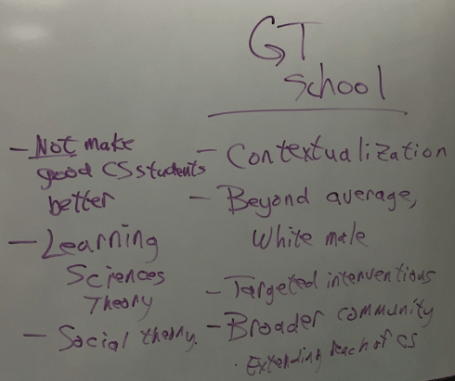
Below is my interpretation of what I wrote on the board as they called out comments.
- Contextualization. The Georgia Tech School of Computing education emphasizes learning computing in the context of an application domain or non-CS discipline.
- Beyond average, white male. We are less interested in supporting the current majority learner in CS.
- Targeted interventions. Georgia Tech computing education researchers create interventions with particular expectations or hypotheses. We want to attract this kind of learner. We aim to improve learning, or we aim to improve retention. We make public bets before we try something.
- Broader community. Our goal is to have a broaden participation in computing, to extend the reach of computer science.
- We are less interested in making good CS students better. To use an analogy, we are not about raising the ceiling. We’re about pushing back the walls and lowering the floors, and sometimes, creating whole new adjacent buildings.
- We draw on learning sciences theory, which includes cognitive science and educational psychology (e.g., cognitive load theory).
- We draw on social theories, especially distributed cognition, situated learning, social cognitive theory (e.g., expectancy-value theory, self-efficacy).
I might have spent hours coming up with a list like this, but in ten minutes, my students came up with a good characterization of what constitutes the Georgia Tech School of Thought in Computing Education.
 Computing Ed Research - Guzdial's Take
Recent Comments