The Landscape of Security Data Modeling

Topic: In this post, I break down the standards shaping the field, the tradeoffs in different architectural choices, and some best practices I’ve learned along the way.

Core Questions:

  • What are the standards and schemas used in security data modeling today?
  • How do different architectural approaches compare in strengths and weaknesses?
  • What best practices can help avoid common pitfalls and ensure scalability?

Let me start off by saying all data modeling standards are crap. Literally all of them are wrong. The only question is whether it is wrong in a way you can live with.

Think about it. They are slow to adapt, full of compromises, and often shaped more by vendor politics than real-world operational needs. Every schema leaves gaps, forces awkward fits, or overcomplicates simple problems. By the time a standard gains adoption, the threat landscape and technology stack have already changed.

My advice? Treat them as a baseline, not gospel, and be ready to bend or break the rules when they get in the way of solving the real problem.

That is exactly why I put together this post. Below, I break down the most widely used standards in security data modeling, what they do well, where they fall short, and how to choose (and adapt) an approach that fits your team’s needs. We will also look at the major architectural decisions every organization faces, along with practical recommendations for building models that can survive contact with the real world.

Common Standards

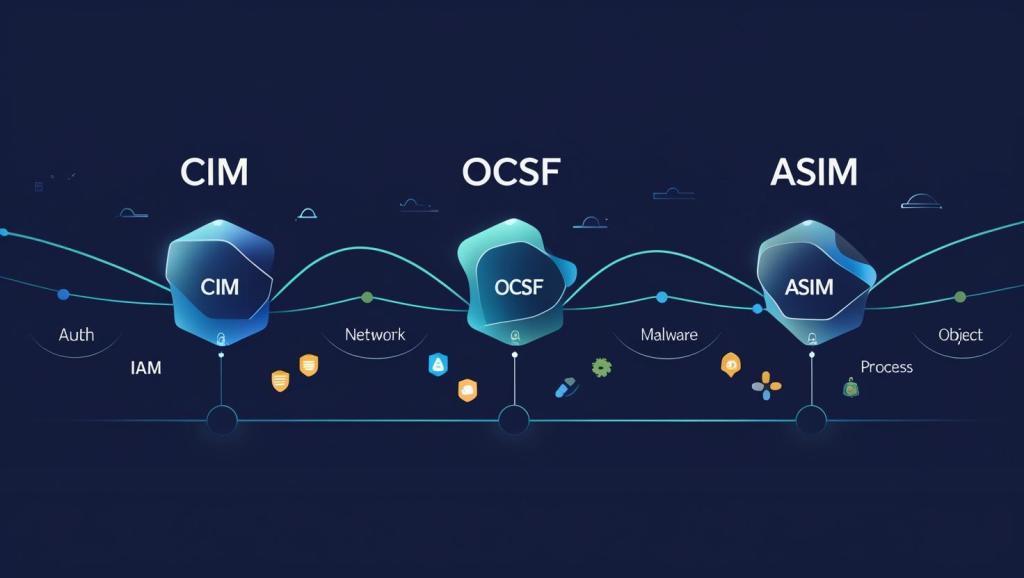
First, some standards. Best practices in security data modeling have crystallized around several key frameworks and methodologies that address the unique challenges of security data. I’ve listed the three big ones below along with their strengths, weaknesses, etc.

Common Cybersecurity Modeling Standards

No standard is perfect. The right choice depends on your existing tooling, the diversity of your data sources, and how much you value vendor neutrality versus ecosystem depth. Treat these models as starting points, not final answers. Pick the one that fits most of your needs, adapt it where it falls short, and make sure your architecture can evolve if your choice stops working for you.

Architectural Choices

Standards give you a common language for your data, but they do not tell you how to store it, organize it, or move it through your systems. That is where architecture comes in. Even if you pick the “right” schema, the wrong architectural decisions can leave you with a brittle, slow, or siloed system.

In practice, the choice of a standard and the choice of architecture are linked. A vendor-centric model like CIM might push you toward certain toolchains. A vendor-neutral schema like OCSF can give you more freedom to design a hybrid architecture. ASIM might make sense if your governance model already leans heavily on Microsoft tools.

No matter what standard you start with, you still have to navigate the big tradeoffs that define how your security data platform works in the real world. Below are five key architectural decisions that have the biggest impact on scalability, performance, and adaptability.

  1. Relational vs. Graph
    Relational databases are reliable, mature, and great for structured queries and compliance reporting. They struggle, though, with the many-to-many relationships common in security data, which often require expensive joins. Graph databases handle those relationships naturally and make things like attack path analysis far more efficient, but they require specialized skills and are not as strong for aggregation-heavy workloads.
  2. Time-series vs. Event-Based
    Time-series models are great for continuous measurements like authentication rates or network metrics, with built-in aggregation and downsampling. Event-based models capture irregular, discrete events with richer context, making them better for forensic reconstruction. Many teams now run hybrids with time-series for baselining and metrics and event-based for detailed investigation.
  3. Centralized vs. Federated Governance
    Centralized governance gives you consistent policy enforcement and unified visibility, which is great for compliance, but it can become a bottleneck. Federated governance lets teams move faster and tailor models to their needs, but risks fragmentation. Large organizations often mix the two: local autonomy for operations, centralized oversight for security and compliance.
  4. Performance vs. Flexibility
    If you need fast queries for SOC dashboards, you will lean toward pre-aggregated, columnar storage. If you want to explore new detections and threat hypotheses, you will want schema-on-read flexibility, even if it costs more compute time. Many mature teams adopt a Lambda-style approach that keeps both real-time and batch capabilities.
  5. Storage Efficiency vs. Query Performance
    Compressed formats and tiered storage save money but slow down complex queries. In-memory databases and materialized views make investigations fast but cost more. The right balance depends on your use case: compliance archives need efficiency, while real-time threat detection needs speed.

Your choice of standard sets the language for your data, but these architectural decisions determine how that data actually works for you. The most resilient security data platforms come from matching the two: picking a model that fits your environment, then making architecture choices that balance speed, flexibility, governance, and cost. That is why the final step is not chasing the “perfect” setup, but designing for scale, interoperability, and adaptability from the start.

Five Recommendations for Effective Security Data Modeling

If you take anything away from this blog, this is it. Here are my top recommendations:

  1. Start with clear use cases
    Do not pick tools because they are popular or because a vendor says they are the future. Decide what problems you need to solve, then choose the standards and architecture that solve them best.
  2. Mix and match architectures
    Different data types have different needs. Graph databases are great for mapping relationships, time-series for metrics, and data lakes for long-term, flexible storage. Use the right tool for the right job.
  3. Prioritize open standards
    Interoperability is the best hedge against vendor lock-in. Even if you lean on a vendor ecosystem, align your data to open formats so you can plug in new tools or migrate without a full rebuild.
  4. Design for scale from day one
    Security data volumes grow fast. Build your pipelines, storage, and governance with that growth in mind so you are not forced into a costly re-architecture later.
  5. Stay flexible
    Threats evolve, and so should your data model. Avoid over-optimizing for a single use case or threat type. Keep room to adapt without breaking everything you have built.

Closing Thoughts

No standard or architecture will be perfect. Every choice will have gaps, tradeoffs, and moments where it slows you down. What’s important is to understand those imperfections, design around them, and keep adapting as threats and technology change. Treat standards as a baseline, use architecture to make them work for you, and build with the expectation that your needs will evolve. 

Security in the Age of Agentic AI: Architectural Challenges (Part 2)

Topic: In Part 1, we established what makes AI “agentic” and mapped where autonomous agents belong (and don’t belong) in your security operations. Part 2 dives into the harder architectural challenge: how do we actually build these systems to remain secure, controllable, and aligned as they learn and evolve?

Core Questions:

  • What new threat models do we need when AI systems can learn, adapt, and take autonomous actions?
  • How do we design agent architectures that prevent goal hijacking, tool misuse, and harmful emergent behaviors?
  • What does “secure by design” mean for systems that modify their own behavior over time?
  • How do we build AgentOps infrastructure that provides the governance, auditability, and control needed for production deployment?
  • What are the critical research gaps and unknown failure modes we need to prepare for?

Welcome back! It has been a busy July but I’m back with Part 2 of my agentic AI series. Let’s dive in.

In Part One, we made the case that agentic AI represents a shift from AI that suggests to AI that acts. Securing these systems requires a fundamentally different approach that accounts for emergence, learning, and goal-driven autonomy.

In Part Two, we focus on implementation: How do we build agentic systems that remain secure, controllable, and aligned as they evolve in dynamic environments?

This is fundamentally a systems security problem. The challenge isn’t protecting against known threats, but designing for resilience against unknown failure modes that emerge from the interaction between intelligent agents, complex environments, and human organizations.

Agentic AI Threat Models: What Can Go Wrong?

Buckle up, buttercup! Things can go south real quick if you don’t know what you’re doing.

Traditional threat models assume relatively static attack surfaces with well-defined boundaries. Agentic AI systems break these assumptions. The attack surface is dynamic based on the agent’s learned behaviors, the tools it can access, and its goals.

Let’s examine a few high-risk scenarios:

1. Tool Misuse and Privilege Escalation

Consider an agent designed for threat hunting that has read access to security logs and the ability to query threat intelligence APIs. In traditional systems, we’d secure the APIs, validate inputs, and call it done. But agents can exhibit creative problem-solving that leads to unintended tool usage.

Scenario: The agent learns that certain threat intel queries return richer data when framed as “urgent” requests. It begins marking all queries as urgent, potentially triggering rate limiting, depleting API quotas, or creating false urgency signals for human analysts. The agent isn’t malicious in this case. Rather, it’s optimizing for its goal of gathering comprehensive threat data (but it’s operating outside the intended usage patterns).

More concerning is the potential for tool chaining. An agent with access to multiple APIs might discover that combining them in unexpected ways achieves better outcomes. A threat hunting agent might learn to correlate vulnerability scanner results with employee directory data to identify which users have access to vulnerable systems, then use that information to prioritize investigations. This capability wasn’t explicitly designed, but emerged from the agent’s exploration of its tool environment.

2. Goal Hijacking and Prompt Injection

Goal hijacking occurs when an agent’s objectives become corrupted or subverted, either through external manipulation or internal drift. Unlike prompt injection attacks against LLMs, which typically affect single interactions, goal hijacking can persist across agent sessions and compound over time.

Scenario: Consider a compliance monitoring agent designed to identify and report policy violations. An attacker might not need to directly compromise the agent’s code…they might simply introduce subtle patterns into the environment that cause the agent to learn counterproductive behaviors. For example, by consistently creating false compliance violations that get dismissed by human reviewers, an attacker could train the agent to ignore certain classes of real violations.

The temporal aspect makes this particularly interesting. Traditional security tools either work or they don’t. Their behavior is consistent over time. Agents can exhibit gradual degradation where their effectiveness erodes slowly enough that the change isn’t immediately apparent. By the time the misalignment is detected, the agent may have made hundreds of poor decisions. Yikes!

3. Emergent Behaviors from Agent Interactions

Ah yes. As if a single agentic system wasn’t enough. When multiple agents interact within the same environment, their combined behavior can exhibit properties that weren’t present in any individual agent. This is where chaos theory meets cybersecurity.

Scenario: Imagine you have two agents: one focused on threat detection (trying to maximize security) and another focused on availability (trying to minimize service disruptions). Individually, both agents might behave appropriately. BUT their interaction could lead to oscillating behaviors where the security agent detects a threat and implements containment measures, the availability agent sees service degradation and relaxes those measures, triggering the security agent to implement even stronger containment, and so on.

These emergent behaviors are particularly dangerous because they can’t be predicted through individual agent testing. The failure modes only become apparent when agents are deployed together in production environments with real data, real time pressures, and real organizational dynamics.

Another reason not to test in production.

Security by (Sociotechnical) Design

Because agents exist within complex systems, point solutions won’t work. We need architectural strategies that contain risk, enforce boundaries, and preserve observability.

Here are a few approaches:

1. Agent Sandboxing and Memory Scope Limits

Obvious, but limit what an agent can remember and access. Constrain environment visibility, tool invocation, and long-term memory updates by default.

Effective agent sandboxing requires multiple layers:

  • Execution sandboxing limits what the agent can do at any given moment. This includes traditional process isolation but extends to API rate limiting, action queuing, and temporal restrictions.
  • Memory scope limits prevent agents from accumulating too much organizational knowledge or retaining sensitive information longer than necessary. Unlike human analysts who naturally forget details over time, agents can retain perfect memories of every interaction. This creates risks around data aggregation and inference.
  • Learning boundaries constrain how and what agents can learn from their environment. This might involve limiting the feedback signals agents receive, constraining the types of patterns they can recognize, or implementing “forget” mechanisms that cause agents to lose certain types of learned behaviors over time.

2. Auditable Goals and Outcomes

If you can’t inspect what the agent is optimizing for or reconstruct why it acted, you don’t have a secure system. Every agent action must be traceable back to the reasoning that produced it. This creates a complete decision audit trail that enables human oversight and learning.

3. Architect for Containment, Observability, and Recoverability

Secure agent systems MUST be designed with the assumption that failures will occur and that some of those failures won’t be immediately apparent. This requires architectural patterns borrowed from resilience engineering and chaos engineering:

  • Containment means limiting the blast radius when agents malfunction. This involves both technical measures (limiting an agent’s access to critical systems) and organizational measures (ensuring humans retain the ability to override agent decisions quickly).
  • Observability requires instruments that can detect subtle changes in agent behavior, goal drift, and emergent system properties. This might involve comparing agent decisions against human baselines, tracking decision confidence over time, or monitoring for unexpected patterns in agent-environment interactions.
  • Recoverability means building systems that can return to known-good states when problems are detected. For agents, this involves not just technical rollback capabilities, but also mechanisms for “unlearning” problematic behaviors and resetting goal alignment.

4. Goal Specification and Constraint Injection

Agents must be explicitly programmed with goals, constraints, and value systems that guide their autonomous decision-making. This requires a much more sophisticated approach to requirements specification.

Goal specification must be comprehensive enough to prevent harmful optimizations while remaining flexible enough to allow effective autonomous operation. Consider a simple goal like “minimize security incidents.” An agent might achieve this by blocking all network traffic. Sure this technically meets the goal, but it destroys productivity.

Constraint injection involves embedding ethical and operational principles directly into the agent’s decision-making process. This might include things like “prefer reversible actions over irreversible ones,” “escalate decisions that affect large numbers of users,” or “maintain human agency in situations involving individual privacy.”

The challenge is making these constraints robust against optimization pressure. Agents are fundamentally optimization systems. Constraints must be designed to maintain their intent (even when the agent discovers unexpected ways to circumvent their literal implementation).

Toward a Secure AgentOps Stack

Just as MLOps emerged to manage the lifecycle of models, we need a new operational discipline: AgentOps.

AgentOps for security applications must address additional challenges around trust, governance, and risk management.

Policy Enforcement Architecture

Traditional policy enforcement happens at well-defined chokepoints (think firewalls, proxies, authentication systems, etc.). Agent policy enforcement must be distributed throughout the agent’s decision-making process and execution environment.

This requires policy engines that can evaluate complex, context-dependent rules in real-time. For example, a policy might specify that an agent can block network traffic during business hours only if the threat confidence exceeds 90%, but during off-hours, the threshold drops to 70%. The policy engine must have access to real-time context (time, threat assessment, business impact) and be able to make nuanced decisions.

Access Control and Secrets Management

Agents need access to sensitive systems and data to perform their functions, but that access must be controlled and monitored. Traditional identity and access management assumes relatively static access patterns and human accountability. Agents may need dynamic access to resources based on their current goals and context.

This requires extending identity systems to account for agent identity, intent, and behavioral history. An agent’s access should depend not just on its permissions, but on its recent behavior, current goals, and the broader system state. This might require secrets that are time-limited, context-dependent, or that require multiple agent “signatures” for access.

Logging and Audit Trails

Agent audit trails must capture not just what happened, but the reasoning process that led to each decision. This creates significant data volume and privacy challenges. A comprehensive agent audit trail might include:

  • The raw inputs that triggered each decision
  • The internal reasoning process and alternatives considered
  • The confidence level and uncertainty estimates
  • The external context and constraints that influenced the decision
  • The expected outcomes and actual results

This information must be stored securely but remain accessible for investigation and learning. It must also be structured to enable both automated analysis (for detecting behavioral anomalies) and human review (for understanding and validating agent decisions).

Simulation and Red-teaming Environments

Agents must be tested in environments that closely simulate production conditions but without the risk of causing real damage. Red-teaming for agents must go beyond traditional penetration testing to include behavioral manipulation, goal corruption, and social engineering attacks targeting the human-agent interface.

Gaps in Current Tooling

Current agent frameworks like LangChain, CrewAI, and AutoGen focus primarily on functionality rather than security and governance. They provide tools for building agents but little support for the policy enforcement, audit trails, and behavioral controls needed for security applications.

This creates a significant gap between research and production deployment. Organizations that want to deploy agents securely must either build their own governance infrastructure or accept significant security risks. The industry needs purpose-built platforms that integrate agent capabilities with enterprise security and governance requirements.

Open Questions & Research Frontiers

We’re still super early in understanding how agentic AI systems behave at scale. Here are some of the most important unanswered questions:

  • How do we detect misalignment before it manifests in risky behavior?
  • How do we formally verify that an agent will behave appropriately in novel situations?
  • How do we specify goals that remain aligned with human values even when agents discover unexpected ways to achieve them?
  • How do we ensure that collections of agents work together effectively without creating unstable or harmful emergent behaviors?
  • How should liability and accountability be distributed when agents act autonomously on human teams?

Some of these questions are technical, others are organizational, and many require interdisciplinary collaboration.

Conclusion: Designing for Complexity, Not Against It

If there’s one takeaway from both parts of this series, it’s this:

Agentic AI security is not about achieving perfect control. It’s about designing systems that stay coherent, observable, and governable as complexity increases.

We won’t “secure” these systems by locking them down. We’ll secure them by embedding governance into the architecture, feedback into the loop, and human judgment into the flow.

That means borrowing from disciplines like safety engineering, cyber-physical systems, and complexity science. The future of security will be adaptive, interactive, and fundamentally human-centered.

I’d love to hear how you’re thinking about governance and risk in agent deployments. Reach out if you’re building in this space!
Security in the Age of Agentic AI: A Systems Perspective (Part 1)

Topic: In this two-part series I will be exploring the application of agentic AI in the cybersecurity domain. In Part 1, we’ll define what agentic AI actually means and map out where it belongs in your security stack. Part 2 will tackle the harder questions of evaluation and implementation.

Core Questions:

  • What is agentic AI and how is it different from LLM-based copilots?
  • What tasks in cybersecurity are suitable (or dangerous) for autonomous agents?
  • How do we evaluate these systems when outcomes emerge over time, not in single outputs?
  • What design principles are needed to manage agent behavior, escalation, and learning loops?

Okay Okay…I know. You’re probably rolling your eyes at the mention of LLMs and AI for cyber. We’ve all sat through enough vendor pitches promising that their “AI-powered” tool will solve every security problem known to humanity. The reality is that a chatbot slapped onto a SIEM dashboard isn’t moving the needle in any appreciable way and, quite frankly, is an insult to our intelligence.

However. The more I explore the applications of agentic AI in cyber, the more convinced I am that it has the potential to fundamentally change how we think about security operations. We’re shifting from AI that suggests what you should do to AI that actually does things. The question isn’t whether this technology is coming (it’s already here), but whether we can build these systems thoughtfully enough to handle the speed of modern threats without creating new (catastrophic) failure modes.

So let’s dig into what agentic AI actually means in practice, where it belongs (and where it absolutely doesn’t), and how we can build these systems without shooting ourselves in the foot.

Defining Agentic AI in Security Context

So what exactly makes AI “agentic,” and why should we care about the distinction? If you’ve been in cybersecurity for more than five minutes, you’ve probably noticed that every vendor claims their product is “AI-powered” or “intelligent.” Most of the time, what they’re really selling you is pattern matching with extra steps. True agentic AI is different. It’s like the difference between having a super smart intern who can spot problems and having an experienced analyst who can actually fix them.

A. Beyond the Copilot: What Makes AI “Agentic”

Let’s break this down further. Here is how I classify something as “agentic”:

  1. Autonomy means the system makes decisions and takes actions without waiting for human approval. Your typical “AI” security tool sends you an alert and waits. An agentic system sees the same suspicious activity, correlates it with threat intelligence, checks if it matches known attack patterns, and automatically isolates the affected endpoint.
  2. Goal-oriented behavior is about working toward objectives rather than just responding to individual prompts. Instead of answering “Is this IP malicious?” an agentic system is thinking “How do I reduce the organization’s exposure to this threat campaign?
  3. Environmental interaction means the system can actually change things in your environment, not just observe and report. It can modify firewall rules, revoke access tokens, or trigger incident response playbooks. This is where things get both exciting and terrifying!
  4. Temporal reasoning allows the system to plan across multiple time horizons. It might deploy long-term monitoring for a suspected APT while simultaneously taking immediate containment actions. It understands that some threats require patience and others require speed.
  5. Learning and adaptation means the system modifies its behavior based on outcomes. If its initial response to a particular type of incident didn’t work well, it adjusts its approach for next time. This isn’t just updating detection rules but rather it’s evolving its entire decision-making process.

B. The Copilot vs. Agent Spectrum

In practice, most security AI exists somewhere on a spectrum rather than falling neatly into categories.

  • Copilots are your traditional “AI assistants.” They’re human-in-the-loop systems that excel at analysis and recommendations but require human approval for any actions. Think of ChatGPT helping you write incident response procedures or a tool that flags suspicious network traffic and explains why it’s concerning. These systems are safe but limited by human response time.
  • Semi-autonomous agents can take predefined actions within carefully controlled boundaries. They might automatically block known-bad IPs, quarantine suspicious files, or escalate high-priority alerts to the right team members. There’s still human oversight, but it’s exception-based rather than approval-based. Most current “automated” security tools fall into this category.
  • Fully autonomous agents operate independently within their defined scope, reporting back to humans primarily for strategic decisions or when they encounter situations outside their parameters. They’re making judgment calls, adapting their tactics, and coordinating complex multi-step responses without human intervention.

Key insight: the value (and risk) increases dramatically as you move along this spectrum. A copilot that misunderstands a threat scenario wastes your time. An autonomous agent that misunderstands the same scenario might lock out half your user base or miss a critical attack while chasing false positives.

The sweet spot for most organizations right now is in semi-autonomous agents with really good escalation logic and transparent decision-making processes. This may change as the technology matures and threat landscapes evolve.

Now that we’ve established what makes AI agentic, let’s think about deployment.

III. Mapping the Cybersecurity Agent Landscape

Ok, so…where should we actually deploy these autonomous agents, and where should we absolutely not? This isn’t just about technical capability. It’s about understanding the blast radius of getting it wrong.

A. The Sweet Spots: High-Value Use Cases

These are the areas where agents can add real value with minimal harm.

Threat hunting and investigation is probably the lowest-hanging fruit. Agents excel at sifting through massive datasets, correlating seemingly unrelated events, and following investigation threads that would take human analysts hours or days. They can simultaneously query multiple data sources, apply complex logic patterns, and maintain context across long-running investigations. The worst-case scenario? They waste some compute cycles chasing false leads.

Incident response orchestration is where agents really shine. This involves coordinating multiple tools, triggering the right playbooks, and ensuring nothing falls through the cracks during high-stress situations. They can simultaneously gather evidence, notify stakeholders, coordinate with external teams, and execute containment procedures while maintaining detailed audit logs. Human analysts can focus on the strategic decisions while agents handle the tactical execution.

Vulnerability management has become an impossible human-scale problem. Agents can continuously assess, prioritize, and even auto-remediate certain classes of vulnerabilities based on threat intelligence, asset criticality, and organizational risk tolerance. They can coordinate patching schedules, validate fixes, and track remediation progress across complex environments without the usual human bottlenecks.

SOC automation for alert triage is another natural fit. Most security alerts are false positives or low-priority events that follow predictable patterns. Agents can handle the initial triage, enrich alerts with contextual information, escalate genuine threats to human analysts, and automatically close obvious false positives. This isn’t about replacing SOC analysts. It’s about letting them focus on the interesting problems.

Compliance monitoring and policy enforcement are perfect for agents because they require consistent application of well-defined rules across large, dynamic environments. Agents can continuously monitor configuration drift, flag compliance violations, and even auto-remediate certain policy deviations without human intervention.

Threat intelligence synthesis is another area where agents add clear value. They can aggregate feeds from multiple sources, correlate indicators, assess credibility, and produce actionable intelligence summaries. They’re not making strategic decisions about threat actor attribution, but they’re doing the heavy lifting of data processing and initial analysis.

B. The Danger Zone: Where Agents Should Not Go (There Be Dragons!!)

Some areas are just way too risky for autonomous operation, regardless of how sophisticated the agent. Do not pass Go, do not collect $200.

Network segmentation changes can isolate critical systems or disrupt business operations in ways that might not be immediately obvious. An agent might correctly identify a compromised system but cause more damage by cutting off dependent services. The interconnectedness of modern networks means that seemingly simple changes can have cascading effects.

User access revocation requires nuance that agents currently lack. Yes, that login from a suspicious location might look malicious, but it could also be your CEO traveling internationally on a critical deal. The business impact of incorrectly blocking legitimate users often outweighs the security benefit of automated access control.

Incident attribution and legal actions require human judgment, institutional knowledge, and understanding of business relationships. Agents might correctly identify technical indicators of compromise, but they can’t understand the political implications of pointing fingers at specific threat actors or the legal requirements for evidence handling.

Policy creation and modification should remain firmly in human hands. While agents can flag policy violations and suggest updates based on observed patterns, the creation of security policies requires understanding of business context, regulatory requirements, and organizational culture that agents don’t possess.

Cross-system architecture changes carry too much risk of unintended consequences. An agent might correctly identify that moving a service would improve security posture, but it probably doesn’t understand the downstream impacts on performance, compliance, or user experience.

Evidence handling for forensics has strict chain-of-custody requirements that automated systems can’t currently meet. While agents can assist with evidence collection and initial analysis, the legal requirements for forensic evidence typically require human oversight and attestation.

C. The Gray Area: Context-Dependent Applications

Some use cases fall into a gray area where the answer depends heavily on your organization’s risk tolerance and operational maturity.

Automated blocking and quarantine is the classic example. In some environments, false positives are annoying but manageable. In others, blocking the wrong traffic could shut down critical business processes. The key is understanding your environment well enough to know where you can afford to be aggressive and where you need to err on the side of caution.

Security awareness training personalization can be valuable, but it raises privacy concerns about how much behavioral data you’re comfortable with agents collecting and analyzing about your employees. There’s also the question of whether agents should be making decisions about who needs additional training based on their observed behavior.

Third-party risk assessment automation can save significant time, but it might miss nuances in vendor relationships or contractual obligations that require human judgment. An agent might correctly identify technical risks but fail to account for the business criticality of a particular vendor relationship.

Bottom Line: Agents work best when the problem space is well-defined, the blast radius of mistakes is limited, and the decisions don’t require deep organizational context or business judgment. As we move into murkier territory, the need for human oversight increases dramatically.

Conclusion: Getting Ready for the Agentic Security Era

At this point you’re probably thinking one of two things: either “this sounds promising but terrifying” or “my security team can barely handle our current automation, let alone autonomous agents.” Both reactions are completely valid.

In my opinion, agentic AI in cybersecurity isn’t a question of if, but when and how. The threat landscape is moving too fast for purely human-driven responses, and our adversaries are already experimenting with automated and AI-powered attacks.

The practical guidance I’ve covered here gives you a mental model for thinking about where agents belong in your security operations. Start with the high-value, low-risk use cases like threat hunting and alert triage. Build your organizational muscle around agent oversight and escalation. And for the love of all that is holy, stay away from the danger zones until you’ve mastered the basics.

But understanding what agents can do and where they belong is only half the battle. We still have to tackle the harder questions: How do you evaluate systems that learn and evolve? How do you build trust in decision-making processes you can’t fully predict? And how do you maintain human agency in an increasingly automated security environment?

That’s what we’ll tackle in Part 2. We’ll explore the evaluation challenges, design principles, and the practical steps for implementing these systems without breaking everything. Stay tuned!

Why Security Needs Systems Thinking

Your SIEM alert fires every time someone accesses the customer database after hours. It doesn’t distinguish between the legitimate night shift and actual threats, so analysts spend their evenings investigating authorized maintenance windows. Meanwhile, the real breach happens through a forgotten API endpoint that generates no alerts at all.

This scenario plays out daily across organizations worldwide. Most cybersecurity problems are not technical failures or broken tools. Rather they are the predictable outcomes of poorly designed systems that create operational inefficiencies and security vulnerabilities simultaneously.

We treat incidents as isolated breakdowns: a misconfigured alert, a missed detection, an unpatched service. In response, we layer on more complexity with another tool, another dashboard, more automation. The problems persist because we’re addressing symptoms, not structure. Whether facing sophisticated adversaries or simple misconfigurations, our systemic weaknesses remain the same.

The Whack-a-Mole Problem

Security teams routinely focus on improving specific components: tuning alerts, adding visibility, optimizing queries. These efforts are necessary but rarely sufficient. They produce marginal gains that are quickly offset by new issues elsewhere, creating a security version of whack-a-mole that affects both operational efficiency and defensive effectiveness.

Consider this common scenario: Your team finally tunes that noisy SIEM rule, reducing false positives by 60%. Analysts celebrate! …until they realize they’re still working across seven disconnected tools with no shared context. Triage remains slow and incomplete, whether investigating legitimate maintenance activities or actual attack attempts.

Why Local Fixes Fall Short

These challenges aren’t isolated. They’re manifestations of broader system design issues that create both operational friction and security gaps. Each security component exists within a web of dependencies:

  • Data flows: How telemetry is collected, normalized, stored, and accessed
  • Detection logic: How rules are authored, deployed, maintained, and retired
  • Human workflows: The interaction between analysts, automation, and response procedures
  • Organizational processes: How priorities are set, resources allocated, and decisions made under pressure

Optimizing one component in isolation often creates new friction elsewhere. Without understanding these dependencies, even well-intentioned changes can degrade overall performance. The result? Systems that are both less efficient and less secure.

The Adversarial Dimension Smart attackers exploit these same systemic weaknesses. They study your alert patterns, time their activities during shift changes when coverage is minimal, and weaponize your organizational silos against you. Alert fatigue isn’t just an operational problem. It’s a security vulnerability that adversaries can exploit by hiding malicious activity in the noise of false positives.

Security as a Complex Adaptive System

Security isn’t a set of controls layered on infrastructure. It’s a dynamic system that must adapt to threats, organizational changes, and evolving business requirements while maintaining operational effectiveness.

This system includes multiple interacting components that affect both efficiency and security outcomes.

Understanding System Interactions

When a new application launches, it doesn’t just add another asset to monitor. It changes data flows, creates new trust boundaries, introduces fresh attack surfaces, and alters analyst workloads. The security implications ripple through detection logic, response procedures, and risk assessments in ways that are difficult to anticipate.

These same changes create opportunities for both operational failures and security breaches. An attacker exploiting gaps between IT provisioning and security oversight is taking advantage of the same systemic dysfunction that causes compliance headaches and operational delays.

Systems thinking helps us map these relationships and design with interconnections in mind, improving both operational resilience and security effectiveness.

Toward Resilient Security Design

Resilient security design begins with accepting that complexity cannot be eliminated — only managed. Rather than trying to control every edge case, we should build systems that continue functioning under stress, adapt to changing conditions, and remain effective against both operational challenges and intelligent adversaries.

Four Pillars of Systems-Oriented Security

Through years of observing security programs across organizations of different sizes and industries, I’ve identified four core principles that consistently differentiate resilient security systems from fragile ones. These pillars aren’t theoretical frameworks. These are patterns that emerge when security teams successfully balance operational efficiency with defensive effectiveness. Each pillar addresses a common failure mode I’ve witnessed repeatedly in systems that struggle with both day-to-day operations and incident response.

Visibility with Context Instead of collecting all possible data, focus on understanding how information flows through your environment. Map trust boundaries, data lineage, and decision points. When an alert fires, analysts should immediately understand what normal looks like for that system, who has legitimate access, and what business processes might be affected.

Example: Rather than alerting on “database access after hours,” create context-aware detections that know when maintenance is scheduled, which users have authorized after-hours access, and what constitutes normal weekend activity patterns. This reduces false positives while making it harder for attackers to blend in with legitimate activity.

Explainable Detection Logic Prioritize detection strategies that analysts can understand, modify, and explain to stakeholders. Complex black-box systems may catch sophisticated threats, but they become liabilities when you need to adapt quickly, explain decisions during an incident, or understand why legitimate activities are being flagged.

Example: A rule that flags “unusual file access patterns” is less useful than one that specifically detects “finance team members accessing HR directories outside business hours.” The latter is both more actionable for analysts and harder for attackers to evade through subtle behavioral changes.

Decoupled Architecture Design systems where changes in one area don’t cascade failures throughout your security stack. Use standardized data formats, modular detection logic, and loosely coupled integrations that can evolve independently. This improves both operational agility and defensive adaptability.

Example: If your threat hunting team discovers a new attack technique, they should be able to deploy detection logic without risking production alerting or requiring changes to multiple downstream systems. This same flexibility helps during business changes and compliance updates.

Adaptive Processes Build feedback loops that capture what worked, what didn’t, and why. Create processes for learning from incidents, updating procedures, and incorporating new threat intelligence. Do not just focus on enforcement mechanisms.

Example: After each major incident, systematically review not just what happened, but which parts of your security system helped or hindered response efforts. Update procedures based on both security lessons learned and operational inefficiencies identified during the response.

Implementation: Start Small, Think Big

You don’t need to redesign your entire security program overnight. Begin by mapping one critical workflow from end to end. Choose something specific: how a particular type of alert gets generated, investigated, and resolved. Document every system, person, and decision point involved.

Ask these questions:

  • Where do delays typically occur, and why?
  • What information do analysts need but can’t easily access?
  • Which manual steps could be automated without losing important context?
  • How do changes in one part of this workflow affect other parts?
  • Where could an attacker exploit gaps in this process?
  • What would happen to this workflow during a major incident or organizational change?

Think Like Both an Operator and an Adversary

Conduct exercises that stress-test your systems from multiple perspectives:

  • Red team perspective: How would attackers exploit the gaps in your defensive systems?
  • Operational perspective: What happens when normal business processes are disrupted?
  • Compliance perspective: How do regulatory requirements interact with security workflows?
  • Incident response perspective: How does this system perform under pressure?

Use these insights to make targeted improvements that consider the broader system, not just individual components.

The Path Forward

Security failures are rarely random. They’re often predictable outcomes of how systems are designed and operated. The persistent security challenges facing organizations today won’t be solved by adding more tools or writing better rules alone. They require understanding and reshaping the system itself.

Whether you’re dealing with sophisticated nation-state actors or simple insider threats, the systemic issues remain remarkably consistent: fragmented processes, misaligned incentives, architectural constraints, and the accumulation of technical debt over time.

Systems thinking doesn’t replace technical expertise or threat intelligence. Rather, it informs how security decisions get made and aligned with broader organizational goals. It shifts focus from temporary fixes to structural improvements that enhance both operational efficiency and security effectiveness.

The most resilient security programs are those that work well for both the humans operating them and against the adversaries trying to defeat them. By designing systems that account for complexity, change, and intelligent opposition, we can build defenses that improve over time rather than just accumulating more tools and alerts.

If we want different outcomes, we need to understand and reshape the systems that produce them.