
A successive sequence of panels or gutters that contract in size, to quicken pacing or evoke a specific effect.
Panel contraction
Succeeding panels become smaller in size (height and/or width).
Contracting panels produce particular evocative affects. Often it increases tension, heightens focus, or evoke physical and experiential affects such as losing consciousness and claustrophobia, among other outcomes.

Panels contract in concert with the momentum of a spinning ring. Flung Out of Space, Hannah Templer.

“I especially love the scene where the panels “pull away” from Donna and Terry’s first kiss as man and wife while doves fly over the page gutters.” – Kayleigh Hearn, WWAC. Panels contract in height as the scene zooms out, heightening the romance. Tales of the Teen Titans #50, George Perez.
Gutter contraction
Succeeding gutters become narrower, sometimes to the point of either disappearing or allowing panels to underlap and overlap.
Contracting gutters quickens pace. Time moves faster, progressing towards synchronity.

Panels squeeze against each other as gutters contract, then underlaps as Lady Whimsy reaches out for Safia in the portal and gets consumed by its light.
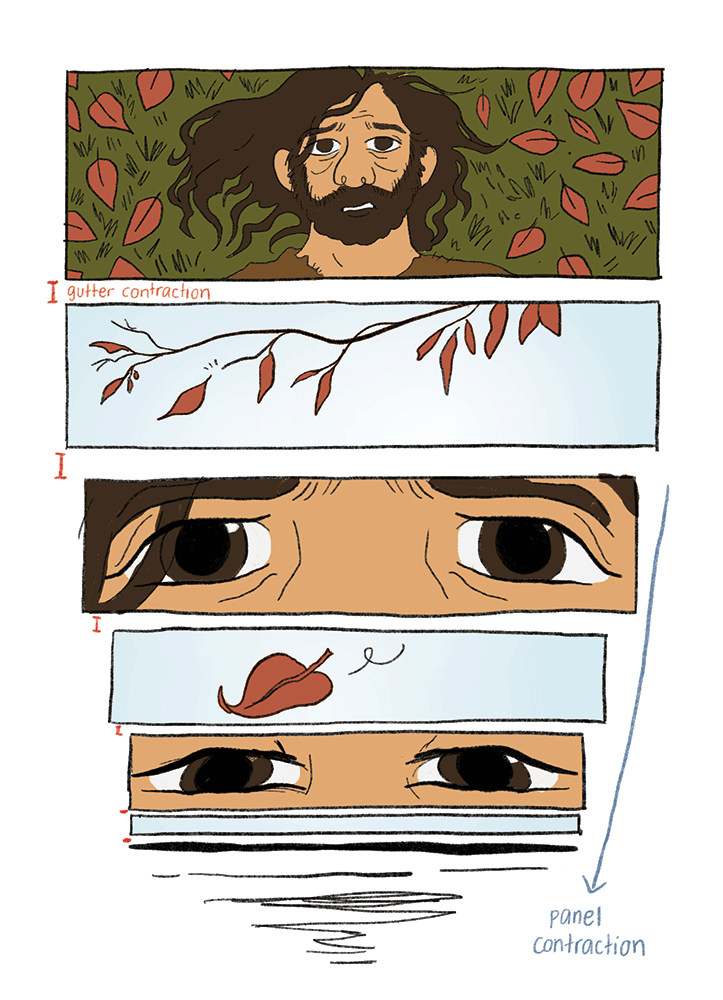
A man lays on the ground. A leaf breaks away from its branch and descends, as the man succumbs to unconsciousness. The gutter and panel contract to evoke the physical sensation of eyes closing and the loss of consciousness.
A Note on Gutter Size:
Gutter size often determines a panel’s relation to each other and therefore, the flow, especially in manga. The closer two sets of panels are, the stronger is their relationship. The panel with the smallest distance from the previous panel is the one that should be read next.

Pay attention to how Panel 1’s gutter is closer to Panel 2, Panel 2 to 3, then Panel 3 to 4, working together with the art and speech bubbles to subtly guide the reading flow.


