
50+ Sales Statistics: Benchmarks, Trends & Data (2026)
Last updated: March 2026
Global B2B ecommerce has reached $20.9 trillion, 80% of sales require 5 or more follow-ups, and top-performing sales reps are 2.7x more likely to use AI. Here are 100+ sales statistics covering market size, benchmarks, cold outreach, CRM, AI adoption, and remote selling for 2026.
Key Sales Statistics (2026)
- Global B2B ecommerce: $20.9 trillion (Statista)
- Average B2B sales cycle: 84 days (Salesforce)
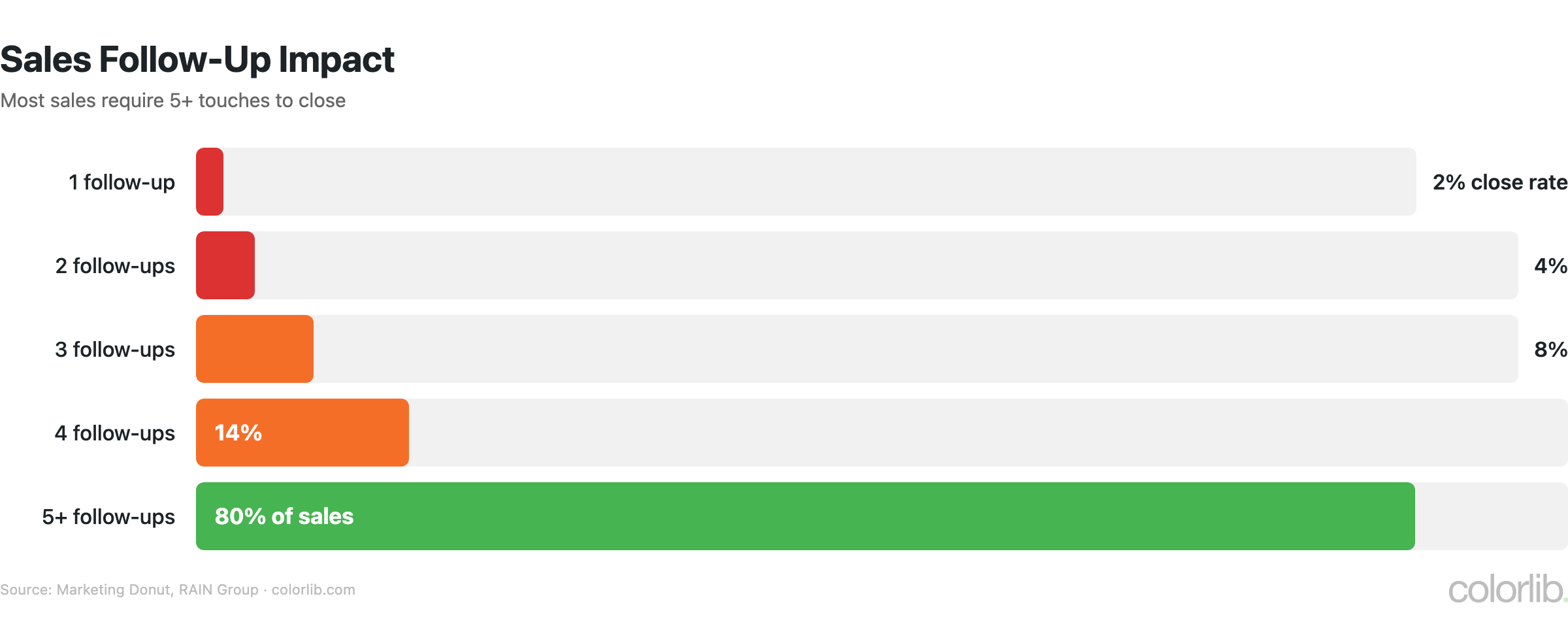
- 80% of sales require 5+ follow-ups (Invesp)
- Top performers 2.7x more likely to use AI tools (Salesforce)
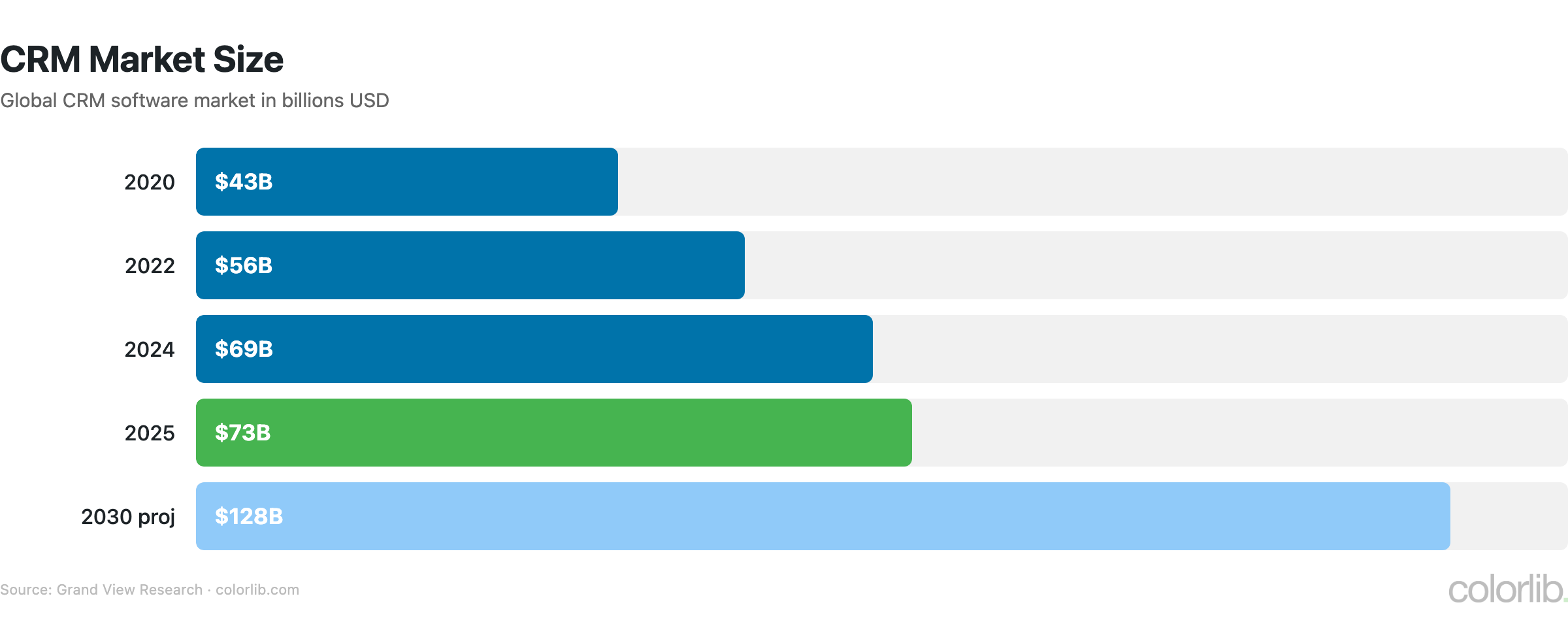
- CRM market: $73 billion (Grand View Research)
- 71% of buyers prefer a rep-free experience (Gartner)
- Average sales win rate: 21% (Salesforce)
- Sales rep quota attainment: 52% (Salesforce)
Sales Market Overview
| Metric | Value | Source |
|---|---|---|
| Global B2B ecommerce | $20.9 trillion | Statista |
| CRM market size | $73 billion | Grand View Research |
| Sales enablement market | $3.2 billion | Grand View Research |
| Sales intelligence market | $5.6 billion | MarketsandMarkets |
| US sales professionals | 5.7 million | BLS |
| Average base salary (US sales rep) | $60,000 | Glassdoor |
| Average OTE (Account Executive) | $130,000-$180,000 | RepVue |
| Sales tech stack per rep | 10+ tools | Salesforce |
- B2B ecommerce at $20.9 trillion is roughly 3x larger than B2C ecommerce — a fact that surprises most people
- The average sales rep uses 10+ tools daily, up from 5-6 in 2020, contributing to tool fatigue and CRM underutilization
- Sales rep turnover averages 35%, with the average ramp time for a new rep being 3.2 months
- The CRM market is dominated by Salesforce (23% share), followed by Microsoft Dynamics (5.8%) and HubSpot (5.2%)
- Inside sales has grown to represent 46% of all B2B sales roles, up from 30% pre-pandemic
Sales Metrics & Benchmarks
| Metric | Value | Source |
|---|---|---|
| Average win rate | 21% | Salesforce |
| Sales rep quota attainment | 52% | Salesforce |
| Average B2B sales cycle | 84 days | Salesforce |
| Follow-ups needed to close | 5+ (80% of sales) | Invesp |
| Reps who give up after 1 follow-up | 44% | Invesp |
| Average deal size (B2B SaaS) | $25,000-$50,000 | RepVue |
| Pipeline-to-close ratio | 3:1 to 5:1 | Salesforce |
| Average activities per closed deal | 8-12 touchpoints | Gong |
- Only 52% of reps hit quota — meaning nearly half of sales teams underperform their targets
- 44% of reps give up after one follow-up, despite 80% of deals requiring 5+ touches to close
- The best day to make sales calls is Wednesday, with the best time window being 4:00-5:00 PM local time
- Deals involving multiple stakeholders have a 31% lower win rate but 3x higher deal values
- Sales cycles have lengthened by 22% since 2020, driven by more decision-makers and tighter budgets
Cold Outreach Statistics
| Metric | Value | Source |
|---|---|---|
| Average cold email response rate | 1-5% | Mailshake |
| Cold call connection rate | 2-3% | Gong |
| Cold calls needed per meeting | 209 | ZoomInfo |
| Email open rate (sales outreach) | 24% | Mailshake |
| Personalized emails response boost | 32% higher | Outreach |
| LinkedIn InMail response rate | 10-25% | |
| Multi-channel outreach lift | 2x higher reply | Outreach |
| Best email length for replies | 50-125 words | Lavender |
- It takes an average of 209 cold calls to book a single meeting — making cold calling the least efficient outreach method
- Personalized cold emails (company name, role, pain point) achieve 32% higher response rates than generic templates
- LinkedIn InMail outperforms cold email with 10-25% response rates, especially for reaching director+ level contacts
- 57% of C-level buyers prefer to be contacted by phone, while managers and individual contributors prefer email
- Multi-channel sequences (email + LinkedIn + phone) produce 2x higher reply rates than single-channel outreach
- The optimal cold email is 50-125 words — shorter emails get 40% higher response rates than emails over 200 words
CRM & Sales Technology
| Metric | Value | Source |
|---|---|---|
| CRM market size | $73 billion | Grand View Research |
| CRM adoption rate | 91% (companies 10+ employees) | Grand View Research |
| CRM ROI | $8.71 per $1 spent | Nucleus Research |
| Salesforce market share | 23% | IDC |
| CRM data quality issues | 30% of data decays annually | ZoomInfo |
| Sales reps time on selling | Only 28% | Salesforce |
| Sales reps time on admin/CRM | 22% | Salesforce |
| Sales tech spend per rep | $5,000-$15,000/year | Forrester |
- Sales reps spend only 28% of their time actually selling — the rest goes to admin tasks, CRM updates, meetings, and email
- CRM delivers $8.71 return for every $1 invested, making it one of the highest-ROI enterprise software categories
- 30% of CRM data decays every year (people change jobs, companies merge), requiring constant maintenance
- Companies that use CRM effectively see 29% higher revenue growth than those with poor CRM adoption
- Despite 91% adoption, 43% of CRM users say they use less than half of their CRM’s features
AI in Sales
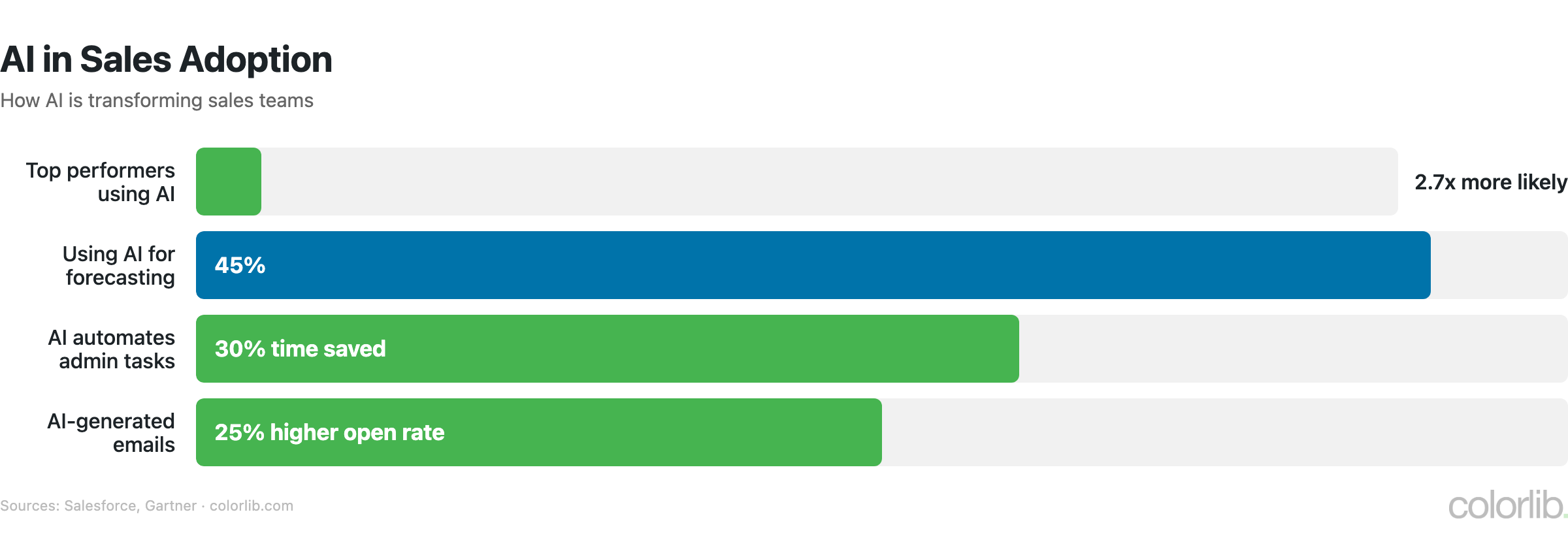
| Metric | Value | Source |
|---|---|---|
| Top performers using AI | 2.7x more likely | Salesforce |
| AI adoption in sales teams | 69% | Salesforce |
| AI time savings (per rep/week) | 5+ hours | HubSpot |
| AI forecasting accuracy improvement | 50% more accurate | Gong |
| AI-generated email personalization | 41% higher open rates | Lavender |
| Conversation intelligence adoption | 45% of sales teams | Gong |
| AI-assisted deal prioritization | 28% higher win rates | Salesforce |
- Top-performing sales reps are 2.7x more likely to use AI tools — the correlation between AI adoption and performance is clear
- AI saves the average sales rep 5+ hours per week on email writing, research, CRM updates, and meeting prep
- Conversation intelligence tools (Gong, Chorus) analyze 100% of calls vs. the 1-2% that managers could manually review
- AI-powered sales forecasting is 50% more accurate than human judgment alone
- 42% of sales leaders say AI is their top technology priority for the next 12 months
Remote Selling Statistics
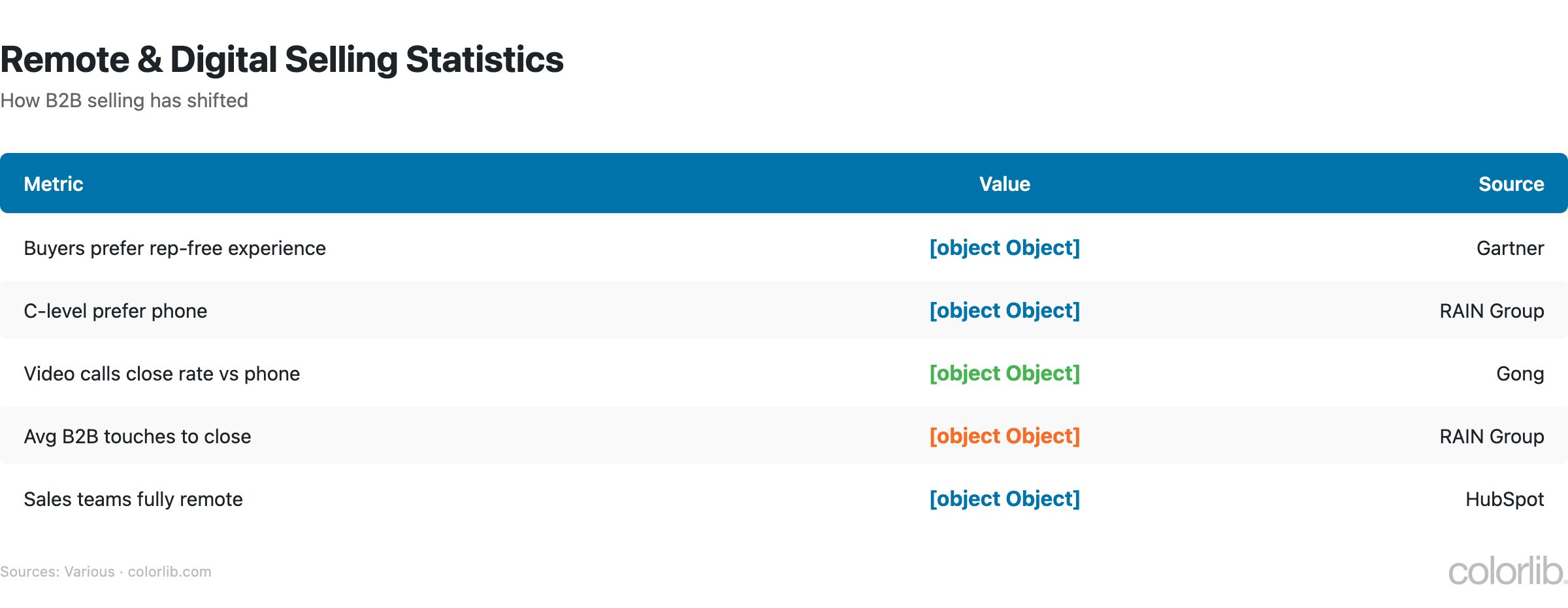
| Metric | Value | Source |
|---|---|---|
| Buyers who prefer remote interaction | 71% | Gartner |
| B2B revenue from digital channels | 43% | McKinsey |
| Sales reps working remotely / hybrid | 64% | HubSpot |
| Video meeting effectiveness vs. phone | 2x higher close rate | Gong |
| C-level buyers preferring phone | 57% | RAIN Group |
| Average video sales call duration | 35 minutes | Gong |
| Self-service purchasing preference | 71% want rep-free experience | Gartner |
- 71% of B2B buyers now prefer a rep-free purchasing experience — the shift toward self-service is accelerating
- Video meetings close deals at 2x the rate of phone calls — yet 37% of reps still default to audio-only
- Despite the self-service trend, 57% of C-level executives still prefer phone contact for complex, high-value purchases
- Remote sales reps who block 2+ hours daily for prospecting outperform peers by 63%
- Digital sales rooms (shared spaces with content, proposals, contracts) increase close rates by 32% by keeping all stakeholders aligned
Key Takeaways
- Most reps miss quota. Only 52% hit their targets. The gap between top performers and the rest is widening, largely driven by technology adoption.
- Follow-up is everything. 80% of sales need 5+ touches, but 44% of reps give up after one. Persistence, not talent, separates winners.
- AI is the new unfair advantage. Top performers are 2.7x more likely to use AI. It saves 5+ hours/week and improves forecasting by 50%.
- Buyers want self-service. 71% prefer a rep-free experience. Sales teams must shift from gatekeeping to guiding.
- CRM is essential but underused. $73B market, 91% adoption, $8.71 ROI per $1. Yet 43% of users leverage less than half its features.
- Multi-channel outreach wins. Email + LinkedIn + phone = 2x reply rates. LinkedIn InMail (10-25%) outperforms cold email (1-5%) for B2B prospecting.
Sources
- Salesforce — State of Sales Report
- Gartner — Future of Sales Research
- Gong — Revenue Intelligence Reports
- Grand View Research — CRM Market Analysis
- Invesp — Sales Follow-Up Statistics
- McKinsey — B2B Digital Sales Research
- Nucleus Research — CRM ROI Study
- RepVue — Sales Compensation Data
- Lavender — Email Effectiveness Research
- Statista — B2B Ecommerce Market Size
Frequently Asked Questions
What is the average sales win rate?
The average B2B sales win rate is 21%, meaning roughly 1 in 5 qualified opportunities converts to a closed deal. Top-performing teams achieve 30%+ win rates. The pipeline-to-close ratio is typically 3:1 to 5:1, meaning you need $3-5M in pipeline to close $1M in revenue. Win rates vary by deal size — smaller deals close at higher rates, while enterprise deals above $100K often close below 15%.
How many follow-ups does it take to close a sale?
80% of sales require 5 or more follow-ups to close. Despite this, 44% of sales reps give up after just one follow-up. The average closed deal involves 8-12 touchpoints across multiple channels (email, phone, LinkedIn, meetings). Persistence is the single biggest differentiator between top performers and average reps. For more on outreach effectiveness, see our lead generation statistics.
How is AI changing sales?
AI is transforming every stage of the sales process. 69% of sales teams now use AI tools, and top performers are 2.7x more likely to leverage them. Key applications include: AI email writing (41% higher open rates), conversation intelligence (analyzing 100% of calls), predictive forecasting (50% more accurate), and deal prioritization (28% higher win rates). AI saves reps 5+ hours per week on administrative tasks.
Do B2B buyers still want to talk to sales reps?
It depends on the buyer level and purchase complexity. 71% of B2B buyers prefer a rep-free, self-service experience for straightforward purchases (Gartner). However, 57% of C-level executives still prefer phone conversations for complex, high-value deals. The trend is clear: sales reps need to shift from information gatekeepers to strategic advisors who add value that self-service cannot. For related insights, explore our digital marketing statistics.
For more business data, explore our lead generation statistics, digital marketing statistics, and online shopping statistics.

Related Posts


Comments (0)