


Accelerating an Ecosystem | October 2021
The potential for meaningful climate impact through materials that serve as carbon sinks now gives such materials a clear advantage, with the potential to reverse the climate profile of buildings from a leading driver of carbon emissions to carbon reservoirs that can help reverse it.
Authors
The research team from the Carbon Leadership Forum at the University of Washington College of Built Environments:
- Julie Kriegh, PhD, AIA, Research Scientist, Carbon Leadership Forum, Department of Architecture, College of Built Environments, University of Washington, Principal and founder of Kriegh Architecture Studios | Design + Research.
- Chris Magwood, Director, Endeavor Center, The Sustainable Building School, Peterborough, Ontario, Canada.
- Wil Srubar III, PhD, Associate Professor, University of Colorado Boulder, Civil, Environmental and Architectural Engineering, Materials Science and Engineering Program.
- Meghan Lewis, Senior Researcher, Carbon Leadership Forum, Department of Architecture, College of Built Environments, University of Washington.
- Kate Simonen, AIA, SE, Executive Director, Carbon Leadership Forum, Department of Architecture, College of Built Environments, University of Washington.
Author contributions: Writing – original draft: J.K., C.M. and W.S.; writing – review and editing: J.K., M.L., C.M., K.S., W.S.; conceptualization: J.K, C.M., K.S., W.S.; methodology: J.K., C.M., W.S.; funding acquisition: J.K. and K.S.; project manager and administration: J.K.; visualization: J.K.
Version: December 2021
Acknowledgments
The research team would like to thank Microsoft for funding this research and the following individuals:
- Sean James, Microsoft, Director of Datacenter Research for commissioning the project.
- Ben Stanley, WSP Sustainability, Energy and Climate Change consultant and project manager and the WSP team member Ryan Dick for their support of the project.
The research team would like to thank Monica Huang for help in preparing this publication and Andrew Himes for preparing the website publication.

Citation
Kriegh, J., Magwood, C., Srubar, W., Lewis, M., Simonen, K. (2021). Transformative Carbon-Storing Materials: Accelerating an Ecosystem Report. https://hdl.handle.net/1773/48126
Copyright
The Transformative Carbon-Storing Materials: Accelerating an Ecosystem Report is licensed under a Creative Commons Attribution 4.0 International License.
Cover image: Shutterstock
Appendix 2: IDEA lab
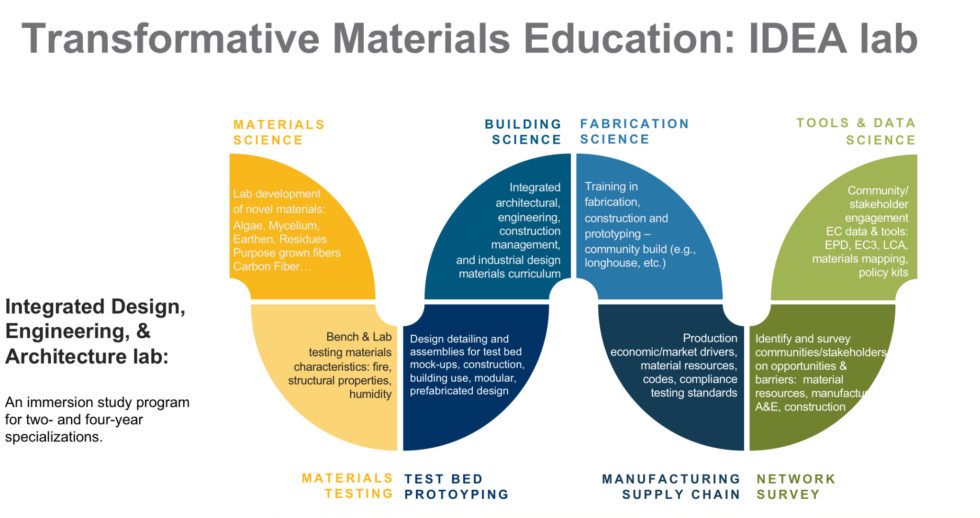
The IDEA lab is adapted from proposals by Drs. Lee, Kriegh, and Dossick (UW College of Built Environments);
Dr. Srubar (UC Boulder); and ED. Magwood (Endeavor Center) that were initiated in early 2021.