


Summary Report | February 2021
The Intergovernmental Panel on Climate Change (IPCC): “Limiting warming to 1.5 degrees C will require removing carbon from the atmosphere in addition to reducing emissions.”
Authors
The research team from the Carbon Leadership Forum at the University of Washington College of Built Environments:
- Julie Kriegh, PhD, AIA, Research Scientist, Carbon Leadership Forum, Department of Architecture, College of Built Environments, University of Washington.
- Chris Magwood, Director, Endeavor Center, The Sustainable Building School, Peterborough, Ontario, Canada.
- Wil Srubar III, PhD, Associate Professor, University of Colorado Boulder, Civil, Environmental and Architectural Engineering, Materials Science and Engineering Program.
Version: February, 2021
Acknowledgments
The research team would like to thank Microsoft for funding this research and the following individuals: Danielle Decatur, Microsoft, Principal Program Manager of Datacenter Sustainability; Sean James, Microsoft, Director of Datacenter Research; Ben Stanley, WSP Sustainability, Energy and Climate Change consultant and project manager and the WSP team Sebastian Danio-Beck, Ryan Dick, Sarah Buffaloe, and Lama Bitar for their work on the project including the WBLCA and technical support; Kurt Swensson, PhD, PE, KSi structural engineering consultant for his work on the data center engineering models and specifications review; Monica Huang, Research Engineer, and Brook Waldman, researcher and consultant with the Carbon Leadership Forum for their assistance in preparing this report.
Citation
Kriegh, J., Magwood, C., Srubar, W. (2021). Carbon-Storing Materials: Summary Report.
A carbon-positive future in three to five years?
The Carbon Leadership Forum at the University of Washington has recently completed a four-month research project with a major US tech company to understand the potential of using low-carbon and carbon-storing materials in new construction. The project focused on carbon-intensive hotspot materials (e.g., concrete foundations and slab floors, insulated roof and wall panels, and structural framing) in light industrial buildings.
The study found that a sizable reduction (~60%) in embodied carbon is possible in two to three years by bringing readily-available low-carbon materials into wider use. Furthermore, this work predicts that fostering a carbon-storing material supply system by investing in the development and manufacturing of nascent carbon-storing materials industries will make a carbon-positive future for individual projects possible in three to five years (see Figure 1).
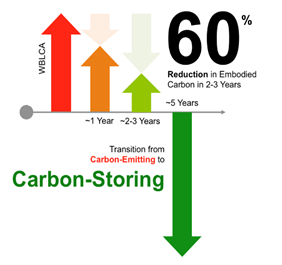
Figure 1. Potential carbon reductions (credit: Wil Srubar).