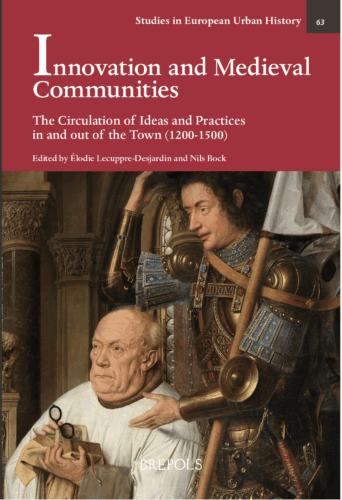
Innovation and Medieval communities. The circulation of Ideas and practices in and out of the town (1200-1500).
This collective work edited by Élodie Lecuppre-Desjardin and Nils Bock, was published in January 2026 in the series Studies in European Urban History [SEUH 63] by Brepols.
Description
It has to be said that when it came to innovation medieval culture demonstrated its mastery of the art of the paradox. Medieval people were compelled to innovate, driven by the dissatisfaction that is part of their nature, leading to changes that could generate not only enthusiasm, but also mistrust and sometimes fear. In a world where innovation was ordinarily perceived in a negative light, societies developed discursive strategies to legitimize such developments, even going so far as to make the old out of the new. This book interrogates this gap between cultural assumptions and practical necessity. Drawing on numerous examples from the towns and cities of Western Europe between the thirteenth and the fifteenth centuries, it examines in context and in practice both sophisticated conceptions and unexamined habits of thought concerning innovation. These offered a range of possibilities for dealing with the new, often imposing novelty quietly, as the only means of maintaining the old state of affairs… at least in appearance.
Table of contents
Introduction – Élodie Lecuppre-Desjardin (Lille University, IRHiS) & Nils Bock (Münster University)
PART 1. Mastering Innovation: Communities and Individuals
Municipal law in the monastery. On becoming and being citizens in the later Middle Ages -Anne Diekjobst (Kiel University CAU)
Burghers’ reactions to new town books in Southwestern Germany in the Late Middle Ages – Olivier Richard (Fribourg University)
Innovation and ways of relating to time in memory writings by German townspeople at the dawn of the Early Modern Period – Aude-Marie Certin (Haute Alsace University)
Innovation in the Great Municipal Charter of Paris (1416) – Boris Bove (Rouen-Normandie University)
PART 2. Technological innovation at the heart of the circulation of knowledge and political intentions
Innovations catalysed by the papal court and the reconfiguration of local communities in and around early 14th-century Avignon – Valérie Theis (ENS Ulm, Paris)
The dukes of Burgundy’s Trésor de l’Épargne and reactions to it within princely administration – Rudi Beaulant (Franche-Comté University)
Technological innovation, social identities and the Dynastic State. Gunpowder Artillery in the Burgundian Polity (late 14th– early 16th c.) – Michael Depreter (University of Oxford)
Innovation and migration: The Economic impact of immigrant craftspeople in Late Medieval England – Bart Lambert (Vrije University of Brussels)
Social incentives for innovation in Flemish artistic workshops: Social Network Analysis in late medieval art production – Joannes Van den Maagdenberg (UGent-ULB-Fondation Périer-d’Ieteren)
Plague Policies in the Fifteenth-Century Low Countries: Duplication, adaptation and Integration – Claire Weeda (Leiden University)
PART 3. Think different: pioneering ideas from artists and scholars
Ecclesiological Innovations in the days of the Reform Councils of the Fifteenth-Century – Bénédicte Sère (Paris Nanterre University)
Mediaeval sacred song: creative impulses and innovation in repertoire, musical notation and transmission – Kristin Hoefener (University Nova of Lisbon, Centro de Estudos de Sociologia e Estética Musical)
“A desire to see more clearly”: theological device and sociological innovation of scholars in thirteenth-fifteenth centuries – Antoine Destemberg (Artois University)
Van Eyck’s Fictive Frames and Reinventions of Memorialisation – Andrew Murray (The Open University)
More Information
Élodie Lecuppre-Desjardin & Nils Bock (eds.), Innovation and Medieval communities. The circulation of Ideas and practices in and out of the town (1200-1500, Turnhout: Brepols, 2026.