
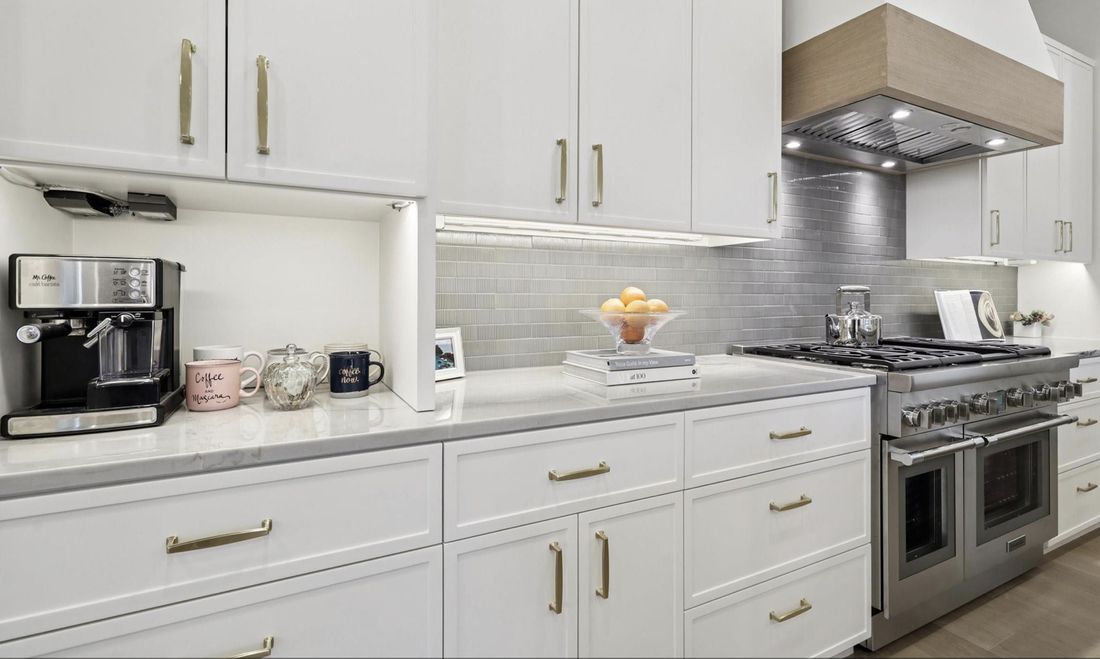
Two kitchens can look identical in a showroom. Same door style, same colour, same handles, same quiet click when you close a drawer. Three years later, in two different houses, they do not look identical at all.
The difference is almost never the part you were looking at. It is the box behind the door, the glide under the drawer, and how the finish was applied. None of that is visible from the front, which is exactly why it is worth knowing what to check.
Here is what we would look at, in order.
1. What the box is made of
This is the single biggest difference between cabinets that age well and cabinets that do not.
A cabinet box is either plywood or particleboard. Plywood is layers of real wood, cross-grained and glued. Particleboard is wood dust and resin pressed into a sheet. From the outside, with a finish on, they can look the same.
They do not behave the same. Plywood holds a screw — which matters enormously, because your wall cabinets are held up by screws and your hinges are held on by them. Particleboard holds a screw until something works loose, and then it crumbles around it. Plywood also tolerates moisture far better. Particleboard that gets properly wet swells, and it does not go back.
In a kitchen there is a dishwasher, a sink and a refrigerator. Something will leak eventually. The question is only whether the cabinet survives it.
Everything we carry is solid-wood plywood. We are not neutral on this, and we would rather say so plainly than pretend it is a matter of taste.
2. Whether a waterproof option is available
For the cabinets that take the most punishment — under a sink, in a laundry, in a bathroom — marine-grade plywood is worth asking about. It is built to handle water rather than merely tolerate it.
Most people do not need it throughout a kitchen. Most would benefit from it in two or three specific places. It is the sort of thing you only think about after something has gone wrong, so raise it before you order.
3. How far the drawers actually open
Pull a drawer out in a showroom. All the way out.
A full-opening drawer — you may see it called full-extension — comes out far enough that you can see and reach the back of it. A three-quarter drawer stops short, and the last third stays in the cabinet permanently.
That back third is real storage you have paid for and will never comfortably use. In a deep base cabinet it can be six or eight inches of drawer that only ever holds the things you have forgotten about.
Full-opening drawers are standard on everything we supply. On plenty of cabinets they are not standard, and they are not always mentioned unless you ask.
4. Whether soft-close is standard or an upcharge
Soft-close hinges and glides catch a door or drawer at the end of its travel and pull it closed quietly instead of letting it slam.
This sounds like a luxury and is actually a longevity feature. A slammed door puts load through the hinge and the box every single time. Over years, that is what loosens things.
The question to ask is not whether soft-close is available. It usually is. The question is whether it is standard or whether it is priced per door and per drawer on top of what you were quoted. On a full kitchen, that distinction can be significant. Ours is standard throughout, on every line.
5. How the finish was applied
A factory finish and a site finish are not the same thing, even when the colour matches exactly.
Factory-applied paint and stain are sprayed in controlled conditions and then cured — heat-treated so the finish hardens properly. The result is more even, more durable, and considerably more resistant to the knocks a kitchen delivers.
A finish applied on site is at the mercy of dust, humidity and whatever else is happening in the house that week. Houston humidity is not a gentle environment for a drying finish.
Everything we supply is factory-finished and cured before it reaches you.
Four things to do in any showroom
You do not need to be an expert to pressure-test a cabinet. You need about ninety seconds.
- Open a drawer all the way. Does it come out fully, or does it stop short?
- Look at the back and underside of a box. Is it layered wood, or compressed dust? Unfinished edges tell you quickly.
- Close a door without holding it. Does it catch and ease shut, or does it bang?
- Ask what is standard and what is an upcharge. Then ask for the quote to show it either way.
Why we are telling you this
Every one of these checks is one we would pass, so there is obvious self-interest in publishing them. They are also the checks we would want our own family to make, including at a competitor.
If you would rather run them on something physical than a photograph, the showroom on Hempstead Road has boxes you can open and doors you can shut. Book a free consultation, or look at the styles we build first.
Still deciding between flat-pack and made to order? Start with RTA, semi-custom or full-custom: which cabinets do you actually need? — construction is the same across all three, so that choice is about time and flexibility, not quality.


Leave A Comment