
Layne Norton and Greg Nuckols are two very well established powerlifters that are always putting out quality free information to help you get stronger. Here are two of their more recent videos that I thought were very informative and easy to follow along. Check them out!
The Steps to a Better Program
Understanding the basics of how to design a program is crucial to continue your progress in the gym and to prevent future plateaus in your lifts. I think the vast majority of people just put a bunch of exercises they like to do in some orderly fashion and just do the exercises with no real progression in mind or how much volume they are doing or how many times they do that exercise a week. Really setting up a program can be broken down into 4 main categories:
- Volume/Intensity Ratio
- Frequency
- Exercise Selection
- Program Goals
I will go into greater detail on what each of these may entail and how to manipulate them to fit your needs based on where you are in your training (offseason vs. peaking/meet prep). As this is also crucial to how you approach your training to peak for the platform or build the solid foundation to get stronger in the offseason.
Volume and Intensity Ratio:
Volume is simply defined as the product of reps, sets, and load (Load x Reps x Sets = Volume). Intensity is just a percentage of your one (two or three depending on your preference) rep max (%1RM). Volume and intensity work in an inverse relationship meaning that if volume increases, intensity will decrease and vice versa. Makes sense right? You are not going to be to do sets of ten with 95% of your 1RM. If you want to work under some heavier loads then you may have to drop off your volume a bit to be able to recover from the increased intensity. Now one could argue that we could do a very large amount of sets at very low reps at high load but that will be discussed further when we talk about goals of the program.
Frequency:
Frequency is defined as how many times a week is the exercise being performed. In my opinion, frequency is probably the biggest downfall of most lifters in the gym when they set up their own programming. We know in exercise science that in order to keep protein synthesis evaluated in a muscle we need to continually keep the muscle stimulated. Also, I would like to note that you if you wanted to become really good at basketball you wouldn’t go to open gym to shoot hoops once a week would you? So if you want to be a great lifter why would you train your lifts only once a week, makes no sense to me. There are many ways to split up your training frequency; I personally like full body only because that is how I would perform the lifts in a meet. But push-pull or upper-lower are both respectable ways of splitting things up.
Exercise Selection:
Exercise selection is just what exercises will you being using on your program. Obviously for powerlifting the squat, bench press and deadlift will have to be included because as a powerlifter, getting stronger at those lifts will result in a better total on the platform. Here is where there is room for variation. As previously stated, the 3 main lifts should be the focal point of your training but outside of those your individual weak points should the next priority in your program. This is where accessory lifts and any variations of your competition lifts should come in.
Program Goals:
I think this is probably the most important part of designing a program. All good programs have one thing in common; they make you do more work! Any combination of the above characteristics can allow you to increase the amount of work you do in the gym. But, understanding what your goals are for that training block is crucial to how you apply those characteristics. You have to ask yourself the question, what am I trying to accomplish with this? Do I want to focus on hypertrophy, strength, or power? Am I peaking for a meet or am I off-season working on weak points and building a foundation? All these questions are things to consider when writing your program.
Off-season Training:
I want to start of this section with saying VOLUME is the most important aspect to building muscle mass. Accumulating volume should be the main focus of your training in your off-season. Although size does not equate strength, a bigger always has the potential to be a stronger muscle. Putting on quality mass is important for any powerlifter/athlete who wants to improve their performance. Frequency in my opinion for the three lifts in order of most frequent to least frequent goes; bench press, squat then, deadlift. Most people take a bit longer to recover from deadlifts than the other two lifts. Most Russian and Bulgarian lifting programs have a very high frequency and they’ve been pretty damn strong throughout history so it must be doing something right. Exercise selection goes as follows; the further you are away from competition the more variety you can have in your training. Offseason work should be focused on weaknesses and bringing up weak points but also keeping your strong points strong. Don’t be afraid to try new movements, variations of lifts, accommodating resistance etc. If it’s within reason and it has carry over to your competition lifts you will get stronger. Program goals should be less focused on higher intensity and more about accumulating volume (mainly focusing on hypertrophy work) and building quality muscle mass to get you bigger and stronger for peaking time.
Peaking/Meet Prep:
Peaking for a meet is pretty much the exact opposite of your offseason work. The volume will decrease and intensity will increase in order for your body to prepare itself for maximal loading. Exercise selection specificity will be more focused on your competition style lifts. The programs goals will be focused on a higher intensity to peak your offseason strength to be ready to perform on the platform.
Welcome to MasterMinds Training

All of you might be wondering what MasterMinds Training is all about. Masterminds Training was started by 3 personal trainers in Rochester, NY. Our vision is to make a major impact on as many lives as possible. Before I get any further let me tell you what “MasterMinds” is all about.
Take the “Training” out of “MasterMinds Training” because what we believe in does not have to be related to training at all. Not everyone wants to be a professional bodybuilder, powerlifter or athlete and that is perfectly fine. Everyone has their own dreams and we want to instill the right mentality so that no matter what one person wants to achieve, they can! Think about when your mom or dad said you could be whatever you want when you grow up well we are taking that very seriously right now. Everyone has that big dream or vision for themselves of…
View original post 308 more words
Girls Who Powerlift
You think powerlifting is just for guys? Powerlifting as of recent has become a rapid growing sport but the most impressive part of this growth is the amount of women getting involved. Personally, I think it is awesome to see. Girls who want to lift heavy, get chalk on their hands, and get that ever distinct feeling of smashing PRs on the platform are good in my books. I have the privilege of experiencing this each time I try train because my training partner (a girl) is a competitive powerlifter.
Even though most women would shy away from this style of training, I think that all women that can perform the power movements should have them in their training. We see a lot of benefits from women lifting heavy weights (or just regular exercise). It reduces the rest of bone demineralization (osteoporosis), lowering you risk of certain cancers (including breast cancer), increases insulin sensitivity, metabolic functions, and improves mobility. Obviously it increases muscle mass and strength but, I think heavy squatting and deadlifting in particular are extremely beneficial to build up the abdominals, spinal erectors (including the lower back), and that ass (not only for it to look nice but, having strong glutes are important for protecting the lumbar spine).
So I included the two videos that inspired me to write this quick post of my training partner (my girlfriend) lifting at a few gyms when we went to on our Florida trip together in December. Just to give you some insight on a girl busting her ass in gym to be the strong women she wants to become.
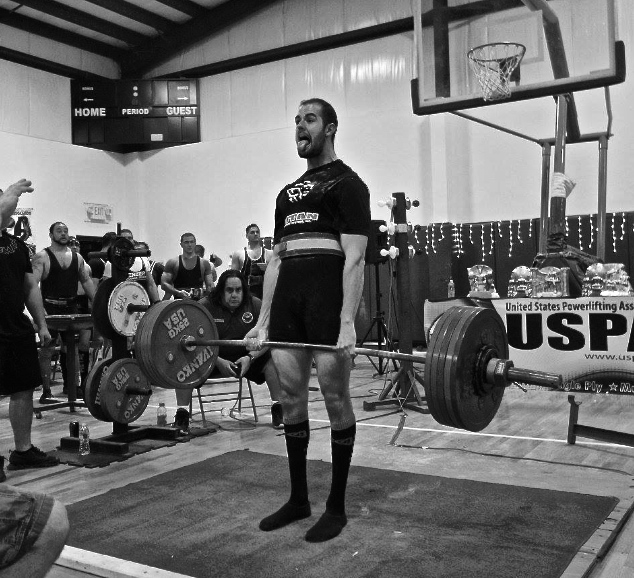
My Deadlift Progression
The video above shows the progress I have made meet to meet over the course of about two and half months (I should mention that in all of these lifts I am less than 200 pounds bodyweight). I’ve added over 20 pounds to my deadlift in that span (I went for something that I know would be challenging in the USPA meet but, I know I can pull 610-ish easily) and many people ask me what I do/did to increase my pull. First off, I should say the deadlift is my best lift and I have always been very strong at it but, I will clue you in on exactly what I did leading into each meet. For RPS in August 2014 I was using an auto regulated Wendler’s 5/3/1 template put out by Bryce Lewis’s powerlifting coaching service “The Strength Athlete” (you can find it here: http://thestrengthathlete.com/freebies/). It only provides you with a protocol for the main lifts so you need to add your own accessories based on your goals and/or weak points. But, for the deadlift my accessories included:
- Deficit Deadlifts (2 to 4 inches) – on the days I wasn’t pulling off the floor
- Weighted Chin/Pull-ups
- Hip Thrusts
After my RPS meet I decided that I needed something different in terms of my training/programming. DUP (Daily Undulating Periodization) was/is the popular programming methodology being used so I decided to hop on the bandwagon and give it a try. I was pulling twice a week on this new program, once off the floor and once off 3-4 inch blocks (accessory work was pretty much the same minus the deficit pulls). Then, just once a week off the floor 4 weeks out from the meet. They were heavy and they were hard as hell. But I know that all those reps and sets are the reason I was even able to break 622 off the ground… Maybe one I’ll be able to pull like my idol Pete Rubish.
An Easy Way to Knowledge Gains
I know it has been awhile since I’ve updated the site but now that I have some time I would like to share with you some excellent and easy sources to get quality information. Below, I am going to list some Youtube that regularly put out great information to help you become a better lifter. I personally watch all these channels and take advantage of the quality information they are putting out.
- Biolayne
- CanditoTrainingHQ
- Cody Lefever (GZCL)
- Bryce Lewis
- icecream4PRs
- JuggernautFitnessTV
- Kelly Starett
- Massthetics
- Michael Tuchscherer
- OmarIsuf
- PowerliftingToWin
- Renaissance Periodization
- Team3DMJ
- Tony Montgomery
That seems like a lot but, believe me I watch plenty more. Whether it’s just motivation or learning quality information, all of these channels can benefit everyone and can help grow your knowledge in and outside the gym. Most, if not all of these guys have been under the bar much longer than I have so they have plenty to offer. If you’re a powerlifting/gym nerd like me then you will definitely have fun listening to these guys, so check them out!
8 Days Out
Full Lower Body Day
Deadlifts:
Top Set: 440 lbs. x 8 @ RPE 9
Backoff sets: 420 lbs.
Low Bar Squat:
135 x 10
225 x 10
285 x 10
285 x 9
300 x 9
Front Squats:
185 x 5
205 x 5
225 x 5
225 x 5
275 x 1
315 x 1 – Missed
GHR
Calf Raises
Ab Work
Forward Knee Travel in the Squat
When lifters are instructed how to squat correctly, making sure the knee does not pass the toes is one of the main cues that are learned and trained. Essentially, many are taught to pretend to “sit in a chair” when learning how to squat. This cue is a general guideline to prevent a large degree of shear force at the knee joint (caused by forward knee travel). But when restricting the squat to prevent forward knee travel, at what cost is the lifter taking to protect the knee?
In the unrestricted squat, a large degree of forward knee travel (knees passing toes) increases the amount of shear force at the knee joint. That amount of shear force at the knee joint is directly related to the load, which should be expected. If the load increases, so does the amount of force.
In the restricted squat, the exact opposite occurs which sounds great, right? It seems great but, although the restricted squat can reduce the shear force at the knee, it does increase the amount of force placed on the lower back. Also, hip moments increase much faster than knee moments relative to the load when comparing the restricted squat to the unrestricted squat. Meaning that when the load increases, the amount of force on the lower back increases to a greater degree than on the knee when comparing the unrestricted and restricted squat.
Now with that in mind, low back and spine health maybe a bit more important than knee joint health. But in relation to powerlifting, using a restricted or unrestricted squat may depend on individual weak points. For instance, if the lifter has a very strong posterior chain (gluteus maximus and hamstrings), the restricted squat may be the strongest position for this given lifter because they can emphasize more of the force on the stronger muscles (almost like looking at the difference in the high and low bar squat). But, simply taking a wider stance maybe the answer to prevent both of the issues listed above. With a wider stance, forward knee travel can be minimized without inducing a greater degree of force at the low back because it allows the lifter to maintain a smaller joint angle at the knee (just like the restricted squat) without anterior flexion at the hips (which causes an increased load on the lumbar spine). Again from a powerlifting perspective, a wider stance means less range of motion, which could lead to an increased total.

(Figure shows the difference in knee and hip angles in the Low Bar Back Squat, High Bar Back Squat, and Front Squat.)
In summary, the unrestricted squat will lead to greater activation of the quadriceps but lead to greater force at the knee joint. The restricted squat will lead to greater activation of the hamstrings and gluteus maximus but lead to greater force at the low back. However a lifter chooses to squat will depend on the individual. But knowing that a general guideline could put one in a potentially more harmful position is extremely important to understand when trying teach/learn how to squat. Especially if one is aware that there is an issue with either the low back or knee joint. Being able to adjust can help any lifter squat safer, stronger and more efficient than ever before.
Sources:
Comparison of the angles and corresponding moments in the knee and hip during restricted and unrestricted squats.
Lorenzetti S, Gülay T, Stoop M, List R, Gerber H, Schellenberg F, Stüssi E.
J Strength Cond Res. 2012 Oct;26(10):2829-36.
Rack Pulls
Some overload work including three sets of triples and max effort attempts at 585 and 605 for singles.
 Buffalo Barbell