Tag Archives: Antennas

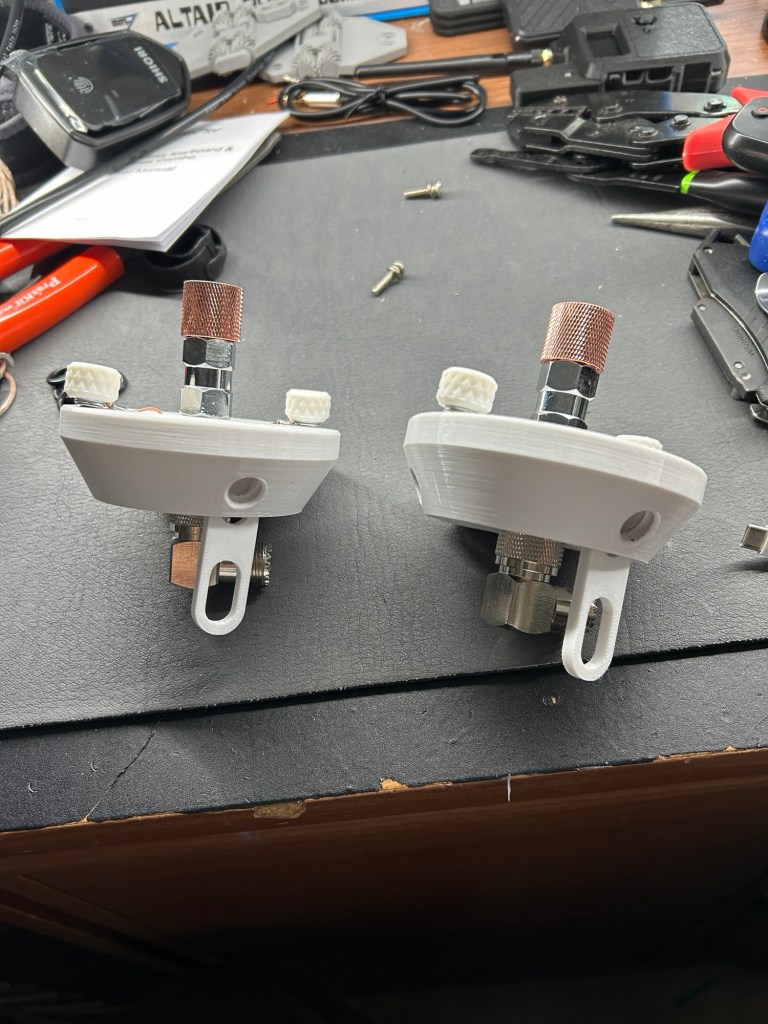
Two polypuck antena tripod hubs

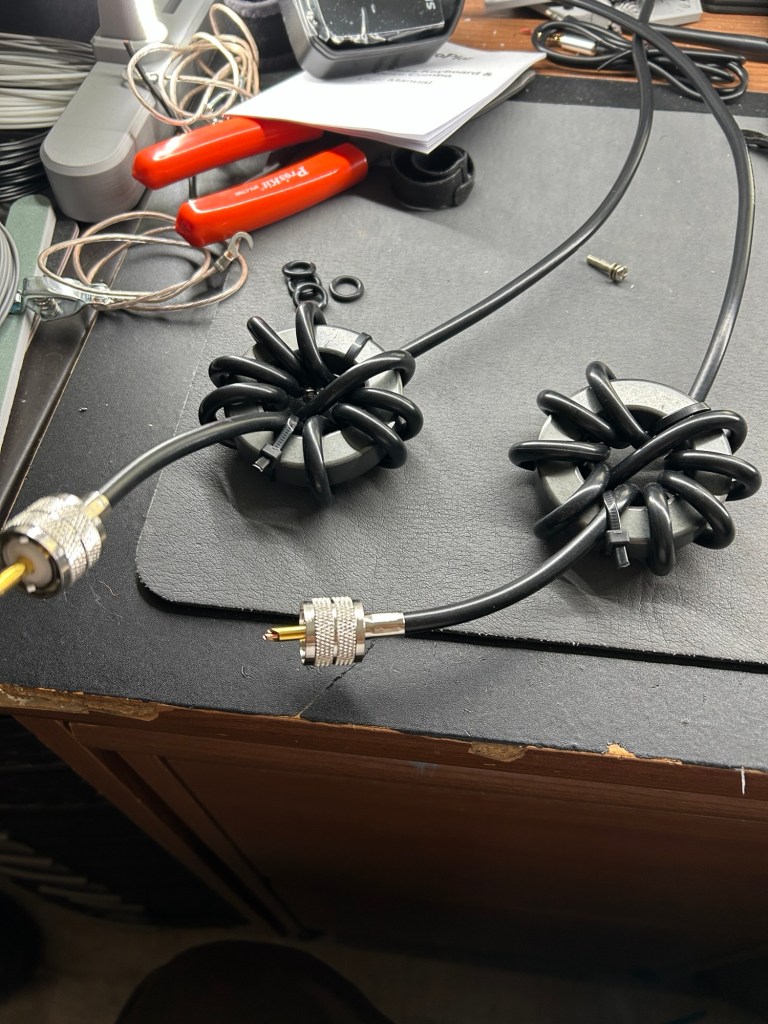
I 3D printed two identical polypuck tripod hubs for use in WSPR experiments. I also made a total of four Rf chokes. Two will be used at the puck feed points and two were installed at the Rf inputs of the zbitx radios in the WSPR lab rack.

Each puck takes three 3/8” aluminum rods as legs. A telescopic whip will allow 20m and up resonant 1/4 wave antenna plus some planned variations. I’ll be using these to compare a 1/4 wave vertical with wire radials versus faraday cloth using these WSPR lab.

Meshtastic Repeater Operational

I setup a solar powered Meshtastic repeater using the “people’s repeater” instructions on printables. This is a nifty design that repurposes a $10 solar spotlight from Lowe’s. Everything works as expected but it is important to fully charge the battery before deploying. The battery drains slightly at night but fully charges during the day. I have the device mounted on my VHF mast up about 10 feet. I’ll raise this higher once I make some changes to the mast I have planned. I also joined RGVmesh channel which has many local enthusiasts exchanging messages from Brownsville up to Los Fresnos.

I’ve also started working on a TinyGS satellite ground station. I just need a 433Mhz antenna that I can mount outside.

WSPR Lab Project

I am going to setup what may prove to be an interesting first project for the WSPR Lab. I plan to setup two JPC-12 vertical antennas one with ground mounted wire radials and the other with a piece of faraday cloth as the ground plane.

Field Day 2026

Well I participated in Field Day this year…just not very long.

I made about a dozen contacts on Saturday afternoon from contest start till about 5pm local time. All were on 20m and most were FT4.

I setup a 1/4 wave vertical on 20m with a 5.6m telescopic whip and four 30 foot radials. This worked really well. I intended to run 50W with an external amplifier but for some reason I could not get it to work. I suspect the finals are bad. I suppose it’s time to learn how to troubleshoot an hf amplifier. I worked with 10w instead power was not an issue with a 100w solar panel.

The bands seemed very bad at the QTH with very few signals were actually heard.

Very little activity on 15m and 10m was dead. I suspect that blanketing was really suppressing propagation this year and I think next year I’ll start working about 4 or 5 pm. Did I mention the heat? 94 degrees and 65% humidity make it very uncomfortable. I packed it in about 4:30pm and met my wife for a late lunch.

I am outside as I write this on Monday. It’s hot humid and hazy due to a plume of Saharan dust but I am setting up my secret weapon…

I’ll look at waterproofing my gear for next field day.

HF Summertime Blanketing

Take a look at some good info on summertime HF blanketing. There is some great advice on how the bands react during Field Day. This explains quite a bit as I have noticed in previous years that propagation on Saturday afternoon tends to be pretty bad especially on 15m and 10m.

Field Day 2026 Begin

Field day is this weekend. I plan to go fairly minimalist this year with the Icom-705 with a 50W amplifier. I will not be running QRP this year. I’ll be using the JPC-12 vertical. It will be interesting to see how my power budget works out on 50W. I’ll use the 10 Ahr battery charged by a 100W solar panel. Everything but the solar panel fits into my backpack. So far the weather forecast looks dry and hot.

I’ll be checking all the components and make sure nothing has degraded or come loose since the last time I worked portable.

Final Results of 2026 CQ WPX Contest

4th in the US operating QRP. I came I in the top 20% globally at 21st. Best performance on this contest yet!

Weedwhacker vs EARCHI Matchbox…

…guess who lost?

The weedwhacker got hold of the PETG Enclosure of the EARCHI end fed matchbox and obliterated it. The internals were intact, but a few connections were broken. I printed a new enclosure from the model I made years ago. I’ve printed it in white PLA this time bit reused the PETG lid which survived the incident. Remounting the toroid and the wiring was a bit of a pain but it when back together largely as before. I installed it back onto the S9 antenna and I’m back in business.

Tomorrow, I plan to install four 30 ft radials and generally clean-up the installation. The wire sets are ready and now I just need some early morning coolness to get some maintenance completed.

The Digitenna

I built a Digitenna from model files provided at printables.com. The reel houses a matching network for an end fed antenna and 10m of wire.

First Tests of WSPR Lab

I hooked up my end fed S9 vertical to one of the zbitx radios to make some initial tests of the WSPR Lab. I did run into a few snags:

  1. The real time clock adjusted on each startup only impacts the zbitx system and not the operating system time. Since I am using WSJT-X for WSPR it needs to have the OS time synched. I solved this manually but have not been able to get NTP time synch working. If the time is not synched you will see signals on the waterfall but they will not be decoded.
  2. I tried transmitting on a 20% duty cycle at 2W. This would work…until it didn’t. I suspect a thermal dissipation issue. Over time the zbitx crashes and I cannot access it anymore over VNC resulting in needing to reboot it. I have a 12V fan installed on the top of the rack but the airflow is hitting the ATU’s and not the radios. I may need to rearrange the panels so the radios are on top. For now, limiting transmit to 1W seems to solve the issue.
  3. The number of received spots just feels low. I suspect I need to place some common mode chokes on the input to each radio. This is leading me down the rabbit hole of CM chokes in general and I’m looking at this in terms of the whole station. More on this to come.
  4. I am likely going to add a power switch to each radio so that they can be controlled independently. I’ll need to reprint the panels and do a bit of rewiring. I am also considering bringing the USB, HDMI, MIC, Key and Audio jacks for each radio to their own panel. This will allow more general purpose use but I’m not sure I need to go to the expense quite yet.

Nothing here is insurmountable but I will need to do a bit more work until this rais fully operational as a WSPR Lab.