Driving a Nature-Positive Future: Pensoft’s Highlights from the 6th ESP Europe Conference in Prague, Czechia

Once again, Pensoft joined the ESP conference as an open-access scholarly publisher, publishing services provider, and a partner at Horizon Europe consortia.

Conference Organising Committee’s Davina Vačkářová thanks the ESP2026EU’s sponsors, exhibitors and partners. Photo courtesy of the ESP.

From 18 to 22 May 2026, the historic city of Prague, Czechia, hosted the 6th European Conference of the Ecosystem Services Partnership (ESP). Set against a backdrop of global turning points, such as biodiversity declines and climate uncertainty, the event served as an important forum for discussing how ecosystem services can cultivate a sustainable and equitable future.

This year’s ESP European conference ran under the theme “Advancing ecosystem services knowledge for achieving a nature- and people-positive Europe.” Photo courtesy of the ESP.

The conference ran under the theme, “Advancing ecosystem services knowledge for achieving a nature- and people-positive Europe.” Attendees focused on how to translate major policy frameworks, including the EU Biodiversity Strategy 2030 and the new Nature Restoration Law, into inclusive and effective action that respects both nature and healthy ecosystems. A major talking point at the event was also the new path ahead of the ESP as it officially becomes an independent international community later in 2026. An election of a new Steering and Executive Committee has already been scheduled for October 2026.

For Pensoft, the ESP 2026 European conference was not only a wonderful occasion to meet once again many long-time partners and friends, including the ESP team itself; editors and loyal authors of our journals; and members of the international project consortia, where we are involved, but also an exciting opportunity to talk with new members of the ESP community and learn about the needs, interests and passions of a new generation of researchers in a rapidly changing scientific field.

Pensoft’s stand at the ESP 2026 Europe conference in Prague, Czechia.

As an open-science publisher well embedded in environmental research through its dozens of journals covering ecology, biodiversity conservation and other related fields, Pensoft Publishers also actively participated in the week’s dialogues, contributing unique perspectives on scientific communication.

The Karolinum: the seat of Prague’s Charles University hosted the pre-conference training sessions, the Opening ceremony and the Welcome reception on Monday. Photo courtesy of the ESP.

The sixth European installment of the conference kicked off on Monday, 18 May, at the Karolinum, the historic seat of Charles University. The energy of a dynamic, highly engaging week was set perfectly by a lavish evening ceremony filled with speeches from renowned local figures, traditional music, and cultural performances. Yet, long before the opening notes played, the Karolinum was already buzzing, having hosted a full slate of pre-conference training sessions throughout the day. 

A get-together for the editors and loyal authors of the open-access peer-reviewed One Ecosystem – the Ecology and Sustainability Data Journal took place on Monday at the Karolinum (Prague, Czechia).

Just ahead of the opening ceremony, our team at Pensoft hosted a semi-formal get-together for the editors and loyal authors of the open-access peer-reviewed One Ecosystemthe Ecology and Sustainability Data Journal. This year, the scholarly outlet, launched in collaboration between Pensoft, the ESP and the ESMERALDA Horizon 2020 project, now succeeded by the Horizon Europe-funded project SELINA, celebrated its tenth anniversary.

Chaired by Editor-in-Chief Prof. Benjamin Burkhard and Pensoft’s Head of Journal Development and PR Iva Boyadzhieva, the meeting recapped the best moments from One Ecosystem’s first decade and inspired discussions and ideas for the journal’s future. They also referred to the recently published editorial titled “Ten years of innovation and the way ahead in scientific publishing in One Ecosystem”. The piece reflects on the journal’s journey since its 2016 launch and addresses modern challenges in academic publishing, such as reviewer fatigue and the rapid rise of generative artificial intelligence. 

Over the last ten years, One Ecosystem has established itself as a unique journal in the field, thanks to its commitment to openly sharing the research data underpinning each publication. It also offers a versatile range of article types. These include traditional formats (e.g. Research Article, Review Article, Data Paper), innovative options (e.g. Software Description, R Package, Single-media Publication), as well as ones specifically devised for the community, such as Ecosystem Inventory, Ecosystem Service Mapping and Ecosystem Accounting Table. 

So far, the journal has published over 200 papers authored by scientists from all continents, accumulating more than 1,500,000 views, 600 citations, and 6,000 online mentions. Today, the journal’s editorial board comprises 50 experts representing diverse geographies and professional fields. One Ecosystem is indexed in over 60 relevant scholarly databases, including Scopus and Web of Science, and holds a Q1 ranking on Scopus. Authors also benefit from a swift turnaround time, with an average of just 2.5 months from submission to acceptance, and articles typically published within three months of submission.

Keynote speeches at the first conference day were delivered by Jakub Kronenberg (University of Lodz), Alessandra La Notte (Senior consultant on natural capital accounting) and Ben Delbaere (LIFE Programme).

On Tuesday, the main schedule opened with inspiring keynote speeches, with Jakub Kronenberg (University of Lodz) examining the transition towards relational values of nature, Alessandra La Notte (Senior consultant on natural capital accounting) sharing two decades of insights into natural capital accounting, and Ben Delbaere (LIFE Programme at ELMEN EEIG) demonstrating how the European LIFE Programme supports a nature- and people-positive society.

Later in the day on Tuesday, Pensoft’s Iva Boyadzhieva, Head of Journal Development and PR, gave a talk on the topic of scholarly communication as part of a  session organised and hosted by the Early Career Researchers (ECR) division of the ESP: Young Ecosystem Services Partnership (YESS) and focused on building practical skills and fostering careers for young researchers.

Pensoft’s Iva Boyadzhieva gave a talk titled “Scholarly Communication: Lessons from the publisher’s kitchen” as part of the YESS session “The Early Career Lab: Skills, Identity, and Growth for the Next Generation of Ecosystem Services Researchers”.

Boyadzhieva shared insights into how authors and publishers can work collaboratively to transform scholarly publications into scientific knowledge that is accessible to everyone, everywhere, regardless of professional background or expertise, by drawing on real-life examples and automated publication processes.

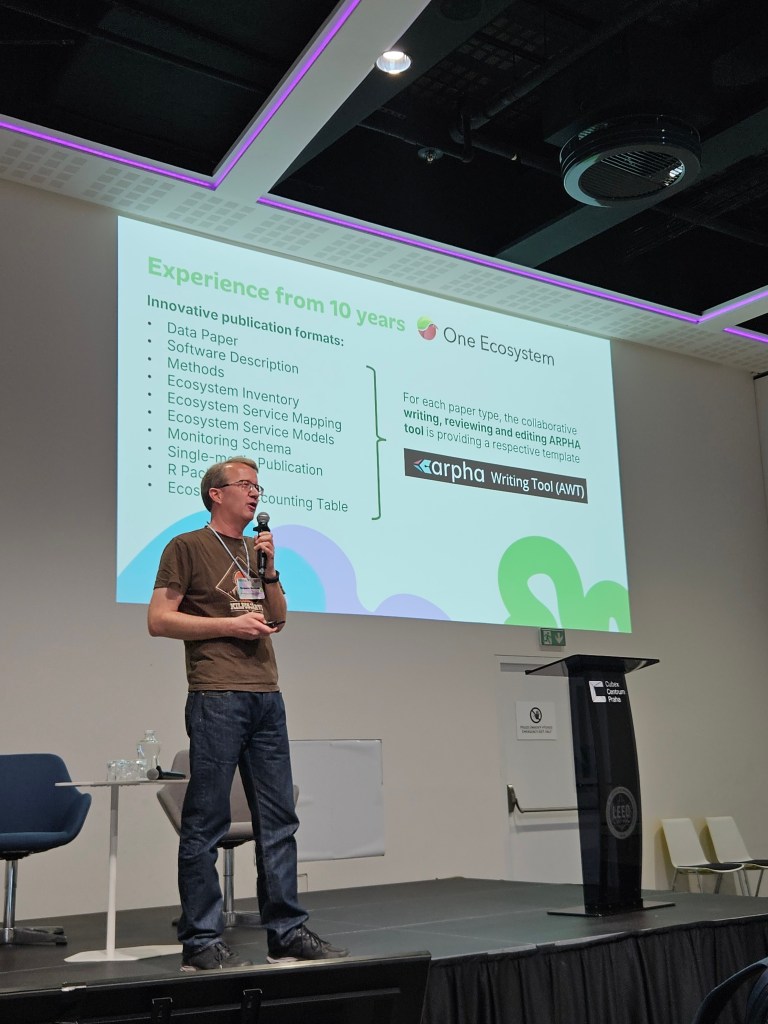
The One Ecosystem journal took center stage once again on Friday afternoon during a panel session titled, “The Changing Landscape of Academic Publishing on Ecosystem Services Research: Editors’ Perspectives.” The event brought together the Editors-in-Chief of the three ESP-associated journals for an engaging open discussion about the shifting dynamics of scientific literature. Sharing insights gained from One Ecosystem’s 10-year journey, Burkhard highlighted how authors of research who work closely with their publishers can support knowledge sharing and empower researchers. In the case of One Ecosystem, this collaboration translates to increased visibility, discoverability, reusability and citability of the published work, as well as rapid and hassle-free authoring and peer review experience, all thanks to the automated workflows and human-centric approaches provided through the publishing solutions of the ARPHA publishing platform.

It is worth issuing a reminder that manuscripts submitted in 2026 and accepted for publication in One Ecosystem journal are eligible for a 10% discount on the article publication charge (APC).

Despite excellent on-site organization, many sessions struggled to accommodate the massive turnout. Photo courtesy of the ESP.

Throughout the week, the daily program featured eight parallel session tracks covering a wide range of topics, many closely aligned with ESP Working Groups and National Networks. A dedicated poster session took place on Wednesday afternoon.

One of the field excursions offered ESP 2026 Europe delegates the challenge of an intense, half-day climbing experience in a nature park just outside Prague. Photo courtesy of ESP.

On Thursday, delegates had the opportunity to join one of several field excursions. These ranged from a visit to the unique rewilding reserve located in the former military area in Milovice, to a walk through the Prague Pasture: one of the city’s most remarkable natural sites, and an intense climbing experience just outside Prague.

Zdeněk Ent was awarded Best Poster for his poster, “Experiencing Ecosystem Services: Art, Sensory Engagement and Transformative Learning in Peri-Urban Landscapes”. In a yearly tradition, part of the award includes a free publication in the One Ecosystem journal.

Following an ESP tradition, the three highest-voted posters were recognised during Friday’s closing ceremony, with the first-prize winner receiving a free publication in One Ecosystem, sponsored by Pensoft. This year, the Best Poster Award went to Zdeněk Ent from Prague Institute of Planning and Development for the poster “Experiencing Ecosystem Services: Art, Sensory Engagement and Transformative Learning in Peri-Urban Landscapes”.

During the week, Pensoft’s exhibition stand welcomed dozens of inquiries regarding the publisher’s tailored journal portfolio. Visitors also expressed keen curiosity about the publishing services and self-developed platform available to journal owners, book authors, and conference organizers. Meanwhile, delegates showed notable interest in several titles, both well-established journals like Nature Conservation, NeoBiota, Metabarcoding & Metagenomics and One Ecosystem, and newly launched ones, including Individual-based Ecology and Advances in Pollinator Research.

A lot of Pensoft stand’s visitors were also pleased to see that there was a new player amongst the journals of Pensoft aimed at an emerging field in ecology. The recently rebranded Agricultural and Ecological Modelling (AEM) provides a unique scholarly outlet thanks to its modern approach to publishing by increasing transparency, giving credit to research objects across the entire modelling research lifecycle. This is achieved through publishing specialised article types, such as: Formal Model, Model Testing and Calibration, Model Implementation and Documentation, Data Papers and Software Descriptions. These new publishing formats are designed to keep pace with advances in Modelling research and to make it FAIR (Findable, Accessible, Interoperable, and Reusable) by enabling scholarly credit for diverse research outputs, often created by different groups of authors. For the time being, AEM remains a Diamond Open Access journal, meaning that it will not charge authors for open-access publication.

AEM also has a focus on open science and reproducibility; it is currently archived in four databases (CLOCKSS, Zenodo, Portico, and Zendy) and indexed in over 40 services, including AGRICOLA, CABI, ChronosHub, CNKI, FAO AGRIS, ResearchGate, and Swisscovery, among others. You can learn more about AEM in the latest editorial.

For those who missed the opportunity to sign up for the journals’ newsletters at the stand, they can do this by filling in their email address from the homepage of the journal they are interested in, or by updating their profiles in the Pensoft system.

Undoubtedly, amongst the greatest highlights at the Pensoft’s stand was the Horizon Europe-funded GREEN TALENT project, where our Project Department leads the project’s Work Package dedicated to Communication, Dissemination and Exploitation. 

The conference delegates were intrigued to learn about the international initiative’s aim to build biodiversity and climate capacity at national, trans-European and global levels, with a focus on Widening Countries. The partners at Green Talent: both from academic and non-academic backgrounds, are to contribute expertise, training, and secondments and connect pilot projects to broader EU and global networks. One of the ways the GREEN TALENT consortia does this is by designating four Demonstration Pilots (a.k.a. Demo Hubs) in four Widening countries: Malta, Greece, Cyprus and Bulgaria, where secondees can benefit from real-world experience and foster partnerships across sectors, while working on scalable solutions to climate and biodiversity challenges, acting as collaboration hubs between academic and non-academic sectors.

Members of the Horizon Europe-funded GREEN TALENT project consortium. Photo courtesy of ESP.

Having only kicked off a year ago and set to run for four years in total, there are many new developments and results yet to be announced from GREEN TALENT, including a Capacity-Building Platform that will allow users to browse various opportunities and events meant to help them improve their skills; to get in touch and foster collaboration with other experts; and to learn about best practices from across different institutions and relevant companies. This is why we strongly recommend visiting the GREEN TALENT, signing up for the project’s newsletter and following the initiative on BlueSky and Linkedin.

GREEN TALENT’s project coordinator, Prof. Dr. Mario V. Balzan, presented at a session dedicated to sustainable and inclusive approaches to ecosystem services tailored to the needs of islands.

In addition to the various GREEN TALENT information brochures and promo materials present at the Pensoft stand, people at the conference could spot quite a few of the project’s members around the ESP venue. There were several talks by GREEN TALENT representatives, including the project’s coordinator: Prof. Dr. Mario V. Balzan (Ecostack Innovations). His talk, part of the session “Islands at the forefront of sustainable and inclusive ecosystem services approaches” examined governance and knowledge gaps in pollinator ecosystem services on small islands, where he used Malta as a case study.

The signature journal stickers by Pensoft were once again a common sight at the ESP conference in Prague. Photo courtesy of ESP.

Ultimately, the conference successfully highlighted the tools needed to drive sustainable development across Europe. Through active contributions to both the overarching policy discussions and the targeted skill-building sessions for the next generation of researchers, Pensoft continued its commitment to making environmental science open, transparent, and globally accessible.

Make sure to stay up to date with the latest from Pensoft by following our social channels on BlueSky, Linkedin, Facebook, Instagram and Weibo.

Pensoft Celebrates the International Day of Women and Girls in Science

In honour of the International Day of Women and Girls in Science, Pensoft Publishers celebrates the remarkable contributions of women in our journals’ editorial teams.

Since its inception by the United Nations in 2015, February 11 has marked the International Day of Women and Girls in Science, dedicated to honouring the transformative role women play in the laboratory, field and archives. Despite their undeniable impact, women account for only a third of the world’s STEM researchers and 35 per cent of all STEM graduates, with only one in ten reaching leadership positions.

This year’s theme and celebration is titled “From Vision to Impact: Redefining STEM by closing the gender gap”, and focuses on how new emerging technologies can shape the future of STEM and their impact on gender equality.

While the campaigns of the previous two years urged concrete steps for the promotion of gender equality in science, this year showcases existing good practices and solutions for making STEM environments more inclusive.  

At Pensoft, we champion this mission by amplifying the voices of the women on our editorial boards. By sharing their wisdom, reflections and visions for the future, we hope to foster a more equitable scientific community and inspire the next generation of girls to pursue their passions in STEM.

For young women and girls dreaming of a career in science, Sandy Knapp, co-Editor-in-Chief of the open-access journal PhytoKeys, offers a powerful reminder:

“Keep going and keep doing. Don’t let anyone tell you that science isn’t for girls – it most certainly is. Science is for everyone, and it thrives on diversity. We need all kinds of people to make it truly work.”

As a woman leading a major scientific journal, Knapp also believes that creating a sense of belonging is a shared responsibility:

“We all need to work on this, both women and men. I think we need to not immediately assume subordinate roles – this doesn’t mean shouting and stamping our feet, but rather assuming a quiet and determined excellence.”

She highlights that representation is key to influence, noting that “the more of any minority there are in the room, the easier it is to make your voice heard and your opinions count.” This same spirit of determination defines the advice she would give her younger self:

“Don’t let anyone tell you something is too difficult – it might be for them – but not for you! Believe in yourself.”

Meanwhile, Tammy Robinson-Smythe, co-Editor-in-Chief of the open-access journal NeoBiota, emphasises the sheer excitement of being at the forefront of scientific research:

“Science is an exciting environment to work in. I love the fact that what we discover today is feeding into the textbooks of tomorrow. A career in science is worth all the effort!”

Robinson-Smythe also shed light on the intersection of professional life and family. “Making space for women to be moms while contributing to the scientific community is vitally important,” she explains. To achieve this, she advocates for practical, structural changes:

“By offering childcare on campus and at conferences we can help moms to feel like they belong, rather than feeling like they need to ‘switch off’ motherhood when they arrive at work.”

Reflecting on her own beginnings, Robinson-Smythe’s advice centers on the importance of individual path-finding:

“I’d remind myself that everyone is different. Learn from how others navigate the research environment, but find a way that matches with your morals and goals.”

The co-Editor-in-Chief of the Natural History and Museomics journal, Deborah L. Paul, similarly encourages young women and girls to believe in their dreams – “your motivation matters the most”. To succeed, she suggests surrounding oneself with supportive individuals who say “yes” to those dreams and actively encourage exploration.

When it comes to building a scientific community where women truly belong, Paul believes the responsibility lies in active leadership and self-reflection. She asserts that “we each need to set an example,” which involves constantly questioning current workflows to ensure we are creating “spaces where we can be heard and contribute.”

Reflecting on her own career, she recalls the impact of mentors and offers the simple yet powerful advice:

“Be that person for someone.”

She ends with a heartwarming piece of advice she would have told her younger self when first starting her career:

“Recognise that one’s path through life may not be linear and that’s okay. Know that discovery will lead you to new places and new adventures.”

For Pensoft, celebrating women in science means building a publishing environment where their research is seen, and their voices heard. As we look at insights from senior editors like Sandy Knapp, Tammy Robinson-Smythe and Deborah L. Paul, the message is clear: the field is better when it is diverse.

ResearchGate and Pensoft Publishers announce expansion of their Journal Home partnership

The partnership now expands to 40 journals, covering the majority of Pensoft’s and partner’s journals.

Berlin (Germany) and Sofia (Bulgaria), 10th February, 2026ResearchGate, the professional network for researchers, and Pensoft Publishers, an independent open access publisher and provider of high-quality scholarly publishing services, today announced an expansion of their Journal Home partnership. Building on an earlier collaboration announced in 2023, the list now expands to 40 journals, covering the majority of Pensoft’s and partners’ journals using the publisher’s ARPHA Publishing Platform

Amongst the journals now enjoying increased visibility across the ResearchGate’s community of 25+ million researcher members are well-renowned scholarly titles affiliated with the Natural History Museum in Berlin, Swiss Academy of Sciences, International Association for Vegetation Science and The International Biogeography Society, as well as recently launched Pensoft journals, such as Individual-based Ecology, Natural History Collections and Museomics, and Food and Ecological Systems Modelling Journal.

With most of Pensoft’s eligible partner journals choosing to participate, the expansion reflects strong demand for greater exposure and engagement opportunities, particularly among smaller and developing journals in niche research areas. Through Journal Home, partner publishers can reach more relevant audiences, improve discoverability, and connect more effectively with researchers worldwide.

Participating Pensoft journals will also benefit from:

  • Increased usage and readership, with full-text open access journal content seamlessly surfaced to highly relevant researcher communities across the ResearchGate platform.
  • Stronger engagement from new and returning authors, connecting partner journals, including specialist and emerging titles, with targeted researchers and potential authors throughout the research lifecycle.
  • Dedicated Journal Profiles and prominent placement of Pensoft journals to enhance visibility and branding, boosting recognition of partner journals with researcher communities around the world.
  • Improved author experience, with the automatic addition of published articles to author profiles, clearer insight into reader engagement, and greater opportunities for meaningful collaboration.

“Journal Home allows us to provide our partner journals with improved visibility and stronger connections with global researcher communities. Many of these journals serve highly specialised fields, and Journal Home helps make sure their articles reach the right researchers, who will benefit from them most.”

Lyubomir Penev, CEO and founder of Pensoft Publishers

“We’re pleased to expand our Journal Home partnership with Pensoft to support an increasing number of partner journals. By bringing these journals onto the platform, smaller and emerging titles can expand their reach, attract high-quality submissions, and connect with the most relevant researcher communities at key moments in their research journey.”

Robyn Mugridge, Head of Partnership Development at ResearchGate

For more information about Journal Home, please visit www.researchgate.net/journal-home.

For more information about ResearchGate, please visit www.researchgate.net.

For more information about Pensoft Publishers, please visit www.pensoft.net.

About ResearchGate

ResearchGate is the professional network for researchers. Over 25 million researchers use researchgate.net to share and discover research, build their networks, and advance their careers. Based in Berlin, ResearchGate was founded in 2008. Its mission is to connect the world of science and make research open to all.

About Pensoft Publishers

Pensoft is an independent, open-access scholarly publisher and technology provider, best known for its 40+ biodiversity journals, including ZooKeys, Biodiversity Data Journal, PhytoKeys, MycoKeys, One Ecosystem, and Metabarcoding and Metagenomics. Ever since becoming the first to introduce semantic enrichments and hyperlinks within a scientific article in the field of biodiversity in 2010, Pensoft has been working on various tools and workflows designed to facilitate data findability, accessibility, discoverability and interoperability.

Pensoft and ARPHA integrate with Prophy to speed up reviewer discovery across 90+ scholarly journals

Prophy’s AI-driven discovery system will provide editors with a broader and more diverse pool of qualified peer reviewers based on automated semantic analysis.

In a new partnership between open-access scholarly publisher Pensoft and the AI-driven reviewer discovery system provider: Prophy, the editorial teams at all journals hosted on the publisher’s ARPHA Platform receive access to a broader and more diverse global pool of researchers. 

The integration connects ARPHA’s editorial and peer review workflows with Prophy’s continuously updated database of millions of active, qualified researchers. As a result, editorial teams across more than 90 open-access peer-reviewed journals powered by ARPHA can now opt to enjoy data-driven reviewer recommendations based on structured analysis of researcher expertise and publication history, with matches based on each manuscript’s topic, field, and research focus.

This development responds to a growing challenge in scholarly publishing. As submission volumes rise, the pressure on a relatively small pool of frequently invited reviewers increases, which eventually leads to delays and reviewer fatigue. By expanding the pool of potential experts and improving how they are identified with the help of semantic analysis, the integration supports a more sustainable and balanced approach to peer review.

“By working with Prophy, we’re helping editors discover expertise that might otherwise be overlooked, opening the door to a more inclusive, well-distributed, and resilient peer review ecosystem. This is about using technology not to replace human judgment, but to support it in a smarter and more responsible way.”

Prof. Dr. Lyubomir Penev, founder and CEO of Pensoft and ARPHA.

“We’re excited to work with Pensoft and ARPHA to bring smarter reviewer discovery to their editorial teams. Peer review should be efficient and fair, and this partnership helps with both. Editors can find the right expertise faster, which means less time searching and fewer delays. This integration helps editorial teams manage growing submission volumes without burning out their reviewer networks.”

Oleg Ruchayskiy, CEO of Prophy.

To further support editorial teams and client journals’ owners, Pensoft and ARPHA are offering the Prophy integration free of charge to all journals on the platform until the end of 2026

The partnership reflects Pensoft and ARPHA’s continued focus on equipping journals with practical, forward-looking tools that strengthen peer review, support editors, and help ensure the long-term sustainability of scholarly publishing.


Stay up to date with the latest from Pensoft and ARPHA by subscribing to our blogs and following us on social media, including BlueSky, Facebook and Linkedin.

Pensoft and Bibsam Consortium announce new OA agreement to advance scholarly publishing in Sweden

The agreement covers almost 100 institutions, including Karolinska Institutet, Lund University, Uppsala University, and the Royal Swedish Academy of Sciences.

Pensoft and the Bibsam Consortium, operated by the National Library of Sweden, are pleased to announce the signing of a comprehensive Open Access (OA) agreement, marking a significant step in the transition towards a more transparent and open scholarly publishing landscape in Sweden.

Thanks to this move, researchers at participating institutions will be able to publish their findings in 65 journals published by Pensoft or using its advanced publishing platform ARPHA, including flagship titles such as ZooKeys, PhytoKeys, Biodiversity Data Journal, NeoBiota and IMA Fungus, without incurring individual article processing charges (APCs). 

The agreement encompasses 97 research bodies, including Karolinska Institutet, Lund University, Uppsala University, and the Royal Swedish Academy of Sciences.

All authors affiliated with participating institutions can benefit from this agreement, with publishing costs 100% covered by an institutional deposit secured by the National Library of Sweden.

Unlike subscription-based systems, an OA framework ensures that scientific findings are immediately and freely available to the global community, supporting the global shift toward accessible science and adhering to the FAIR principles (Findable, Accessible, Interoperable, and Reusable). 

OA agreements like this one reduce the financial burden on scientists and encourage them to share their work with both academia and the wider public, ultimately lowering barriers to sharing knowledge in a time when scientific input is key to resolving global challenges.

“We are excited to start this partnership with Bisbam and sign an agreement that reflects our strong commitment to open science. By supporting researcher-driven publishing, we continue to foster a sustainable environment for high-impact scientific communication.”

Prof. Lyubomir Penev, CEO of Pensoft

“We are delighted to announce the addition of Pensoft Publishers to our portfolio of nationally funded agreements for 2026. This represents an important step towards achieving full open access to scientific publications in Sweden.”

Niklas Willén, License Manager at Bibsam Consortium and National Library of Sweden

Are you affiliated with a research institution operating with OA agreements? Is your institution interested in helping resident researchers navigate the complex processes underpinning academic publishing and knowledge sharing? Reach out to <[email protected]> to discuss a potential collaboration.

Record-breaking success: Study on spider megacolony is the most popular article published by Pensoft

In less than a month, a paper in Subterranean Biology surpassed nearly 27,000 Pensoft studies in popularity.

Pensoft is thrilled to announce a new record in science communication: the research article “An extraordinary colonial spider community in Sulfur Cave (Albania/Greece) sustained by chemoautotrophy,” authored by István Urák et al., has achieved unprecedented publicity.

Published in the journal Subterranean Biology, the paper has become by far the most popular research article ever published across Pensoft’s scientific journal portfolio in terms of both news media coverage and overall online attention.

Issue 53 (2025) of Subterranean Biology, where the spider megacolony paper was published.

Thanks to an integration with our partners at Altmetric, we have quantifiable metrics that measure just how exceptional the attention to this article is. The paper’s Altmetric Attention Score of 2254 places it in the top 5% of all research outputs scored by Altmetric globally. For less than a month, it became more popular than nearly 27,000 research papers published by Pensoft and tracked by Altmetric.

The study was covered globally by major news outlets, reaching audiences far beyond niche scientific circles. The article garnered over 2,200 online mentions linking directly to the publication, with Altmetric tracking attention from 290 news outlets specifically. The story was featured by numerous top global news organizations, including The New York Times, BBC, The Washington Post, The Independent, Die Welt and NBC News,as well as popular science publications such as Smithsonian Magazine and Science Alert.

Beyond traditional media, the study gained significant traction on various social platforms, including YouTube, TikTok and Instagram, alongside mentions on Bluesky and X.

@zekedarwinscience

A massive spider web colony in a bizarre ecosystem underneath the border of Greece and Albania #evolution #spider #animals #biology #learnontiktok

♬ original sound – Zeke Darwin

The paper details fascinating discovery from the Sulfur Cave, which sits on the border between Albania and Greece. There, the research team documented an extraordinary spider community centered around a massive communal web spanning more than 100 square meters. This giant structure, dense enough to resemble a living curtain, is home to an estimated total of over 110,000 spiders, comprised of approximately 69,000 Tegenaria domestica and 42,000 Prinerigone vagans individuals.

A video of the spider colony in Sulfur cave. Courtesy Blerina Vrenozi

Crucially, this study marks the first documented instance of colonial behavior in both of these spider species, and the first recorded case of colonial web-building in a chemoautotrophic cave environment.

This unusual coexistence, where the larger, normally predatory T. domestica does not eat the smaller P. vagans, is believed to be facilitated by the cave’s total darkness and, most importantly, the overwhelming abundance of food resources. The ecosystem is sustained entirely without sunlight through chemoautotrophy, where sulfur-oxidizing bacteria form biofilms that support invertebrates that serve as the spiders’ primary, highly dense food source. This specialized, isolated environment has also driven the evolutionary adaptation of the spiders, which are genetically distinct from their surface relatives, illustrating the remarkable genetic plasticity that emerges under extreme environmental conditions.

A man in a red jumpsuit examines a giant spider web in a dimly lit cave.
The interior of Sulfur Cave. Photo by Marek Audy

In terms of popularity, the article comes right before two studies from our flagship taxonomic journal, ZooKeys. Our second most popular article is a crustacean study titled “A new species of supergiant Bathynomus A. Milne-Edwards, 1879 (Crustacea, Isopoda, Cirolanidae) from Vietnam, with notes on the taxonomy of Bathynomus jamesi Kou, Chen & Li, 2017,” published in ZooKeys in January 2025.

Following closely  is “Review of Neopalpa Povolný, 1998 with description of a new species from California and Baja California, Mexico (Lepidoptera, Gelechiidae),” published in ZooKeys in January 2017, which describes a new moth species with a curious scientific name.

We are proud that our journal Subterranean Biology is the platform for publishing such globally compelling research. This record success only confirms the widespread interest in high-quality, specialized scientific discoveries.

We continue our dedication to effective, high-reach science communication and look forward to sharing other compelling research with both scientists and the wider public.

New Horizon Europe project supports land-coast-sea systems under climate change

“COAST-SCAPES is a collective effort to rethink how we coexist with coastal systems”, explains project coordinator Prof. Manel Grifoll.

COAST-SCAPES: a newly launched project, funded by the European Commission, is to propose a reconsideration of the current coastal ecosystem to enhance resilience and biodiversity protection through nature-based solutions.

Leading maritime engineering specialists, marine ecologists, and biodiversity experts, gathered in Barcelona (Spain) between 7 and 9 October to officially kick start the project’s vision on climate-resilient coastal landscapes. Hosted by the Maritime Engineering Laboratory from the Polytechnic University of Catalonia, the meeting focused on setting the strategic direction of the project, aligning the scientific, technical and communication objectives and establishing synergies between project partners across Europe and beyond. 

In the span of two days, consortium partners were given the opportunity to present their missions with the COAST-SCAPES project, showcasing how each partner institution will contribute to building science-based and community-driven resilience pathways. 

The project coordinator, Prof. Manel Grifoll, navigated the discussions, which centered around key deliverables and milestones, future challenges and plans on work-related activities, highlighting the crucial role of the project’s Core and Replicating Pilots for scalable resilience plans for replication and export. 

A group photo of the COAST-SCAPES consortium at the project’s kick-off (Barcelona, October 2025).

Officially started on 1 September 2025, the COAST-SCAPES project has major ambitions to co-design systemic resilience solutions for coastal landscapes by developing integrated indicators, proactive climate warning systems, as well as knowledge-based strategies for business and maintenance in order to reduce the risks of climate change and improve land-sea interactions. To achieve this, COAST-SCAPES will promote the utilisation of nature-based solutions (NbS), seeking biodiversity gains and reduction of the environmental footprint under scarce natural resources. 

The project brings together a diverse group of partners, including research institutions, universities and technological organisations from Europe, Africa and Latin America. Their shared goal is to restore vulnerable coastal areas and apply resilience through adaptation. Due to human intervention, which drastically altered the evolution of coastal ecosystems, the ecological role of such areas is becoming crucial. By harnessing their low-carbon adaptation potential, coastal ecosystems can mitigate climate-related risks and boost biodiversity.

COAST-SCAPES is a collective effort to rethink how we coexist with coastal systems. By integrating natural processes, technology, and community knowledge, we aim to create adaptive landscapes that safeguard biodiversity and support sustainable livelihoods. Our ambition is to build resilient coasts that can thrive, not just survive, under climate change.

says Prof. Manel Grifoll, project coordinator.

The selected project’s Core Pilots, among which the Mar Menor lagoon in the Iberian Peninsula, will serve as a starting point for leading experts to carry out large-scale resilience plans, while protecting coastal biodiversity and addressing existing infrastructure challenges. 

Supported by social and technical innovation, as well as a governance shift, these plans will connect scientists, citizens, policy-makers, environmental activists, and the industry with administrations responsible for local implementations for an increased cross-sectoral engagement. Contributing to a balanced land-to-sea ecosystem and a sustainable biodiversity protection, COAST-SCAPES reminds us that coastal restoration is vital for our adaptation to climate change.

Pensoft’s contribution to COAST-SCAPES:

Pensoft will lead two tasks within the COAST-SCAPES’ Work Package dedicated to dissemination and communication for practical exploitation. The objectives of these tasks are focused on the identification of key exploitable results of the project. Together with other consortium members, Pensoft will be working on establishing the most suitable exploitation pathways for each result. The experienced communication team at the scholarly publishing and technology providing company will also be actively raising societal and technical awareness necessary to transform governance for systemic resilience through yearly newsletters and policy briefs. In addition, Pensoft takes part in Work Package 6, where it will be responsible for the project’s visual identity and ensuring constant visibility of project results, as well as proper data management

List of project consortium members: 

Coordinated by the Polytechnic University of Catalonia, the project brings together 30 partner organisations from 15 countries to develop coastal resilience through nature-based solutions (NbS).

  1. Polytechnic University of Catalonia (UPC) 
  2. EURECAT Technology Centre 
  3. The New Water Culture Foundation (FNCA)
  4. National Research and Development Institute for Marine Geology and Geoecology (GeoEcoMar) 
  5. Consortium for the coordination of research relating to the Venice lagoon system (CORILA) 
  6. National Institute of Oceanography and Experimental Geophysics (OGS) 
  7. Euro-Mediterranean Center on Climate Change (CMCC)
  8. Scottish Association for Marine Science (SAMS)
  9. Royal Melbourne Institute of Technology Spain SL (RMIT Spain)
  10.  University of Aveiro (UA) 
  11.  Pensoft Publishers (Pensoft) 
  12.  Ludwig-Maximilians-Universität München (LMU)
  13.  Lower Saxony State Office for Water Management, Coastal Protection and Nature Conservation (NLWKN) 
  14.  University of Save (USV)
  15.  Northern University Foundation (UNR) 
  16.  Mohammed Premier University (UMP) 
  17.  Assane-Seck University of Ziguinchor (UASZ)  
  18.  Global Climate Forum (GCF) 
  19.  Helmholtz-Zentrum Hereon GMBH 
  20.  Odesa I.I. Mechnykov National University 
  21.  International Center for Coastal Resources Research of Spain 
  22.  Can Tho University 
  23.  Ministry of Infrastructure and of Transport of Italy 
  24.  Spanish National Research Council (CSIC) 
  25.  University of San Francisco de Quito (USFQ) 
  26.  WWF Romania 
  27.  Association for the Defense of Nature/WWF – Spain 
  28.  Royal Melbourne Institute of Technology – RMIT University (RMIT Uni) 
  29.  Ministry for Ecological Transition and the Demographic Challenge of Spain (MITECO) 
  30.  Portuguese Environment Agency (APA)

For more information:

Follow the COAST-SCAPES project on Bluesky and LinkedIn.

Project website coming soon!


Funded by the European Union under grant agreement No. 101213138, COAST-SCAPES (rethinking COASTal landSCAPES with climate-resilient interventions: systemic land-to-sea solutions).

Views and opinions expressed are, however, those of the author(s) only and do not necessarily reflect those of the European Union or the European Research Executive Agency (REA). Neither the EU, nor the REA can be held responsible for them.

Celebrating One Year on Weibo

One year ago, Pensoft embarked on an exciting new journey to connect with the vibrant scientific community in China by launching our official Weibo account. This initiative was designed to foster closer ties with Chinese researchers, academics, and science enthusiasts—helping to broaden the reach of scientific knowledge and promote international collaboration.

Highlights from Our First Year

Over the past 12 months, we’ve shared a wide range of articles, research highlights, and updates from our diverse portfolio of open-access journals. Here are some of the most memorable moments from our first year:

Our most viewed video featured the discovery of three new species of Nautilus—the iconic deep-sea mollusks. Published in ZooKeys, the study described species from the Coral Sea and South Pacific. The video captivated marine biology fans and drew thousands of views. Videos are a powerful way to share science, and we encourage researchers to include video materials whenever possible!

Video by Gregory J. et al. 

Another example was the video from the study Kleptoparasitism in Micrurus mipartitus competing for the same Caecilia sp. in western Colombia, published in Herpetozoa. The footage documented a rare and dramatic interaction between coral snakes fighting over a caecilian, and it fascinated our followers with its unusual ecological behavior.

Video by Henrik Bringsøe, Niels Poul Dreyer

Our most viral post introduced the newly described supergiant Bathynomus vaderi—a massive deep-sea isopod discovered off the coast of Vietnam. Its name, vaderi, was inspired by the creature’s head, which bears a striking resemblance to the iconic helmet worn by Darth Vader in Star Wars.

Another popular post highlighted new mimetid spider species (Araneae, Mimetidae) discovered in Guizhou Province, published in Zoosystematics and Evolution. The study shed light on the region’s rich spider biodiversity and sparked strong engagement from our Chinese followers. It seems that spiders are a consistent fan favorite, with arachnid discoveries regularly going viral on our Weibo!

This trend continued with our most popular longread, which told the story of Otacilia khezu sp. nov., a newly discovered cave-dwelling spider from Guangxi, China, published in the Biodiversity Data Journal. What truly captured readers’ imaginations—beyond the biological discovery—was the name itself. The spider was named after the Khezu, a wyvern from the popular video game Monster Hunter, known for its blindness and eerie appearance. Just like its namesake, Otacilia khezu completely lacks eyes — a striking adaptation to life in the dark.

We’re also thrilled to see research from Pensoft’s journals featured widely across Chinese media. Articles have appeared in blogs, popular outlets such as People’s Daily, Xinhua, Global Times, Science and Technology Daily, on CCTV, in local news, and even in print newspapers!

Looking Ahead

As we celebrate this milestone, we’re filled with excitement for what lies ahead. We look forward to continuing to share cutting-edge science, uncovering new discoveries, and building stronger connections with our Chinese readers and partners.

Thank you to everyone who has followed, shared, and supported us over the past year. Your engagement has made this journey meaningful and rewarding. 

Stay connected with us on Weibo: Pensoft’s Official Weibo Account

Pensoft joins the Biodiversity Meets Data Horizon project to support biodiversity monitoring and conservation

As part of the new consortium, Pensoft is to use innovative communication tools in support of evidence-based biodiversity conservation across Europe.

The European Union (EU) has been working to protect nature for decades, with the Natura 2000 network now safeguarding over 18% of EU land and 9% of its marine territory. Yet, biodiversity is still in trouble, with only 50% of bird species and 15% of habitats in good conservation status. 

To turn the tide, the EU’s Biodiversity Strategy for 2030 will expand the existing Natura 2000 areas, implement the EU’s first-ever Nature Restoration Law, and introduce concrete measures to achieve global biodiversity targets. Success will depend on enhancing biodiversity monitoring, making better use of data and gaining a clearer picture of how nature is changing.

Addressing this urgent challenge, the EU Horizon project BMD (abbreviated for Biodiversity Meets Data) will offer a centralised platform (Single Access Point or SAP) for improved biodiversity monitoring across Europe. 

Pensoft’s role

Pensoft will play a role in Biodiversity Meets Data’s impact by planning and implementing the communication, dissemination and exploitation of project results, as well as helping with the training and capacity building for BMD’s end-users, which will be led by LifeWatch ERIC. Pensoft will adopt a multi-format approach to knowledge transfer with tailored outputs for the scientific community, decision-makers, industry representatives and the general public. 

Furthermore, the BMD SAP will also incorporate elements of the Biodiversity Knowledge Hub (BKH), developed under the BiCIKL project, coordinated by Pensoft.

“It’s incredibly rewarding to see the continuity in our projects, with the legacy of the BiCIKL project continuing with Biodiversity Meets Data. This seamless progression not only builds on our past successes but also ensures that our work continues to deliver long-lasting value to the biodiversity community.”

said Prof. Dr. Lyubomir Penev, CEO and Founder of Pensoft, and project coordinator of BiCIKL (abbreviated from Biodiversity Community Integrated Knowledge Library).
The BMD project consortium at the project’s kick-off meeting in early March 2025 (Leiden, the Netherlands).
International consortium

Coordinated by Naturalis Biodiversity Center, the project brings together 14 partner organisations from 11 countries to develop innovative solutions for biodiversity management.

  1. Naturalis Biodiversity Center – the Netherlands
  2. Royal Botanic Garden Edinburgh – the United Kingdom
  3. Meise Botanic Garden – Belgium
  4. Helmholtz Centre for Environmental Research – Germany
  5. e-Science European Infrastructure for Biodiversity and Ecosystem Research – Spain
  6. Pensoft Publishers – Bulgaria
  7. The European Land Conservation Network – the Netherlands
  8. University of Tartu – Estonia
  9. Stichting Catalogue of Life – the Netherlands
  10. The International Hellenic University – Greece
  11. The Senckenberg Nature Research Society – Germany
  12. The Environment Agency Austria – Austria
  13. The National Research Council – Italy
  14. SIB Swiss Institute of Bioinformatics – Switzerland
For more information:

Visit the BMD project website at https://bmd-project.eu/, and make sure to follow the project’s progress via our social media channels on Bluesky and Linkedin.

Unseen ecosystems, unheard stories: How art can amplify subterranean science

Bridging art and science can have profound, lasting impacts on scientific communication and conservation efforts.

Guest blog post by Veronica Nanni, Jagoba Malumbres-Olarte, and Stefano Mammola

In an era where information is more accessible than ever, one might assume that communicating science has never been easier. However, science communicators often find themselves in a constant battle against public skepticism and media sensationalism. Scientific research is, by nature, intricate and nuanced, making it inherently challenging to communicate effectively. Academic papers are often laden with equations, technical jargon, and acronyms that, while ensuring precision and accuracy, may alienate even the most intrepid readers. The challenge, then, lies in translating complex findings into digestible and engaging narratives without oversimplifying or distorting the truth. Striking this balance is crucial, as misrepresentation can lead to misunderstanding, erode public trust, or even fuel misinformation.

As scientists working with subterranean biodiversity, we face an additional layer of challenges in science communication. Unlike more familiar ecosystems, such as forests or oceans, caves and other subterranean environments are foreign and unseen to most audiences. These hidden worlds are often perceived as mysterious, inhospitable, or even irrelevant to everyday life. This lack of direct experience or knowledge creates a significant barrier to interest and engagement. For instance, the delicate balance of subterranean ecosystems and their hidden interconnection with surface ecosystems is not only difficult to visualize but also challenging to relate to broader environmental issues that resonate with the public, such as climate change or biodiversity loss.

A speckled gecko with a light brown body climbs on a rocky surface.
Werner’s leaf-toed gecko (Asaccus elisae), picture from https://doi.org/10.3897/subtbiol.18.8185

Furthermore, subterranean organisms, such as blind fish, pale invertebrates, and microbial communities, often lack the visual appeal of iconic surface species (e.g., lions, dolphins, polar bears), making it difficult to generate interest or concern. Such scarce interest often means that subterranean ecosystems are scarcely represented in global biodiversity agendas, leaving most of them unprotected or poorly regulated.

This communication challenge and policy gap became even more apparent at the start of the Biodiversa+ project DarCo, a transnational project involving 13 research institutes across Europe. The project aims to advance knowledge about subterranean biodiversity in Europe and advance its conservation. DarCo’s overarching goal is to develop a concrete plan to incorporate subterranean ecosystems into the European Union (EU) Biodiversity Strategy for 2030.

For the successful implementation of the project, there is a need to engage with diverse audiences, from the general public to stakeholders who rely on subterranean resources in various ways—e.g., speleological groups, water managers, national park authorities, and even politicians involved in EU-level legislation on nature conservation. This is where the challenge of communicating the importance of subterranean biodiversity to the health of ecological systems and the well-being of society became quite apparent. We realized that tapping into non-scientific forms of communication might offer a promising way forward.

Illustration of a cave ecosystem featuring spiders, a centipede, bats, and a guano pile, highlighting food sources and detritus flow.
Figure 1. Life in the darkness of caves through an illustration targeting kids. Modified from https://doi.org/10.3389/frym.2022.657265 (original illustration by Irene Frigo).

We began collaborating with various artists and scientific illustrators to aid in our communication efforts. Whether illustrating cave life and its conservation for children (Figure 1) or involving illustrators to create compelling visuals for our scientific publications (Figure 2), the science-art collaboration proved particularly effective. We even invited a scientific illustrator, Dr. Jagoba Malumbres-Olarte, to the 26th International Conference on Subterranean Biology (Cagliari, Italy, 9–14 September 2024), where the DarCo team organized a workshop on subterranean conservation open to both scientists and stakeholders. Jagoba’s role was to create an artistic representation of the workshop flow (Figure 3) and illustrate key aspects of selected scientific talks.

An illustrated scene of a sunset over mountains, as seen from the inside of a cave, showcasing diverse life forms such as insects, worms, and bats.
Figure 2. Scientific illustration for a scientific publication on climate change’s impact on subterranean ecosystems. Modified from https://doi.org/10.1016/j.oneear.2023.09.001 (original illustration by Jagoba Malumbres-Olarte).

Stemming from these fruitful collaborations, we decided to write a scientific paper on the role art can play in the conservation of subterranean ecosystems, highlighting the benefits for subterranean scientists engaging with artists and vice versa. Although there is no quantitative proof yet that art directly promotes subterranean conservation, our experience as scientists who frequently collaborate with artists—and artists who often collaborate with scientists—suggests that bridging these worlds can have profound, lasting impacts on scientific communication and conservation efforts. By engaging with artists, subterranean scientists can create more impactful visuals for research papers and presentations, enhance public engagement through powerful storytelling, and spark fresh insights that may drive new research directions.

To maximize these benefits, scientists should foster collaborations by inviting artists to conferences and workshops, involving them in cave expeditions, and even dedicating small portions of research budgets to artistic initiatives. On the other hand, artists can undertake projects focused on conservation and related scientific fields, using their own platforms and tapping into funding sources beyond traditional scientific grants.

Illustration summarizing the DarCo Project Workshop themes: data, questions, impact, and dissemination for subterranean ecosystem conservation.
Figure 3. Infographic created through the graphic facilitation of DarCo’s workshop held during the 26th International Conference on Subterranean Biology (Cagliari, Italy, 9–14 September 2024). Original illustration by Jagoba Malumbres-Olarte.

Art has long been a bridge between knowledge and emotion, making complex ideas accessible through storytelling, visuals, and performance. Scientific illustrations, data visualizations, and interactive exhibits can transform abstract information into tangible experiences. Moreover, films, theater, and literature can create emotional connections with audiences, helping them grasp the real-world implications of scientific discoveries.

By integrating art with science communication, we can reach people who might otherwise feel disconnected from scientific discourse. Art and science are not opposing forces but complementary ones, enriching each other in profound ways. As we face global challenges such as climate change, biodiversity loss, and public health crises, integrating artistic expression with scientific inquiry can foster deeper understanding, empathy, and action, spreading knowledge and awareness of these threats in society.

Research article:

Mammola S, Malumbres-Olarte J, Vaccarelli I, Nanni V, Bellvert A, Jarić I (2025) On art, science, and the conservation of subterranean ecosystems. Subterranean Biology 51: 1-19. https://doi.org/10.3897/subtbiol.51.139954