

Guest Blog Post by the Research Team of Samar Island’s Herpetofauna
In the darkness of the Samar rainforest, a flash of color stopped the research team in their tracks. Their headlamps illuminated a small shrub on a worn limestone trail, revealing a tiny pink snake. With a quiet sense of triumph, Yñigo del Prado readied his camera and leaned forward to photograph the coiled serpent within the branches of the shrub.
Although unknown to del Prado’s research team at the time, their rediscovery of the rare blindsnake Ramphotyphlops marxi would become one of the significant findings of the most recent comprehensive field study to document reptile and amphibian diversity found in Samar Natural Park (SINP) and Samar Island. Indeed, first recorded by the eminent zoologist Dioscoro Rabor in 1957 and unseen since, the snake is now a key highlight of the the survey, now published in the open-access journal ZooKeys.

“Samar Island is a biological frontier hiding in plain sight,” remarks Arvin Diesmos, a former curator in herpetology at the National Museum of the Philippines, and present senior director at the ASEAN Centre for Biodiversity. He was part of an expedition team from the Herpetological Research Collection of the University of Santo Tomas to survey the biodiversity of Samar Island Natural Park.
The primary goal of the expedition was to generate updated and comprehensive data on the terrestrial vertebrate fauna—from amphibians and reptiles to birds and mammals—that aim to strengthen the scientific foundation for the nomination of SINP to the UNESCO World Heritage List.
The diverse team of biologists was assembled by UST Assistant Professor Mae Diesmos and head of UST–HRC, to spearhead the terrestrial faunal surveys, while project was designed by Professor Eric Zerrudo, also from UST, and the director of the Center for Conservation of Cultural Property and Environment in the Tropics.
Together with biologists from the University of the Philippines in Diliman and Los Banos campus, in close partnership with the Department of Environment and Natural Resources and the Samar provincial government, the project undertook a month-long biodiversity survey of the karst rainforest of SINP – a ~333,339 hectare protected area of intact lowland forest over limestone and a Key Biodiversity Area in the Philippines.

At an estimated area of ca 1,310,700 ha, Samar and the nearby island of Leyte count as one of the largest islands of the Philippines. While Samar has gradually experienced progressive decline in forest cover over the last couple of decades, its interior still houses one of the largest intact labyrinths of habitats spanning karst rainforest and cave systems.
“The reptiles and amphibians in limestone karst systems have evolved in remarkable ways. Every major survey [we] conducted reveals something new, something previously undetected just hiding under the woodworks. Which tells us that Samar remains one of the most important—and often understudied, biodiversity strongholds in the eastern region of the Philippines.”
Mae Diesmos
Though, perhaps “understudied” is an overstatement. A number of biological surveys have been conducted in SINP, as referenced in the article, with some of the extensive surveys dating back as early as the 1850s.
With the benefit of hindsight, the team integrated historical records into their paper, updating species names and distributions to match current classifications. This process effectively cleared up past confusion over identification. In addition, the larger taxon-based field biologists from UST and UP, allowed for more targeted sampling of several taxonomic groups. Increasing the sampling effort subsequently led to more extraordinary discoveries.
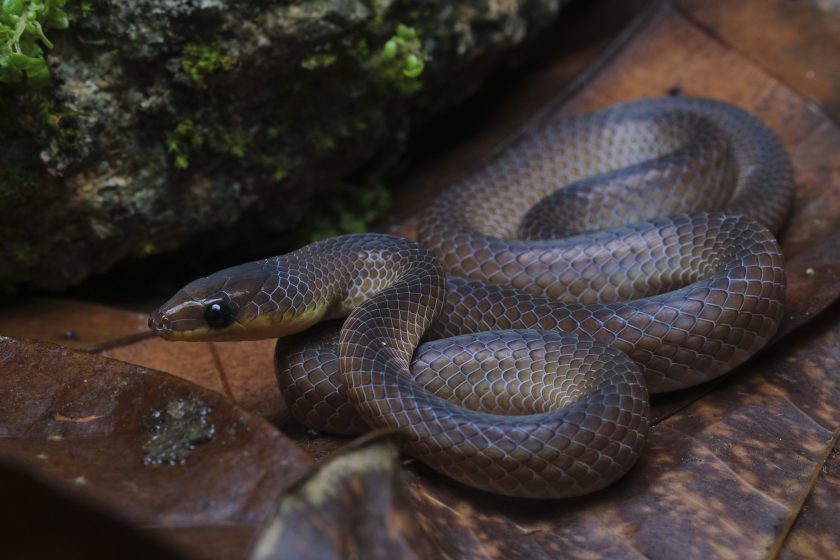
Case in point, the team found an additional 39 new records of reptiles and amphibians that bolstered the listing in SINP to a total of 79 species, and new distribution records of three species previously unknown from the island. And of course, there was the collection of the two specimens of R. marxi, whose existence had only been known from two historical records.



Acquiring this valuable data was by no means a simple task. The herpetology team was beset by the onset of the monsoon season, meaning that dry transect walks and even dry clothing were rare. The team also faced the strong currents and high rapids of the adjacent Ulot River as they moved from one site to another, and endured sandfly-infested campsites.

Encounters with local herpetofauna were always a joy. In the search for unique and cryptic species of lizards and snakes, the herpetology team relied on some tried and tested methods such as targeted microhabitat sampling of decaying logs, forest litter, and stream banks to look for fossorial species. Some methods were largely improvised; collapsible fishing poles became indispensable to shake down arboreal species or at the very least, encourage them to descend from the canopies.
Some species, however, had to be approached differently, as was the case for Platymantis bayani. The species is part of a larger complex of limestone frogs that could be found in karst formations in the Philippines, and each known species is unique to the location where it is found. On more than one occasion, the herpetology team had to search through overgrown limestone crevices; in others, the group descended into the depths of massive limestone caves in the dark to search for these elusive frogs.

But Filipinos are nothing if resilient, as a local adage goes. Certainly, Mae Diesmos and her team had their work cut out for them. The officials of the Samar provincial government were notably also very thorough in their coordination and movement across study sites, to ensure the safety of the team. This highlights the importance of collaborative work between research institutions and local government units and stakeholders. Research is considerably more difficult without proper funding and local coordination.
This issue is not unique to Samar. Limited and precious funding to support scientific research remains a challenge to sustain biodiversity surveys across many islands and regions of the country. Much work remains to be done because numerous areas and habitats still lack detailed biodiversity surveys. Field biologists and conservationists have, for many decades now, been locked in a dizzying and (at times) disheartening race against habitat destruction and population decline of key species.

As more field studies continue, Samar and nearby islands will likely continue to reveal even more of its hidden biodiversity. An inspiring reminder to future researchers that even in the 21st century, the rainforest of the Philippines still holds many scientific discoveries waiting to be made.
Original source:
Diesmos MLL, del Prado YLC, Kim PMM, Caguimbal NALE, Venturina REL, Lorenzo II AN, Diesmos AC (2026) Amphibians and reptiles of Samar Island Natural Park, Philippines, with an updated checklist, a rediscovery, and new records for Samar Island. ZooKeys 1269: 303-328. https://doi.org/10.3897/zookeys.1269.173854
For more articles on zoology, visit the ZooKeys website and follow the journal on BlueSky and Facebook.