New ‘Ecclesiastical’ Moth named after Pope Leo XIV

Described as Pyralis papaleonei, the finding serves as a powerful call for biodiversity conservation, inspired by a biblical reference.

Distinguished by its striking colors and a name that carries the weight of a high ecclesiastical office, a new species of moth has been discovered in the rugged terrain of Greece. When researchers from the Tyrolean State Museum, the Finnish Museum of Natural History and the Bavarian State Collection of Zoology identified this unique insect in the White Mountains of Crete, they chose a name that reflects both its noble appearance and a message of environmental hope: Pyralis papaleonei – derived from “Papa Leone” (Pope Leo).

The discovery, published in the open-access journal Nota Lepidopterologica on 28 April 2026, highlights that even among such conspicuous European moths, overlooked species remain to be discovered. The new species is currently only known from the White Mountains (Lefka Ori) in the western part of Crete, where it appears to be an endemic treasure of the island.

Type-locality of Pyralis papaleonei sp. nov. (Greece, Crete, Omalos plateau). Image credit: Peter Huemer.

Striking purple forewings

The so-called Pope Leo Moth has a wingspan of around two centimeters, placing it among the medium-sized representatives of its group. Its most distinctive features are its purple forewings with an orange-golden patch and prominent white bands. The moths were recorded at artificial light sources and appear to be mainly active in June. So far, little is known about the biology and lifestyle of the new species. It was distinguished from related species based on classical morphological characteristics – such as wing pattern, coloration, and genital morphology – as well as genetic fingerprinting. Molecular analyses revealed a divergence of around six percent from its closest relative, clearly indicating that it represents a distinct species.

Pyralis papaleonei sp. nov., holotype. Image credit: Peter Huemer.

A tradition of remarkable species names

Butterflies and moths are often named after physical characteristics, geographic origins, or in honor of distinguished individuals. Within the genus Pyralis, however, a particular tradition can be observed: as early as 1775, Austrian naturalists Michael Denis and Ignaz Schiffermüller described the first species of the group as Pyralis regalis (“royal”), inspired by its splendid coloration. This was followed by sonorous names such as Pyralis princeps and Pyralis cardinalis, also referring to the remarkable beauty of these moths.

All these species belong to the diverse superfamily Pyraloidea, which comprises around 16,000 described species worldwide and represents one of the largest groups among micro-moths.

Specimen of Pyralis regalis. Image credit: Peter Huemer.

Taxonomy as the “first profession” of humankind

The naming of living organisms also has a cultural-historical dimension: in the Old Testament (Genesis 2), Adam is firstly tasked with naming all animals. In this sense, taxonomy – the science of classifying, naming, and organising organisms – can be regarded as one of humanity’s earliest endeavors.

For study leader Peter Huemer of the Tyrolean State Museum Ferdinandeum, naming a species is therefore more than a formal scientific act: it also serves as a symbolic appeal to the head of the Catholic Church, Pope Leo XIV, to highlight humanity’s central responsibility in safeguarding creation. This is particularly fitting as butterflies and moths are regarded in Christianity as symbols of resurrection, transformation (metamorphosis), and the immortal soul.

Specimens of Pyralis papaleonei. Image credit: Peter Huemer.

Only a fraction of global biodiversity documented

Peter Huemer, former head of the Natural Science Collections at the Tyrolean State Museums and now a volunteer researcher, explains:

“We are facing a global biodiversity crisis, yet only a fraction of the world’s species has been scientifically documented. Effective conservation of biodiversity requires that species are first recognised, described, and named.”

Around 700 new moth species are described each year, primarily in the tropics. However, fundamental research in Europe is far from complete: in the Alps alone, approximately 200 previously unknown species have been identified in recent decades.

With their internationally significant scientific collections, the Tyrolean State Museums make an important contribution to this work. The discovery of the Pope Leo Moth, Pyralis papaleonei, highlights how much remains to be discovered even in well-studied regions of Europe—and underscores the urgent need to protect sensitive habitats.

Original source:

Huemer P, Kaila L, Segerer AH (2026) Pyralis papaleonei sp. nov. from Crete (Greece) (Lepidoptera, Pyralidae). Nota Lepidopterologica 49: 63-74. https://doi.org/10.3897/nl.49.185483

For more interesting articles on lepidopterology, follow Nota Lepidopterologica on Bluesky and Facebook.

Austrian-Danish research team discover as many as 22 new moth species from across Europe

The last time so many previously unknown moths have been discovered at once in the best-studied continent was in 1887

One of the newly discovered moths, Megacraspedus faunierensis, in its natural habitat in the Alps.

Following a long-year study of the family of twirler moths, an Austrian-Danish research team discovered a startling total of 44 new species, including as many as 22 species inhabiting various regions throughout Europe.

Given that the Old Continent is the most thoroughly researched one, their findings, published in the open access journal ZooKeys, pose fundamental questions about our knowledge of biodiversity. Such wealth of new to science European moths has not been published within a single research article since 1887.

“The scale of newly discovered moths in one of the Earth’s most studied regions is both sensational and completely unexpected,” say authors Dr Peter Huemer, Tyrolean State Museum, and Ole Karsholt of the University of Copenhagen‘s Zoological Museum. To them, the new species come as proof that, “despite dramatic declines in many insect populations, our fundamental investigations into species diversity are still far from complete”.


The challenge of taxonomy

Type locality of the new moth species Megacraspedus faunierensis, Cottian Alps, Italy.

For the authors, it all began when they spotted what seemed like an unclassifiable species of twirler moth in the South Tyrolean Alps. In order to confirm it as a new species, the team conducted a 5-year study into the type specimens of all related species spread across the museum collections of Paris, London, Budapest and many in between.

To confirm the status of all new species, the scientists did not only look for characteristic colouration, markings and anatomical features, but also used the latest DNA methods to create unique genetic fingerprints for most of the species in the form of DNA barcodes.


What’s in a name?

A particular challenge for the researchers was to choose as many as 44 names for the new species. Eventually, they named one of the species after the daughter of one of the authors, others – after colleagues and many others – after the regions associated with the particular species. Megacraspedus teriolensis, for example, is translated to “Tyrolean twirler moth”.

Amongst the others, there is one which the scientists named Megacraspedus feminensisbecause they could only find the female, while another – Megacraspedus pacificus, discovered in Afghanistan – was dubbed “an ambassador of peace”.


Mysterious large twirler moths

One of the newly discovered moths, Megacraspedus faunierensis, in its natural habitat in the Alps.

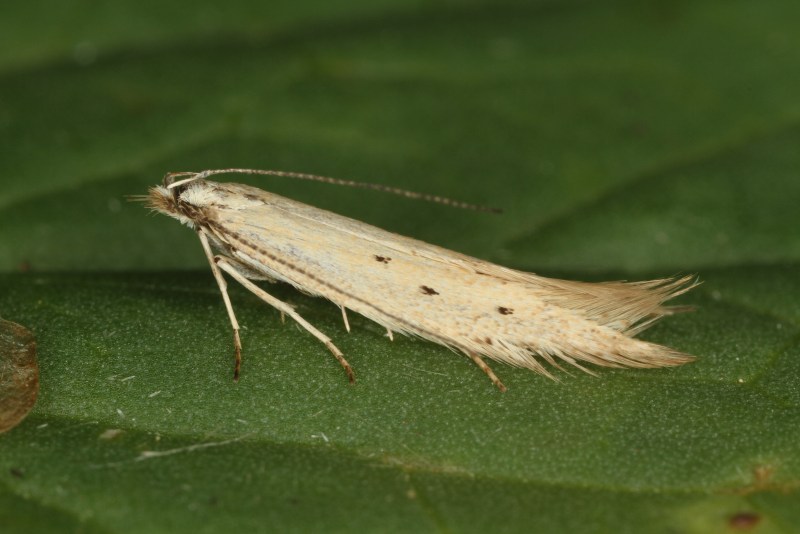
All new moths belong to the genus of the large twirler moths (Megacraspedus) placed in the family of twirler moths (Gelechiidae), where the common name refers to their protruding modified mouthparts (labial palps).

The genus of the large twirler moths presents an especially interesting group because of their relatively short wings, where their wingspan ranges between 8 and 26 millimetres and the females are often flightless. While it remains unknown why exactly their wings are so reduced, the scientists assume that it is most likely an adaptation to the turbulent winds at their high-elevation habitats, since the species prefer mountain areas at up to 3,000 metres above sea level.

Out of the 85 documented species, however, both sexes are known in only 35 cases.

The scientists suspect that many of the flightless females are hard to spot on the ground. Similarly, caterpillars of only three species have been observed to date.

While one of the few things we currently know about the large twirler moths is that all species live on different grasses, Huemer and Karsholt believe that it is of urgent importance to conduct further research into the biology of these insects, in order to identify their conservation status and take adequate measures towards their preservation.

###

Original source:

Huemer P, Karsholt O (2018) Revision of the genus Megacraspedus Zeller, 1839, a challenging taxonomic tightrope of species delimitation (Lepidoptera, Gelechiidae). ZooKeys 800: 1-278. https://doi.org/10.3897/zookeys.800.26292