Driving a Nature-Positive Future: Pensoft’s Highlights from the 6th ESP Europe Conference in Prague, Czechia

Once again, Pensoft joined the ESP conference as an open-access scholarly publisher, publishing services provider, and a partner at Horizon Europe consortia.

Conference Organising Committee’s Davina Vačkářová thanks the ESP2026EU’s sponsors, exhibitors and partners. Photo courtesy of the ESP.

From 18 to 22 May 2026, the historic city of Prague, Czechia, hosted the 6th European Conference of the Ecosystem Services Partnership (ESP). Set against a backdrop of global turning points, such as biodiversity declines and climate uncertainty, the event served as an important forum for discussing how ecosystem services can cultivate a sustainable and equitable future.

This year’s ESP European conference ran under the theme “Advancing ecosystem services knowledge for achieving a nature- and people-positive Europe.” Photo courtesy of the ESP.

The conference ran under the theme, “Advancing ecosystem services knowledge for achieving a nature- and people-positive Europe.” Attendees focused on how to translate major policy frameworks, including the EU Biodiversity Strategy 2030 and the new Nature Restoration Law, into inclusive and effective action that respects both nature and healthy ecosystems. A major talking point at the event was also the new path ahead of the ESP as it officially becomes an independent international community later in 2026. An election of a new Steering and Executive Committee has already been scheduled for October 2026.

For Pensoft, the ESP 2026 European conference was not only a wonderful occasion to meet once again many long-time partners and friends, including the ESP team itself; editors and loyal authors of our journals; and members of the international project consortia, where we are involved, but also an exciting opportunity to talk with new members of the ESP community and learn about the needs, interests and passions of a new generation of researchers in a rapidly changing scientific field.

Pensoft’s stand at the ESP 2026 Europe conference in Prague, Czechia.

As an open-science publisher well embedded in environmental research through its dozens of journals covering ecology, biodiversity conservation and other related fields, Pensoft Publishers also actively participated in the week’s dialogues, contributing unique perspectives on scientific communication.

The Karolinum: the seat of Prague’s Charles University hosted the pre-conference training sessions, the Opening ceremony and the Welcome reception on Monday. Photo courtesy of the ESP.

The sixth European installment of the conference kicked off on Monday, 18 May, at the Karolinum, the historic seat of Charles University. The energy of a dynamic, highly engaging week was set perfectly by a lavish evening ceremony filled with speeches from renowned local figures, traditional music, and cultural performances. Yet, long before the opening notes played, the Karolinum was already buzzing, having hosted a full slate of pre-conference training sessions throughout the day. 

A get-together for the editors and loyal authors of the open-access peer-reviewed One Ecosystem – the Ecology and Sustainability Data Journal took place on Monday at the Karolinum (Prague, Czechia).

Just ahead of the opening ceremony, our team at Pensoft hosted a semi-formal get-together for the editors and loyal authors of the open-access peer-reviewed One Ecosystemthe Ecology and Sustainability Data Journal. This year, the scholarly outlet, launched in collaboration between Pensoft, the ESP and the ESMERALDA Horizon 2020 project, now succeeded by the Horizon Europe-funded project SELINA, celebrated its tenth anniversary.

Chaired by Editor-in-Chief Prof. Benjamin Burkhard and Pensoft’s Head of Journal Development and PR Iva Boyadzhieva, the meeting recapped the best moments from One Ecosystem’s first decade and inspired discussions and ideas for the journal’s future. They also referred to the recently published editorial titled “Ten years of innovation and the way ahead in scientific publishing in One Ecosystem”. The piece reflects on the journal’s journey since its 2016 launch and addresses modern challenges in academic publishing, such as reviewer fatigue and the rapid rise of generative artificial intelligence. 

Over the last ten years, One Ecosystem has established itself as a unique journal in the field, thanks to its commitment to openly sharing the research data underpinning each publication. It also offers a versatile range of article types. These include traditional formats (e.g. Research Article, Review Article, Data Paper), innovative options (e.g. Software Description, R Package, Single-media Publication), as well as ones specifically devised for the community, such as Ecosystem Inventory, Ecosystem Service Mapping and Ecosystem Accounting Table. 

So far, the journal has published over 200 papers authored by scientists from all continents, accumulating more than 1,500,000 views, 600 citations, and 6,000 online mentions. Today, the journal’s editorial board comprises 50 experts representing diverse geographies and professional fields. One Ecosystem is indexed in over 60 relevant scholarly databases, including Scopus and Web of Science, and holds a Q1 ranking on Scopus. Authors also benefit from a swift turnaround time, with an average of just 2.5 months from submission to acceptance, and articles typically published within three months of submission.

Keynote speeches at the first conference day were delivered by Jakub Kronenberg (University of Lodz), Alessandra La Notte (Senior consultant on natural capital accounting) and Ben Delbaere (LIFE Programme).

On Tuesday, the main schedule opened with inspiring keynote speeches, with Jakub Kronenberg (University of Lodz) examining the transition towards relational values of nature, Alessandra La Notte (Senior consultant on natural capital accounting) sharing two decades of insights into natural capital accounting, and Ben Delbaere (LIFE Programme at ELMEN EEIG) demonstrating how the European LIFE Programme supports a nature- and people-positive society.

Later in the day on Tuesday, Pensoft’s Iva Boyadzhieva, Head of Journal Development and PR, gave a talk on the topic of scholarly communication as part of a  session organised and hosted by the Early Career Researchers (ECR) division of the ESP: Young Ecosystem Services Partnership (YESS) and focused on building practical skills and fostering careers for young researchers.

Pensoft’s Iva Boyadzhieva gave a talk titled “Scholarly Communication: Lessons from the publisher’s kitchen” as part of the YESS session “The Early Career Lab: Skills, Identity, and Growth for the Next Generation of Ecosystem Services Researchers”.

Boyadzhieva shared insights into how authors and publishers can work collaboratively to transform scholarly publications into scientific knowledge that is accessible to everyone, everywhere, regardless of professional background or expertise, by drawing on real-life examples and automated publication processes.

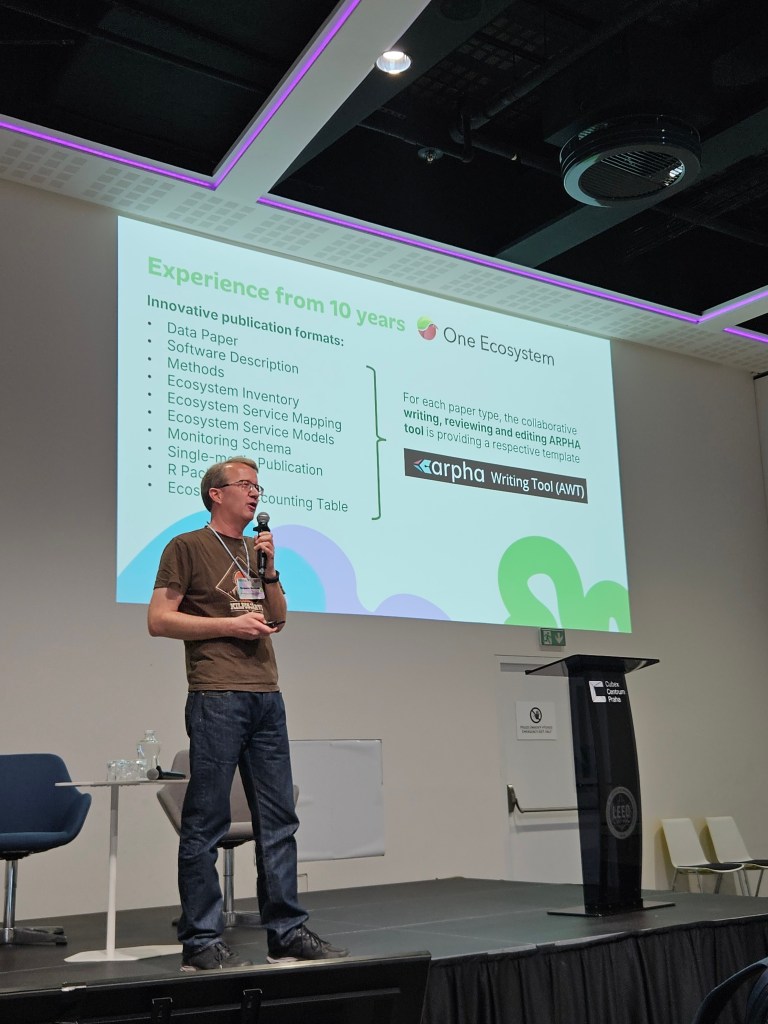
The One Ecosystem journal took center stage once again on Friday afternoon during a panel session titled, “The Changing Landscape of Academic Publishing on Ecosystem Services Research: Editors’ Perspectives.” The event brought together the Editors-in-Chief of the three ESP-associated journals for an engaging open discussion about the shifting dynamics of scientific literature. Sharing insights gained from One Ecosystem’s 10-year journey, Burkhard highlighted how authors of research who work closely with their publishers can support knowledge sharing and empower researchers. In the case of One Ecosystem, this collaboration translates to increased visibility, discoverability, reusability and citability of the published work, as well as rapid and hassle-free authoring and peer review experience, all thanks to the automated workflows and human-centric approaches provided through the publishing solutions of the ARPHA publishing platform.

It is worth issuing a reminder that manuscripts submitted in 2026 and accepted for publication in One Ecosystem journal are eligible for a 10% discount on the article publication charge (APC).

Despite excellent on-site organization, many sessions struggled to accommodate the massive turnout. Photo courtesy of the ESP.

Throughout the week, the daily program featured eight parallel session tracks covering a wide range of topics, many closely aligned with ESP Working Groups and National Networks. A dedicated poster session took place on Wednesday afternoon.

One of the field excursions offered ESP 2026 Europe delegates the challenge of an intense, half-day climbing experience in a nature park just outside Prague. Photo courtesy of ESP.

On Thursday, delegates had the opportunity to join one of several field excursions. These ranged from a visit to the unique rewilding reserve located in the former military area in Milovice, to a walk through the Prague Pasture: one of the city’s most remarkable natural sites, and an intense climbing experience just outside Prague.

Zdeněk Ent was awarded Best Poster for his poster, “Experiencing Ecosystem Services: Art, Sensory Engagement and Transformative Learning in Peri-Urban Landscapes”. In a yearly tradition, part of the award includes a free publication in the One Ecosystem journal.

Following an ESP tradition, the three highest-voted posters were recognised during Friday’s closing ceremony, with the first-prize winner receiving a free publication in One Ecosystem, sponsored by Pensoft. This year, the Best Poster Award went to Zdeněk Ent from Prague Institute of Planning and Development for the poster “Experiencing Ecosystem Services: Art, Sensory Engagement and Transformative Learning in Peri-Urban Landscapes”.

During the week, Pensoft’s exhibition stand welcomed dozens of inquiries regarding the publisher’s tailored journal portfolio. Visitors also expressed keen curiosity about the publishing services and self-developed platform available to journal owners, book authors, and conference organizers. Meanwhile, delegates showed notable interest in several titles, both well-established journals like Nature Conservation, NeoBiota, Metabarcoding & Metagenomics and One Ecosystem, and newly launched ones, including Individual-based Ecology and Advances in Pollinator Research.

A lot of Pensoft stand’s visitors were also pleased to see that there was a new player amongst the journals of Pensoft aimed at an emerging field in ecology. The recently rebranded Agricultural and Ecological Modelling (AEM) provides a unique scholarly outlet thanks to its modern approach to publishing by increasing transparency, giving credit to research objects across the entire modelling research lifecycle. This is achieved through publishing specialised article types, such as: Formal Model, Model Testing and Calibration, Model Implementation and Documentation, Data Papers and Software Descriptions. These new publishing formats are designed to keep pace with advances in Modelling research and to make it FAIR (Findable, Accessible, Interoperable, and Reusable) by enabling scholarly credit for diverse research outputs, often created by different groups of authors. For the time being, AEM remains a Diamond Open Access journal, meaning that it will not charge authors for open-access publication.

AEM also has a focus on open science and reproducibility; it is currently archived in four databases (CLOCKSS, Zenodo, Portico, and Zendy) and indexed in over 40 services, including AGRICOLA, CABI, ChronosHub, CNKI, FAO AGRIS, ResearchGate, and Swisscovery, among others. You can learn more about AEM in the latest editorial.

For those who missed the opportunity to sign up for the journals’ newsletters at the stand, they can do this by filling in their email address from the homepage of the journal they are interested in, or by updating their profiles in the Pensoft system.

Undoubtedly, amongst the greatest highlights at the Pensoft’s stand was the Horizon Europe-funded GREEN TALENT project, where our Project Department leads the project’s Work Package dedicated to Communication, Dissemination and Exploitation. 

The conference delegates were intrigued to learn about the international initiative’s aim to build biodiversity and climate capacity at national, trans-European and global levels, with a focus on Widening Countries. The partners at Green Talent: both from academic and non-academic backgrounds, are to contribute expertise, training, and secondments and connect pilot projects to broader EU and global networks. One of the ways the GREEN TALENT consortia does this is by designating four Demonstration Pilots (a.k.a. Demo Hubs) in four Widening countries: Malta, Greece, Cyprus and Bulgaria, where secondees can benefit from real-world experience and foster partnerships across sectors, while working on scalable solutions to climate and biodiversity challenges, acting as collaboration hubs between academic and non-academic sectors.

Members of the Horizon Europe-funded GREEN TALENT project consortium. Photo courtesy of ESP.

Having only kicked off a year ago and set to run for four years in total, there are many new developments and results yet to be announced from GREEN TALENT, including a Capacity-Building Platform that will allow users to browse various opportunities and events meant to help them improve their skills; to get in touch and foster collaboration with other experts; and to learn about best practices from across different institutions and relevant companies. This is why we strongly recommend visiting the GREEN TALENT, signing up for the project’s newsletter and following the initiative on BlueSky and Linkedin.

GREEN TALENT’s project coordinator, Prof. Dr. Mario V. Balzan, presented at a session dedicated to sustainable and inclusive approaches to ecosystem services tailored to the needs of islands.

In addition to the various GREEN TALENT information brochures and promo materials present at the Pensoft stand, people at the conference could spot quite a few of the project’s members around the ESP venue. There were several talks by GREEN TALENT representatives, including the project’s coordinator: Prof. Dr. Mario V. Balzan (Ecostack Innovations). His talk, part of the session “Islands at the forefront of sustainable and inclusive ecosystem services approaches” examined governance and knowledge gaps in pollinator ecosystem services on small islands, where he used Malta as a case study.

The signature journal stickers by Pensoft were once again a common sight at the ESP conference in Prague. Photo courtesy of ESP.

Ultimately, the conference successfully highlighted the tools needed to drive sustainable development across Europe. Through active contributions to both the overarching policy discussions and the targeted skill-building sessions for the next generation of researchers, Pensoft continued its commitment to making environmental science open, transparent, and globally accessible.

Make sure to stay up to date with the latest from Pensoft by following our social channels on BlueSky, Linkedin, Facebook, Instagram and Weibo.

Pensoft Welcomes Endocrinologia Journal to its Open-Access Journal Portfolio

The peer-reviewed, open-access Endocrinologia Journal, published by the Bulgarian Society of Endocrinology is moving to ARPHA, the publishing platform developed by Pensoft.

Launched by the Bulgarian Society of Endocrinology back in 1996, the open-access, peer-reviewed Endocrinologia Journal is now moving to the publishing platform ARPHA, developed by the scholarly publisher and technology provider Pensoft.

Focusing on research in basic and clinical endocrinology and metabolic disorders, the journal publishes review articles in Bulgarian, alongside original papers and case reports available in both English and Bulgarian. The paper issues of the journal are published quarterly while the electronic online versions of the papers are published as soon as final approval is granted and formatting is completed. 

Due to the generous support of the Bulgarian Society of Endocrinology, publication in the journal is free to all authors.

Homepage of the Endocrinologia Journal.

In addition to a refreshed, user-friendly design, the Pensoft-developed publishing platform ARPHA provides its signature fast-track, end-to-end publishing system to the benefit of its users: authors, reviewers and editors alike.

Each submitted manuscript is carried through the review, editing, publication, dissemination and archiving stages without leaving ARPHA’s collaboration-focused online environment. The articles are available in PDF and machine-readable XML formats, so that they are easy to discover, access, cite and reuse. Endocrinologia Journal is indexed in Scopus, CrossRef, EMBASE, and the Bulgarian Citation Index, and archived through CLOCKSS and Zenodo.

Endocrinologia Journal

The introduction of an online platform for submitting manuscripts will contribute to improved management of the publishing activities of the journal Endocrinology and will help the journal, as the official publication of the Bulgarian Society of Endocrinology, meet current standards for full integration into international scientific databases,

commented Prof. Maria Orbetzova, the journal’s Editor-in-Chief.

Endocrinologia Journal brings a rich legacy of peer-reviewed endocrinology research to our portfolio, and we are excited to support its next chapter. Through ARPHA, we hope to give the journal’s authors, reviewers and editors the tools they need to publish faster, reach further, and make a greater impact,

added Prof. Lyubomir Penev, founder and CEO of Pensoft and ARPHA.

About the Bulgarian Society of Endocrinology:

Founded in 1958, the Bulgarian Society of Endocrinology (BSE) is a professional medical organization dedicated to advancing endocrinology in Bulgaria. Its core mission encompasses the continuous education of endocrinologists, trainees, GPs, and other specialists, alongside the development of national screening programmes for diabetes, obesity, hypertension, and dyslipidaemia, and the establishment of Bulgarian clinical guidelines on diabetes management. The BSE supports both healthcare professionals, through Schools of Endocrinology and specialist symposia, and patients, via public education courses and media outreach. It hosts annual scientific congresses and publishes the peer-reviewed journal Endocrinologia.

About ARPHA:

ARPHA is a full-featured, end-to-end publishing platform for journals, books, conference materials and preprints. ARPHA offers flexible operating and business models, and a wide-range of automated and human-provided services. The ARPHA team places a special focus on its scholarly communication solutions designed to leverage the visibility and outreach of academic output, while promoting inclusivity and engagement.

About Pensoft Publishers:

Founded in 1992 “by scientists, for scientists”, the academic open-access publishing company is well known worldwide for its novel cutting-edge publishing tools, workflows and methods for text and data publishing of journals, books and conference materials. Back in 2010, Pensoft became the first scientific publisher to introduce semantic enrichments in scholarly publications. Through its Research and Technical Development department, the company is involved in various research and technology projects.

Annals of the Natural History Museum Vienna begins publishing with Pensoft

The Annals of the Natural History Museum Vienna (ANHMW) has launched its first issue since transitioning to the ARPHA scholarly publishing platform and entering a co-publishing partnership with Pensoft. 

The open-access, peer-reviewed journal publishes original research relating to the museum’s scientific collections and ongoing projects, covering anthropology, biosciences, earth sciences, genetics, prehistory, and the museum’s history.

journal mockup.

Established in 1836 as the Annalen des Wiener Museums der Naturgeschichte, the journal is one of Europe’s oldest periodicals, maintaining a longstanding tradition of scientific publishing. Over the years, the journal experienced various iterations and name changes and, in 1980, it was divided into three series. Now, following the transition to Pensoft, these series have been reunited under one title.

ANHMW operates as a diamond open-access journal, allowing authors to publish freely thanks to the generous support of the Natural History Museum Vienna. Co-published by Pensoft and the museum, all articles are available in multiple formats including HTML, JATS XML, and high-resolution full-colour PDF. 

journal mockup.

Content is enhanced semantically and converted into Linked Open Data and OpenBiodiv Biodiversity knowledge graphs. To meet nomenclatural standards for electronic publication, all articles will be indexed and archived in repositories such as Zenodo, CLOCKSS, Portico, and more, with nomenclatural acts registered in ZooBank.

The joint Editors-in-Chief, Dr Anna Weinmann, Mag Andrea Krapf, and Dr Nesrine Akkari, expressed enthusiasm for the journal’s digital transformation. Andrea Krapf commented, “I am very proud to accompany such a venerable and traditional journal as the Annalen des Naturhistorischen Museums in Wien on its journey into the digital future under its new English title, Annals of the Natural History Museum Vienna. In Pensoft, we have found a reliable partner to publish the journal under a modern diamond open access model, making it thus more attractive to the scientific community and the general public.”

Dr Nesrine Akkari said, “Since joining the editorial team of the Annalen des Naturhistorischen Museums in Wien as the editor-in-chief of Serie B in 2018, I have witnessed continuous attempts to modernise the journal’s editorial workflow and publications. The idea of moving to Pensoft as a co-publisher was discussed and I am delighted that our managers support it.

“As both a scientist and an editor, I recognise the importance of the Annals as part of the museum’s legacy, while I also recognize the many advantages of the collaboration with Pensoft. I believe that this change marks a new era for the Annals and that, by combining modernity and tradition, our journal will continue to thrive.”

Prof Lyubomir Penev, CEO and Founder of Pensoft, welcomed the partnership: “We are thrilled to welcome the Annals of the Natural History Museum Vienna into the Pensoft family of next-generation scientific journals. ARPHA’s publishing solutions will allow the journal to modernise and find new audiences.”

The first issue is now available on the ANHMW’s new website, including an editorial by the Editors-in-Chief reflecting on the past and future of this historic journal.

Nota Lepidopterologica welcomes new Editor-in-Chief Marcin Wiorek

Wiorek has strong skills in lepidopteran morphology and molecular knowledge, and will join co-Editor-in-Chief Théo Léger to continue the development of the journal.

Marcin Wiorek joins Nota Lepidopterologica’s editorial team as a co-Editor-in-Chief together with Théo Léger. He was elected to replace David Lees in this capacity on 22 August 2025  at the meeting of the Society for European Lepidopterology (SEL), the society behind the open-access, peer-reviewed Nota Lepidopterologica journal.

A man in a beige shirt stands near a stone wall, accompanied by a large yellow moth resting on their shoulder.
Marcin Wiorek.

“I am truly honoured, but also happy to join the team of Nota Lepidopterologica as a successor of David C. Lees and all previous great Editors. My interest in Lepidoptera focuses on tiger moths (Arctiinae), and different aspects of their systematics, phylogeny, biology and zoogeography. During the past few years, I have been studying the Syntomini of Madagascar, a group that ignited my professional and deep interest in moths, resulting in my recently obtained PhD,” Wiorek said.

The move follows David Lees’ resignation as a co-Editor-in-Chief after eight years of service. Here is a note from him on his time in Nota Lepidopterologica:

A man stands in a dense jungle, wearing a hat and carrying a net for collecting insects, surrounded by lush greenery.
David Lees. Photo by Brian Fisher

“It has been a real privilege to serve as an Editor-in-Chief of the open-access journal Nota Lepidopterologica since 2017 (Issue 40 (2)). Over these eight years I have aimed to keep up the high standards established by my predecessors, the fine lepidopterists Erik van Nieukerken, Jadranka Rota (currently president of SEL, now known as Society for European Lepidopterology) and later Maria Heikkilä, whom I replaced, and to be able to help improve the accessibility, inclusivity (e.g., we welcome submissions outside the EU), and high scientific standards of the journal, working with the team at Pensoft. Plamen Pankov and Boriana Ovcharova have been particularly helpful, aided by their colleagues, as well as Matthias Nuss and Wolfgang Eckweiler in solving printing issues.

“As a co-Editor-in-Chief, I helped edit 11 issues between 2017 and 2025, containing 148 papers and 2,114 pages, occupying some 12 cm of shelf space! During this time, an Impact Factor was introduced (currently 0.7). I trust its quality, accessibility and readership will continue to improve, for example each paper integrates an Altmetric score and Pensoft often offer to promote papers with a wider interest.

“My co-Editor-in-Chief Théo Léger will continue his fine work, together with Marcin Wiorek who was elected to replace me at the 24th European Congress of Lepidopterology held in the Czech Republic last month. I know Marcin very well; we have been to the field together in Madagascar on two occasions and I have also had the pleasure to collaborate with him, and can thus vouch for his strong scientific and linguistic abilities as well his broad skillset in Lepidoptera (particularly erebid moth) morphology and strong molecular knowledge and other technical abilities. These will be invaluable in deciding on the increasingly integrated nature of submissions received at Nota Lepidopterologica. He is already well known in the SEL community.

“I will continue as a Senior Curator at the Natural History Museum, London, where I am in charge of microlepidopterans, and look forward to having more time to focus on my own scientific output.“

Nota Lepidopterologica’s latest issue.

“I am thrilled to contribute – together with co-Editor-in-Chief Théo Léger – to the further development of the journal and the maintenance of its high professional and editorial level,” added Wiorek. “I believe that my dedication to high publishing standards, implementing modern research methods embedded in the classical taxonomy and systematics of Lepidoptera, will help me work effectively on adding further centimetres of substantive shelf space to the legacy of our journal. I think that my interest in European languages (especially English, crucial to fully enjoy the British humour of my predecessor during joint field trips to Madagascar) can also help me a bit…”

Pensoft and Nota Lepidopterologica thank David for his hard work and dedication and wish him all the best in his future endeavours. We also look forward to working with Marcin on the journal’s development and wish him every success as he takes on this new role.

Pensoft to co-publish Problems of Dental Medicine with Faculty of Dental Medicine at Medical University Sofia

By joining Pensoft, the journal will benefit from improved publishing infrastructure and increased visibility and discoverability for its publications.

A dental publication titled "Problems of Dental Medicine" featuring a gloved hand holding a dental X-ray.

Pensoft Publishers has partnered with the Faculty of Dental Medicine at Medical University Sofia to co-publish the peer-reviewed journal Problems of Dental Medicine.

Published continuously since 1973, the journal offers a venue for high-quality research in dental medicine, public dental health, and healthcare. It publishes research and review articles and short communications, as well as methods, data, and forum papers in a wide range of disciplines in dentistry and dental sciences. Thanks to support from Medical University Sofia, authors of Problems of Dental Medicine can publish their articles for free.

Along with its most recent articles, the journal’s backlist content is also available on its website.

In joining Pensoft, Problems of Dental Medicine will get access to improved publishing infrastructure and benefit from increased visibility and discoverability for its published research. The journal will use Pensoft’s self-developed platform, ARPHA – an end-to-end publishing solution that makes it easy for both humans and machines to access, cite, and reuse research. ARPHA streamlines publishing workflows, providing a single online ecosystem for the entire editorial process, from manuscript submission to peer review, editing, publication, and archiving.

“Problems of Dental Medicine has a long history and established traditions, but joining Pensoft marks a major step forward in the journal’s development,” said Editor-in-Chief Prof. Boyko Bonev. “I am confident that this collaboration will be extremely beneficial, providing broader international visibility, greater accessibility, and new opportunities for the advancement of dental science.”

“We are excited to start this new chapter with Problems of Dental Medicine and believe this partnership will significantly contribute to the development and understanding of dental science,” commented Prof. Lyubomir Penev, CEO and founder of Pensoft and ARPHA.

Scientific Annals of the Danube Delta Institute publishes its first articles with Pensoft

Established in 1993, the journal offers a multidisciplinary platform for studies related to wetlands and deltaic environments.

The first articles of Scientific Annals of the Danube Delta Institute (SADDI) —the official journal of the Danube Delta National Institute for Research and Development in Tulcea, Romania—have now been published on the journal’s new website following its transition to Pensoft’s ARPHA platform.

Two white spoonbills standing in shallow water, reflecting in the pond, surrounded by lush greenery and scattered debris.
Eurasian Spoonbills (Platalea leucorodia) in the Gandoman Wetlands. Photo by Ruhollah Asgari

The newly published articles focus on supporting the sustainable management of the Danube Delta, including an assessment of the impact of pesticide residues on the river and some insights on the potential of earth observation data for monitoring the Delta. The journal also publishes research on the ecology and biogeography of wetland ecosystems in general, such as a study on the habitat and behaviour of the Eurasian Spoonbill (Platalea leucorodia).

Established in 1993, the journal offers a multidisciplinary platform for studies in the fields of ecology, biodiversity, environmental protection, hydrology, ichthyology, ornithology, limnology, and sustainable development related to wetlands and deltaic environments. It is free to publish and open for submissions.

“With the launch of the first articles in Volume 30 of the Scientific Annals of the Danube Delta Institute, now published with Pensoft, we celebrate an important milestone in advancing research on biodiversity, aquatic ecology, and data integration,” said the journal’s Editor-in-Chief Iuliana-MihaelaTudor of the Danube Delta National Institute for Research and Development.

“This new stage reflects not only the scientific value of the contributions, but also the collaborative spirit that strengthens our community and drives innovation forward.

“As Louis Pasteur once said, ‘Science knows no country, because knowledge belongs to humanity, and is the torch which illuminates the world.’

“We warmly invite our readers, authors, and collaborators to explore this volume, to share in the exchange of ideas, and to continue building together a future where open science connects and empowers us all.”

Senckenberg Nature Research Society’s General director Prof. Klement Tockner on a visit at the National Museum of Natural History and Pensoft

An important discussion point was the performance of the four Senckenberg journals, which moved to Pensoft’s publishing platform a few years ago. On the agenda was also the opportunity for an Open Access agreement

Prof. Klement Tockner, Director general of the Senckenberg Society for Nature Research (centre) with Pensoft’s founder and CEO Prof. Lyubomir Penev (right) and Prof. Pavel Stoev, Director of the National Museum of Natural History (Bulgaria) and COO at Pensoft (left).

On 2 June 2023, we welcomed Prof. Klement Tockner, Director general of the Senckenberg Society for Nature Research, who travelled to Bulgaria to meet with Pensoft’s and the National Museum of Natural History’s (NMNHS) senior management to discuss current and future collaborations. 

The visit took place in the NMNHS, where Tockner had fruitful discussions with Pensoft’s founder and CEO Prof. Lyubomir Penev and Prof. Pavel Stoev, Director of the Museum and COO at Pensoft.

An important point in the discussion was the performance of the four scientific journals, owned by the Society, which moved to Pensoft’s publishing platform ARPHA a couple of years ago, and marked the beginning of a fruitful and highly promising partnership.

On the agenda was also the opportunity for an Open Access agreement to be signed between the Society and the publisher, in order to support researchers who wish to publish in any Pensoft journal. 

Tockner was also curious to learn more about the additional publishing services, provided by Pensoft via the ARPHA platform, including the various and continuously elaborated data publishing workflows, and the opportunities to streamline the description of new marine species, identified from DNA material.

In early 2021, the Senckenberg Society for Nature Research signed with the publisher to move three of its legacy titles from the natural sciences domain: Arthropod Systematics & Phylogeny, Contributions to Entomology, Geologica Saxonica and Vertebrate Zoology.

Later the same year, in November, the journal Contributions to Entomology followed suit. All four of them went for the white-label publishing solution available from ARPHA, designed to preserve the exclusive identity of historical journals.

The partners also talked about further extending the collaboration between Senckenberg and Pensoft to European Commission-funded scientific projects. Tockner was particularly fascinated with the progress made by the currently undergoing project Biodiversity Community Integrated Knowledge Library (BiCIKL), coordinated by Pensoft and involving 14 European institutions from ten countries. Additionally, over the past 20 years, Pensoft has also partnered in over 50 different consortia as a publisher, science communicator and technology provider.

Stoev (right) showing Tockner (left) around the collections of the National Museum of Natural History (Sofia, Bulgaria).

In his role as Director of the NMNHS, Stoev used the occasion to tour Tockner around the NMNHS collections and tell him more about the Museum’s latest achievements and projects, as well as its traditions in the fields of human evolution research and paleornithology.

Stoev (left) tells Tockner (right) more about the recently launched Bulgarian national unit of DiSSCo.

The two also engaged in a vivid discussion about the poorly studied biodiversity in Bulgaria and the region, but also about the recent efforts of the NMNHS team, including the launch of a Bulgarian national unit of DiSSCo tasked to digitise a large proportion of the institution’s collection in the next three years. Tockner and Stoev also talked about the need of additional networking activities and closer collaborations between smaller natural history museums across Europe that could be mediated through the Consortium of European Taxonomic Facilities (CETAF), where Senckenberg is an active member.

***

Follow ARPHA Platform on Twitter and LinkedIn for further updates.

RIO shifts gears to serve as a project-driven knowledge hub

Research Ideas and Outcomes (RIO Journal) upgrades its unique concept to appeal to scientific projects, conference organisers and research institutions

Research Ideas and Outcomes (RIO Journal) upgrades its unique concept to appeal to scientific projects, conference organisers and research institutions

Over the last few years, we’ve been increasingly observing how major funders of research around the world, including the likes of the European Commission, Wellcome, U.S. National Institutes of Health (NIH), Deutsche Forschungsgemeinschaft (DFG) and the Japan Society for the Promotion of Science (JSPS) recognise the research cycle as a continuum, rather than scattered standalone conclusions and reports. 

Hence, as a forward-looking, open science-driven journal Research Ideas and Outcomes (RIO) took it as its own responsibility to encourage scientific project teams, conference organisers and research institutions to bring together unconventional research outputs (e.g. grant proposals, data management plans, project deliverables, policy briefs, conference materials) as well as traditional (e.g. research or review papers, monographs, etc.), including such published elsewhere. To do so, RIO now provides the platform ready to be used as a research knowledge hub, where published outcomes are preserved permanently and easier to share, disseminate, reference and reuse.

Hence, RIO stepped up its game by turning permanent article collections into a one-stop source of diverse research items, where project coordinators, conference organisers or research institutions can not only publish early, interim and conclusive research items as they emerge within a research project, a series of events or the continuous scientific efforts at their lab, but also link relevant publications (i.e. preprints, articles or other documents, published elsewhere) available elsewhere through their metadata. As a result, they will receive a one-stop source under their own branding for every piece of scientific contribution ready to present to funding bodies or prospective collaborators and future research teams.

A permanent topical collection in RIO Journal may include a diverse range of both traditional and unconventional research outputs, as well as links to publications from outside the journal (see What can I publish on the journal’s website). 

Apart from bringing contextually linked research outcomes together, thus prompting findability, readership and citability en masse, RIO’s approach to collections ensures further accessibility by not only having RIO-published articles available in traditional PDF, semantically enriched HTML and minable XML format. The open-science journal has now made it possible for users to add to their collections preprints from ARPHA Preprints, as well as author-formatted PDFs (e.g. project deliverables, reports, policy briefs, etc.) and linked metadata to documents published elsewhere. Thanks to the integration of the journal with the general-purpose open-access repository Zenodo, all items in a collection are archived, and additionally indexed, disseminated and cited.

By focusing on article and preprint collections coming out from a research project, institution or conference, RIO provides a quite specific and unique combination of benefits to all actors of the research process: scientists, project coordinators, funders and institutions: 

  1. Project, institution or conference branding and promotion.
  2. One-stop point for outputs of a research project, institution or conference.
  3. Free publication of author-formatted project outputs (i.e. grant proposals, deliverables, reports, policy briefs, conference materials and others).
  4. Inclusivity through adding articles, preprints and other documents published elsewhere as easy as entering the DOI number of the document.
  5. Credit and recognition for the Collection and Guest editors, who take care to organise and manage the article collection.
  6. Easier discoverability and usability of topically related studies to benefit both authors and readers.
  7. Increased visibility of related papers in a collection, even when these might otherwise not have much exposure.
  8. Simultaneous citation of multiple articles related to a certain subject.
  9. Citation and referencing of the whole collection as a complete entity.
  10.  DOI and citation details for collections and individual articles.

Furthermore, RIO Journal maps all publications to the Sustainable Development Goals  (SDGs), in order to emphasise the real-world impact of each published contribution, by displaying the corresponding badge within the article list. 

Last, but not least, both collections and individual publications in RIO enjoy the variety of default and on-demand science communication services, provided by Pensoft.  

How do project coordinators, funders and institutions benefit from a collection in RIO?

At the time a grant proposal is submitted to a research funder for evaluation, the team behind the proposed project has already put in considerable efforts, resulting in a unique idea with the potential to make a great stride towards the resolution of an outstanding problem in science, if only given the chance. However, too many of these ideas are bound to remain locked away in the archives of those funders, not because they are lacking in scientific value, but due to limited funds.

So, with its launch back in 2015, RIO Journal made it possible to publish and shed light on grant proposals and research ideas in general, similar early research outputs regardless of whether they are eventually funded or not, a novelty in scholarly publishing which earned RIO the SPARC Innovator Award Winner in 2016. To date, the journal has already published 75 grant proposals

Then, imagine what a contribution to science it would make to bring together the whole continuum of knowledge and scientific work all the way from the grant proposal to data  and software management plans, workshop reports, policy briefs and all interim and final deliverables produced within the span of the project!

On the other hand, funders are increasingly evaluating a prospective project’s impact based on its communication strategy. So, why not publish a grant proposal at the time of the submission of your proposal, in order to prove to the funding body that your project is serious about optimising its outreach to both the public and academia? Furthermore, by having an academic journal host any subsequent project deliverable, as a coordinator, you can rest assured that the communication activities of your project remain consistent and efficient.

In an excellent example of a project collection, the EU-funded ICEDIG (Innovation and Consolidation for Large Scale Digitisation of Natural Heritage), led by several major natural history institutions, including the Natural History Museum of London, Naturalis Biodiversity Center (the Netherlands), the French National Museum of Natural History and Helsinki University, brought together policy briefs, project reports, research articles and review papers, in order to provide a fantastic overview of their own research continuum. As a result, future researchers and various stakeholders can easily piece together the key components within the project, in order to learn from, recreate or even build on the experience of ICEDIG.

The Path2Integrity Project Outcomes collection demonstrates how research papers published elsewhere are featured in RIO Journal.

Similarly, conference organisers can make use of their own branded collections to overcome the ephemerality of presented research by collating virtually all valuable conference outputs, including abstracts, posters, presentations, datasets and full-text conference talks. For further convenience, a collection can be divided into subcollections, in order to organise the contribution by type or symposium. What particularly appeals to conference participants is the ARPHA Writing Tool, an intuitive collaborative online environment, which practically guides the user through each step: authoring, submission and pre-submission review, within a set of pre-designed, yet flexible templates available for each type of a conference output, thus sparing them the hassle to familiarise themselves with specific and perplexing formatting requirements

For institutions, RIO offers the opportunity to continuously provide evidence of the scholarly impact of their organisation. To better serve the needs of different labs or research teams, an institution can easily organise their outputs into various subcollections, and also customise their own article types, as well as the available usage tracking systems. Furthermore, by making use of the available pre-paid plans, institutions can support their researchers by covering fully or partially the publication charges at a discounted rate.

***

Find more information regarding the submission and review process, policies and pricing, visit RIO Journal’s website.

Follow RIO Journal on Twitter and Facebook.

Making the most of conferences with modern publishing and indexing practices

Given scientific conferences present academics with the fantastic opportunity to meet up and discuss their latest work, as well as share their vision for the future of their field, it’s no wonder that, historically, the majority of ground-breaking science can easily be traced back to a particular event.

This said, don’t you think that we need to do everything within our powers to ensure the visibility, dissemination and long-term accessibility of research presented and linked to these wonderful drivers of scientific progress that conferences are? Similarly to the care conference organisers take to make sure the event runs smoothly and the attendants are happy with the programme and enjoy themselves, the organisational committee should also be thinking how to preserve all those promising pieces of research well after the event is over.

Here at Pensoft, an open-access scholarly publisher, founded by scientists, we’ve been contemplating for a while now how to encourage and support the community to efficiently open up the valuable outputs to researchers and readers well beyond the publication of abstracts in an abstract book of the conference. 

As a result, we came up with several simple, yet efficient publishing solutions for scientific conferences to collect and contextualise various research outputs either presented at or resulting from the event.

Bear in mind that with any solution, all publications enjoy the benefits seen in conventional research papers, such as:

  • Crossref registration and individual DOI to ensure preservation;
  • Publication in PDF, semantically enhanced HTML and data-minable XML formats to improve readability, accessibility and findability;
  • Indexing and archiving at multiple, industry leading databases to increase visibility;
  • PR and social media promotion to boost outreach to various audiences.

Collections of conference abstracts, posters and presentations

Conference (video) abstracts, posters and presentations are easily the first to fall victims of the ephemerality of an event, yet these are too often the stepping stones to major scientific discoveries. This is why a few years back we launched ARPHA Conference Abstracts (ACA), where conference organisers can open their own collection and provide the participants with submission, review and publication of their abstracts ahead of the conference.

Furthermore, these abstracts can be handled editorially in sub-collections, e.g. the convenors of symposia or working groups within a conference will take care of the abstracts submitted to them, thus spreading the editorial workload across larger teams of editors and organisers.

Not only will conference organisers spare themselves the worries about providing a special platform for abstracts submissions, but this will also facilitate presenting authors, who will be able to easily point to their contribution before, during or after their presentations. On the contrary, the abstracts are assigned with DOIs, published in human-readable PDF and HTML and machine-actionable JATS XML, permanently preserved on ARPHA and Zenodo, and easy to find, access and cite, just like a conventional research paper, providing authors with full credit for their work early on.

Further, with ACA, the conference abstracts can be enhanced into what we call “extended abstracts”, meaning they can also include data, images, videos and multimedia. After the conferences, we can add video recordings of the presentations or graphic files of posters, so that these are visualised on the page of each abstract.

For example, take a look at the conference abstract collection of the Vth International Congress on Biodiversity: “Taxonomy, Speciation and Euro-Mediterranean Biodiversity”.

Conference proceedings

About the time we launched ACA, we also created ARPHA Proceedings, in order to also find a place for full-text conference papers. Similarly, the platform supports dedicated collections, where conference attendants are invited to submit and publish dynamically articles under the imprint of the event.

Conference papers in ARPHA Proceedings can also include data, figures and citations, and can also be updated with video recordings, posters and presentations following the conference.

Check out an example by the VI International Forum on Teacher Education.

Article topical collections and special issues resulting from conferences

Naturally, papers resulting from a particular conference are contextually linked, so a one-stop place to discover topical studies sharing one and the same topic would be greatly appreciated by readers and future researchers. In turn, this would lead to better viewership and citability of the papers in the collection.

With our user-friendly, dedicated workflow for special issues and permanent topical article collections, we’ve made it easy for guest editors across our journals to pitch and manage article collections, in order to bring together valuable and related studies. Using such a collection under the theme of your conference in a suitable journal, you can invite your conference’s participants or, better yet, all scientists working within the field, to submit their work in a nice package of topical science. We’d be happy to assist you with the identification of the most suitable journal for your conference, authors and goals.

See an example from One Ecosystem and the collection “Mapping and assessment of ecosystem condition and ecosystem services across different scales and domains in Europe”, the result from the “Mapping and assessment of ecosystem services – Science in action” conference, held in 2017.

Bringing together traditional and non-conventional research outputs, (e.g. research ideas, grant proposals, conference materials or workshop reports) with RIO Journal’s article collections

Undoubtedly, valuable research outcomes come in many shapes and sizes well beyond research papers, conference abstracts, posters and proceedings. We are firm supporters that every research item, even early and interim outputs, could be of value to the scientist next in line within a particular study.

This is why we launched the award-winning journal Research Ideas and Outcomes (RIO), where your collections can include both conventional and non-traditional research outputs, such as research ideas, posters, workshop reports, forum papers, policy briefs, software and data management plans to name a few. Furthermore, in RIO, you can even link articles or preprints published elsewhere to your collection via their metadata. Similarly to other Pensoft journals, in RIO, you will have the full control to whom you are opening your collection for submissions, allowing you to either limit it to the outcomes coming from your conference or welcome submissions from other researchers as well.

A permanent topical collection in RIO Journal may include a diverse range of both traditional and unconventional research outputs, as well as links to publications from outside the journal (see What can I publish on the journal’s website). 

See the Brainhack 2016 Project Reports, whose aim is to collate reports from the 2016 Brainhack events. Also, check out the collection of the European Biodiversity Observation Network (EU BON) Project, providing a nice example for a wide range of publication types.

***

Don’t hesitate to get in touch to discuss your own case and select the best option for your conference – we’ll be happy to hear from you!

***

Follow Penoft on Twitter and Facebook and subscribe for Pensoft’s blog.

Bulgarian Academy of Sciences signs with Pensoft to move Silva Balcanica journal to ARPHA

The first 2020 issue of the journal by the Academy’s Forest Research Institute is already online on a brand new and user-friendly website

The scholarly publisher and technology provider Pensoft welcomes the open-access, peer-reviewed international journal in forest science concerning the Balkan Peninsula, Central and Southern Europe Silva Balcanica to its self-developed publishing platform ARPHA. Having become the latest addition to the lengthy portfolio of scholarly outlets dedicated to the fields of ecology and biology for Pensoft and ARPHA, Silva Balcanica is now offering a wide range of benefits and services to its readers, authors, reviewers and editors alike.

Having already acquired its own glossy and user-friendly website provided by ARPHA, Silva Balcanica also takes advantage of the platform’s signature fast-track, end-to-end publishing system. In addition, the published content enjoys automated export of data to aggregators, as well as web-service integrations with major global indexing and archiving databases.

Silva Balcanica’s new website on ARPHA Platform. Visit athttps://silvabalcanica.pensoft.net 

Ever since its inception in 2001, the journal by the Forest Research Institute at the Bulgarian Academy of Sciences (FRI-BAS), has been providing open access to the latest research in all aspects of forest ecosystems and landscapes of the Balkan Peninsula, and also Central and Southern Europe.

Silva Balcanica invites scientific analysis of practical results, as well as investigations, in the forest sciences, including forest ecology; forest soil science; forest genetics, tree breeding and plantation forestry; biometry and sylviculture; forest economy and management; forest entomology and pathology; ecology and management of game fauna, urban forestry and green infrastructure. Constructive critique addressing scientific publications or events in the field of forestry and forest science are also accepted.

In the first 2020 issue of Silva Balcanica, we can find a total of eight research papers, dealing with a range of various topics, including studies on local plant diversity, genetics, application of experimental designs for forestry research, ecosystem services, population dynamics, invasive pathogens and previously unknown populations of forest-dwelling insects. It brings together single-authored research contributions as well as international collaborative projects, with input from authors from Bulgaria, Greece, Northern Macedonia and Italy.

CEO and founder of both Pensoft and ARPHA Platform Prof. Lyubomir Penev comments:

“Silva Balcanica is an important scholarly outlet and also a remarkable example of international cooperation, inspired and maintained by curiosity, care and responsibility towards the unique, but fragile ecosystems this part of Europe hosts. This is why we take pride in having this particular journal joining our portfolio,”

Silva Balcanica’s Editorial Board says:

“The Scientific Council of the Forest Research Institute at the Bulgarian Academy of Sciences decided to begin publishing Silva Balcanica as an international series in 2001 and since 2014, Silva Balcanica has been published as an international journal.

We are honored to have as members of our Editorial Advisory Board eminent European professors and researchers in forestry and related sciences that join our efforts in pursuit of high quality scientific publishing.

We are confident that Silva Balcanica will unite the research of scientists and specialists in forestry from Southeastern, Central and Eastern Europe and beyond, and will help them in the processes of their European integration.”

###

Visit the new website of Silva Balcanica at https://silvabalcanica.pensoft.net.