


From 18 to 22 May 2026, the historic city of Prague, Czechia, hosted the 6th European Conference of the Ecosystem Services Partnership (ESP). Set against a backdrop of global turning points, such as biodiversity declines and climate uncertainty, the event served as an important forum for discussing how ecosystem services can cultivate a sustainable and equitable future.

The conference ran under the theme, “Advancing ecosystem services knowledge for achieving a nature- and people-positive Europe.” Attendees focused on how to translate major policy frameworks, including the EU Biodiversity Strategy 2030 and the new Nature Restoration Law, into inclusive and effective action that respects both nature and healthy ecosystems. A major talking point at the event was also the new path ahead of the ESP as it officially becomes an independent international community later in 2026. An election of a new Steering and Executive Committee has already been scheduled for October 2026.
For Pensoft, the ESP 2026 European conference was not only a wonderful occasion to meet once again many long-time partners and friends, including the ESP team itself; editors and loyal authors of our journals; and members of the international project consortia, where we are involved, but also an exciting opportunity to talk with new members of the ESP community and learn about the needs, interests and passions of a new generation of researchers in a rapidly changing scientific field.

As an open-science publisher well embedded in environmental research through its dozens of journals covering ecology, biodiversity conservation and other related fields, Pensoft Publishers also actively participated in the week’s dialogues, contributing unique perspectives on scientific communication.

The sixth European installment of the conference kicked off on Monday, 18 May, at the Karolinum, the historic seat of Charles University. The energy of a dynamic, highly engaging week was set perfectly by a lavish evening ceremony filled with speeches from renowned local figures, traditional music, and cultural performances. Yet, long before the opening notes played, the Karolinum was already buzzing, having hosted a full slate of pre-conference training sessions throughout the day.

Just ahead of the opening ceremony, our team at Pensoft hosted a semi-formal get-together for the editors and loyal authors of the open-access peer-reviewed One Ecosystem – the Ecology and Sustainability Data Journal. This year, the scholarly outlet, launched in collaboration between Pensoft, the ESP and the ESMERALDA Horizon 2020 project, now succeeded by the Horizon Europe-funded project SELINA, celebrated its tenth anniversary.
Chaired by Editor-in-Chief Prof. Benjamin Burkhard and Pensoft’s Head of Journal Development and PR Iva Boyadzhieva, the meeting recapped the best moments from One Ecosystem’s first decade and inspired discussions and ideas for the journal’s future. They also referred to the recently published editorial titled “Ten years of innovation and the way ahead in scientific publishing in One Ecosystem”. The piece reflects on the journal’s journey since its 2016 launch and addresses modern challenges in academic publishing, such as reviewer fatigue and the rapid rise of generative artificial intelligence.
Over the last ten years, One Ecosystem has established itself as a unique journal in the field, thanks to its commitment to openly sharing the research data underpinning each publication. It also offers a versatile range of article types. These include traditional formats (e.g. Research Article, Review Article, Data Paper), innovative options (e.g. Software Description, R Package, Single-media Publication), as well as ones specifically devised for the community, such as Ecosystem Inventory, Ecosystem Service Mapping and Ecosystem Accounting Table.
So far, the journal has published over 200 papers authored by scientists from all continents, accumulating more than 1,500,000 views, 600 citations, and 6,000 online mentions. Today, the journal’s editorial board comprises 50 experts representing diverse geographies and professional fields. One Ecosystem is indexed in over 60 relevant scholarly databases, including Scopus and Web of Science, and holds a Q1 ranking on Scopus. Authors also benefit from a swift turnaround time, with an average of just 2.5 months from submission to acceptance, and articles typically published within three months of submission.

On Tuesday, the main schedule opened with inspiring keynote speeches, with Jakub Kronenberg (University of Lodz) examining the transition towards relational values of nature, Alessandra La Notte (Senior consultant on natural capital accounting) sharing two decades of insights into natural capital accounting, and Ben Delbaere (LIFE Programme at ELMEN EEIG) demonstrating how the European LIFE Programme supports a nature- and people-positive society.
Later in the day on Tuesday, Pensoft’s Iva Boyadzhieva, Head of Journal Development and PR, gave a talk on the topic of scholarly communication as part of a session organised and hosted by the Early Career Researchers (ECR) division of the ESP: Young Ecosystem Services Partnership (YESS) and focused on building practical skills and fostering careers for young researchers.

Boyadzhieva shared insights into how authors and publishers can work collaboratively to transform scholarly publications into scientific knowledge that is accessible to everyone, everywhere, regardless of professional background or expertise, by drawing on real-life examples and automated publication processes.

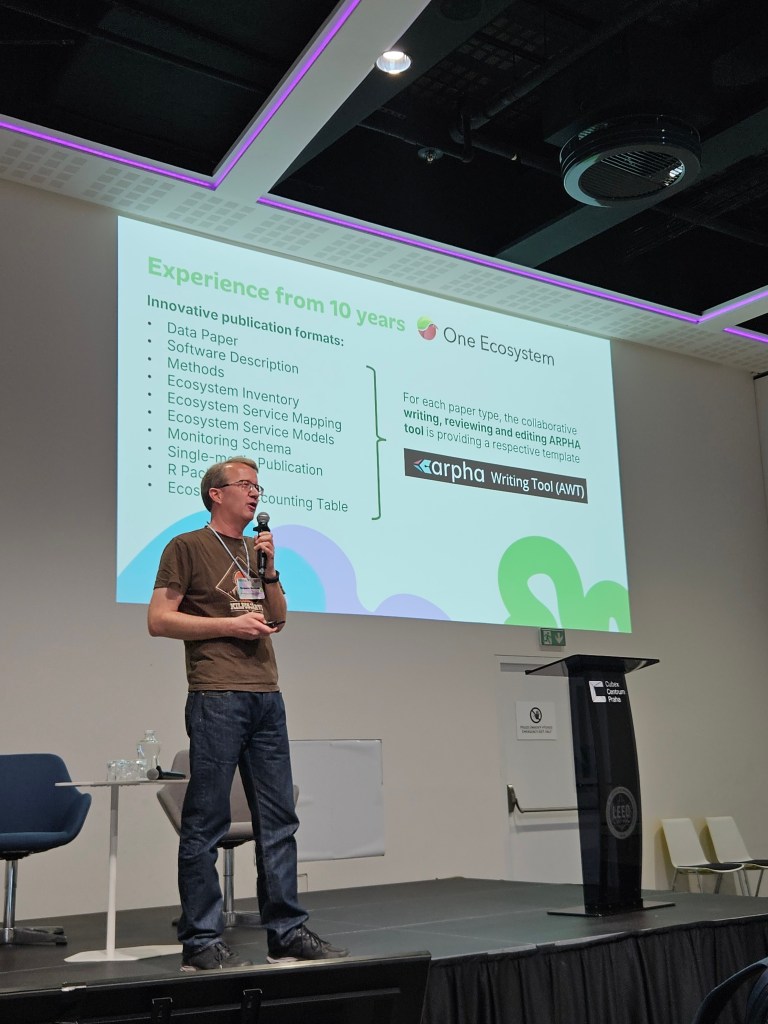


The One Ecosystem journal took center stage once again on Friday afternoon during a panel session titled, “The Changing Landscape of Academic Publishing on Ecosystem Services Research: Editors’ Perspectives.” The event brought together the Editors-in-Chief of the three ESP-associated journals for an engaging open discussion about the shifting dynamics of scientific literature. Sharing insights gained from One Ecosystem’s 10-year journey, Burkhard highlighted how authors of research who work closely with their publishers can support knowledge sharing and empower researchers. In the case of One Ecosystem, this collaboration translates to increased visibility, discoverability, reusability and citability of the published work, as well as rapid and hassle-free authoring and peer review experience, all thanks to the automated workflows and human-centric approaches provided through the publishing solutions of the ARPHA publishing platform.
It is worth issuing a reminder that manuscripts submitted in 2026 and accepted for publication in One Ecosystem journal are eligible for a 10% discount on the article publication charge (APC).

Throughout the week, the daily program featured eight parallel session tracks covering a wide range of topics, many closely aligned with ESP Working Groups and National Networks. A dedicated poster session took place on Wednesday afternoon.

On Thursday, delegates had the opportunity to join one of several field excursions. These ranged from a visit to the unique rewilding reserve located in the former military area in Milovice, to a walk through the Prague Pasture: one of the city’s most remarkable natural sites, and an intense climbing experience just outside Prague.

Following an ESP tradition, the three highest-voted posters were recognised during Friday’s closing ceremony, with the first-prize winner receiving a free publication in One Ecosystem, sponsored by Pensoft. This year, the Best Poster Award went to Zdeněk Ent from Prague Institute of Planning and Development for the poster “Experiencing Ecosystem Services: Art, Sensory Engagement and Transformative Learning in Peri-Urban Landscapes”.

During the week, Pensoft’s exhibition stand welcomed dozens of inquiries regarding the publisher’s tailored journal portfolio. Visitors also expressed keen curiosity about the publishing services and self-developed platform available to journal owners, book authors, and conference organizers. Meanwhile, delegates showed notable interest in several titles, both well-established journals like Nature Conservation, NeoBiota, Metabarcoding & Metagenomics and One Ecosystem, and newly launched ones, including Individual-based Ecology and Advances in Pollinator Research.
A lot of Pensoft stand’s visitors were also pleased to see that there was a new player amongst the journals of Pensoft aimed at an emerging field in ecology. The recently rebranded Agricultural and Ecological Modelling (AEM) provides a unique scholarly outlet thanks to its modern approach to publishing by increasing transparency, giving credit to research objects across the entire modelling research lifecycle. This is achieved through publishing specialised article types, such as: Formal Model, Model Testing and Calibration, Model Implementation and Documentation, Data Papers and Software Descriptions. These new publishing formats are designed to keep pace with advances in Modelling research and to make it FAIR (Findable, Accessible, Interoperable, and Reusable) by enabling scholarly credit for diverse research outputs, often created by different groups of authors. For the time being, AEM remains a Diamond Open Access journal, meaning that it will not charge authors for open-access publication.
AEM also has a focus on open science and reproducibility; it is currently archived in four databases (CLOCKSS, Zenodo, Portico, and Zendy) and indexed in over 40 services, including AGRICOLA, CABI, ChronosHub, CNKI, FAO AGRIS, ResearchGate, and Swisscovery, among others. You can learn more about AEM in the latest editorial.
For those who missed the opportunity to sign up for the journals’ newsletters at the stand, they can do this by filling in their email address from the homepage of the journal they are interested in, or by updating their profiles in the Pensoft system.
Undoubtedly, amongst the greatest highlights at the Pensoft’s stand was the Horizon Europe-funded GREEN TALENT project, where our Project Department leads the project’s Work Package dedicated to Communication, Dissemination and Exploitation.
The conference delegates were intrigued to learn about the international initiative’s aim to build biodiversity and climate capacity at national, trans-European and global levels, with a focus on Widening Countries. The partners at Green Talent: both from academic and non-academic backgrounds, are to contribute expertise, training, and secondments and connect pilot projects to broader EU and global networks. One of the ways the GREEN TALENT consortia does this is by designating four Demonstration Pilots (a.k.a. Demo Hubs) in four Widening countries: Malta, Greece, Cyprus and Bulgaria, where secondees can benefit from real-world experience and foster partnerships across sectors, while working on scalable solutions to climate and biodiversity challenges, acting as collaboration hubs between academic and non-academic sectors.

Having only kicked off a year ago and set to run for four years in total, there are many new developments and results yet to be announced from GREEN TALENT, including a Capacity-Building Platform that will allow users to browse various opportunities and events meant to help them improve their skills; to get in touch and foster collaboration with other experts; and to learn about best practices from across different institutions and relevant companies. This is why we strongly recommend visiting the GREEN TALENT, signing up for the project’s newsletter and following the initiative on BlueSky and Linkedin.

In addition to the various GREEN TALENT information brochures and promo materials present at the Pensoft stand, people at the conference could spot quite a few of the project’s members around the ESP venue. There were several talks by GREEN TALENT representatives, including the project’s coordinator: Prof. Dr. Mario V. Balzan (Ecostack Innovations). His talk, part of the session “Islands at the forefront of sustainable and inclusive ecosystem services approaches” examined governance and knowledge gaps in pollinator ecosystem services on small islands, where he used Malta as a case study.

The signature journal stickers by Pensoft were once again a common sight at the ESP conference in Prague. Photo courtesy of ESP.
Ultimately, the conference successfully highlighted the tools needed to drive sustainable development across Europe. Through active contributions to both the overarching policy discussions and the targeted skill-building sessions for the next generation of researchers, Pensoft continued its commitment to making environmental science open, transparent, and globally accessible.


