GURPS DSA – Wirklich eine gute Idee?

This is a German variant of the English article. There isn’t much here that isn’t in the English version.

In der irrigen Annahme, dass jemand aus Deutschland daran interessiert sein könnte, hier noch eine Version des letzten Artikels in der Originalsprache des Schwarzen Auges.

Als langjähriger Freund und Playtester von GURPS habe ich schon manche Konversion unternommen, aber von DSA hatte ich mich immer ferngehalten bis alter Freund mal wieder spielen wollte und wir nach zwei Abenteuern feststellen mussten, dass niemand die Regeln mochte.

Für den geneigten deutschen Leser – d.h. jemanden, dem Pen & Paper Rollenspiele bekannt sind – brauche ich nicht viele Worte um DSA zu machen, aber ein paar Stichpunkte zu den Eigenschaften des Settings sind natürlich nützlich.

Gutes

1) DSA ist ein dichtes Setting. Nicht jeder Spielleiter – auch nicht jeder GURPS-SL – ist gut im Worlbuilding und DSA hat genug Material, dass so ein Makel nie auffallen wird. Die Welt ist – für eine Fantasywelt – auch nicht zu unlogisch (jaja, die Klimazonen, ich weiß).

2) Der Support mit neuem Material ist sichergestellt. Alte Abenteuer sind auch gut als PDF zu erhalten. Insgesamt ist der Support vergleichbar mit GURPS, wenn auch mit anderer Stoßrichtung (Setting, Abenteuer) und etwas schwankender Qualität.

3) Durch die Abenteuer und das sehr ausgestaltete Setting nimmt DSA dem Spielleiter viel ab. Wer keine vorgefertigten Abenteuer mag, ist natürlich falsch beraten DSA oder eine GURPS-Variante zu seinem System zu erküren.

4) Es gibt jede Menge originelle Charakterkonzepte. Nicht nur vermeidet man den Standard-Krieger und -Magier, Charaktere wie Schelm, Zibilja, Kristallomant oder Geweihter laden zum etwas anderen Rollenspiel ein. Abstimmung mit Gruppe und SL ist dabei natürlich immer wichtig.

5) Die große Fangemeinde macht das Finden von Spielern recht einfach. Ob das auch für die GURPS-Variante zutrifft kann ich nicht sagen, aber eine bestehende DSA-Gruppe zu überzeugen, die GURPS-Regeln auszuprobieren war bei mir machbar.

Schlechtes

1) Das Setting kann überwältigend sein. Der prospektive SL sollte sich klar machen, wie nahe er am “offiziellen” Aventurien bleiben will und wie fanatisch seine Spieler auf dem Kanon beharren. Abenteuer sind besonders schlimm in dieser Hinsicht mit ihren Orts- und Zeitbeschränkungen. Jedoch ist es häufig möglich letztere zu umgehen, wenn man den Kleinkram überliest. Ortsbeschränkungen sind dagegen oft nicht zu ändern, auch wenn die Abenteuer es manchmal übertreiben. Hier könnte eine gute Liste Abhilfe schaffen, aber bislang konnte ich noch nichts finden.

2) Über die Regeln kann man einiges sagen, aber viel Gutes ist nicht dabei. Ohne Automatisierung ist die Charaktererstellung ein einziger Horror, die Talent-Probe ist ein schlechter Witz, der aber für 50% des Spiels verantwortlich ist, Sonderfertigkeiten machen aus realistischer Perspektive selten Sinn und Beschränkungen wie Elfische Weltsicht sind einfach blöd. Vieles was an der vierten Edition gut ist (echte Vor- und Nachteile, mehr Kampfoptionen, Variation von Zaubern) wurde von anderen Systeme (v.a. GURPS) mehr schlecht als recht übernommen. Schwer wiegt auch die Tatsache, dass vieles einfach nicht so zum Hintergrund passt wie man ihn aus Romanen und Zitaten kennt.

3) DSA-Fans sind oft recht fanatisch. Einerseits ist das gut, da die Spieler dann nicht schnell die Lust verlieren, andererseits muss man sich als SL oft mal auf die Finger klopfen lassen. Und es ist auch nicht witzig sich von realweltlichen Praioten runterputzen zu lassen, nur weil man eine Hexe in der Gruppe hat.

4) Die Kosten für die Materialien sind hoch. Auch wenn man sich als GURPS-SL auf die Basics beschränken kann wird man doch an Schwerter & Helden, Zauberei & Hexenwerk, Götter & Dämonen und einigen Hintergrundwerken nicht vorbei kommen. Selbst als PDF laufen diese drei veralteten “Grund”regelwerke auf 60€ heraus. Das (gerade noch) aktuelle Wege-Paket schlägt sohar mit 90€ zu Buche. Und damit sind noch nicht die Hintergrüne und Abenteuer abgedeckt. Okay, GURPS ist auch nicht gerade billig, aber die Vielzahl von DSA-Regionalbänden kann den Erwerb recht teuer machen (zumal nicht alle als PDF vorhanden sind).

5) Der Sprach-Mix macht’s schwer. Die vierte Edition von GURPS gibt es nur auf Englisch und DSA gibt es praktisch nur auf Deutsch. Ich muss tatsächlich mal nachfragen, ob es legal ist Übersetzungen zu posten. DSA mit englischen Skills und Disadvantages zu spielen macht jedenfalls nicht soviel Spaß.

Schönes

Warum sollte man sich überhaupt an einer Konversion versuchen? Da gibt es durchaus Gründe dafür:

1) Etwas, das GURPS immer wieder Probleme bereitet, ist das Fehlen detaillierter Settings. Ja, es gibt die Infinite Worlds, in die man jedes Setting einbetten kann. Sowohl für Infinite Worlds als auch für Banestorm gibt es sogar eine kleine Quellenbücher, aber das war’s dann auch schon, wenn man sich nicht auf Transhuman Space und dessen Übergang von 3. auf 4. Edition einlassen will. GURPS ist nichts für SLs, die ein komplettes Setting mit allen wichtigen NSCs, detaillierten Stadtbeschreibungen und einer fortlaufenden Timeline erwarten. Das heisst aber nicht, dass jeder GURPS-SL ständig nur eigene Sachen erfinden will. Manchmal ist es auch einfach schön sich einfach auf eine existierende Welt einzulassen.

2) DSA ist, im Gegensatz zu Spaßvögeln wie D&D und Rifts, einfach zu konvertieren. Ja, es gibt viel Material, aber vieles davon braucht keine Spielwerte. Es gibt nicht in jedem dritten Buch zwanzig neue Rassen und Monster. Das Regelsystem versucht realistisch zu sein (Attacken und Paraden, Rüstungen, die tatsächlich Schaden aufhalten, keine arbiträren “3 x pro Tag”-Kräfte, energiebasierte Zauber und so weiter und so fort. Wenn man sich von der inneraventurischen Wirklichkeit leiten lässt, so muss man nicht alle Heldentypen konvertieren, sondern kann sich auf den gesunden Menschenverstand der Spieler verlassen. Natürlich sind Magie und Götterwirken eine Ausnahme. Natürlich müssen Rassen und Kreaturen Stats haben, aber das ist kein unüberwindliches Problem.

3) GURPS macht DSA tatsächlich besser. Techlevel, Vertrautheiten, Martial-Arts-Stile, Göttliche Gnade, detaillierte Rüstungen, Regeln für Höhlenforschung, ausgewogene Vor- und Nachteile, realistische Fertigkeiten, Start mit erfahrenen Charakteren und vieles mehr.

Nicht so schönes

Einige Sachen komplizieren die Konversion:

1) GURPS Magic braucht nach all den Jahren immer noch ein Patch. Eines der wenigen Büchern, bei denen die Qualität auf der Strecke blieb.

2) Es gibt immer noch kein aktuelles GURPS Bestiarium. Man kann aber auf andere Publikationen und die alte Version zurückgreifen.

3) Gibt es überhaupt ein Interesse daran. Klar mache ich das sowieso für meine Gruppe, aber es wäre schon schön zu wissen, dass andere auch daran Interesse hätten. Warum sollte man’s sonst posten? Kommentare sind also sehr willkommen.

Für’s Erste wird das der letzte GURPS DSA Artikel in deutscher Sprache sein. Vielleicht schreibe ich ja noch Übersetzungen für die folgenden Artikel, wenn ich ein paar Hits aus Deutschland kriege. Bei Kommentaren schreib ich definitiv was.


The material presented here is my original creation, intended for use with the GURPS system from Steve Jackson Games. This material is not official and is not endorsed by Steve Jackson Games.

GURPS is a registered trademark of Steve Jackson Games, and the art here is copyrighted by Steve Jackson Games. All rights are reserved by SJ Games. This material is used here in accordance with the SJ Games online policy
GURPS DSA – A Good Idea?

You can find a German variant of this article here.

Das Schwarze Auge / The Dark Eye, commonly known as DSA among fans and detractors alike, ranks among the top three RPGs in Germany, but has never quite managed to gain a foothold anywhere else. Americans are most likely to recognize it as the engine that ran the three PC games released under the name “Realms of Arkania” in the nineties.

Now, there’s a couple of reasons why DSA has a very loyal following in Germany and also why it never made much headway anywhere else. And some of these make you really wish for a comprehensive GURPS conversion of the setting.

The Good

1) The setting is extremely dense. There are hidden secrets in every other town. History stretches back to reptilian precursor races. Named NPCs interact in a complex political web. Current events are very detailed and reported from multiple points of view. There’s a host of academies, holy orders, army units and fighting instructors for your characters to learn from and interact with. There are complete libraries of books to look for, ancient evils to defeat and countless causes to fight for.
If your players want to get involved in their campaign world, they’ll find hooks aplenty. Even if they don’t want to do a lot of work themselves, you can easily provide them with connections that have the right flavour.

2) The system is extremely well-supported. You want to game in a certain part of the world? There’s a regional module for you. You want to know more about secret societies or mage academies? Three modules each. Need to know more about elves or dwarves? Of course, there’s a supplement! Want to play in another time period? There’s limited support even for that. Need more info on magical artefacts? Of course, there’s a book on that. Want to read in-universe tracts about your chosen deity? The last ones will be out within the year. Maps? There are detailed posters of every spot on the continent; major cities are also mapped. Adventure modules? 250 and counting. You need an official in-universe newspaper? That was revamped a bit and now includes more scenarios than news, but there’s 150 back issues you can peruse if you prefer the straight dope.
Imagine the Forgotten Realms and cram all that detail into its western coast from Icewind Dale to Calimshan. Then multiply the number of relevant supplements by five and the number of adventure modules by fifteen. Then you come close the level of support DSA offers to the GM with deeper pockets. Note that there are PDF versions and second-hand copies that offer much cheaper alternatives.

3) The system takes a lot of work off the GM’s shoulders. I know not everybody likes adventure modules, but for the GM with a full-time job they often spell the difference between running a game or not. For everyone else they are at least a nice diversion or useful for mining for ideas. In contrast to the usual D20 dungeon the last two and a half decades of DSA has seen a varied mix ranging from intrigue and detective stories, to war, exploration and mystic themes, to more traditional dungeons, but ones that actually make sense. The same goes for much of the support supplements. DSA is pretty much the anti-GURPS in this regard. There’s very little world-building and system-tuning required by the GM.

4) The system helps players who have trouble coming up with original character concepts. The use of archetypes and the extremely dense background material are helpful for  players and GMs alike. You won’t end playing a level one fighter that is only distinguished through his random attributes, race selection and starting feat. You will have disadvantages that define you, a place ore unit where you learned your trade, ready-made connections and antipathies and even a reason to go adventuring.

5) There’s a huge fan following in Germany, which makes it very easy to get new players. Everybody plays in the same world and there aren’t all that many ways to tweak the system and world, so you can even introduce characters from other GMs’ campaigns. Of course, that also means there’s quite a lot of unofficial material readily available. A lot of it is quite good and actually on par with D20 titles.

The Bad

1) The setting can be overwhelming. There’s a myriad of details to take into account. For example, you need a very clear idea of when and where to start your campaign, because there are metaplots that will radically change your world. If you decide to leave them out, a large amount of the support elements will become unusable or take a considerable amount of work to adapt. Worst of all are the adventure modules – a significant number of which thrust the characters into the limelight of politics and unfolding supernatural events. Many players are aware of those and will want to take part in them. They might object if you change the world too much.
In the end player and GM freedom are often restricted by the burgeoning realms of the writers’ imagination. Take into account that the early generation of writers were German literature and anthropology students and you get deliberate restrictions that railroad you into a direction the writers thought proper for your game.

2) The rules show a a truly Teutonic obsession with details: For example every skill roll sees three twenty-sided dice rolled to beat three different attributes with skill points used to make up the difference. Where GURPS has four skill difficulties with everyday names (cost progression 1-2-4-8-12…), DSA sports nine difficulties from A* to H (cost progression a convenient 1-1-2-3-4-6-7-8-10-11-13-14-16-17-19-21-22-24-26-27-29 – for type A that is). The system did not use to be so complicated, but in the current edition it is virtually impossible to make a character without using a spreadsheet. Granted, spreadsheets are a good idea for every point-build system, but DSA takes complications to unhealthy heights. It used to be a half-way beginner-friendly system, but it shed that with its 4th Edition.
At the same time the system makes it very hard for beginning characters to succeed at anything. An average character who has spent years training in a skill has less than half a chance to beat an unmodified skill roll – and few skill rolls in adventures and examples are unmodified, most carry a penalty. A trained warrior who has spent six years or more doing weapons training has less than half a chance to hit an opponent before they get a chance to defend. Combat takes forever, especially since characters can often take three or four sword hits without much of an effect.Part of these problems stem from marrying what was originally a D&D-esque random roll system with a point-based system (that incidentally steals a lot of small details from GURPS). The effect isn’t very pretty in play and encourages players to invest heavily in attributes and take the maximum disadvantages before start of play. Attributes are even more important than in GURPS, but at the same time there are so many and all are important for spells that the average player is easily lured into munchkinny builds.

3) The fan base has a large number of fanatics. Even in the good old times before the internet you could post a notice in the game shop and have people ring you up only to tell you about how the Praiotian inquisition was the best thing ever and that you were a disgusting heretic for having a witch in your group. The internet hasn’t made things easier. It’s probably a good idea to never invite more than one unknown player into your group. DSA players are often defensive, because their system is often to maligned by others. DSA has a bit of a reputation as simplistic, illogical, goody-two-shoes system and if you like it very much that can hurt.

4) The system is huge and can be costly. It also tends to reinvent itself every eight years on average. Thankfully these reinventions don’t really introduce huge world-sweeping changes on their own (like in the Forgotten Realms), but you still need to shell out for new basic rules and all the extras you need to make your characters work. This is all the more infuriating, because the changes are often very subtle (4th Edition to 4.1 to 5 for example didn’t change the basic mechanics at all). On the whole this a system to sink a lot money in if you want to cover all eventualities.

5) All the nice things can only be had in German. Sure, there’s an English version consisting of like three books and there used to be versions in French and Dutch, but basically you need to either be a German native speaker or somebody with a degree in German and a huge interest in translating this stuff.

The Beautiful

Now, most of what I said serves only to whet the appetite of the average GURPS GM. Why?

1) The one huge drawback of GURPS is the lack of detailed settings. The only exception is Transhuman Space and that has to deal with an awkward 3rd/4th Edition split. Sure, GURPS attracts GMs who want to stat their own settings or run real-world campaigns, but when you’re short on players you tend to run back to vaguely Tolkieneque fantasy. DSA nicely fills that gap in GURPS.

2) There’s nothing in the setting that makes it very hard to convert. DSA tries to be realistic even if falls far short of this goal. The system is already skill-based, combat is more or less realistic with parries, dodging and armour that stops damage. Most non-supernatural stuff works on a somewhat logical basis and spell magic is skill-based, differentiated by spell traits and uses energy points.
There are a limited number of creatures, cultures, races and magics and most of the latter can be given more flavour by representing them as different GURPS variants. The same goes for DSA adventures. Instead of a different monster with three dozen modifiers per room, you’ll mainly face humanoids, animals and maybe a monster or two with at most a couple of special abilities each.
Compared to other RPG settings like D&D, Rifts or Star Trek (any incarnation) converting the DSA setting isn’t much of a chore.

3) GURPS actually makes DSA better. Tech levels, familiarities, martial arts and magical styles, divine favour, detailed armour, spelunking rules, supernatural abilities, a balanced disadvantage system, the possibility to start with experienced characters…
The possibilities are staggering.

The Not So Beautiful

There are still some things that complicate a GURPS DSA conversion:

1) The GURPS Magic spell system is still in bad need of a fix.
2) There’s no bestiary yet and that slows down creature conversion.
3) Is there even any interest in this? American GURPS players might be interested in the setting, but can’t take advantage of the German material, while German DSA players might be interested in better rules, but don’t want to buy a minimum of six English rulebooks (Characters, Campaigns, Powers, Low-Tech, Magic, Thaumatology and Martial Arts). I mean obviously I’m doing this for my own group anyway, but is there any interest online? Feedback is very welcome, especially on whether this should be German-only or English-only content or something both could appreciate.

The first part of my step-by-step conversion guide for DSA is available here.


The material presented here is my original creation, intended for use with the GURPS system from Steve Jackson Games. This material is not official and is not endorsed by Steve Jackson Games.

GURPS is a registered trademark of Steve Jackson Games, and the art here is copyrighted by Steve Jackson Games. All rights are reserved by SJ Games. This material is used here in accordance with the SJ Games online policy

Review: GURPS Zombies – Day One

As all my other reviews this one will be rated according to meat (rules, stats, game mechanics), cheese (setting, characters, story), sauce (form, writing, style, art) and generic nutritional substance (universal nature, adaptability). At the end you find a weighted average of those components and a value score that also takes into account price per page.

I’m going backwards through my collection for these reviews, although I skip all the Pyramids and some of the supplements with which I am unfamiliar. In this case Monster Hunters 5 – Applied Xenology, which I mainly bought to show my support. That brings us to GURPS Zombies Day One – a rather cheesy item (or fluffy if you go by the standard nomenclature).

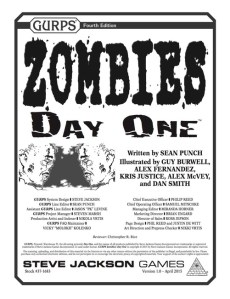
Title Page from GURPS Zombies - Day One

Now zombies are not my usual fare when it comes to monsters – I like a bit more motivation for my antagonists – but I have to admit that the GURPS treatment of the matter has been excellent so far. Now the question is what does this volume provide that sets it apart from the standard survival scenario – in short: a lot.

Facts

Author: Sean Punch (Dr. Kromm)
Date of Publication: 2015/04/02
Format: PDF-only (Warehouse 23-only)
Page Count: 56 (1 title page, 2 content pages, 1 index page)
Price: $9.99 (PDF), $ 0.19 per page of content; Score of 6/10
Preview: http://www.warehouse23.com/products/gurps-zombies-day-one

Review

Please take note that this book is a companion volume to GURPS Zombies, which incidentally was the last hardcover GURPS release back in… 2013 – time really flies. All the meaty rules bits (crunch) are in that volume, while this one presents all the cheesy (fluffy) campaign infos for making use of all the zombie types and biting rules so nicely provided by GURPS Zombies.

As such Day One is structured very differently from Zombies proper. Each of the eight chapters is basically its own campaign setting, although the second the “Fields of Fear” is basically an extended adventure set in the antebellum American South. While those are only 6-7 pages long, the information given is very dense and covers everything the GM needs to know to write their own campaign.

Write? Sure, this is still GURPS and even the densest treatment can’t give you everything you need to know on half a dozen pages. Even if you are completely in love with one of the treatments you still need to fill in the blanks (locations, NPCs, etc.), but the supplement does a very good job at holding your hands, explicitly calling out the parts (pun intended) of Zombies you need for this type of campaign and what other supplements are useful. Power level of player characters, suggested character types and (in)appropriate traits are given for each of the eight campaigns. Of special interest is a section appropriately titled “Tough Calls” that answers questions like “Can I play a zombie?”. The eponymous “Day One” section covers the situation, in which the characters find themselves at the start of the campaign and the “Homework” section covers the most intensive prep work the GM has to do.

Meat

The settings are mainly background information, but there are enough hooks to get the more rules-oriented GM busy looking things up. The setup, rules and character creation sections are rather meaty, but they don’t introduce new rules, just explain how things work in terms of existing ones. The meat isn’t he focus, but – depending on the campaign in question – you end up with 1 to 3 pages that are mostly rules and rules explanation.

It’s the explanations that make this book especially useful to the novice GM. It’s completely possible to run some of the campaigns using  just the Basic Set and Zombies – a definite plus for convention games too. That’s not saying, things can’t be improved by owning every GURPS book, but don’t get carried away; some of the campaigns are better if you don’t get side-tracked.

Meat score: 6 (enough meat to satisfy tinkering GMs, but not a meat-focused book)

Cheese

Each of the campaigns has enough information to set up an atmospheric campaign, but some of the are more focused on the basics and the rules supporting them, while others are more “cheesy”. The campaigns are in order:

Empire of the Necromancer-King: A single bastion of light is resisting the armies of evil, mindless zombies in a setting that’s basically Dungeon Fantasy with some things removed – evil player characters and dubious spells are the first to go, but even the dungeon itself is purely optional. There’s not that much cheesy goodness in this one, but that’s intentional. It is heroic fantasy writ large, after all. The main mystery here is why the evil empire is ruled by a king, of course.

Fields of Fear: The complete opposite on the meat/cheese scale from the Necromancer King, this adventure/campaign is set in the old South where slavery is still alive and well. It is a gentle reminder of the origin of the zombie myth and explores concepts of race, class and gender in an unusually thoughtful way. It can be used as a good starting point for historical campaigns with a little extra.

Savage Streets: This is a more gruesome campaign that still fits a cinematic treatment: A new drug has hit the streets and its users are running amok. Cynical politicians want the problem to “burn itself out” and its up to the PCs – police officers, first responders, vigilantes – to protect ordinary citizens. It’s a bit peculiar in that is still has a safe zone for much of the campaign. If you want to, you can easily run it in a realistic style – and raise a whole lot of moral questions.

Zeta Force: PCs are members of a secret UN force that deals with only one threat. Guess what Zeta stands for! The cinch is that humans are naturally predisposed to become zombies. This is basically a government-founded Monster Hunter group that veers a bit into Black Ops territory, although without aliens and at much reduced proficiency. Anything that could conceivably made to rise from the dead using weird science or psychic powers is fair game here.

Ultimate Zombie Fighters: This is your basic zombie apocalypse with the twist that all PCs are immune to the zombie plague; that doesn’t mean they can easily deal with zombies or the apocalypse though. The goal here is to find the truth about the zombie plague and whether it can be cured. It’s very action-oriented and too combat-heavy for my taste, but your mileage may vary.

Alpha and Omega: Supersoldier research created a zombie plague, but also immune metahumans that look just like the zombies. These are the PCs and their job is to prevent the worst of the apocalypse while looking like its four horsemen. It’s an interesting premise that forces the group to deal with understandable prejudice. It gives borderline nods to realism, so that any powers that are physically impossible are off limits (including snazzy Innate Attacks). You don’t absolutely need GURPS Powers to run it, but having it certainly doesn’t hurt.

Time of the Zombies: Pretty much the A Canticle for Leibowitz among the zombie campaigns, this starts off long after the apocalypse that produced living, raging madmen. There are some of these “zombies” left and the pathogen that created them is also there, but there are no raving masses and constant fear of infection. If you liked the Fallout games, that’s the right campaign for you. It might have benefited from some more expansive rules for gear, but that’s the only disadvantage I see. Be advised that taking place so long after the apocalypse it’s even more free-form than the other ones.

Depravity Well: This obligatory SF version takes the zombie apocalypse and places it in a first contact situation. The first species humanity makes contact with (after singular and painstaking effort) turns out to have its own industrialised zombie plague – what an unfortunate step for mankind! The campaign raises the issue of pollution – the aliens were even less concerned about the environment than humans – and reckless use of new technology.

Each of the campaigns has sections on the zombie metaphor used, important turning points, the meaning of sacrifice, replacement characters, mood and pacing. It’s enough to satisfy the majority of GMs, even those for whom the rules are just an afterthought. However, none are as expansive as those for normal campaign settings – even the smaller ones like Infinite Worlds – Brittanica-6.

On the other hand the variety is really nice. You get four campaigns where being zombified is a real danger and four where it isn’t. There’s something for Dungeon Fantasy, SF, history, Monster Hunter, survivalism, tactical shooting and action (the latter twice even). What I’m missing a bit is the supernatural angle. Except for “Empire of the Necromancer-King” there’s nothing that encourages PCs with supernatural abilities and all but two zombie types are of the more or less weird science and psionics variety. I’d have preferred a bit more options for the supernaturally-minded zombie slayer. Still, that might have been difficult to pull off while keeping the genres separated as they are now.

Cheese Score: 9 (satisfying campaign collection)

Sauce

The writing is the usual top-notch style of Dr. Kromm’s, although it doesn’t quite reach the heights of his Dungeon Fantasy volumes and there’s a lot of technical information to convey for each campaign framework. Sometimes that makes you skip paragraphs you don’t yet need. But that’s still complaining on a high level. The writing is good and so’s the editing. Of course, there’s complete bookmarking for each of the headings and sub-headings and hyperlinks to each item on the content page.

The pull-quotes are fitting and there are some interesting titbits hidden within the text that make you shudder or grin should you research them on wikipedia. So far so good.

Unfortunately the art is pretty bad. You may remember Dan Smith, the guy who illustrated a lot of 3rd Edition books in black and white. While those were mostly okay if a bit sub-par, his illustrations here are a collection of his worst attempts for 3rd Edition. At least the ones for fantasy campaign are pretty evocative. The rest are just ugly. The better illustrations are all pilfered from Horror and Zombies. I’m not sure whether the book wouldn’t have been better without any pictures.

Sauce score: 5 (good writing, mostly annoying art)

Generic Nutritional Substance

Day One pretty much pushes the envelope when it comes to presenting campaigns only united by their theme. You could get more universal than that, but not in the space provided. Still, it might not have hurt to include one more fantasy or supernatural scenario. Most campaigns, even in GURPS, take place in a world where those things matter. That’s nitpicking, however. The book is almost as generic as Zombies itself.

Generic Nutritional Substance score: 9 (almost among the most universal)

Summary

If you like zombies or want to explore the themes they’ve come to embody, this book is for you. The same goes for any GM that read Zombies and thought “Now if I only could fit all that into a coherent framework.” It’s not meant for GMs that want their brains served ready-to-eat, but they’ll be hard-pressed to run GURPS anyway. Some of the campaigns can even be started off with just a few hours of work beyond character creation.

Total score: 7.75  (good for your grey matter)
Total score is composed of a weighted average of Meat (15%), Cheese (50%), Sauce (20%) and Generic Nutritional Substance (15%). This is a cheese-oriented book. A “meaty” rules-orientied book would turn the percentages for cheese and meat around.

Value score: 6.875 (for its length it’s hard to find better value)
Value Score is composed of the average of Total and Price.


GURPS is a registered trademark of Steve Jackson Games, and the art here is copyrighted by Steve Jackson Games. All rights are reserved by SJ Games. This material is used here in accordance with the SJ Games online policy.