Technique Pricing

House rule articles contain a short intro, a rambling section on how to come up with a solution to a problem called “Cooking It up“, just the plain rules in a section called “The Finished Dish” and some musings about what else you could do with that in the final section: The Leftovers“.

For highly-skilled characters I’ve frequently run into the problem that I can’t really justify putting points in more than one technique apiece and often these are very powerful hard techniques like Feint or Dual-Weapon Attack. In 3rd Edition with its 8 points a level for DX-based skills above DX+1 it made much more sense to use techniques (then called manoeuvres). I feel that this led to more colourful characters. So how can we achieve the same thing in 4th Edition?

Cooking It up

There’s no reason to go back to 3rd Edition’s skill pricing. DX and IQ are already much more useful than buying more than three skills based on each up to above the attribute level. So, the techniques themselves need to become cheaper.

There’s also no reason not to include easy techniques alongside average and hard ones. These would be for things you really don’t want to spend a lot of points for, like the Impersonate technique (B233). There’s also room for very hard techniques. These could be used as a catch-all category for skills currently classed as hard that you might want to make more expensive, because they are a good idea under most circumstances (Dual-Weapon Attack, Feint and many cinematic techniques). This way easy techniques will be very different price-wise from their more heavy-hitting brethren.

While you’re at it, ignore the advice on B229 about selecting the difficulty level. The rules in Martial Arts for building your own techniques don’t use it either. Difficulty is based on how difficult something would be in real life, how large a part of the skill it helps with and how useful it is. Generally nothing that on its own allows you to pursue a decent career (e.g. Motion-Picture Camera for Photography) should be less than an average technique. On the other hand, many easy skills mostly have easy and average techniques.

For the actual pricing it’s good to consider half-points or – as an alternative for those not using these – skipping over certain levels.

The Finished Dish

To make some very specialised and/or not so useful applications of a skill easier, introduce easy and very hard techniques. Use half-points to give smoother progressions or skip over every second level for easy, average and very hard skills.

Final Skill Level Easy Average Hard Very  Hard
Default 0 0 0 0
Default +1 0,5 1 1 2
Default +2 1 1,5 2 3,5
Default +3 1,5 2 3 5
Default +4 2 2,5 4 6,5
Default +5 2,5 3 5 8
Default +6 3 3,5 6 9,5
Further +1 +0,5 +0,5 +1 +1,5

Be sure to re-evaluate all existing techniques in your campaign. They might fit better in a neighbouring category with this scheme.

The Leftovers

Ideally, I’d also post an adjusted technique listing for all the techniques found in Basic and Martial Arts, but I’m not sure whether it’s legal to list all techniques and I don’t have the time to go over each of them at the moment.

If you want to encourage techniques even more, consider giving a character a free point in a technique once they reach attribute level +1 in a skill.

The less coarse-grained technique difficulties also invite you to think about a way to redo optional specialisations as techniques. Instead of shifting down the difficulty of a skill if a character knows only one special subject, buy a lower level of the skill normally and buy up a technique for the character’s speciality. Base the difficulty on how large a subset and how useful the speciality is. Zoology is probably an very hard speciality technique of Biology, while Entomology might just be hard and the study of domestic cats might get away with being average.

Everything that uses techniques is also affected by these changes. I’m especially fond of the way they impact adjustable spells, which were really too pricey in most cases. You might think up a scheme that makes use of the different difficulty classes, too. Maybe reduced energy costs for higher difficulties.


The material presented here is my original creation, intended for use with the GURPS system from Steve Jackson Games. This material is not official and is not endorsed by Steve Jackson Games.

GURPS is a registered trademark of Steve Jackson Games, and the art here is copyrighted by Steve Jackson Games. All rights are reserved by SJ Games. This material is used here in accordance with the SJ Games online policy

The Humble Half-Point

House rule articles contain a short intro, a rambling section on how to come up with a solution to a problem called “Cooking It up“, just the plain rules in a section called “The Finished Dish” and some musings about what else you could do with that in the final section: The Leftovers“.

One of the things from 3rd Edition Revised I’ve been missing is the use of half-points for skills with little training. It was an easy way to give a character some background colour without making them spend too many points. Of course, that turned out to be the crux of the problem. In 3rd Edition spending half a point on a skill gave you a skill level of -1 below what you got for spending a whole point. That worked fine for a regular-guys range of attributes, but it quickly broke down for mages and martial artists – the former especially spent only 0.5 points on each of their hard spells and 1 point on their very hard ones. In short abolishing the half-point was better than keeping it unchanged.

Cooking it up

This section contains my thoughts on the matter at hand. It may be a bit rambling. Look at the next section if you just want the rules.

Now, in 4th Edition we have the Dabbler perk, which seems to offer a good way out of problems like that. I don’t like it for several reasons:

  • You basically need two or more skills you want to be slightly proficient in and whatever level you choose in one affects what level you can choose in the others. In practice it’s a bit messy. Do you write the skills and their levels with the perk or do you write them in your skill list with a special note? What happens if you learn one of the skills for real?
  • The maths is based not skill level as when learning a skill, but on default attribute level. That makes for weird cases like having a level of attribute-4 in Mathematics (a hard skill) as costly as having it in Physics (a very hard skill). That may be more of a problem of the defaults, but that’s how it works out in play.
  • That brings us to the worst offender so far: it’s darn cheap. The typical IQ 15-mage can get the classics Diplomacy, Mathematics, Naturalist and Tactics all at skill level 11 for a single point.
    Sure, you need to sacrifice a general perk slot, but I haven’t ever run afoul of that limit in 100-point and higher campaigns – in lower-point campaigns dabbler doesn’t do much anyway. It doesn’t count as a studied skill, but that’s the only drawback.
  • That drawback makes sense game-mechanically, but not story-wise. What does dabbler represent if not superficial learning?

Now, an easy solution is to reintroduce the half-point, but keep it at steady -2 to skill below the 1-point level. The mage in the example above would pay two points for his four skills. There would be no incentive to use dabbler for very hard skills with defaults of -6. Skills could still be listed in the regular skill section with a cost of 0.5. They could be used as defaults and so on. In order to prevent abuse they cannot be used to fulfil prerequisites.

The Finished Dish

This section gives the plain and simple houserules that can be used without further ado.

Skills can be bought for 0.5 points. That gives you a skill level of -2 compared to what 1 point in a skill gets you (e.g. attribute -4 for a hard skill). That skill is normal in every other regard. The rule for prerequisite skills is unchanged. You need at least a whole point in a skill for it to count as a prerequisite.
The GM is free to set a limit on the number of half-point skills a character can have if they feel the rule invites abuse. That may be a hard cap on the number of these skills – preferably an even one – or restricting them to mundane skills and requiring a one point minimum in esoteric skills, cinematic ones and spells.

The Leftovers

This section contains further musings on the topic that might be codified at some later point.

If half-points get out of hand in your campaign, insist that character’s have to spend the other half point, once they have used a skill often enough to justify some increase in proficiency.

Half-points could also be used for determining the final cost of abilities. This would often prevent the common problem of having a low point advantage with a low-point, but non-trivial limitation. It would however make it necessary to recalculate all the official abilities and templates. But for those using multiplicative modifiers that work has to be done anyway.

Another option would be spending half-points to turn a marginal failure by one into a success. Sure, it’s pricey compared to turning any failure into a success, but if you don’t need to succeed by more than 0 you might as well save that half-point.

Also giving out half-points (or even quarter-points) is a good way to reward clever players or moving role-playing without inflating points in essentially realistic campaigns. If the players get three points a sessions adding one whole point is a big deal. If you just give half a point extra it’s perfectly justifiable.

Or you might use half-points to give smoother progression of technique levels.


The material presented here is my original creation, intended for use with the GURPS system from Steve Jackson Games. This material is not official and is not endorsed by Steve Jackson Games.

GURPS is a registered trademark of Steve Jackson Games, and the art here is copyrighted by Steve Jackson Games. All rights are reserved by SJ Games. This material is used here in accordance with the SJ Games online policy

Review: GURPS Zombies – Day One

As all my other reviews this one will be rated according to meat (rules, stats, game mechanics), cheese (setting, characters, story), sauce (form, writing, style, art) and generic nutritional substance (universal nature, adaptability). At the end you find a weighted average of those components and a value score that also takes into account price per page.

I’m going backwards through my collection for these reviews, although I skip all the Pyramids and some of the supplements with which I am unfamiliar. In this case Monster Hunters 5 – Applied Xenology, which I mainly bought to show my support. That brings us to GURPS Zombies Day One – a rather cheesy item (or fluffy if you go by the standard nomenclature).
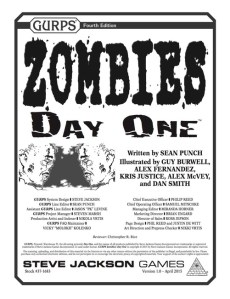
Title Page from GURPS Zombies - Day One

Now zombies are not my usual fare when it comes to monsters – I like a bit more motivation for my antagonists – but I have to admit that the GURPS treatment of the matter has been excellent so far. Now the question is what does this volume provide that sets it apart from the standard survival scenario – in short: a lot.

Facts

Author: Sean Punch (Dr. Kromm)
Date of Publication: 2015/04/02
Format: PDF-only (Warehouse 23-only)
Page Count: 56 (1 title page, 2 content pages, 1 index page)
Price: $9.99 (PDF), $ 0.19 per page of content; Score of 6/10
Preview: http://www.warehouse23.com/products/gurps-zombies-day-one

Review

Please take note that this book is a companion volume to GURPS Zombies, which incidentally was the last hardcover GURPS release back in… 2013 – time really flies. All the meaty rules bits (crunch) are in that volume, while this one presents all the cheesy (fluffy) campaign infos for making use of all the zombie types and biting rules so nicely provided by GURPS Zombies.

As such Day One is structured very differently from Zombies proper. Each of the eight chapters is basically its own campaign setting, although the second the “Fields of Fear” is basically an extended adventure set in the antebellum American South. While those are only 6-7 pages long, the information given is very dense and covers everything the GM needs to know to write their own campaign.

Write? Sure, this is still GURPS and even the densest treatment can’t give you everything you need to know on half a dozen pages. Even if you are completely in love with one of the treatments you still need to fill in the blanks (locations, NPCs, etc.), but the supplement does a very good job at holding your hands, explicitly calling out the parts (pun intended) of Zombies you need for this type of campaign and what other supplements are useful. Power level of player characters, suggested character types and (in)appropriate traits are given for each of the eight campaigns. Of special interest is a section appropriately titled “Tough Calls” that answers questions like “Can I play a zombie?”. The eponymous “Day One” section covers the situation, in which the characters find themselves at the start of the campaign and the “Homework” section covers the most intensive prep work the GM has to do.

Meat

The settings are mainly background information, but there are enough hooks to get the more rules-oriented GM busy looking things up. The setup, rules and character creation sections are rather meaty, but they don’t introduce new rules, just explain how things work in terms of existing ones. The meat isn’t he focus, but – depending on the campaign in question – you end up with 1 to 3 pages that are mostly rules and rules explanation.

It’s the explanations that make this book especially useful to the novice GM. It’s completely possible to run some of the campaigns using  just the Basic Set and Zombies – a definite plus for convention games too. That’s not saying, things can’t be improved by owning every GURPS book, but don’t get carried away; some of the campaigns are better if you don’t get side-tracked.

Meat score: 6 (enough meat to satisfy tinkering GMs, but not a meat-focused book)

Cheese

Each of the campaigns has enough information to set up an atmospheric campaign, but some of the are more focused on the basics and the rules supporting them, while others are more “cheesy”. The campaigns are in order:

Empire of the Necromancer-King: A single bastion of light is resisting the armies of evil, mindless zombies in a setting that’s basically Dungeon Fantasy with some things removed – evil player characters and dubious spells are the first to go, but even the dungeon itself is purely optional. There’s not that much cheesy goodness in this one, but that’s intentional. It is heroic fantasy writ large, after all. The main mystery here is why the evil empire is ruled by a king, of course.

Fields of Fear: The complete opposite on the meat/cheese scale from the Necromancer King, this adventure/campaign is set in the old South where slavery is still alive and well. It is a gentle reminder of the origin of the zombie myth and explores concepts of race, class and gender in an unusually thoughtful way. It can be used as a good starting point for historical campaigns with a little extra.

Savage Streets: This is a more gruesome campaign that still fits a cinematic treatment: A new drug has hit the streets and its users are running amok. Cynical politicians want the problem to “burn itself out” and its up to the PCs – police officers, first responders, vigilantes – to protect ordinary citizens. It’s a bit peculiar in that is still has a safe zone for much of the campaign. If you want to, you can easily run it in a realistic style – and raise a whole lot of moral questions.

Zeta Force: PCs are members of a secret UN force that deals with only one threat. Guess what Zeta stands for! The cinch is that humans are naturally predisposed to become zombies. This is basically a government-founded Monster Hunter group that veers a bit into Black Ops territory, although without aliens and at much reduced proficiency. Anything that could conceivably made to rise from the dead using weird science or psychic powers is fair game here.

Ultimate Zombie Fighters: This is your basic zombie apocalypse with the twist that all PCs are immune to the zombie plague; that doesn’t mean they can easily deal with zombies or the apocalypse though. The goal here is to find the truth about the zombie plague and whether it can be cured. It’s very action-oriented and too combat-heavy for my taste, but your mileage may vary.

Alpha and Omega: Supersoldier research created a zombie plague, but also immune metahumans that look just like the zombies. These are the PCs and their job is to prevent the worst of the apocalypse while looking like its four horsemen. It’s an interesting premise that forces the group to deal with understandable prejudice. It gives borderline nods to realism, so that any powers that are physically impossible are off limits (including snazzy Innate Attacks). You don’t absolutely need GURPS Powers to run it, but having it certainly doesn’t hurt.

Time of the Zombies: Pretty much the A Canticle for Leibowitz among the zombie campaigns, this starts off long after the apocalypse that produced living, raging madmen. There are some of these “zombies” left and the pathogen that created them is also there, but there are no raving masses and constant fear of infection. If you liked the Fallout games, that’s the right campaign for you. It might have benefited from some more expansive rules for gear, but that’s the only disadvantage I see. Be advised that taking place so long after the apocalypse it’s even more free-form than the other ones.

Depravity Well: This obligatory SF version takes the zombie apocalypse and places it in a first contact situation. The first species humanity makes contact with (after singular and painstaking effort) turns out to have its own industrialised zombie plague – what an unfortunate step for mankind! The campaign raises the issue of pollution – the aliens were even less concerned about the environment than humans – and reckless use of new technology.

Each of the campaigns has sections on the zombie metaphor used, important turning points, the meaning of sacrifice, replacement characters, mood and pacing. It’s enough to satisfy the majority of GMs, even those for whom the rules are just an afterthought. However, none are as expansive as those for normal campaign settings – even the smaller ones like Infinite Worlds – Brittanica-6.

On the other hand the variety is really nice. You get four campaigns where being zombified is a real danger and four where it isn’t. There’s something for Dungeon Fantasy, SF, history, Monster Hunter, survivalism, tactical shooting and action (the latter twice even). What I’m missing a bit is the supernatural angle. Except for “Empire of the Necromancer-King” there’s nothing that encourages PCs with supernatural abilities and all but two zombie types are of the more or less weird science and psionics variety. I’d have preferred a bit more options for the supernaturally-minded zombie slayer. Still, that might have been difficult to pull off while keeping the genres separated as they are now.

Cheese Score: 9 (satisfying campaign collection)

Sauce

The writing is the usual top-notch style of Dr. Kromm’s, although it doesn’t quite reach the heights of his Dungeon Fantasy volumes and there’s a lot of technical information to convey for each campaign framework. Sometimes that makes you skip paragraphs you don’t yet need. But that’s still complaining on a high level. The writing is good and so’s the editing. Of course, there’s complete bookmarking for each of the headings and sub-headings and hyperlinks to each item on the content page.

The pull-quotes are fitting and there are some interesting titbits hidden within the text that make you shudder or grin should you research them on wikipedia. So far so good.

Unfortunately the art is pretty bad. You may remember Dan Smith, the guy who illustrated a lot of 3rd Edition books in black and white. While those were mostly okay if a bit sub-par, his illustrations here are a collection of his worst attempts for 3rd Edition. At least the ones for fantasy campaign are pretty evocative. The rest are just ugly. The better illustrations are all pilfered from Horror and Zombies. I’m not sure whether the book wouldn’t have been better without any pictures.

Sauce score: 5 (good writing, mostly annoying art)

Generic Nutritional Substance

Day One pretty much pushes the envelope when it comes to presenting campaigns only united by their theme. You could get more universal than that, but not in the space provided. Still, it might not have hurt to include one more fantasy or supernatural scenario. Most campaigns, even in GURPS, take place in a world where those things matter. That’s nitpicking, however. The book is almost as generic as Zombies itself.

Generic Nutritional Substance score: 9 (almost among the most universal)

Summary

If you like zombies or want to explore the themes they’ve come to embody, this book is for you. The same goes for any GM that read Zombies and thought “Now if I only could fit all that into a coherent framework.” It’s not meant for GMs that want their brains served ready-to-eat, but they’ll be hard-pressed to run GURPS anyway. Some of the campaigns can even be started off with just a few hours of work beyond character creation.

Total score: 7.75  (good for your grey matter)
Total score is composed of a weighted average of Meat (15%), Cheese (50%), Sauce (20%) and Generic Nutritional Substance (15%). This is a cheese-oriented book. A “meaty” rules-orientied book would turn the percentages for cheese and meat around.

Value score: 6.875 (for its length it’s hard to find better value)
Value Score is composed of the average of Total and Price.


GURPS is a registered trademark of Steve Jackson Games, and the art here is copyrighted by Steve Jackson Games. All rights are reserved by SJ Games. This material is used here in accordance with the SJ Games online policy.

Review: GURPS Dungeon Fantasy Monsters 2 – Icky Goo

This thing went right into the category “How-did-they-come-up-with-this?”, of course. It’s a classic weird GURPS book, although one with a lower-case w. It doesn’t have the quite same weirdness level as GURPS I.O.U. or Weird War or even Bunnies and Burrows, but its right there with classics like the Creatures of the Night series and Hotspots – Renaissance Florence.

Featured image

At first glance you might wonder why Steve Jackson Games publish things like these, but if you think about it for a while, you realise it’s actually pretty logical. And no, that’s not because the line editor can damn well publish anything he likes. It’s because nobody else is publishing these. They might not find more than 500 buyers, but those 1800 bucks are apparently enough to pay author, editor, layout team and publishing costs while building up brand reputation for GURPS.

GM: I need a system that has a realistic representation of all kinds of fantastic slimes I can let loose in a detailed representation of 9th century Byzantium only all the player characters are adolescents bonded to alien bio-suits that they think are manifestations of the Holy Spirit.
Game shop clerk: Er, you know what? I’m going to give you 20% off the GURPS Basic Set and Powers if you promise never to talk to me again.

As this is my first review on this site, I’ll explain some of the terms I use a while I go along. These paragraphs are in italics.

Facts

Author: Sean Punch (Dr. Kromm)
Date of Publication: 2015/06/04
Format: PDF-only (Warehouse 23-only)
Page Count: 22 (1 title page, 1 content page, 1 index page (+special goo index), 1 ad page)
Price: $5.99 (PDF), $ 0.33 per page of content; Score of 4/10
Preview: http://www.warehouse23.com/products/gurps-dungeon-fantasy-monsters-2-icky-goo

Review

This book is part of the Dungeon Fantasy line (more specifically it made Dungeon Fantasy Monsters 1 finally worthy of the numeral), so it’s mostly addressed to the folks who play DF or – as many do – use the line as a quarry for useful rules, monsters and gear. It’s, however, quite a bit more focused than a normal DF supplement, DF 12 – Ninja comes closest in terms of unity of content and also in page count, though DF 14 – Psi is actually more linked thematically. I think I won’t spoil anything if I mention that some of those slimes might be elder spawn.

For those of the readers who have read and enjoyed DF Monsters 1, the book on hand might come as something of a shock as the structure is very different: Instead of handy 1-page write-ups for each monster (including an atmospheric picture), we get a section each of for fungi, jellies, moulds, oozes, puddings, slimes and spore clouds. Each of the seven is two pages long and starts with monster stats for a generic specimen, but that’s where the similarity stops. Some sections list differently coloured specimens, some give different modes of attack and others describe at length what makes the gooey enemy in question different from all other gooey enemies described.

These sections are framed by a page of general gooey characteristics and two pages of how to GM for goo. Of especial importance is the caveat of when not to use – few players enjoy fighting disgustingly tough foes that don’t have any treasure. And that’s where I stumbled: Why start of your cool series on monster types with a book on oozes? Sure, it’s original, but that’s about it. A GM, possibly still at school, who spent six bucks on this book will want to use it, but it’s really easy to over-use gooey foes in any context. Even in a swamp or river dungeon the players are going to groan after the third encounter with weird slime. It’s a bit of a head-scratcher, but that doesn’t detract from the books usefulness. And that’s the meat of the matter.

Meat

The meat is the heart of most RPG splatbooks, what’s generally referred to as crunch. Basically rules that can be used by players and GMs. For a GURPS book – barring historical and fictional setting books – that is usually the meat of the matter. So I’ll call it that. Some books are less interested in rules and that will be reflected in the scoring.

DFM 2 contains a host of useful crunch. If you count all the variants there are 36 different fungi, 2 kinds of jellies, one of them deliciously adaptable depending on its latest meals, 27 variants of moulds (admittedly a pretty passive hazard), 1 type of ooze that scales heavily with total mass, 6 types of puddings, 15 types of slimes and 36 types of spore clouds.

Now most of these are just minor modifications, but it’s still an impressive array and enough to confuse even those players who quickly buy up supplements and try to memorise them. I’m not sure these exist, but I grew up with Knights of the Dinner Table and try to be on the paranoid side where it’s fun.

All the monsters are ready-to-use for Dungeon Fantasy and the ones with double-digit numbers of subtypes even feature tables to roll on for extra randomness. The GM tips are more extensive than in DFM 1 – simply because there’s more space for each type and general information is on the introduction page. There are good hints on how to make things more interesting for the players.

On the whole the information is dense, while easy to use, but it doesn’t quite reach the nice at-a-glance nature of DFM 1.

Meat score: 9/10 (very hearty – solid GURPS rules crunch, albeit very specific)

Cheese

Now everybody likes meat (I’m joking of course), but what we really appreciate is the cheese (not joking any more – cheese is great). Folks generally call setting details that don’t impact rules very much fluff. I find the term (along with its sibling crunch) a bit annoying, so I’ll go with cheese instead as a synonym for all the good things that make life worth living.

DFM 2 doesn’t offer a whole lot. This lack of fluff is typical and intended for the Dungeon Fantasy line. It’s supposed to plug into any vaguely Tolkienesque fantasy setting.

Here we get just some hints about what scholars think of the whole gooey business and some ideas of how the everything relates to certain elder things. And of course, there’s habitat information, but that almost veers over into crunchy meat territory. That’s basically it. Oh and barbarian culture uses umlauts while dwarves g0 heavy 0n the apostrophes and limericks. Not a ringing endorsement, I know, but fluff is really not the focus here.

Cheese score: 3/10 (nothing to see here folks)

Sauce

You could see the sauce as superfluous, but don’t be fooled, nice art, good pull quotes, complete and correct indices and above all well-written prose are what makes reading books fun. And if they’re not fun to read, they’re often just skimmed. And that often leads to annoying mistakes.

The writing style is a no-brainer in this case as the good doctor’s skill level in writing is well above professional level. Even the description of game mechanics are pleasure to read and everywhere you can find the tongue-in-cheek humour that makes DF the Munchkin among GURPS products. Especially of note are the cringeworthy box headings (from “Goo Things Come to those who Wait” to “Breaking the Mould”). There’s even bonus poetry content: a dwarven limerick on the content page and a bona fide sonnet in the glossary. If you want nothing else to do with this book you still owe it to yourself to check these out. They are part of the free preview.

Unfortunately, the art is a step back from DFM 1, no make that three steps – DFM 1 was the first 4th Edition book with really great art. Now, it doesn’t matter too much when we’re talking of slimes and stuff, but the spore cloud art is basically a sphere of dots and the others are not much better. The picture of the pudding in the preview is actually one of the better ones. While it doesn’t quite reach the depths of GURPS Magic‘s poser art the art is really weak.

Pull quotes are fun, proof-reading is top-notch and the index is useful with an extra goo index that covers goo from other books. The only mistake I could notice is that the Slime bookmark redirects to the last page on Puddings. Not that you really need bookmarks for a book of this length.

Sauce score: 6/10 (great writing, uninspired art)

Generic Nutritional Substance

Given the generic nature of GURPS it’s quite important how adaptable the material is for other settings. That depends mostly on things like subject matter and relative power levels.

DFM 2 is pretty good in this regard. Actually, the material presented here almost seems more appropriate for a weird SF or supers campaign. Most goo is definitely a tough challenge for DF groups, because of its Injury Tolerance. For supers with area or explosive powers that don’t cost FP the GM might want to add Injury Tolerance: Damage Reduction, but for most space operas explosive weapons are dependant on an ever short supply of ammunition. All in all it’s easy to port the material to other settings that are at least border-line weird. Moulds and even fungi might make an appearance in campaigns that are only mildly cinematic. None of the critters in here are suitable for a thoroughly realistic setting, though.

Generic Nutritional Substance score: 7/10 (pretty generic if specific)

Summary

A really nice GURPS supplement that is fun and useful, but suffers a bit from the specificity of the topic matter, the lack of interesting in-world fluff and good art. Still a good buy for Dungeon Fantasy GMs and everybody interested in things gooey.

Total score: 7.2  (really decent stuff for those who like it, but not necessarily everybody’s thing)
Total score is composed of a weighted average of Meat (50%), Cheese (15%), Sauce (20%) and Generic Nutritional Substance (15%). This is a meat-oriented book. A “cheesy” setting book would turn the percentages for cheese and meat around.

Value score: 5.6 (slightly average for the price)
Value Score is composed of the average of Total and Price.


GURPS is a registered trademark of Steve Jackson Games, and the art here is copyrighted by Steve Jackson Games. All rights are reserved by SJ Games. This material is used here in accordance with the SJ Games online policy.

Let’s Get this Party Started

So, WordPress won my personal contest for the best blogging platform so far. Granted Blogger’s policy of needing a Googlemail account was the deciding criterion, but still WordPress is free and doesn’t seem to be super-annoying when it comes to formatting like a certain other engine I’ve been using so far.

So, what’s going to be on here? Mostly I’m planning on posting rules articles on GURPS with some reviews added in for extra fun. Then there’s also maps to be had and some of the more memorable anecdotes from my gaming groups as they crop up. There might also be the occasional political rambling of mine, but you can quickly skip over these by perusing the categories.

I won’t post adventure synopses from my groups here, since I find wikis much more useful for organising this information and – lets face it – almost no one not taking part is interested in these kind of things. I might post links to our wiki if a group has no problems with making their adventures public.

So that’s it for now. I plan to get started on actual articles later today. Thanks for reading.